- Place
- Weimar Germany
- Years
- 1922–1923
- Policy
- The decree of 15 October 1923 created the Rentenbank, barred the Reichsbank from discounting Treasury bills once Rentenmark notes were issued, and came with cuts to public employment and pay.
- Outcome
- Monthly price rises peaked at about 30,000 percent in October 1923; after Rentenmark issue began on 15 November the wholesale index stayed between about 116 and 124 trillion in February to June 1924.
Weimar hyperinflation (https://therealigned.com/story/hyperinflation-how-a-currency-collapses), the collapse of the German mark in 1922 and 1923, reached its worst in October 1923, when prices rose at a monthly rate of about 30,000 percent4.4 Deficit finance, reparations and a Reichsbank that discounted government debt fed it, and it ended within weeks of the Rentenmark, issued from 15 November 1923 at one trillion paper marks. Economists still argue about which cause mattered most.
Before
Weimar Republic hyperinflation: how the mark lost its value
The story starts with the First World War. After 1914 German banknotes were no longer redeemable in gold, and the government paid for the war by borrowing, increasingly from the Reichsbank, which printed the notes.3 The Bundestag’s research service adds that the central bank (https://therealigned.com/story/what-a-central-bank-does)’s money supply rose 10.8-fold between August 1914 and November 1918, and that state debt of about 150 billion marks exceeded the estimated 1919 national income of 142 billion.2
The Bundesbank’s teaching text (https://publikationen.bundesbank.de/publikationen-de/schule-bildung/geld-und-geldpolitik-921580?article=5-der-wert-stabilen-geldes-922608) puts numbers on the early habit. The government told the Reichsbank to grant unlimited credit, which covered about a third of war costs, and Reichsbank notes in circulation rose from 2.6 billion to 22.2 billion marks between 1914 and 1918.5 After the war, the same text says, about three-quarters of public spending was financed by selling debt papers to the Reichsbank.5
The peace did not end the borrowing. Under the Treaty of Versailles, dated 28 June 1919, Germany accepted responsibility for the loss and damage of the war, and a Reparation Commission was to fix the total by 1 May 1921.6 In May 1921 the London Ultimatum put it at 132 billion gold marks.7
Economists dispute the burden but agree it was large. Holtfrerich estimated that Germany paid about 10 percent of its national income in reparations in 1919 to 1922, and Steven Webb found a similar share, equal to about 80 percent of German exports.7 On the same account the government ran deficits above 50 percent of its spending from 1919 to 1923.7
Printing money was a tax, though not a visible one. Hetzel reports figures, reproduced from Holtfrerich, showing that revenue from inflation made up 62, 53, 43 and 43 percent of government revenue in 1919, 1920, 1921 and 19227.7 A Hamburg banker quoted there put the appeal plainly: people see the state’s hand in taxes, but treat price movements as something like frost and hail.7
The early phase was not all misery. According to Brunnermeier and co-authors, prices rose by a factor of 30 between November 1918 and June 1922, yet real GDP per capita rose 20 percent from 1919 to 1922, unemployment stayed low until late 1922 and Germany avoided the post-war slump seen in the United States, Britain and France.4 The authors reserve the word hyperinflation for July 1922 to November 1923, when monthly inflation exceeded 50 percent.4
The Reichsbank went along. In July 1919 its directorate wrote that the growth of the money supply had for the most part its origin in the growth of the government’s floating debt, according to Webb’s translation, and in August 1923 President Havenstein was still saying the same thing.8 The Reichsbank’s policy, Webb argues, was constant and passive until stabilisation at the end of 1923.8
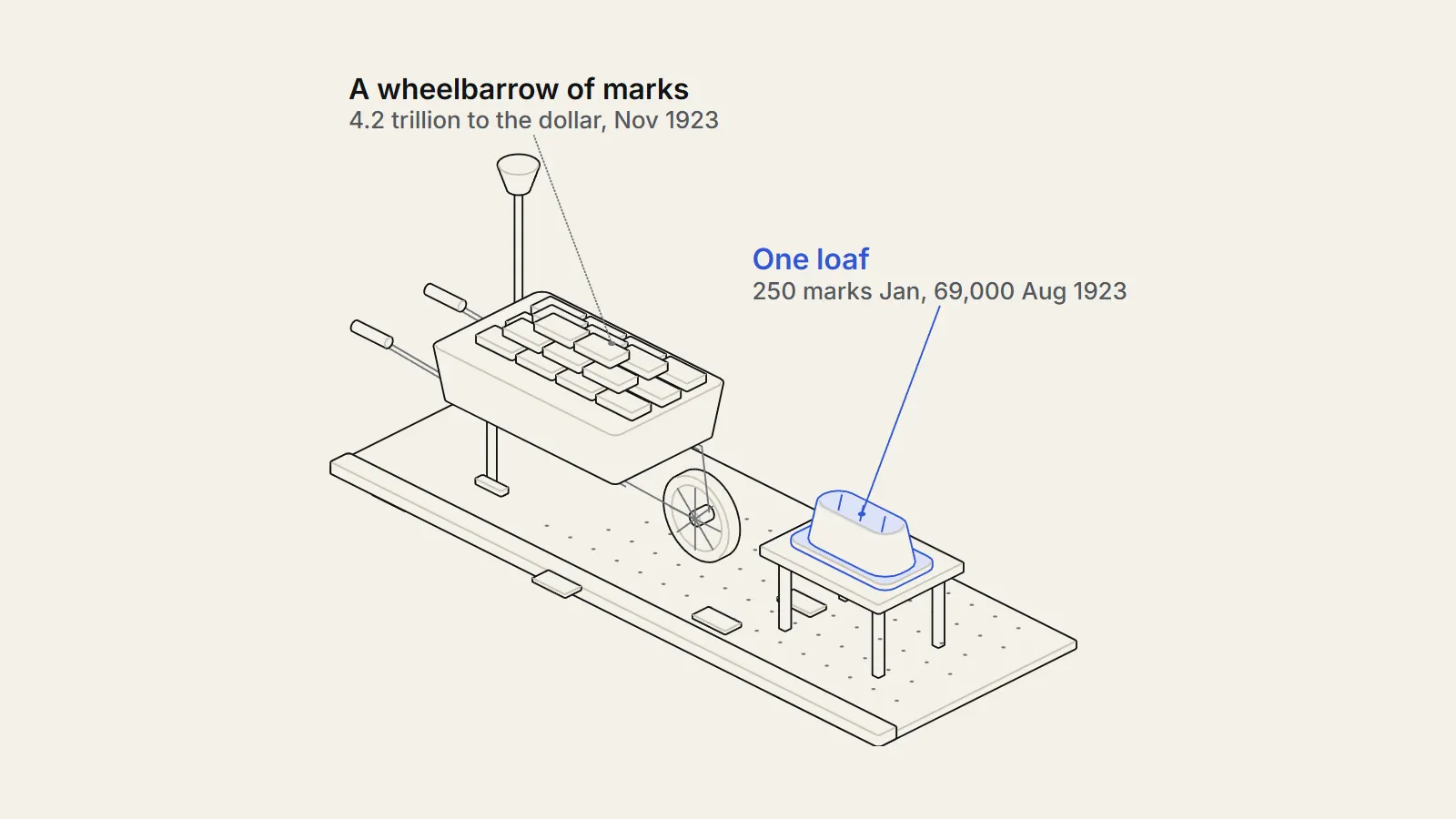
The French and Belgian occupation of the Ruhr on 11 January 1923 turned a crisis into a collapse. Germany answered with passive resistance, paying striking workers and officials with money raised by discounting Treasury bills at the Reichsbank.72 The Bundestag service gives the exchange rate as 45 marks to the dollar in early 1922, 1,807 in December 1922, 1 million in July 1923 and 4.2 trillion in November 1923.2
How much was the German mark worth in 1923?
In 1923 the German mark fell from 1 million to the dollar in July to 4.2 trillion in November, according to the Bundestag research service. It had stood at 45 to the dollar in early 1922 and 1,807 in December 1922. A loaf of bread rose from 250 marks in January 1923 to 69,000 in August.2
The decision
How Germany’s hyperinflation ended in 1923: a new bank, a new currency and fiscal cuts
The turn came with a change of government. According to Brunnermeier and co-authors, a Great Coalition under Gustav Stresemann replaced the Cuno government in August 1923, introduced taxes with accelerated indexation and issued a 500 million gold mark loan, and passive resistance in the Ruhr ended on 26 September 1923.4
Then came the Rentenmark. A decree dated 15 October 1923 (https://de.wikisource.org/wiki/Verordnung_%C3%BCber_die_Errichtung_der_Deutschen_Rentenbank), issued under the Enabling Act of 13 October and signed by Stresemann and Finance Minister Hans Luther, set up the Deutsche Rentenbank with capital and reserves of 3,200 million Rentenmark9.9 Its backing was not gold but a burden on German land, industry, trade and banking, expressed in gold marks.9
The decree’s most important rules were limits. The bank could lend at most 1,200 million Rentenmark to the Reich over two years and a further 1,200 million to the Reichsbank and private note banks, and once Rentenmark notes began to be issued the Reichsbank could no longer discount Treasury bills.9 That last clause cut the formal link between deficits and the printing press.
The end of the Weimar hyperinflation came quickly. The Rentenbank began issuing notes on 15 November 1923 and the exchange rate was fixed from 20 November at 4.2 Rentenmark to the dollar, with one Rentenmark equal to one trillion paper marks.4 The authors note a final depreciation of the mark from 1.26 trillion to 4.2 trillion to the dollar between 14 and 20 November, which cut real money balances sharply.4
Austerity came with it. A decree of 27 October 1923 led to the dismissal of about 400,000 public employees2, roughly a quarter of the public workforce, and wages and salaries were cut to 60 percent of their pre-war level.2 Brunnermeier and co-authors give the same order of magnitude, a 25 percent cut in government personnel over four months, and say Stresemann and Luther balanced the budget.4
There was no foreign loan to cushion it. Brunnermeier and co-authors point out that, unlike Austria and Hungary, Germany stabilised without foreign assistance.4 Relief on reparations came only with the Dawes Plan of August 1924, which also introduced the Reichsmark at parity with the Rentenmark.4
- A bank with a ceiling: Rentenmark issue was capped, at 3.2 billion according to the Bundesbank, and loans to the Reich were limited.
- A hard rule: from the start of note issue the Reichsbank could not discount Treasury bills.
- A fixed rate: 4.2 Rentenmark to the dollar from 20 November 1923, with old marks exchanged at one trillion to one.
- A balanced budget: dismissals, pay cuts and new taxes.
- 4 Aug 1914Reichsbank gold redemption suspendedSource 2 (opens the source in a new tab)
- 28 Jun 1919Treaty of Versailles signed; reparations to be fixed by the Reparation CommissionSource 6 (opens the source in a new tab)
- May 1921London Ultimatum sets reparations at 132 billion gold marksSource 7 (opens the source in a new tab)
- Jul 1922Hyperinflation phase begins (monthly inflation above 50 percent)Source 4 (opens the source in a new tab)
- 11 Jan 1923France and Belgium occupy the Ruhr; passive resistance followsSource 2 (opens the source in a new tab)
- 26 Sep 1923Passive resistance in the Ruhr endedSource 4 (opens the source in a new tab)
- Oct 1923Monthly inflation peaks at about 30,000 percentSource 4 (opens the source in a new tab)
- 15 Oct 1923Decree creating the RentenbankSource 9 (opens the source in a new tab)
- 27 Oct 1923Decree dismissing about 400,000 public employeesSource 2 (opens the source in a new tab)
- 15 to 20 Nov 1923Rentenbank notes issued; exchange rate fixed at 4.2 per dollarSource 4 (opens the source in a new tab)
- Aug 1924Dawes Plan; Reichsmark replaces the RentenmarkSource 4 (opens the source in a new tab)
The strongest case against stopping the printing press
So long as the reparations burden remains, there is no other means to procure the necessary means for the Reich than the discounting of Reich Treasury notes at the Reichsbank.
— Rudolf von Havenstein, Reichsbank President, quoted in Hetzel (2002)
Helfferich made the same point in different words, saying that if the Reichsbank ended the printing of notes "all national and economic life would be stopped".7 Hetzel treats the argument as "a mixture of economic fallacy and political insight". The fallacy, in his reading, is the claim that a falling exchange rate alone could push up domestic prices; the political insight is that without an end to reparations, balancing the budget was "if not insuperable, at least extremely difficult".7
The costs of the stabilisation are on the record. The Bundestag research service lists workers, small pensioners, war-disabled veterans and middle-class savers among the losers, with real wages falling sharply and unemployment and strikes rising.2 It adds that the eight-hour day was relaxed.2
| Group | Outcome | Note in the source |
|---|---|---|
| Workers | Lost | Real wages fell sharply; unemployment and strikes rose |
| Small pensioners and war-disabled veterans | Lost | Listed among the losers |
| Savers from the middle and upper classes | Lost | Savings effectively expropriated |
| Debtors | Won | Obligations shed almost overnight |
| Industrialists with cheap central bank credit | Won | Hugo Stinnes is named as an example |
| Farmers and landowners | Won | Listed among the winners |
| The state | Won | Domestic war debts repaid cheaply |
Debt was where the redistribution of the Weimar hyperinflation was starkest. The Bundesbank states that German war debt of 154 billion marks was worth 15.4 pfennig3 on the day the Rentenmark was introduced, and that the state benefited most.3 Brunnermeier and co-authors find that the ratio of nominal liabilities to assets of the average firm fell by about 25 percentage points, a 60 percent decline, between 1918 and 1923, and that bankruptcies fell as inflation rose.4
What happened
What happened after November 1923
The new money held, and by mid-1924 the Weimar hyperinflation was over. On the index in Sargent’s tables (https://www.nber.org/system/files/chapters/c11452/c11452.pdf), wholesale prices were 126 trillion in December 1923, 117 trillion in January 1924 and between 116 and 124 trillion in February to June 1924.1 The December figure was still 74 percent above November, on our calculation, so the rise did not stop on the day the Rentenmark appeared.
Confidence returned quickly in daily life. The Bundestag service reports that shops began restocking in December 1923 and that farmers resumed supplying the cities.2 Brunnermeier and co-authors say the situation had been grim: food shortages, farmers refusing marks, rising extremism, and wages paid daily.43
The old money had also been replaced by private substitutes. The Bundesbank text says printing could not keep up with prices, so cities, municipalities and firms issued emergency money, and that by the end of the inflation 496 trillion marks of Reichsbank notes and 727 trillion marks of emergency money were in circulation.5 In mid-November a loaf of bread cost more than 230 billion marks.5
Stabilisation was not painless. Hetzel reports that in April 1924, when the mark weakened against the dollar, the Reichsbank restricted credit sharply, and a cable from the agent general for reparations described a fall in commodity prices and large failures of many firms.7
Weimar hyperinflation also changed the rules of the central bank. The Banking Act of 1924, part of the Dawes plan, required Germany to back its currency with gold and foreign exchange equal to 40 percent of notes, and a foreign member of the General Council could stop note issue if convertibility looked threatened.7
The longer shadow was institutional. The November 1923 programme committed Germany to exchange 1,392 reichsmarks for a pound of gold, Hetzel notes, which made German stability dependent on the international gold standard (https://therealigned.com/story/the-gold-standard-and-why-it-ended), and from 1928 the deflationary policies of France and the United States forced deflation (https://therealigned.com/story/inflation-vs-deflation) and depression on Germany.7
Weimar hyperinflation in the data: what the numbers can and cannot show
Our price charts use the wholesale price index that Sargent reports from Young, which stands at 96 in January 1914.1 A wholesale index is not a household cost-of-living measure, so it describes what traders faced more than what families paid, although the Bundestag figures for bread rose in a similar pattern: 250 marks in January 1923 and 69,000 in August.2
What economists still disagree on
What caused hyperinflation in Weimar Germany? Three explanations
Three explanations of the Weimar hyperinflation compete. The monetary or fiscal view says deficits, financed by the Reichsbank, created money faster than the economy needed. The balance-of-payments view says reparations forced a currency collapse that drove prices up. A newer view points to a sudden stop in capital flows in 1922.10
The monetary view of the Weimar hyperinflation has most of the literature behind it. Webb found three factors behind money growth: the Reichsbank freely issuing money for government or corporate debt, persistent deficits, and expectations of inflation.8 He adds that historians have come to side with the deficit explanation because government debt and money kept growing even when the exchange rate was steady or improving, though a dispute remains over how much the Reichsbank, the governments and the constitution each contributed.8
Helfferich’s balance-of-payments view reverses the chain: depreciation caused by the burden of reparations raised import prices, then internal prices and wages, then the need for more money.10 Hetzel agrees that reparations mattered politically, since the reparations burden made fiscal balance extremely difficult, but not that depreciation itself could drive prices.7
Seghezza and Morelli propose a third path. They argue that inflows of foreign capital, attracted by expectations that the mark would appreciate, reversed in the summer of 1922; the mark fell, output declined, and social conflict fed a wage-price spiral that monetary authorities accommodated.10 They also cite literature that judges the effective reparations burden sustainable, a judgement that sits uneasily with Holtfrerich’s argument, reported by Hetzel, that direct taxation could not have raised the sums required.107
The Germany of the inflation was paradise for anyone who owed money.
— Frederick Taylor, The Downfall of Money (2013), quoted by Brunnermeier and co-authors (2023)
Even the end of the hyperinflation is explained in competing ways. Sargent argues that fiscal stabilisation, through higher taxes and spending cuts, was crucial, and notes that stabilisation coincided with strong money growth.4 Dornbusch emphasises exchange-rate stabilisation, discount rates at times around 90 percent a year in November and December 1923, limits on the Reichsbank and Rentenbank, the end of passive resistance and the sharp fall in real money balances.4
The costs and benefits are also contested. Brunnermeier and co-authors find that inflation reduced real debt burdens, cut bankruptcies and, in the aggregate, raised employment among highly indebted firms: 10 percentage points higher initial leverage was associated with 3.5 percent higher employment, and the debt-inflation channel accounts for a 17 percent increase in employment.4 That finding does not make hyperinflation benign, since the same paper says the hyperinflation phase coincided with rising unemployment, but it complicates a picture of uniform ruin.
The evidence on firms has limits. Brunnermeier and co-authors built their firm-level data from a financial manual covering about 700 joint-stock companies, and they warn that accounting statements for 1923 can give a distorted picture of firms’ finances during the hyperinflation, which is why they also use employment and stock returns.4 The sources we opened do not tell us how small, unlisted businesses fared, so we do not generalise the firm results to the whole economy.
There is a fourth, non-economic dispute. The Bundestag research service says the hyperinflation left a lasting collective trauma, citing the historian Gerald Feldman, and links it to loss of trust in the republic and the later rise of the NSDAP.2 We treat that as a historian’s judgement. The sources we opened measure prices and money, not votes, and we cannot test the political claim here.
Was the Weimar hyperinflation mainly a fiscal story that reparations made worse, or mainly an exchange-rate crisis that the Reichsbank chose to accommodate, and can the data tell the two apart?
Lessons
Key takeaways
- Money creation was a tax: it supplied 43 to 62 percent of German government revenue in 1919 to 1922.
- Stabilisation needed a rule, a bank barred from discounting Treasury bills, and a budget that no longer needed it.
- The price was paid unevenly: debtors gained and the state shed 154 billion marks of war debt, while workers and savers lost.
- Economists still dispute whether deficits, reparations or capital flows came first.
What carries over is the link between a government that cannot tax enough and a central bank that cannot say no. What does not carry over is the scale of reparations or the exchange-rate regime of 1923. Hetzel’s point that the stabilisation worked because there was political consensus that it had to work is an interpretation, not a measurement, and the sources we read do not say how much of that consensus other countries could count on.7
Sources
- 1The Ends of Four Big Inflations (opens the source in a new tab) · National Bureau of Economic Research (chapter in Inflation: Causes and Effects, 1982), 1982 · Paper · https://www.nber.org/system/files/chapters/c11452/c11452.pdf
- 2Hyperinflation in Deutschland 1923 (Wissenschaftliche Dienste, WD 1) (opens the source in a new tab) · Deutscher Bundestag, 2023 · Report · https://www.bundestag.de/parlament/geschichte/100-jahre-weimar/hyperinflation-970722
- 3Inflation: lessons learnt from history (opens the source in a new tab) · Deutsche Bundesbank, 2012 · Primary source · https://www.bundesbank.de/en/tasks/topics/inflation-lessons-learnt-from-history-666006
- 4The Debt-Inflation Channel of the German Hyperinflation (opens the source in a new tab) · Princeton University working paper (version of 27 May 2023; NBER Working Paper 31298), 2023 · Paper · https://markus.scholar.princeton.edu/sites/g/files/toruqf2651/files/documents/Hyperinflation_Weimar_Germany.pdf
- 5Geld und Geldpolitik, chapter 5: Der Wert stabilen Geldes (Hyperinflation: Geldentwertung ausser Kontrolle) (opens the source in a new tab) · Deutsche Bundesbank, Schuelerbuch fuer die Sekundarstufe II (edition of spring 2024), 2024 · Primary source · https://publikationen.bundesbank.de/publikationen-de/schule-bildung/geld-und-geldpolitik-921580?article=5-der-wert-stabilen-geldes-922608
- 6Treaty of Versailles, Part VIII (Reparation), Articles 231 and 233 (opens the source in a new tab) · Yale Law School, Avalon Project, 1919 · Primary source · https://avalon.law.yale.edu/imt/partviii.asp
- 7German Monetary History in the First Half of the Twentieth Century (opens the source in a new tab) · Federal Reserve Bank of Richmond Economic Quarterly 88(1), 2002 · Paper · https://www.richmondfed.org/~/media/richmondfedorg/publications/research/economic_quarterly/2002/winter/pdf/hetzel.pdf
- 8The Supply of Money and Reichsbank Financing of Government and Corporate Debt in Germany, 1919-1923 (opens the source in a new tab) · Journal of Economic History 44(2), 1984 · Paper · http://www.piketty.pse.ens.fr/files/capitalisback/CountryData/Germany/Other/Pre1950Series/RefsHistoricalGermanAccounts/Webb84.pdf
- 9Verordnung ueber die Errichtung der Deutschen Rentenbank (15 October 1923), Reichsgesetzblatt 1923 I, No. 100, pp. 963-966 (opens the source in a new tab) · Deutsches Reichsgesetzblatt (transcribed on Wikisource), 1923 · Primary source · https://de.wikisource.org/wiki/Verordnung_%C3%BCber_die_Errichtung_der_Deutschen_Rentenbank
- 10Was a sudden stop at the origin of German hyperinflation? (opens the source in a new tab) · Financial History Review 27(2), 2020 · Paper · https://www.cambridge.org/core/journals/financial-history-review/article/was-a-sudden-stop-at-the-origin-of-german-hyperinflation/2A745D4120859E1ACF28A64CED23E7BD