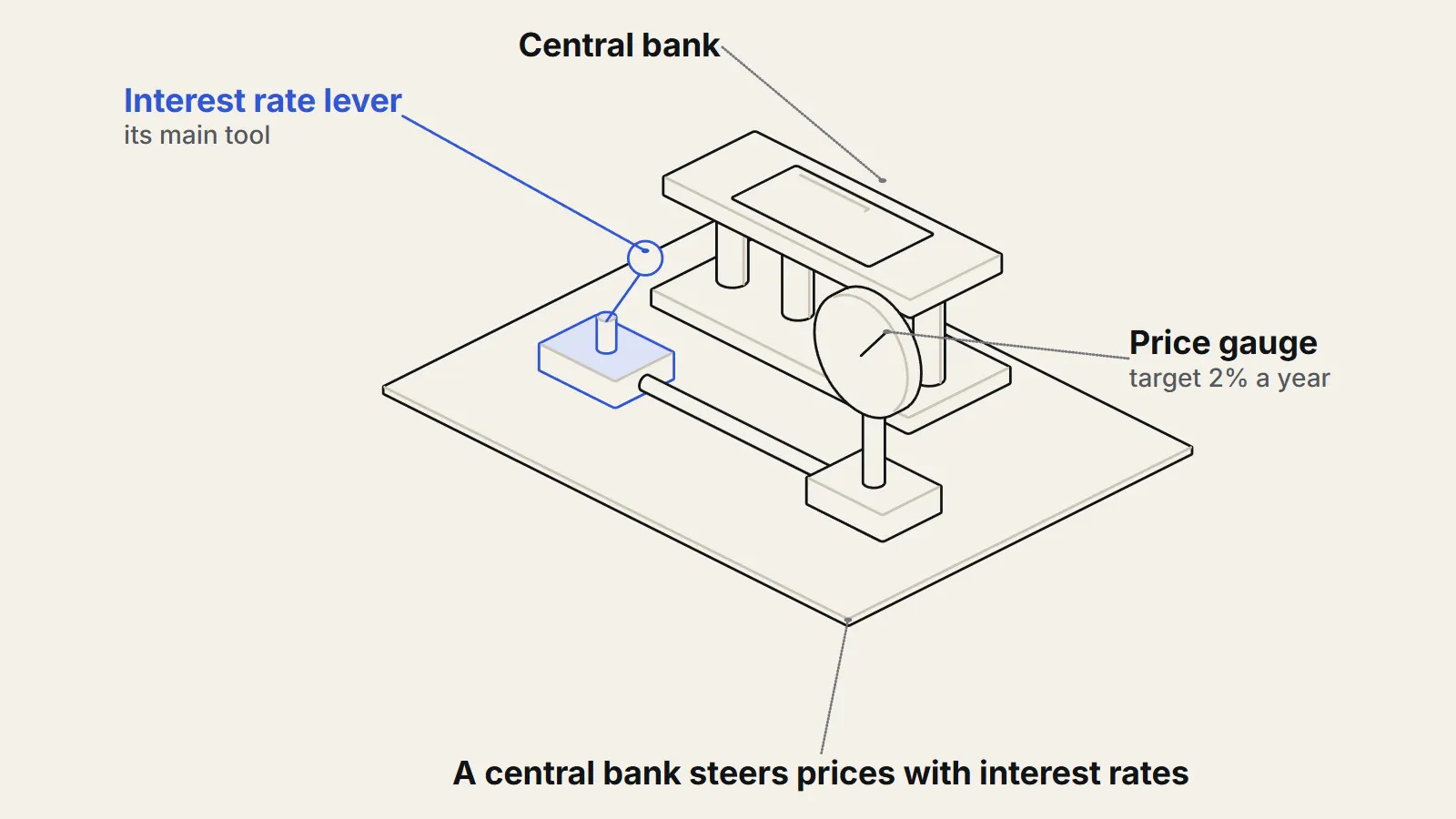
A central bank is the public institution at the centre of a country's money system, and what a central bank does comes down to four jobs. It sets the price of short-term borrowing to influence inflation and employment. It lends to banks that need cash. It supervises parts of the financial system. And it runs some of the payment plumbing that moves money between banks. The United States Federal Reserve, the Fed, does all four. Just as important is what a central bank cannot do: it cannot set every price, create jobs by decree, or push interest rates far below zero.
What does a central bank do with interest rates?
The best-known job is monetary policy, which means managing money and credit conditions in the economy. In the United States the instructions come from Congress. Section 2A of the Federal Reserve Act (https://www.federalreserve.gov/aboutthefed/section2a.htm)1 tells the Fed to keep the growth of money and credit in line with the economy's long-run potential, so as to promote maximum employment, stable prices and moderate long-term interest rates. The Act names three goals, but the Fed concentrates on the first two, which is why people call it a dual mandate.2
The main lever is the federal funds rate (https://therealigned.com/story/how-the-fed-sets-interest-rates), the rate banks pay to borrow reserve balances from one another overnight. The Fed announces a target for it and steers it by changing the interest it pays on those reserves. From there the effect spreads: to other short-term rates, to longer-term rates (which depend on what investors expect), and on to asset prices, exchange rates and what households and firms decide to spend. When the economy is weak, the Fed lowers rates to encourage spending, which is called easing. When inflation runs too high, it raises them to cool demand, called tightening.2
Central banks usually turn the goal of stable prices into a number. The Fed's rate-setting committee judges that inflation of 2 percent per year2, measured by the personal consumption expenditures price index, best supports both halves of its mandate.2 Aiming a little above zero, rather than at zero, leaves room to cut rates when the economy weakens. The Bank of England works to a similar number set by its government: consumer price inflation of 2 percent (https://www.bankofengland.co.uk/monetary-policy/inflation). If inflation moves above 3 percent or below 1 percent, the Governor must write to the Chancellor explaining why and how inflation will return to target.3
What other jobs does a central bank have?
A central bank also acts as a lender to banks. The Fed's discount window (https://www.federalreserve.gov/monetarypolicy/discountrate.htm) lends to depository institutions, which must sign legal agreements and pledge collateral first. Banks in generally sound financial condition qualify for the main rate, called the primary credit rate. Since March 2020 it has been set at the top of the FOMC's federal funds target range4, and loans run overnight or for up to 90 days.4 The aim is to give banks dependable access to funding so that strains on their cash are easier to manage.
Congress gave the Fed further tasks beyond rates: financial stability, bank supervision, safety of the payment system, consumer protection and community development.2 On payments, the Fed's own site lists services such as Fedwire, FedNow, check and automated clearinghouse services and currency and coin. Under financial stability it lists monitoring risks, stress testing and responding to financial system emergencies.5
One older tool has faded from use. Reserve requirements were rules that forced banks to hold a share of certain deposits as reserves. Before 2020 the ratios on transaction accounts were 0, 3 and 10 percent, depending on the size of the balances. The Board reduced the ratios to zero percent effective March 26, 20206, which eliminated requirements for every depository institution and was estimated to cut required reserves by about $200 billion.6
What can a central bank not do?
Rates have a floor. Nominal interest rates cannot be pushed much below zero, because lenders could hold cash instead of accepting a negative return. When the federal funds rate neared zero in 2008, the Fed fell back on two other approaches: forward guidance, which means telling markets about its likely path, and large-scale asset purchases.2 Those purchases are covered in our separate piece on quantitative easing (https://therealigned.com/story/quantitative-easing-explained).
Jobs are harder still. The maximum sustainable level of employment depends largely on factors that have little to do with money, and it is hard to measure directly. For that reason the committee sets no fixed employment number and has to judge it from the data.2 A rate decision can lean against a weak or overheated labour market, but it does not change things like skills, demographics or how workers and employers are matched.
Nor does a central bank set prices one by one. The target is a measured index. The UK Office for National Statistics builds its inflation figure from about 700 items and roughly 180,000 prices collected each month.3 The bank steers the overall level through demand, not the price of any single good.
What is disputed about the central bank's role?
The strongest objection is that the mandate is looser than it sounds. The Federal Reserve Act lists three goals, the Fed treats two as primary, and one of those, maximum employment, has no fixed number. That leaves real room for judgment about how hard to push on jobs when inflation is above target, or the reverse. The 2 percent figure is likewise a judgment: the Fed's stated reason is that it is high enough to leave room for rate cuts, not that it is a natural constant.2
A second question is whether one institution should hold so many roles. The same Fed that sets rates also supervises banks, runs payment services and lends in emergencies. The official pages cited here describe these arrangements and who assigned them. They do not weigh whether the combination is the best design, and economists and legislators differ on that.
What is not known?
The official descriptions explain the channels through which a rate change spreads, but they do not put a single size or timing on the effect. How much a one-point rise slows inflation, and how quickly, varies with the episode. The level of employment the economy can sustain is not directly observable. And how well the tools work when rates sit near zero has been tested only a few times since 2008, so the evidence is thinner than for ordinary conditions.
Key takeaways
- A central bank steers short-term interest rates to pursue stable prices and maximum employment, with an inflation goal of 2 percent at both the Fed and the Bank of England.
- Beyond rates, the Fed lends to banks through the discount window, supervises parts of the financial system and provides payment services.
- Reserve requirements were cut to zero in March 2020, so the Fed now steers rates mainly through other tools.
- Central banks cannot push rates far below zero or fix the level of employment, and the size and timing of their effects are uncertain.
Sources
- 1Federal Reserve Act, Section 2A: Monetary policy objectives (opens the source in a new tab) · Board of Governors of the Federal Reserve System, 2024 · Law · https://www.federalreserve.gov/aboutthefed/section2a.htm
- 2Monetary Policy: What Are Its Goals? How Does It Work? (opens the source in a new tab) · Board of Governors of the Federal Reserve System, 2024 · Primary source · https://www.federalreserve.gov/monetarypolicy/monetary-policy-what-are-its-goals-how-does-it-work.htm
- 3Inflation and the 2% target (opens the source in a new tab) · Bank of England, 2026 · Primary source · https://www.bankofengland.co.uk/monetary-policy/inflation
- 4The Discount Window (opens the source in a new tab) · Board of Governors of the Federal Reserve System, 2024 · Primary source · https://www.federalreserve.gov/monetarypolicy/discountrate.htm
- 5Federal Reserve Board: supervision, payment systems and financial stability sections (opens the source in a new tab) · Board of Governors of the Federal Reserve System, 2026 · Primary source · https://www.federalreserve.gov/faqs/about_12799.htm
- 6Reserve Requirements (opens the source in a new tab) · Federal Reserve Board, 2020 · Primary source · https://www.federalreserve.gov/monetarypolicy/reservereq.htm