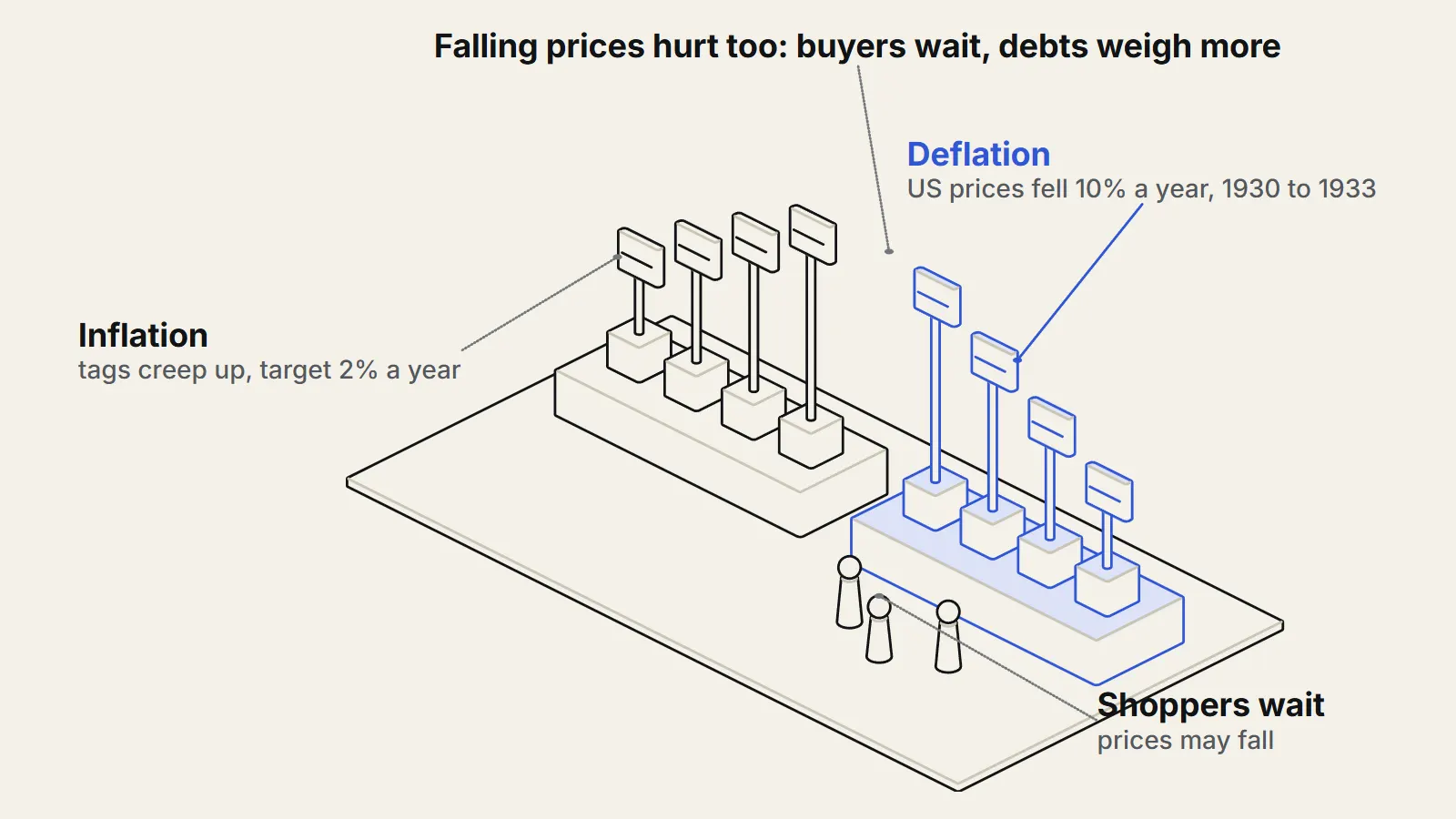
Inflation is a general rise in prices, and deflation is a general fall. Falling prices sound like good news for shoppers, yet central banks (https://therealigned.com/story/what-a-central-bank-does) treat sustained deflation as a danger and aim for mild inflation instead, usually about 2 percent a year. The short reason in the inflation vs deflation debate is that falling prices make existing debts heavier, give people a reason to delay spending, and can leave a central bank with too little room to respond.
Why does deflation make debt heavier?
Debts are fixed in money terms. If you owe 100,000 and prices and wages fall, you still owe 100,000, but it now takes a larger share of your income to pay it. Ben Bernanke, then a Fed governor, made the point in a 2002 speech: deflation raises the real value of existing debts, so borrowers repay in money that is worth more than the money they received.1 The San Francisco Fed gives the same reasoning, noting that wages and incomes typically fall during deflation while debts do not.2
When borrowers struggle, lenders suffer too. Bernanke said deflation-driven debt burdens raise delinquencies and defaults and make the banking system more fragile, and that the US deflation of 1930 to 1933 brought widespread defaults, bankruptcies and bank failures.1 He also cited Irving Fisher's argument that forced sales of assets push prices down further, so the damage feeds on itself.1
Why would falling prices delay spending?
If people expect prices to be lower next year, waiting becomes attractive. Saving beats buying, and weaker spending then weakens the economy.2 There is also an interest rate effect. Nominal interest rates cannot fall much below zero because lenders could hold cash instead. If prices fall by 10 percent a year and the nominal rate is zero, Bernanke noted, the real cost of borrowing is 10 percent, which discourages business investment and home buying.1
The US price level fell about 10 percent per year during 1930 to 19331, according to Bernanke, and he credited the 40 percent devaluation of the dollar against gold in 1933 and 1934 with ending the deflation quickly.1
Japan is the modern case people usually cite. Bernanke described consumer prices there falling by about 1 percent a year, alongside years of slow growth, rising joblessness and persistent banking and corporate problems. He called deflation an important negative factor but attributed its persistence to political constraints rather than a lack of policy tools.1 The case shows both sides of the argument: a mild, prolonged fall in prices coincided with weak growth, yet the causes were tangled with a damaged financial system.
Why do central banks aim for inflation instead of zero?
A small positive inflation rate is a cushion. It keeps the economy away from the edge of deflation, and it tends to come with higher interest rates, which gives the central bank more room to cut them in a recession. A St. Louis Fed article makes the argument, noting that some economists think deflation of a given size does more harm than inflation of the same size, so a central bank should err on the side of a positive number.3
The 2 percent figure itself has a short history. The Federal Open Market Committee adopted it as an explicit goal in January 20124, measured by the personal consumption expenditures price index, though the Atlanta Fed traces earlier discussion, including a 2003 remark by Bernanke that something near 2 percent might be the optimal long-run average. New Zealand had already set a target of zero to 2 percent in 1989.4 The Bank of England describes its own 2 percent target as low enough to keep price rises small but high enough to avoid deflation.Bank of England (https://www.bankofengland.co.uk/explainers/what-is-inflation)
Is deflation always harmful?
Not always, and this is the strongest counterargument. Andrew Atkeson and Patrick Kehoe studied 17 countries over more than 100 years. They found that deflation and depression did seem linked during the 1930s, but in the rest of the data there was virtually no evidence of such a link5.5 In most of the long record, then, falling prices did not coincide with depression. One reading is that a fall in prices has different effects depending on its cause, and that deflation alongside collapsing demand and failing banks, as in the 1930s, is the dangerous kind.
The result describes broad patterns across countries, so it says little about how any one deflation unfolds. Read the original on the Minneapolis Fed site (https://www.minneapolisfed.org/research/staff-reports/deflation-and-depression-is-there-an-empirical-link), and Bernanke's speech in full on the Federal Reserve website (https://www.federalreserve.gov/boarddocs/speeches/2002/20021121/default.htm).
What is not known?
Several questions remain open. Why 2 percent rather than another low number is partly a judgement call: it became an international standard in the inflation-targeting era beginning in the 1990s.3 It is also not settled how much of the harm in the 1930s came from deflation itself and how much from bank failures and policy mistakes that happened at the same time. Bernanke argued that a central bank still has tools when rates reach zero, but he also warned against over-confidence, since deflation episodes are rare and hard to generalise about.1 This article explains mechanisms and evidence. It is not advice about debts, savings or investments.
Key takeaways
- Deflation raises the real value of fixed debts, which strains borrowers and can weaken banks.
- Expected falling prices can encourage people to delay purchases, and zero interest rates limit the central bank's response.
- Central banks aim for mild inflation, about 2 percent, partly as a cushion against deflation.
- Historical evidence suggests falling prices are not always tied to depressions; the 1930s are the main exception.
- How much damage deflation does on its own, apart from bank failures and policy errors, is still debated.
Sources
- 1Deflation: Making Sure "It" Doesn't Happen Here (opens the source in a new tab) · Board of Governors of the Federal Reserve System, 2002 · Primary source · https://www.federalreserve.gov/boarddocs/speeches/2002/20021121/default.htm
- 2What is deflation, what are the risks of deflation, and how can the Fed combat deflation? (opens the source in a new tab) · Federal Reserve Bank of San Francisco (Doctor Econ), 2003 · Primary source · https://www.frbsf.org/research-and-insights/publications/doctor-econ/2003/05/deflation-risks/
- 3Why the Fed Targets a 2 Percent Inflation Rate (opens the source in a new tab) · Federal Reserve Bank of St. Louis, 2019 · Primary source · https://www.stlouisfed.org/open-vault/2019/january/fed-inflation-target-2-percent
- 4The Fed and Inflation: Origins of the 2 Percent Target Rate (opens the source in a new tab) · Federal Reserve Bank of Atlanta, 2026 · Primary source · https://www.atlantafed.org/research-and-data/2026/04/14/fed-and-inflation-origins-of-the-two-percent-target-rate
- 5Deflation and Depression: Is There an Empirical Link? (opens the source in a new tab) · Federal Reserve Bank of Minneapolis, 2004 · Paper · https://www.minneapolisfed.org/research/staff-reports/deflation-and-depression-is-there-an-empirical-link