Summary
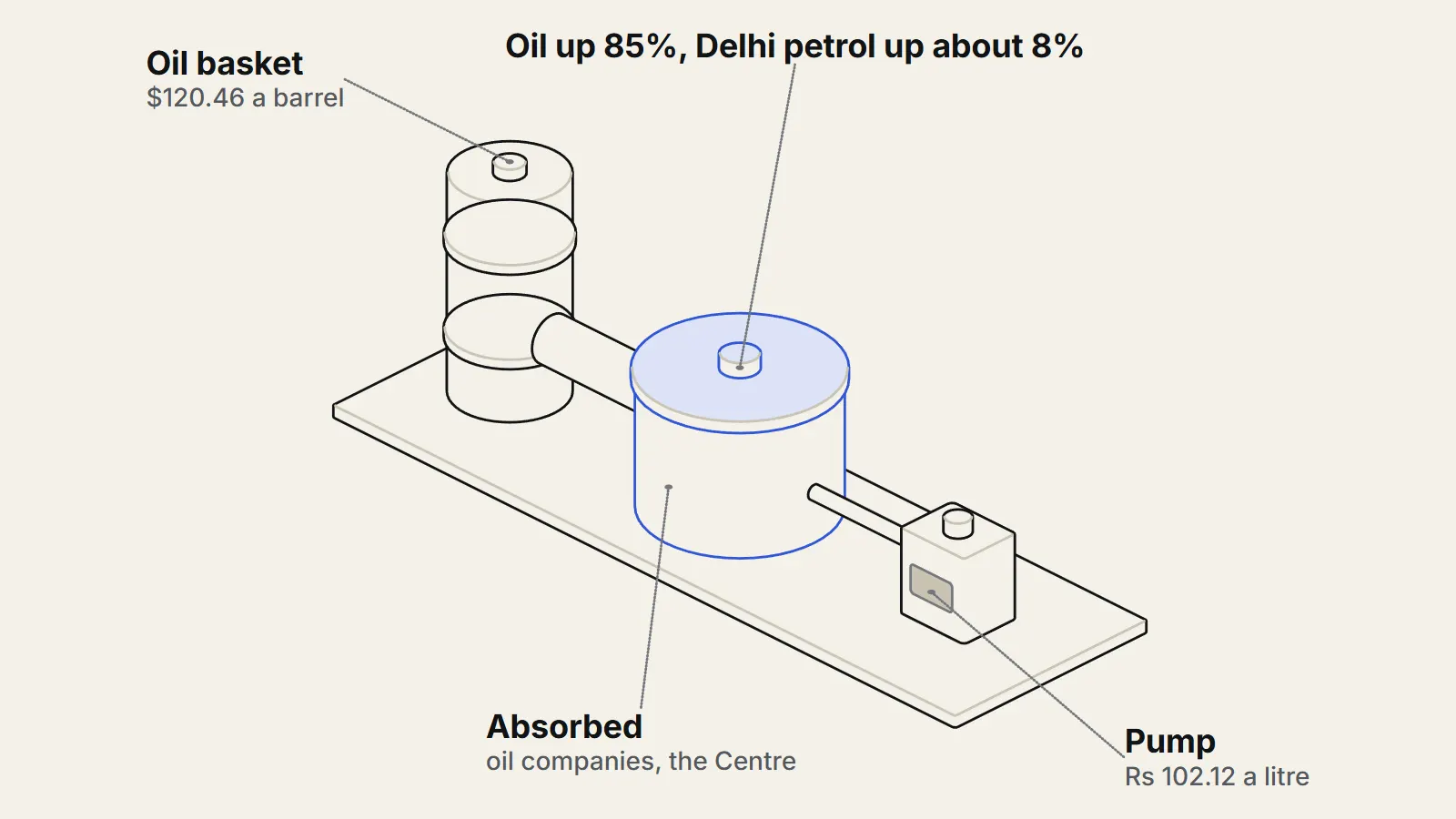
India's crude oil basket averaged $120.46 a barrel for 1 to 26 October 2026, against $65.08 in October 20251. Over the same period Delhi petrol rose Rs 7.35 a litre, about 7.8%, in four steps in May and has not changed since 25 May2. We used official data to trace where the rest of the shock has landed. Public-sector oil marketing companies lost Rs 18,150 crore in April to June3, the Centre cut excise by Rs 10 a litre4, domestic jet fuel was reported at Rs 137 a litre on 1 October5, and consumer inflation reached 5.54% in September6. The 6.49% fall in September air traffic is a year-on-year figure, and the release gives no reason for it. Holding pump prices is a choice with costs, and economists disagree on how fast to pass them on.
The question
How does an oil price shock reach Indian households and budgets?
India imports almost all its crude, so a rise in the world price is a rise in what India pays. The question is who feels it. A price at the pump is not the same as the cost of oil: governments tax fuel, companies set prices, and the state can hold a price down by absorbing the difference. This research post follows one shock, the surge in oil prices since the West Asia war began disrupting shipping in 2026, through four channels: the pump, the oil companies' accounts, the government's budget, and flights and prices.
It uses a few terms. The Indian Basket is PPAC's derived price of the crude mix India's refineries import, a blend of sweet Brent and sour Oman and Dubai crude1. An under-recovery is the gap when a company sells fuel below its cost of supply. ATF is aviation turbine fuel, or jet fuel. A lakh is 100,000 and a crore is 10 million.
We were careful about two numbers in the news. The "$120" is a month-to-date average, not a single day's price, and the "6.49%" fall in air traffic compares September with the same month last year. Both are explained below.
Data
Which data did we use?
Most numbers come from official publications: PPAC, the Petroleum Planning and Analysis Cell of the oil ministry; the Press Information Bureau; the Reserve Bank of India; the Statistics Ministry; and the Finance Ministry's monthly review. PPAC's terms allow its material to be reproduced free of charge if it is reproduced accurately and the source is acknowledged8. News reports are used only for jet fuel prices and the air-traffic release, where we could not open the primary source, and they are labelled as reports.
| Dataset | Source | Period |
|---|---|---|
| Indian Basket crude, monthly average | PPAC | April 2023 to October 2026 |
| Delhi petrol and diesel pump prices | PPAC (Indian Oil) | May 2025 to 27 October 2026 |
| Price build-up for Delhi, 1 October 2026 | PPAC Snapshot | 1 October 2026 |
| State VAT on petrol and diesel | PPAC | table dated 12 August 2026 |
| Crude import bill and import dependence | PPAC Snapshot | 2024-25 to September 2026 |
| Oil company profits and exchequer contribution | PPAC Snapshot | 2023-24 to Q1 2026-27 |
| Domestic jet fuel prices, Delhi | News reports | April to October 2026 |
| Domestic air passengers | DGCA, as reported | August and September 2026 |
Method
How did we check the numbers?
We read each figure from the document that publishes it, wrote down the date and unit, and recomputed any percentage we state. Where we calculate something ourselves, the text says so. We did not use figures that appeared only in news summaries of paywalled articles, and we did not use a claim that the basket reached its highest level since 2012, because we could not open the source for it.
We also tested the headline figures against their sources. The "$120 a barrel" is PPAC's October average to 26 October, $120.46, while the daily price on 26 October was $123.721. Some outlets call $120.46 the price on 26 October; that is not what PPAC's table says. DGCA's "monthly growth" is, per its own August table, a comparison with the same month a year earlier; we explain the effect on the air-traffic number below.
Findings
What is the "$120"?
The basket was low for most of the last three years and then jumped. It averaged $69.01 a barrel in February 2026 and $113.49 in March1, fell back to about $83 in June and $82 in July, and rose again to $116.09 in September and $120.46 for 1 to 26 October1. Against October 2025's $65.08 that is a rise of about 85% (our arithmetic).
The cause is outside India. The International Energy Agency said world oil supply fell by 10.1 million barrels a day in March 2026, the largest disruption in history, with restrictions on tanker movements through the Strait of Hormuz9. The US Energy Information Administration says Brent averaged $114 a barrel in September, with a peak of $131 on 15 September after attacks on a Saudi pipeline that bypasses Hormuz, and forecasts $105 in the fourth quarter10. (Our earlier piece on the helium market covers another Hormuz-exposed supply chain.)
How much of this reached the pump?
Not much. Delhi petrol sat at Rs 94.77 a litre and diesel at Rs 87.67 from at least May 2025 until mid-May 2026, then rose in four steps to Rs 102.12 and Rs 95.20, unchanged since 25 May2. That is a rise of 7.76% for petrol and 8.59% for diesel (our arithmetic), against an 85% rise in the basket.
| Delhi price from | Petrol (Rs a litre) | Diesel (Rs a litre) |
|---|---|---|
| Before 15 May 2026 | 94.77 | 87.67 |
| 15 May 2026 | 97.77 | 90.67 |
| 19 May 2026 | 98.64 | 91.58 |
| 23 May 2026 | 99.51 | 92.49 |
| 25 May 2026 (still current on 27 October) | 102.12 | 95.20 |
The pump price is mostly not crude oil. In Delhi on 1 October, petrol's Rs 102.12 was a price charged to dealers of Rs 81.12 including central excise, Rs 4.41 of dealers' commission and Rs 16.59 of VAT; diesel's Rs 95.20 was Rs 78.30, Rs 2.99 and Rs 13.913. Central excise is Rs 11.90 a litre on petrol and Rs 7.80 on diesel11. So excise and VAT together are about 28% of Delhi's petrol price and 23% of diesel (our arithmetic).
State VAT matters because it is mostly a percentage. PPAC's table shows Delhi charging 19.40% VAT on petrol, Maharashtra 25% plus Rs 5.12 a litre, Karnataka 29.84% and Telangana 35.20%7. A percentage tax rises when the price rises, so states gain revenue from each increase, while a fixed per-litre tax does not.
Who absorbed the rest?
The oil companies, the Centre and airlines have carried a large part of it. First, the companies. On 2 April the ministry reported under-recoveries to the public-sector companies of Rs 24.40 a litre on petrol and Rs 104.99 on diesel at unchanged retail prices12. PPAC's Snapshot shows the public-sector downstream companies earned a profit after tax of Rs 77,281 crore in 2025-26 but lost Rs 18,150 crore in April to June 20263. No official October under-recovery figure exists: PPAC's under-recovery series stops at 2025-26.
Second, the Centre. On 27 March it cut excise by Rs 10 a litre on petrol and diesel and said retail prices would not change, the cut offsetting part of the companies' losses4. The cost shows in the accounts: excise collections fell about 23% year on year to Rs 86,687 crore in April to August 2026, according to a summary of government accounts data13. ICRIER estimates that holding petrol and diesel prices costs about 0.58% of GDP a year14, on assumptions it states.
The Finance Ministry's own reading is that this was worth it. Its September review says limited pass-through of higher global energy prices helped contain the shock and protect household purchasing power15.
What did it do to jet fuel and flights?
Airlines are exposed because fuel is a large cost. The Cabinet note of 3 June says ATF is nearly 40% of an airline's operating cost, and that capping domestic ATF prices is a temporary measure that is not sustainable for oil companies16. The government's answer was an interest-free advance of up to Rs 10,000 crore to the oil companies to compensate them when the import price of ATF exceeds a benchmark16.
Domestic prices have since risen. Delhi domestic ATF was unchanged at Rs 1,04,927.18 a kilolitre, or about Rs 104.93 a litre, from April to June17, and was reported at Rs 137 a litre on 1 October, up from Rs 1215. That is about 31% above the April to June price (our arithmetic). These prices come from news reports; the oil companies' own jet fuel page was not accessible to us.
The air-traffic number needs care. DGCA's September release, as reported, shows 118.23 lakh domestic passengers, a "monthly growth" of -6.49%18. DGCA's August table, as reported, defines "monthly growth" as August 2026 against August 202519, so the -6.49% is a year-on-year fall, not a fall from August. Against August's 121.26 lakh, September is down about 2.5% (our arithmetic). The DGCA report does not identify reasons for the fall20, and we found no fare or capacity data. A link to jet fuel prices is plausible but not shown.
What did it do to the import bill and to prices?
India pays more for the same oil. The crude import bill was $90.6 billion in April to September 2026 against $61.9 billion a year earlier, while volume rose from 121.8 to 122.7 million tonnes3. That is a 46% rise in value on a 0.7% rise in volume (our arithmetic). Import dependence on a consumption basis was 88.1% in April to September 2026, and 88.7% in 2025-263.
On prices, consumer price inflation was 5.54% in September, up from 4.83% in August, with transport services for goods at 14.73%6. The Reserve Bank raised the repo rate by 25 basis points to 5.50% on 7 October, projected inflation of 5.2% for 2026-27, and said the pass-through of high energy and commodity prices is still continuing21. Demand has not yet fallen: petrol consumption was up 7.21% and diesel 4.86% year on year in September22.
Should India pass the price through, or hold it?
This is a real debate, and the sources disagree. ICRIER argues for a gradual, well-communicated move to greater pass-through of international prices, with targeted support for vulnerable households14, partly because holding prices is costly and weakens price signals. IMF staff advise full pass-through with targeted cash transfers where safety nets are strong, and gradual pass-through with a commitment to end subsidies where they are weak23.
The costs of holding are visible too: the Cabinet itself called the ATF cap not sustainable16, oil company losses and falling excise revenue appear above, and the RBI says the pass-through is still continuing21 and has tightened policy. Whether holding was the right choice depends on how long the shock lasts, which no source we read can say.
Related on The Realigned: our piece on helium and the Strait of Hormuz (https://therealigned.com/story/helium-critical-material-why-the-us-added-a-gas), the 1970s Great Inflation (https://therealigned.com/story/1970s-great-inflation), what inflation actually measures (https://therealigned.com/story/what-inflation-measures-and-what-it-misses) and money supply growth and inflation (https://therealigned.com/research/money-supply-growth-and-inflation).
Primary data: PPAC's Indian Basket prices (https://ppac.gov.in/prices/international-prices-of-crude-oil) and the RBI's October policy resolution (https://www.rbi.org.in/scripts/BS_PressReleaseDisplay.aspx?prid=63742).
Limitations
What are the limits?
This is a descriptive account from published series, not a causal study. It cannot say how much of any price rise came from oil rather than other causes, or how much of the fall in air traffic came from fuel costs.
The October basket figure is an average for part of the month, so it will change; the daily price was higher on 26 October. The air-traffic figures come from news reports of the DGCA release, which we could not open, and the September 2025 comparison base is derived from the stated percentage.
Domestic jet fuel prices are from news reports, not an official series, and the April price was reported in two different ways; we use the lower figure that domestic airlines paid. We found no October 2026 under-recovery figure and did not read the RBI minutes, so we do not know the crude price the RBI assumed. Fiscal-cost estimates are on different bases and should not be added up.
What is the current gap between the price oil companies pay for crude and the pump price they charge? No official figure for October has been published.
Conflicts
Conflicts of interest
The Realigned has no commercial relationship with any government body, oil company, airline or think tank cited in this post and no funding tied to it. Our wider coverage includes arguments for markets and price signals; we have reported the government's case for holding prices as its own documents state it.
Sources
- 1PPAC: International Prices of Crude Oil (Indian Basket), monthly averages (file dated 27 October 2026) (opens the source in a new tab) · Petroleum Planning and Analysis Cell, Ministry of Petroleum and Natural Gas, 2026 · Primary source · https://ppac.gov.in/prices/international-prices-of-crude-oil
- 2PPAC: Retail selling price of petrol and diesel in metro cities (daily, posted 27 October 2026) (opens the source in a new tab) · PPAC (Indian Oil prices), 2026 · Primary source · https://ppac.gov.in/uploads/page-images/1793079220_PP_9_a_DailyPriceMSHSD_Metro_27.10.2026.pdf
- 3PPAC: Snapshot of India's Oil and Gas data, October 2026 (September 2026 data) (opens the source in a new tab) · PPAC, 2026 · Primary source · https://ppac.gov.in/download.php?file=rep_studies%2F1792155544_Snapshot_of_India_Oil_and_Gas_Sept_2026_V3.pdf
- 4Government slashes excise duty on petrol and diesel to shield consumers and oil companies from global oil shock (27 March 2026) (opens the source in a new tab) · Press Information Bureau, Ministry of Petroleum and Natural Gas, 2026 · Primary source · https://www.pib.gov.in/PressReleaseIframePage.aspx?PRID=2245970®=48&lang=2
- 5ATF prices rise Rs 16 per litre as India cuts windfall tax on diesel, jet fuel exports (1 October 2026) (opens the source in a new tab) · Indian Aviation News, 2026 · Reporting · https://www.indianaviationnews.net/home/2026/10/atf-prices-rise-%E2%82%B916-per-litre-as-india-cuts-windfall-tax-on-diesel-jet-fuel-exports.html
- 6Press release on the Consumer Price Index (base 2024) for September 2026 (opens the source in a new tab) · Ministry of Statistics and Programme Implementation, 2026 · Primary source · https://www.pib.gov.in/PressReleseDetailm.aspx?PRID=2322244&lang=2®=48
- 7PPAC: VAT, sales tax and GST rates on petrol and diesel by state (table dated 12 August 2026) (opens the source in a new tab) · PPAC, 2026 · Primary source · https://ppac.gov.in/prices/vat-sales-tax-gst-rates
- 8PPAC: Terms and Conditions (opens the source in a new tab) · PPAC, 2026 · Primary source · https://ppac.gov.in/terms-conditions
- 9Oil Market Report, 14 April 2026 (opens the source in a new tab) · International Energy Agency, 2026 · Primary source · https://iea.blob.core.windows.net/assets/515f3128-df1a-4d6c-beb4-fd91d2434bef/-14APR2026_OilMarketReport_Free_version1.pdf
- 10Short-Term Energy Outlook, October 2026 (opens the source in a new tab) · U.S. Energy Information Administration, 2026 · Primary source · https://www.eia.gov/outlooks/steo/pdf/steo_text.pdf
- 11PPAC: Central excise and customs tariff on major petroleum products (file dated 27 March 2026) (opens the source in a new tab) · PPAC, 2026 · Primary source · https://ppac.gov.in/prices/central-excise-and-customs-rate-on-major-petroleum-products
- 12Inter-ministerial briefing on West Asia developments (2 April 2026) (opens the source in a new tab) · Press Information Bureau, 2026 · Primary source · https://www.pib.gov.in/PressReleaseIframePage.aspx?PRID=2248537®=48&lang=2
- 13India fiscal deficit hits 42% of FY27 target as tax growth slows (30 September 2026) (opens the source in a new tab) · Ventura Securities (summary of CGA data), 2026 · Reporting · https://www.venturasecurities.com/news/economy/fiscal-deficit-hits-42-of-fy27-target-as-tax-growth-slows/
- 14The Fiscal Cost of Holding Down Fuel Prices in India After the Middle East War (Policy Brief 68) (opens the source in a new tab) · ICRIER (Sanjeev Gupta and Pratik Tiwary), 2026 · Paper · https://icrier.org/pdf/India-piece-on-fiscal-costs-of-higher-oil-prices.pdf
- 15Monthly Economic Review, September 2026 (opens the source in a new tab) · Department of Economic Affairs, Ministry of Finance, 2026 · Primary source · https://dea.gov.in/files/monthly_economic_report_documents/MERSept2026.pdf
- 16Cabinet approves Price Stabilization Fund for scheduled Indian airlines towards ATF pricing (3 June 2026) (opens the source in a new tab) · Press Information Bureau, 2026 · Primary source · https://www.pib.gov.in/PressReleaseIframePage.aspx?PRID=2268337®=48&lang=2
- 17ATF prices held steady for domestic airlines; international cut by 27% (1 June 2026) (opens the source in a new tab) · PSU Watch, 2026 · Reporting · https://www.psuwatch.com/newsupdates/atf-prices-held-steady-for-domestic-airlines-prices-for-international-airlines-cut-by-27
- 18Airlines flew fewer passengers in September; traffic falls 6.5 pc (PTI) (opens the source in a new tab) · PTI via ETV Bharat, 2026 · Reporting · https://www.etvbharat.com/en/business/airlines-flew-fewer-passengers-in-september-traffic-falls-six-point-five-per-cent-on-annual-basis-enn26102707906
- 19Domestic air passenger traffic falls 6.34 pc to 121.26 lakh in August: DGCA (PTI) (opens the source in a new tab) · Daily Excelsior (PTI), 2026 · Reporting · https://www.dailyexcelsior.com/domestic-air-passenger-traffic-falls-6-34-pc-to-121-26-lakh-in-august-dgca/
- 20Domestic air traffic drops 6.5% in September; year to date passenger numbers turn negative (opens the source in a new tab) · BusinessToday, 2026 · Reporting · https://www.businesstoday.in/latest/corporate/story/domestic-air-traffic-drops-6-5-in-september-year-to-date-passenger-numbers-turn-negative-564093-2026-10-27
- 21Monetary Policy Statement 2026-27: Resolution of the Monetary Policy Committee, 5 to 7 October 2026 (opens the source in a new tab) · Reserve Bank of India, 2026 · Primary source · https://www.rbi.org.in/scripts/BS_PressReleaseDisplay.aspx?prid=63742
- 22PPAC: Flash Report on Oil and Gas, September 2026 (opens the source in a new tab) · PPAC, 2026 · Primary source · https://ppac.gov.in/download.php?file=menu%2F1790857950_WEB_UPLOAD_Sep26_Flash_Report.pdf
- 23Fiscal Policy for Mitigating the Social Impact of High Energy and Food Prices (IMF Note 2022/001) (opens the source in a new tab) · International Monetary Fund, 2022 · Paper · https://www.imf.org/-/media/files/publications/imf-notes/2022/english/insea2022001.pdf
Plain-language version
The short version
Oil has been about $120 a barrel in October, nearly twice a year ago. India pays more, but much of that has not reached drivers. Petrol in Delhi is up about 8% since mid-May. The rest has been taken by the oil companies, which lost money, and by the government, which cut a fuel tax. Airlines are paying more for jet fuel, and inflation is above 5%. Whether it was wise to hold prices down is argued: some economists say pass the cost through slowly and help poorer households directly; the government says holding protected families.
Two numbers in the news are easy to misread. The $120 is an average for most of October, not one day's price, and the 6.49% fall in air travel compares September with last September.
Key takeaways
- The Indian Basket averaged $120.46 a barrel for 1 to 26 October 2026, about 85% above a year earlier.
- Delhi petrol is up about 7.8% since mid-May, so much of the rise has fallen on oil companies, the Centre's excise revenue and airlines.
- The 6.49% fall in September air traffic is year on year, and DGCA's release gives no reason.
- Economists disagree on whether to pass costs on gradually or hold prices; both have costs.