- Place
- Bolivia
- Years
- 1985–1987
- Policy
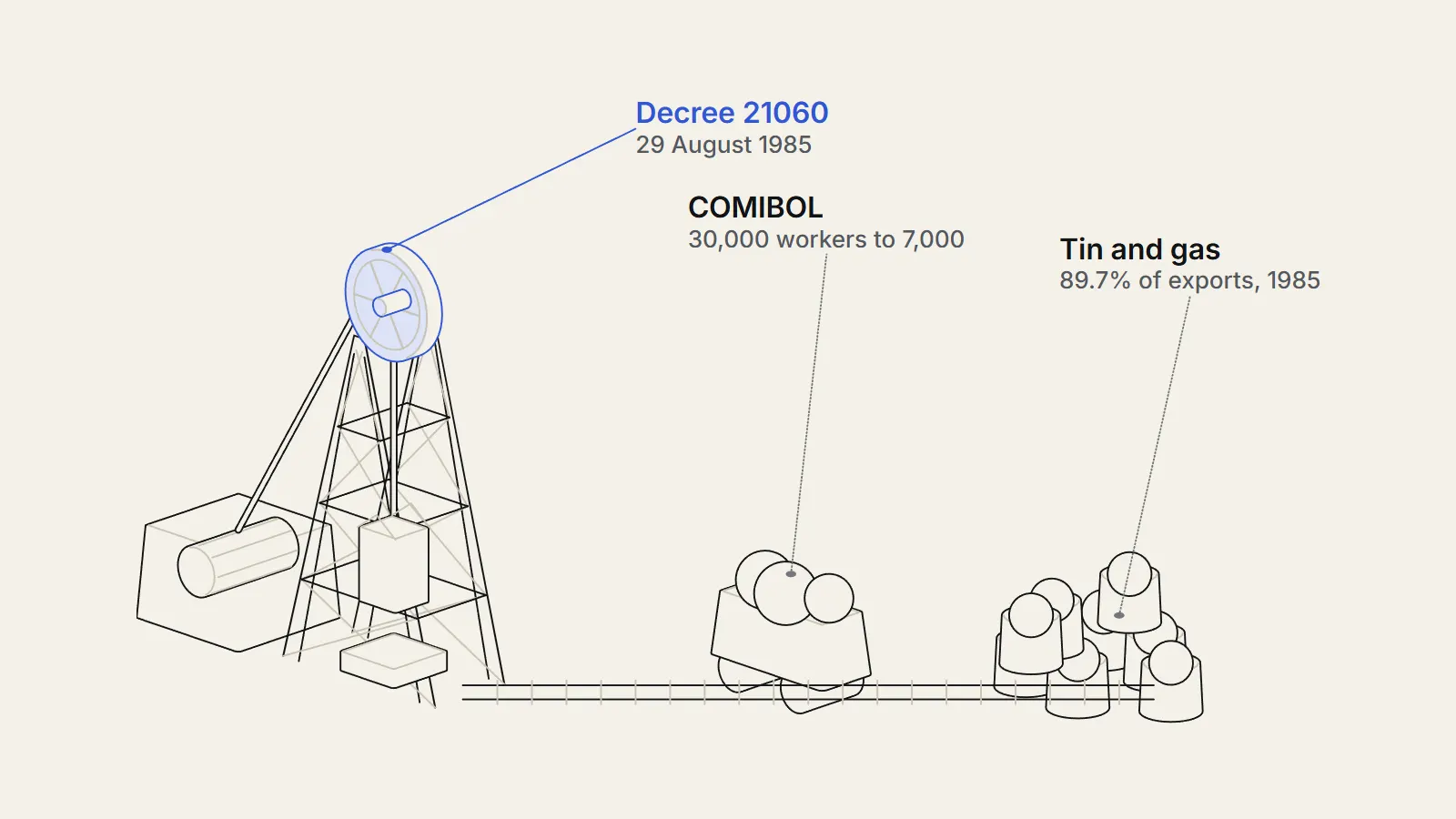
- Supreme Decree 21060 (29 August 1985): a single floating exchange rate, sharply higher fuel prices, a public pay freeze, freed prices, mass job cuts at the state mining company and suspended payments to private foreign creditors.
- Outcome
- Annual inflation fell from 11,750 percent in 1985 to 276.3 percent in 1986 and 14.6 percent in 1987, and the deficit fell from 8.1 to 2.3 percent of GDP in 1986, but unemployment reached 20 percent by end 1986 and growth stayed slow.
Bolivia's 1985 hyperinflation (https://therealigned.com/story/hyperinflation-how-a-currency-collapses), which pushed consumer prices up 11,750 percent in a single year, began to break within weeks of Supreme Decree 21060, signed on 29 August 1985.2 The decree fixed one exchange rate, lifted fuel prices, froze public pay and freed most other prices. Annual inflation fell to 276 percent in 1986 and 14.6 percent in 1987.1 The cost was heavy: unemployment rose, thousands of miners lost their jobs and growth stayed slow for a decade. Economists still argue about how much of that cost the plan itself caused.
Before
Where did Bolivia's hyperinflation come from?
Bolivia began the 1980s as the poorest country in South America, with an income per person of about 500 dollars.3 Its exports leaned on very little: tin and natural gas made up an estimated 89.7 percent of merchandise exports in 1985.3 A government that lives off mineral taxes is exposed whenever prices or credit move against it.
The first blow was financial. In 1982 foreign lenders stopped adding new loans while interest on the old ones kept falling due. Net transfers on the public medium and long-term debt swung from a positive 6.2 percent of GNP in 1980 to a negative 6.9 percent in 1983.3 Morales describes the cause as Bolivia being rationed out of credit quite suddenly.4
With foreign money gone, the state printed pesos. Morales and Sachs estimate that this money creation, called seigniorage, ran at about 12 percent of GNP a year from mid-1982 until stabilisation in late 1985.3 A steady share of income needed ever faster price rises, because people held less cash as prices climbed. Meanwhile the tax base melted. Revenues of the central administration fell from more than 9 percent of GNP in 1980 to just 1.3 percent in the first nine months of 19853.3 Taxes paid late lose value when prices race, and duties fixed in pesos were eroded the same way.
Economists date the hyperinflation using Cagan's rule of more than 50 percent a month. Morales puts the start at about April 1984, while Morales and Sachs say May 1984.43 Between March 1984 and August 1985, prices rose by a factor of 623, an average of 46 percent a month, with a record 182 percent in February 1985.4 For the whole of 1985 the World Bank series shows consumer prices up 11,749.6 percent1.1
Rescue attempts failed. Morales counts six stabilisation attempts between November 1982 and August 1985, all unsuccessful. General strikes called by the Bolivian workers' confederation, the COB, delivered the killing blow to the April 1984 and February 1985 packages.4 Price controls and multiple exchange rates did not touch the general price level, and Morales and Sachs say they often turned into hidden subsidies that added to the deficit.3
The damage was broad. GDP fell 18 percent between 1982 and 1985.4 Debt service reached 63 percent of exports of goods, services and factor income in 1984.2 Not everyone lost: Morales and Sachs note that people who could buy official dollars at the central bank (https://therealigned.com/story/what-a-central-bank-does) and resell them on the black market made quick fortunes.3
Jeffrey Sachs, who advised the incoming government, called it the first peacetime hyperinflation in history. He told PBS that when he reached La Paz in July 1985, the pace of the previous six months, if kept up for a year, would have meant about 60,000 percent.5 We note this is his own estimate, recalled in an interview in 2000, not a data series.
The decision
What did Supreme Decree 21060 actually do?
Victor Paz Estenssoro became president on 6 August 1985 after an election that gave no candidate a majority.35 His government unveiled the New Economic Policy three weeks later. The legal instrument was Supreme Decree 21060 (https://www.lexivox.org/norms/BO-DS-21060.html) of 29 August 19856, whose opening considerations call the crisis a "verdadero colapso nacional" and name hyperinflation, deep recession and the growing public deficit.6
- October 1982Hernan Siles Zuazo takes officePrices had risen 308 percent in the 12 months before.Source 3 (opens the source in a new tab)
- About April 1984Hyperinflation begins by Cagan's test of 50 percent a monthMorales and Sachs date it to May 1984.Source 4 (opens the source in a new tab)
- February 1985Monthly inflation hits a record 182 percentA stabilisation attempt that month was also defeated by general strikes.Source 4 (opens the source in a new tab)
- 6 August 1985Victor Paz Estenssoro takes officeSource 5 (opens the source in a new tab)
- 29 August 1985Supreme Decree 21060 issuedThe program was unveiled three weeks after the government took power.Source 6 (opens the source in a new tab)
- Late October 1985Tin market collapses on the London Metal ExchangeSource 4 (opens the source in a new tab)
- December 1985 to January 1986Inflation flares againBrought under control by February 1986.Source 4 (opens the source in a new tab)
- May 1986New tax structure imposed (Law 843)Source 2 (opens the source in a new tab)
- 21 to 28 August 1986Miners' March for Life from Oruro, stopped at CalamarcaA state of siege was declared on 28 August.Source 7 (opens the source in a new tab)
- February 1987131 creditor banks approve a refinancing amendment allowing debt buybacksSource 2 (opens the source in a new tab)
- March 1988Bolivia spends 34 million dollars to buy back 308 million dollars of bank debtSource 8 (opens the source in a new tab)
The decree was wider than a price fix. Morales and Sachs describe a program that also covered trade liberalisation, tax and administrative reform, deregulation and privatisation, in effect a call to dismantle the state-run model of the previous thirty years.3 The main moves, drawn from the text of the decree and from the accounts of it, were these.
- Exchange rate: Article 1 set up a single, real and flexible exchange rate, with dollars sold in central bank auctions in La Paz.
- Prices: Article 72 let prices of goods and services be set freely across the country.
- Fuel: Article 75 had the state oil company adjust domestic fuel prices every two weeks, and gasoline rose by a factor of seven in real terms overnight.
- Pay and jobs: Article 61 banned public pay rises until 31 December 1985, and Article 55 let employers freely agree or end employment contracts.
- State firms: Article 102 ordered the decentralisation of the state mining corporation COMIBOL.
- Debt: payments to private foreign creditors were suspended while a deeper settlement was sought, and official creditors were rescheduled.
The articles above come from the decree text.6 The sevenfold gasoline rise is from Morales, and the debt arrangement is from Morales and Sachs.43
The logic rested on the exchange rate. By the end of the hyperinflation, Morales and Sachs argue, long-term contracts had vanished, so peso prices were being set by converting dollar prices at the spot rate. Fix that rate, back it with tight budgets, and peso prices stop rising.3 The fiscal engine was the fuel price. Sachs later said the key was "raising the oil price sharply", and in the last quarter of 1985 oil taxes supplied 74 percent of central government revenue.54
stabilization is a cumulative process, not an event
— Juan Antonio Morales and Jeffrey Sachs, "Bolivia's Economic Crisis", NBER, 1989
The start was rough. When the tin market collapsed in late October 1985, speculation against the peso returned. A one-off increase in the money base to pay the civil servants' Christmas bonus made it worse, and inflation flared in December 1985 and January 1986.4 The government delayed wages by almost a month, raised bank reserve requirements, and then flooded the auctions with dollars while announcing it expected the dollar to fall about 35 percent. Morales writes that it worked, and by February 1986 stabilisation was back on its feet.4 The leading union federation called a general strike against the program; Morales and Sachs say a temporary state of siege was declared and the strike was quickly broken.3
What was the strongest case against the plan?
The sharper objection in the sources we read was not a defence of hyperinflation. It was about how the bill was shared, and whether it needed to be so large. The decree froze public pay, allowed dismissals and wound up a state mining system that employed tens of thousands.
The cost showed first in the mines. COMIBOL cut employment from about 30,000 workers in 1985 to just 7,000 by 1987, a result Morales and Sachs call fiscally necessary yet a social tragedy3.3 Morales reports that 23,000 of the 30,000 were discharged in the last quarter of 1986.4 Elsewhere in the state, public employment fell 10 percent by March 1987, more than 60 percent of central bank staff were dismissed, and around 25 percent of rural teachers left their schools.4
The miners fought back. The March for Life ran from 21 to 28 August 1986, setting out from Oruro toward La Paz to demand the repeal of Decree 21060 and an end to the layoffs. During it, on 25 August, Decree 21377 ordered the definitive closure of COMIBOL mines and the creation of cooperatives. Reports give very different crowd sizes, from more than 10,000 to 25,000. At Calamarca the army and police surrounded the marchers, the government declared a state of siege on 28 August, and the miners' federation chose to dissolve the march to avoid a massacre.7
A second line of criticism concerns the debt, which we take up in the section on what is still disputed. A third looks at where displaced workers went. A NACLA report by Marie Dennis argues that as mine and factory jobs vanished, coca grew quickly, at about 13 percent a year in the first three years of the New Economic Plan.9 NACLA is an advocacy publication, and Morales and Sachs themselves note that some ex-miners went to the coca-growing region.3
What happened
Why did Bolivia's 1985 hyperinflation stop so fast?
The price record is not in dispute. World Bank data (https://api.worldbank.org/v2/country/BOL/indicator/FP.CPI.TOTL.ZG?format=json&per_page=100&date=1985:2023) show consumer price inflation of 11,749.6 percent in 1985, 276.3 percent in 1986 and 14.6 percent in 1987, then between 15 and 21 percent a year from 1988 to 1991.1 Kehoe and co-authors (https://bfi.uchicago.edu/wp-content/uploads/The-Case-of-Bolivia.pdf) report that the devaluation rate of the parallel dollar fell from almost 7,300 percent in 1985 to 13 percent in 1987, and that stabilisation was achieved in two years.2 Sachs and Morales say the break came within about a week of the program.3
The budget moved with prices. The deficit of the non-financial public sector fell from 8.1 percent of GDP in 1985 to 2.3 percent in 1986, as inflation stopped eating the real value of taxes.2 It then rose again to 6.8 percent in 1987, and a tax reform followed. Law 843, passed in May 1986, reduced the tax system to seven taxes, with a value-added tax the most important, and did not tax labour or capital income.2 From 1989 to 1997 the deficit averaged 3.8 percent of GDP.2
What happened to jobs and output?
Output kept falling. World Bank figures show GDP per person shrinking 3.7 percent in 1985 and 4.6 percent in 1986, with a first small gain of 0.3 percent in 1987.1 Morales, writing in 1987, gives estimates of the 1986 fall in GDP between 2.9 and 3.5 percent and says investment hit 6.1 percent of GDP, one of its lowest on record.4 The two series measure different things, so we do not read them as a contradiction.
Jobs fared worse. Morales reports that open unemployment reached 20 percent by the end of 1986 and underemployment rose from 56 to 60 percent, concentrated in the highland cities where the state had been the main employer. He adds that Bolivian employment data are notoriously poor.4 Real wages fell sharply after the program, recovered quickly until mid-1986, and then stagnated.4
On the external side, lenders returned. Morales reports more than 1.2 billion dollars of new official loans arranged, most not yet disbursed in mid-1987. Net international reserves at the central bank rose from 30 million dollars at the end of August 1985 to 350 million by December 1986, although he says part of that came from Bolivians bringing capital home in response to high interest rates.4 Between 1987 and 1989 Bolivia cut its external debt by 797.4 million dollars, partly by buying bank debt at 11 cents on the dollar.2
How fast did Bolivia grow after 1985?
Slowly at first. Kehoe and co-authors measure growth in GDP per working-age person of 1.1 percent a year on average between 1986 and 1998, and 2 percent a year for GDP per person between 1990 and 1997.2 The World Bank series in constant 2015 dollars gives 1,596 dollars per person in 1986, 2,026 in 1998 and 3,123 in 2023.1 By our calculation that is roughly 27 percent higher in 1998 than in 1986 and about 87 percent higher in 2023 than in 1985.
| Year | Consumer price inflation (percent) | GDP per person growth (percent) |
|---|---|---|
| 1985 | 11,749.6 | -3.7 |
| 1986 | 276.3 | -4.6 |
| 1987 | 14.6 | 0.3 |
| 1988 | 16.0 | 0.8 |
| 1989 | 15.2 | 1.6 |
| 1990 | 17.1 | 2.5 |
What economists still disagree on
What do economists still dispute about the Bolivian stabilisation?
Who caused the output loss? Morales sets out three arguments that the 1986 falls in output, investment and jobs cannot be pinned on stabilisation. Bolivia suffered external shocks, including falling gas sales to Argentina and the intervention of American troops that curtailed illegal cocaine exports. The hyperinflation had disorganised production, so recovery needed time. And, in the view of Sachs (1986) as Morales summarises it, the program merely swapped the inefficient inflation tax for more efficient taxes, so demand and activity should not have fallen.4
Morales is not convinced. He accepts that the fall in the terms of trade in 1986 meant an income loss of 3.8 percent, but argues that the large rise in foreign lending should have more than offset it, and that a looser foreign exchange constraint did not lift investment.4 He concludes that the program contained a "heavy (and may be unwarranted) dose of overkill". He also says disturbances in the external sector keep clear-cut conclusions out of reach, and we agree that the data cannot cleanly separate the causes.4
a heavy (and may be unwarranted) dose of overkill
— Juan Antonio Morales, "Inflation Stabilization in Bolivia", IISEC working paper, 1987
Was the debt deal a good one? Bolivia stopped paying private banks, then used donor money to buy back debt. Bulow and Rogoff examined the March 1988 buyback. Bolivia spent 34 million dollars to retire 308 million dollars of face value8, 46 percent of its 670 million dollars of bank debt. Before the plan the debt traded at 6 cents on the dollar, with a total market value of 40.2 million dollars; afterwards the remaining 362 million dollars traded at 11 cents, worth 39.8 million.8 Their reading is that the marginal reduction in the debt's value was only about 400,000 dollars, 1.2 percent of the 34 million dollar cost, so the buyback mainly helped the creditors, though they warn that the debt market was thin and say a buyback can be justified if it wins concessions.8 Kehoe and co-authors, by contrast, present the buyback as a success that led to a second round in 1992 and 1993.2
Did dollarisation help or hurt? The program allowed dollar deposits and dollar transactions. Kehoe and co-authors link the bimonetary system and the crawling-peg exchange rate to a rise in dollarisation from 48.3 percent in 1986 to 90.1 percent in 1997.2 We did not find a source that settles whether this was a gain in stability or a long-term constraint on policy, and we do not claim either.
Who gained in the later years? A Kiel Institute paper by Thiele covering 1985 to 1999 found that urban poverty fell somewhat after the initial stabilisation, urban inequality showed no clear trend, premiums for skilled workers rose, and rural poverty stayed high with the rural-urban gap widening.10 A 2026 preprint by Fernandez Salguero uses an instrumental-variables model and concludes that economic liberalisation appears to have raised vulnerability and inequality. It states that the causal reading depends on an assumption that may not hold, and it is a preprint that we have read only through its abstract page.11 A 2015 IMF working paper found that Bolivia's large falls in inequality and poverty came after 2000, driven by labour income gains at the bottom during a commodity boom, from a Gini coefficient that in the mid-1990s was well above the Latin American average.12 That makes it hard to credit or blame the 1985 policy for either the earlier or the later movement.
How much of the output and job losses of 1986 to 1987 were caused by the stabilisation itself, rather than by the tin collapse and the hyperinflation that came before it?
Lessons
What does the Bolivian case teach, and what does it not?
Key takeaways
- Bolivia's hyperinflation was financed by printing money to cover a budget that foreign loans no longer funded, and it broke when the budget and the exchange rate were fixed together.
- Prices stopped within about a week, but the fiscal repair took years and a relapse came in December 1985.
- The costs fell on specific groups: miners, public employees, rural teachers and the unemployed of the highland cities.
- Economists disagree on how much of the 1986 slump came from the plan, from the tin crash and from the hyperinflation before it, and the data cannot separate them cleanly.
- Growth after 1985 was modest, and the larger gains in poverty and inequality came mostly after 2000.
Several features of 1985 may not travel. Morales and Sachs argue that years of hyperinflation had already erased long-term contracts and indexation, so a stable exchange rate could stabilise peso prices without wage and price controls.3 They also stress that the program was orthodox on money, budgets and prices, yet unorthodox in suspending payments on foreign debt.3 Politically, Morales notes that the 1985 election had weakened the unions.4 A country with a different inflation history, a different debt situation or a stronger labour movement would not face the same arithmetic. We describe what happened and what is contested; we do not recommend a policy.
Sources
- 1World Development Indicators, Bolivia: inflation, consumer prices (annual %) and GDP per capita (constant 2015 US$, and annual growth) (opens the source in a new tab) · World Bank, World Development Indicators, 2026 · Primary source · https://api.worldbank.org/v2/country/BOL/indicator/FP.CPI.TOTL.ZG?format=json&per_page=100&date=1985%3A2023
- 2The Case of Bolivia (The Monetary and Fiscal History of Bolivia, 1960-2017) (opens the source in a new tab) · Becker Friedman Institute, University of Chicago / Federal Reserve Bank of Minneapolis, 2019 · Paper · https://bfi.uchicago.edu/wp-content/uploads/The-Case-of-Bolivia.pdf
- 3Bolivia's Economic Crisis (in Developing Country Debt and the World Economy) (opens the source in a new tab) · University of Chicago Press / National Bureau of Economic Research, 1989 · Paper · https://www.nber.org/chapters/c7520
- 4Inflation Stabilization in Bolivia (Documento de Trabajo 06/87) (opens the source in a new tab) · Instituto de Investigaciones Socio-Economicas (IISEC), Universidad Catolica Boliviana, 1987 · Paper · http://hdl.handle.net/10419/72943
- 5Commanding Heights: interview with Jeffrey Sachs (opens the source in a new tab) · PBS, Commanding Heights, 2000 · Other · https://www.pbs.org/wgbh/commandingheights/shared/minitext/int_jeffreysachs.html
- 6Decreto Supremo No 21060, 29 de agosto de 1985 (opens the source in a new tab) · Lexivox (Bolivian legal text archive), 1985 · Primary source · https://www.lexivox.org/norms/BO-DS-21060.html
- 739 anos de la Marcha por la Vida: historica movilizacion de miles de mineros en 1986 (opens the source in a new tab) · Opinion Bolivia, 2025 · Reporting · https://www.opinion.com.bo/cultura/39-anos-marcha-vida-historica-movilizacion-miles-mineros-1986/20250821105922978631.html
- 8The Buyback Boondoggle (opens the source in a new tab) · Brookings Papers on Economic Activity, 2:1988, 1988 · Paper · https://www.brookings.edu/wp-content/uploads/1988/06/1988b_bpea_bulow_rogoff_dornbusch.pdf
- 9Bolivia: The Social Consequences of Debt (opens the source in a new tab) · NACLA Report on the Americas, Vol. XXXI No. 3, 1997 · Reporting · https://www.search.opinionarchives.com/Summary/NACLA/V31I3P37-1.htm
- 10The Social Impact of Structural Adjustment in Bolivia (Kiel Working Paper 1056) (opens the source in a new tab) · Kiel Institute for the World Economy, 2001 · Paper · https://www.kielinstitut.de/publications/the-social-impact-of-structural-adjustment-in-bolivia-9368
- 11Stabilization without Inclusive Development: Neoliberalism, Economic Liberalization, Poverty, and Inequality in Bolivia (preprint) (opens the source in a new tab) · arXiv (not peer reviewed), 2026 · Paper · https://arxiv.org/abs/2606.29086
- 12Explaining Inequality and Poverty Reduction in Bolivia (IMF Working Paper WP/15/265) (opens the source in a new tab) · International Monetary Fund, 2015 · Paper · https://www.imf.org/external/pubs/ft/wp/2015/wp15265.pdf