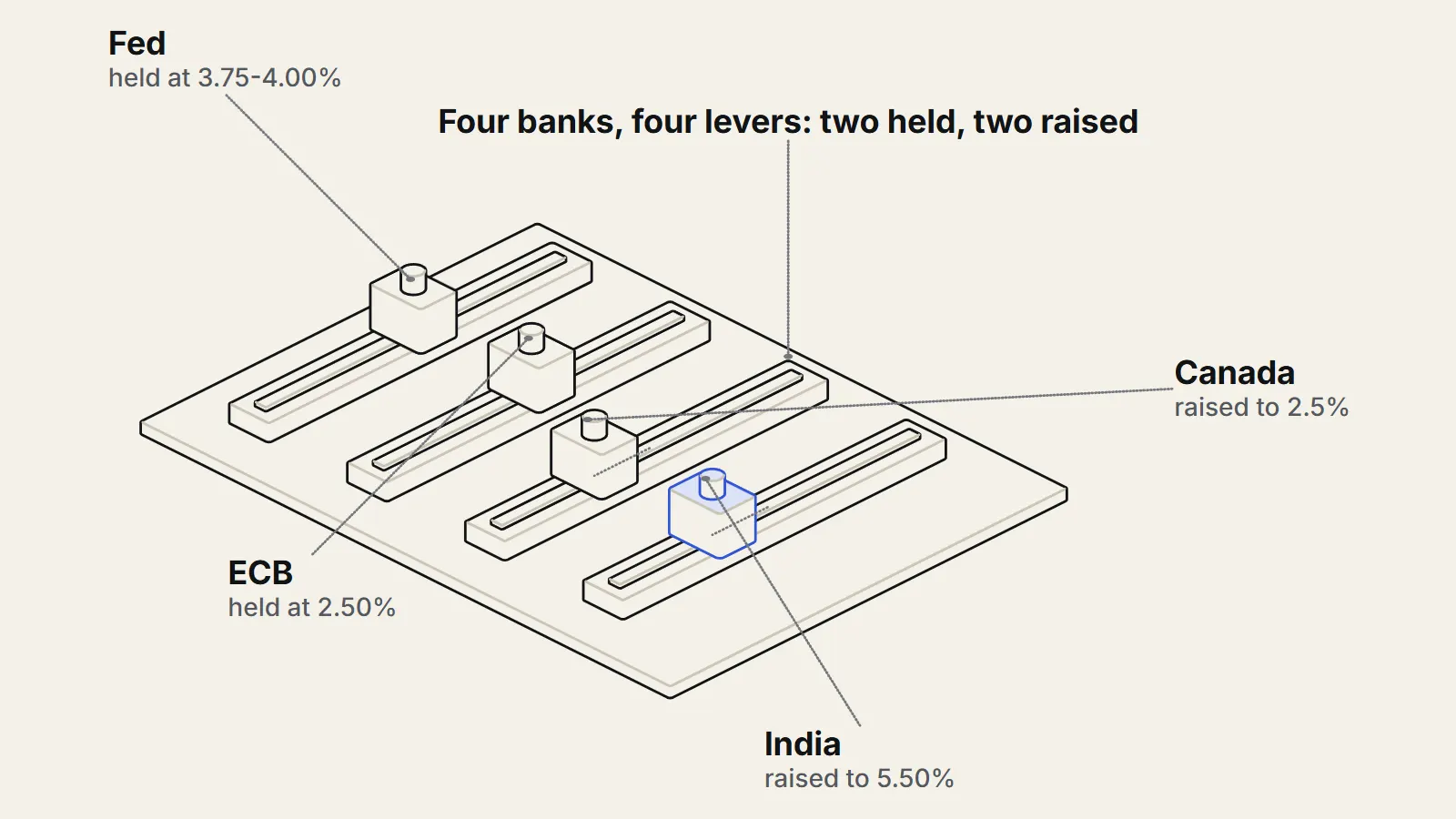
Headlines say central banks are tightening against an oil shock. The record is more mixed. In October only two of the four banks we look at raised rates: the Bank of Canada, by 0.25 points to 2.5% on 28 October1, and India's Reserve Bank, to 5.50% on 7 October2. The US Federal Reserve held at 3.75 to 4.00% on 28 October, by 10 votes to 2, with two members wanting a rise3, and the European Central Bank held on 29 October with its deposit rate at 2.50%4. Both had raised rates in September. The banks differ on one question: can interest rates fix inflation that comes from costlier energy?
What did each central bank do?
| Central bank | Rate | Before | After | Decision date |
|---|---|---|---|---|
| US Federal Reserve (September) | Target range | 3.50-3.75% | 3.75-4.00% | 16 September |
| US Federal Reserve (October) | Target range | 3.75-4.00% | 3.75-4.00% (hold) | 28 October |
| European Central Bank (September) | Deposit rate | 2.25% | 2.50% | 10 September |
| European Central Bank (October) | Deposit rate | 2.50% | 2.50% (hold) | 29 October |
| Bank of Canada | Overnight rate | 2.25% | 2.50% | 28 October |
| Reserve Bank of India | Repo rate | 5.25% | 5.50% | 7 October |
The Fed. In September the Fed raised its range by a quarter of a point, by a 12-0 vote5. In October Lisa Cook and Beth Hammack dissented, preferring another quarter-point rise3. Chair Kevin Warsh said he does not believe in forward guidance absent a crisis, and declined to say what the Committee would do at its next meeting6. The September projections put the median end-2026 policy rate at 4.1%, above today's midpoint7, which would be consistent with one more quarter-point rise this year (our reading). The next meeting is on 8 and 9 December8.
The ECB. The ECB raised its deposit rate by 25 basis points to 2.50% in September9 and held all three key rates on 29 October4. Its statement says the increased magnitude and duration of the energy shock raise the risk of indirect and second-round effects, and that the Governing Council is not pre-committing to a particular rate path4. Press reports of a likely December rise come from the press-conference questions, whose transcript we could not read, so we do not rely on them.
The Bank of Canada. It raised its rate to reduce the risk that continuing high energy prices spread broadly to the prices of other goods and services, and said there could be a need to raise it further but that it would proceed carefully1.
The Reserve Bank of India. The Monetary Policy Committee voted unanimously to raise the repo rate by 25 basis points to 5.50% and moved its stance to calibrated tightening2. We covered the data behind India's oil shock in our research post on the petrol price and the Indian budget (https://therealigned.com/research/petrol-price-india-120-oil-who-pays).
What inflation are they fighting?
A basis point is one hundredth of a percentage point, so 25 basis points is 0.25 points. Headline inflation counts every price; core leaves out food and energy, which swing most. The oil shock shows up in the gap between the two.
| Economy | Headline inflation | Excluding energy or core | Energy |
|---|---|---|---|
| United States (CPI, September) | 3.7% | 2.6% (all items less food and energy) | 20.4% |
| Euro area (HICP, September) | 3.8% | 2.3% (excluding energy, per the ECB) | 18.9% |
| Canada (CPI, September) | 3.1% | 2.2% (excluding gasoline) | 19.0% |
US consumer prices rose 3.7% over the 12 months to September, with energy up 20.4% and gasoline up 34.2%, while prices excluding food and energy rose 2.6%10. In the euro area energy contributed 1.71 percentage points of the 3.8% inflation rate11. In Canada gasoline rose 27.8%, and inflation excluding gasoline was 2.2%12. The gap between headline and underlying inflation is about 1.1 points in the US and 0.9 in Canada (our arithmetic).
Why can't higher rates simply fix an oil shock?
Interest rates work on demand. The Bank of Canada explains that an increase in its policy rate reduces demand for goods and services, and that the effect on inflation usually takes about 12 to 18 months13. A war that cuts oil supply is a supply shock: prices rise because less is available, not because people are spending too much. Higher rates cannot create oil.
So central banks often "look through" a temporary price jump. The ECB's president said in March that small, one-off and short-lived supply shocks can be looked through14. The Bank for International Settlements says the rationale remains compelling, but only up to a point15. The point is second-round effects: a first price rise spreads when workers ask for higher pay and firms raise prices, so inflation lasts after oil stops rising. BIS staff found that when inflation expectations are above target, the inflationary impact of oil supply shocks can be more than twice as large as when expectations are well anchored16.
The Bank of Canada's governor laid out both sides in public. The main argument for an increase was that energy prices are higher, are expected to stay higher, and cost pressures are building17.
Why is the US different?
In the US the argument is that inflation is no longer only about energy. Real GDP rose at a 3.4% annual rate in the third quarter18, and the PCE price index, the Fed's preferred gauge, rose 3.6% over 12 months to September, or 3.1% excluding food and energy19. Real spending rose by less than 0.1% in September19, so most of the extra spending was higher prices. When a reporter asked about growth driving inflation, Warsh said it does not tell him that economic growth is causing inflation and making the Fed's job harder6.
What does tightening cost households?
The costs show up in loans. The average US 30-year fixed mortgage rate was 7.24% on 29 October, against 6.17% a year earlier20. In the euro area mortgage rates rose to 3.6% in August from 3.5% in July and mortgage demand declined substantially21. The ECB says higher financing costs are likely to weigh on growth4. Those with variable-rate or maturing borrowing feel it first, which is a general feature of rate rises rather than a figure from these banks.
What to watch next
- 18 November: US central bank minutes of the October meeting and Statistics Canada's October inflation figures, per the agencies' calendars.
- 2 to 4 December: the Reserve Bank of India's next meeting.
- 8 and 9 December: the Fed meets and publishes new projections; the Bank of Canada decides on 9 December.
- 16 and 17 December: the ECB's next monetary policy meeting.
If energy prices stay high, will the second-round effects the banks fear appear in wages and core inflation? So far the ECB, the Bank of Canada and the RBI all say the evidence is limited.
This is general information about public policy, not investment or borrowing advice.
Key takeaways
- Only the Bank of Canada and India's RBI raised rates in October; the Fed and ECB held after September rises.
- The banks agree energy is driving inflation but differ on whether tightening helps against a supply shock.
- The risk they cite is second-round effects, when higher energy prices spread into wages and other prices.
- The US case rests on strong growth and core inflation as well as energy; the euro area and Canada point to a narrower energy effect.
Sources
- 1Bank of Canada raises the policy rate by 25 basis points to 2 1/2% (opens the source in a new tab) · Bank of Canada, 2026 · Primary source · https://www.bankofcanada.ca/2026/10/fad-press-release-2026-10-28/
- 2Monetary Policy Statement 2026-27: Resolution of the Monetary Policy Committee, 5 to 7 October 2026 (opens the source in a new tab) · Reserve Bank of India, 2026 · Primary source · https://www.rbi.org.in/scripts/BS_PressReleaseDisplay.aspx?prid=63742
- 3Federal Reserve issues FOMC statement (28 October 2026) with implementation note (opens the source in a new tab) · Board of Governors of the Federal Reserve System, 2026 · Primary source · https://www.federalreserve.gov/monetarypolicy/files/monetary20261028a1.pdf
- 4Monetary policy decisions, 29 October 2026 (opens the source in a new tab) · European Central Bank, 2026 · Primary source · https://www.ecb.europa.eu/press/pr/date/2026/html/ecb.mp261029~9a493adf17.en.html
- 5Federal Reserve issues FOMC statement, 16 September 2026 (opens the source in a new tab) · Board of Governors of the Federal Reserve System, 2026 · Primary source · https://www.federalreserve.gov/newsevents/pressreleases/monetary20260916a.htm
- 6Transcript of Chairman Warsh's press conference, 28 October 2026 (preliminary) (opens the source in a new tab) · Board of Governors of the Federal Reserve System, 2026 · Primary source · https://www.federalreserve.gov/mediacenter/files/FOMCpresconf20261028.pdf
- 7FOMC Summary of Economic Projections, 16 September 2026 (opens the source in a new tab) · Board of Governors of the Federal Reserve System, 2026 · Primary source · https://www.federalreserve.gov/monetarypolicy/fomcprojtabl20260916.htm
- 8FOMC meeting calendars and information (opens the source in a new tab) · Federal Reserve, 2026 · Primary source · https://www.federalreserve.gov/monetarypolicy/fomccalendars.htm
- 9Monetary policy decisions, 10 September 2026 (opens the source in a new tab) · European Central Bank, 2026 · Primary source · https://www.ecb.europa.eu/press/pr/date/2026/html/ecb.mp260910~314e508016.en.html
- 10Consumer Price Index, September 2026 (opens the source in a new tab) · US Bureau of Labor Statistics, 2026 · Primary source · https://www.bls.gov/news.release/cpi.htm
- 11Annual inflation up to 3.8% in the euro area (euro indicators, 16 October 2026) (opens the source in a new tab) · Eurostat, 2026 · Primary source · https://ec.europa.eu/eurostat/web/products-euro-indicators/w/2-16102026-ap
- 12The Daily: Consumer Price Index, September 2026 (opens the source in a new tab) · Statistics Canada, 2026 · Primary source · https://www150.statcan.gc.ca/n1/daily-quotidien/261019/dq261019a-eng.htm
- 13How higher interest rates affect inflation (opens the source in a new tab) · Bank of Canada, 2023 · Primary source · https://www.bankofcanada.ca/2023/12/how-higher-interest-rates-affect-inflation/
- 14Navigating energy shocks: risks and policy responses (Lagarde, 25 March 2026) (opens the source in a new tab) · European Central Bank, 2026 · Primary source · https://www.ecb.europa.eu/press/key/date/2026/html/ecb.sp260325~ac2916a211.en.html
- 15BIS Annual Economic Report 2026, chapter I (opens the source in a new tab) · Bank for International Settlements, 2026 · Report · https://www.bis.org/publications/aer-2026/progress-peril
- 16BIS Bulletin No 131: Energy shocks and inflation: challenges for monetary policy (opens the source in a new tab) · Bank for International Settlements (staff authors), 2026 · Paper · https://www.bis.org/publications/bulletin-131-energy-shocks-and-inflation-challenges-monetary-policy.pdf
- 17Monetary Policy Report press conference opening statement, 28 October 2026 (Macklem) (opens the source in a new tab) · Bank of Canada, 2026 · Primary source · https://www.bankofcanada.ca/2026/10/opening-statement-2026-10-28/
- 18GDP (advance estimate), 3rd quarter 2026 (opens the source in a new tab) · US Bureau of Economic Analysis, 2026 · Primary source · https://www.bea.gov/sites/default/files/2026-10/gdp3q26-adv.pdf
- 19Personal Income and Outlays, September 2026 (opens the source in a new tab) · US Bureau of Economic Analysis, 2026 · Primary source · https://www.bea.gov/news/2026/personal-income-and-outlays-september-2026
- 20Freddie Mac Primary Mortgage Market Survey (opens the source in a new tab) · Freddie Mac, 2026 · Primary source · https://www.freddiemac.com/pmms
- 21Monetary policy statement, press conference of 29 October 2026 (opens the source in a new tab) · European Central Bank, 2026 · Primary source · https://www.ecb.europa.eu/press/press_conference/monetary-policy-statement/2026/html/ecb.is261029~5c5ffe99e5.en.html