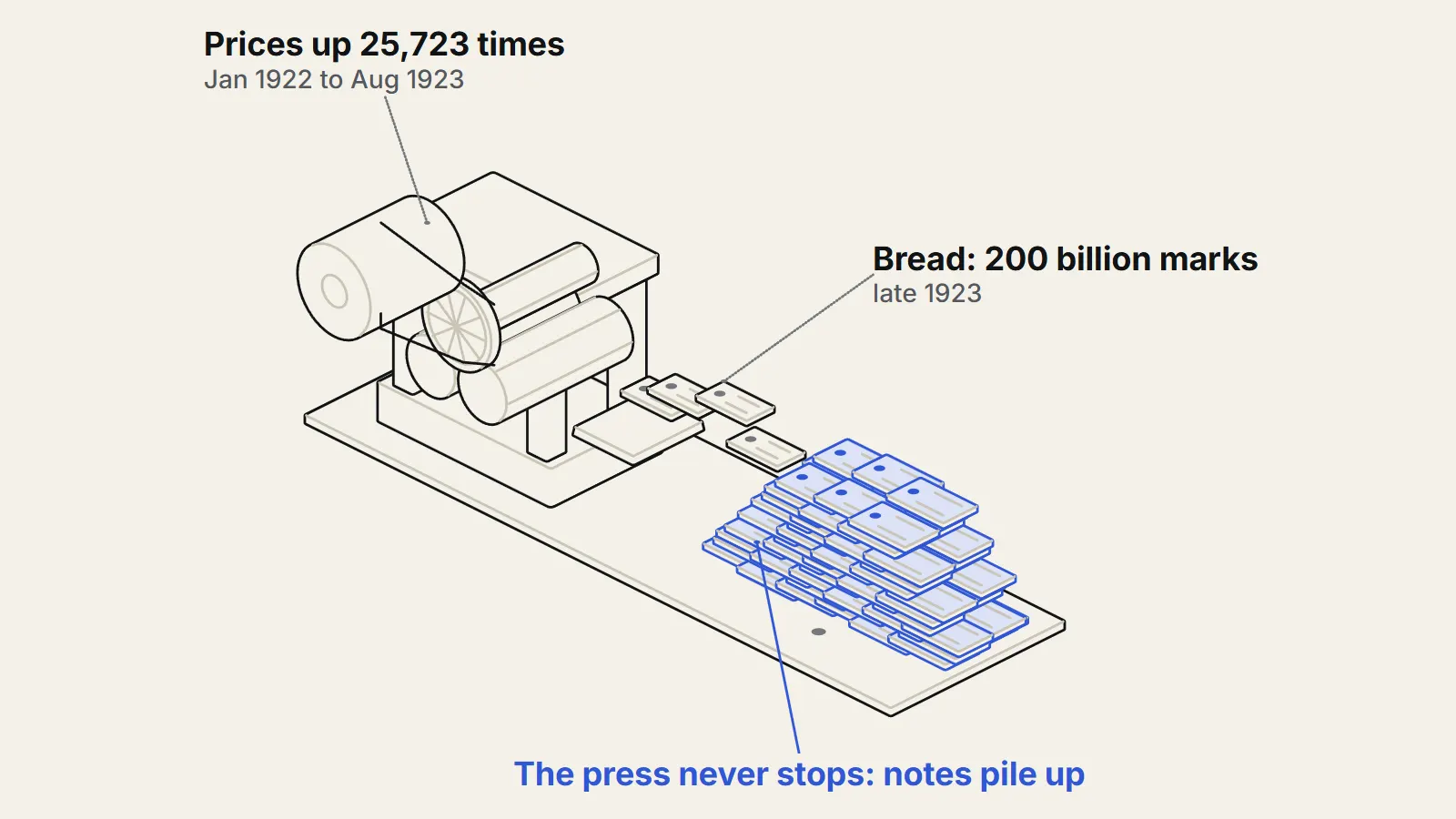
Hyperinflation is a collapse of a currency in which prices rise so fast that the money stops doing its job. The pattern in the best-documented cases is the same: a government that cannot cover its spending with taxes or loans pays its bills with newly created money, people see the money losing value and rush to get rid of it, and prices climb faster than the money supply itself. It ends only when the government makes a believable change in how it finances itself.
What counts as hyperinflation?
The standard definition comes from the economist Phillip Cagan in 1956. He counted a hyperinflation as beginning in the month when inflation first exceeds 50 percent per month1 and ending in the month before it falls below that rate for at least a year.1 Cagan studied seven episodes between 1920 and 1946, including Germany (August 1922 to November 1923) and Hungary twice, in 1923 to 1924 and again from August 1945 to July 1946.1 The authors of a later IMF-linked survey add that hyperinflations are largely a modern phenomenon tied to printing paper money to cover large deficits caused by wars, revolutions, the end of empires and the creation of new states.1
How does a currency collapse?
The first step is a budget the government cannot pay for. In the four post-First World War cases studied by Thomas Sargent (Austria, Hungary, Poland and Germany), each government financed large deficits with unbacked money.2 The central bank (https://therealigned.com/story/what-a-central-bank-does) did this mainly by discounting, meaning buying, the government's short-term treasury bills with newly issued notes.2
The second step is the flight from the currency. Once people expect prices to keep rising, they hold less of their wealth in the money and move into foreign currency or real goods. In Germany, Sargent's figures show wholesale prices rising by a factor of 25,723 between January 1922 and August 19232, while the number of Reichsbank notes in circulation rose by a factor of 5,748.2 Prices grew several times faster than the money, which means the real value of all the notes in circulation was shrinking. That shrinking is the government's problem too: the less people hold, the more new money it must print to buy the same goods, and the faster inflation runs.
Expectations matter here. Sargent argues that people expect high inflation because the government's current and likely future monetary and fiscal policies justify the expectation.2 That is also why the process can feed on itself.
What happened in Weimar Germany?
Germany financed most of the First World War by borrowing and ended it with a national debt of 156 billion marks. In May 1921 the London Schedule of Payments set reparations at 132 billion gold marks, though only a part of that was in bonds that Germany had to service, and historians disagree about how much reparations drove the crisis.3 In January 1923 French and Belgian troops occupied the Ruhr after a missed coal delivery. The German government supported striking workers by printing banknotes, which Sargent describes as discounting treasury bills at the Reichsbank.2
- First half of 1921About 90 marks buy one US dollar.Source 3 (opens the source in a new tab)
- First half of 1922About 320 marks per dollar.Source 3 (opens the source in a new tab)
- December 19227,400 marks per dollar.Source 3 (opens the source in a new tab)
- November 1923The peak: about 4.2 trillion marks per dollar.Source 3 (opens the source in a new tab)
By November 1923 the exchange rate reached about 4.2 trillion marks to the dollar3. A loaf of bread in Berlin that cost about 160 marks at the end of 1922 cost about 200 billion marks by late 1923.3
What happened in Hungary in 1945 and 1946?
Hungary's second hyperinflation reached extraordinary levels. The war had destroyed much of the economy, reparations were demanded, government revenue was low, and the national bank was under government control, so money issue followed budget needs.4 At one stage prices doubled roughly every 15 hours, and the highest note issued, in 1946, was for 100 million b.-pengo, or 10 to the power of 20 pengo.4
What ends a hyperinflation?
Sargent's central finding is that in each of the four countries a dramatic change in the fiscal policy regime coincided with the end of the hyperinflation, and in each case prices stopped rising abruptly rather than gradually.2 The changes included moving to a balanced budget and setting up a central bank that could no longer lend freely to the government.2 All four ended their hyperinflations by becoming credible, committing to far smaller deficits or balanced budgets.5
In Germany the turning point came in November 1923. The Reichsbank was no longer allowed to discount government treasury bills, and a new currency, the Rentenmark, was introduced on 16 November 1923, with twelve zeros cut from prices.3 The mark stabilised at 1 trillion paper marks to the prewar gold mark.2 Hungary replaced the pengo with the forint on 1 August 1946.4
What is disputed?
The strongest counterargument is that the cause was not only bad budgeting but also reparations and the Reichsbank's own policy. The role of reparations in Germany is disputed. From August 1921 the Reichsbank bought foreign currency with marks at any price; Germany said this was to make cash reparation payments, while British and French experts argued it was meant to ruin the currency and avoid reparations.3 A second dispute is about the cure. Sargent's account stresses regime change, and a later article stresses that stabilisation was costly, bringing recession and unemployment, and that many inflations ended in premature celebrations followed by relapses.6
What is not known?
The numbers in the early cases are imperfect, and the sources for Hungary in particular include figures that are hard to check, such as the annualised peak rate of 2.9 times 10 to the power of 177 percent.4 It is also not settled how much weight to give each driver, since war damage, reparations, weak revenue and central bank policy all operated together. This article explains mechanisms and evidence and is not advice about money or investments. For the full account of how four countries stopped the inflation, see Sargent's chapter (https://www.nber.org/system/files/chapters/c11452/c11452.pdf), and for the definition and a modern survey, see the Journal of Economic Literature paper (https://economics.mit.edu/sites/default/files/2023-05/fischer_modern_hyper-inflations.pdf).
Key takeaways
- Hyperinflation is usually defined as inflation above 50 percent per month.
- In the classic cases, governments financed deficits with newly printed money.
- People move out of a collapsing currency, so prices rise faster than the money supply.
- Germany and Hungary ended theirs with new currencies and credible changes in how the government financed itself.
- Stabilisation can be costly, and historians still disagree about the weight of reparations and central bank choices.
Sources
- 1Modern Hyper- and High Inflations (opens the source in a new tab) · Journal of Economic Literature, 2002 · Paper · https://economics.mit.edu/sites/default/files/2023-05/fischer_modern_hyper-inflations.pdf
- 2The Ends of Four Big Inflations (opens the source in a new tab) · National Bureau of Economic Research (chapter in Inflation: Causes and Effects, 1982), 1982 · Paper · https://www.nber.org/system/files/chapters/c11452/c11452.pdf
- 3Hyperinflation in the Weimar Republic (opens the source in a new tab) · Wikipedia, 2025 · Reporting · https://en.wikipedia.org/wiki/Hyperinflation_in_the_Weimar_Republic
- 4Hungarian pengo (opens the source in a new tab) · Wikipedia, 2025 · Reporting · https://en.wikipedia.org/wiki/Hungarian_peng%C5%91
- 5Thomas J. Sargent (opens the source in a new tab) · Econlib (Concise Encyclopedia of Economics), 2008 · Reporting · https://www.econlib.org/library/Enc/bios/Sargent.html
- 6Hyperinflation after the First World War in Central Europe: Causes, Remedies, Consequences (opens the source in a new tab) · Financial and Economic Review (Magyar Nemzeti Bank), 2024 · Paper · https://hitelintezetiszemle.mnb.hu/en/fer-23-4-st3-james