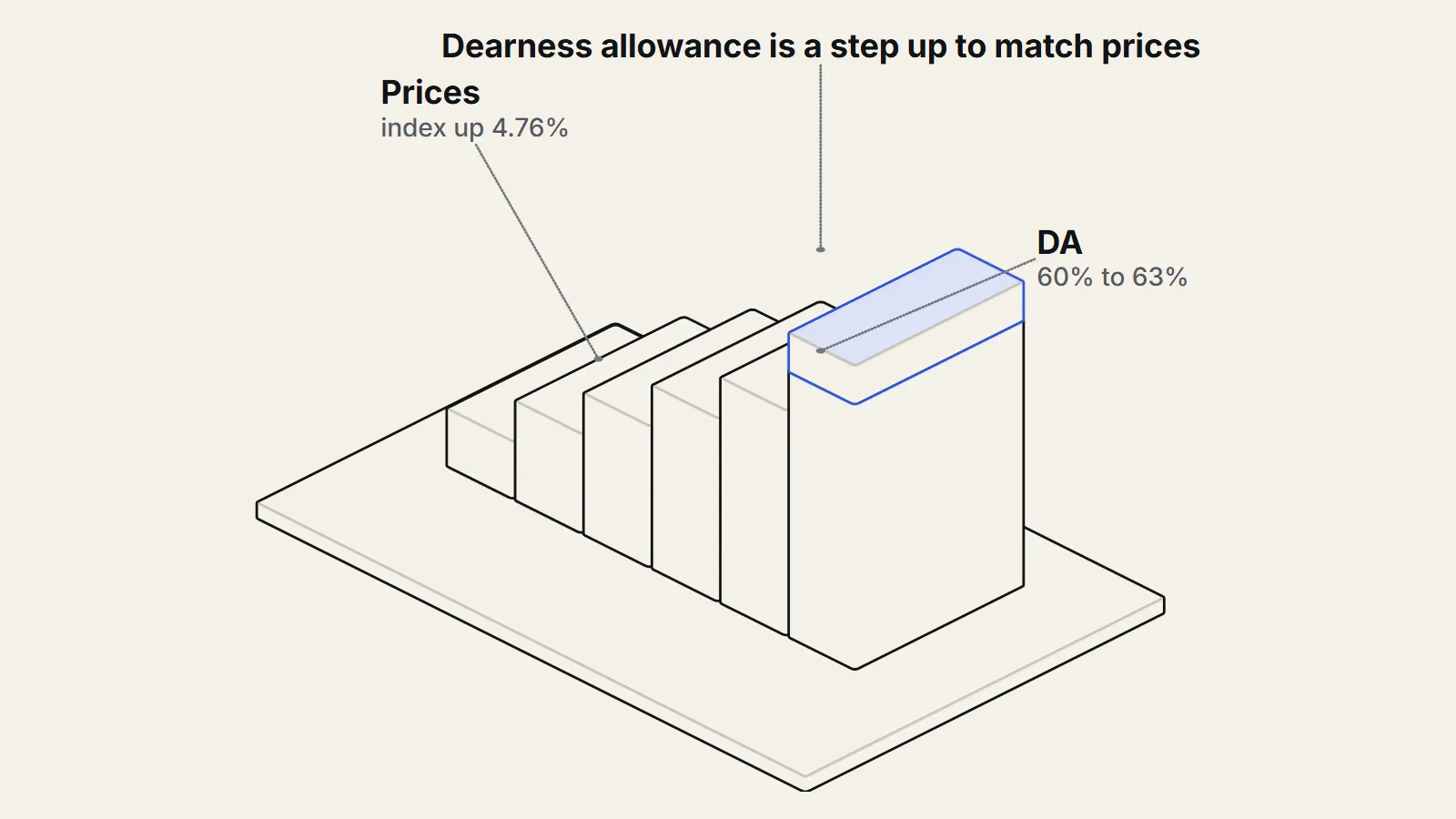
On 28 October 2026 India's Union Cabinet raised dearness allowance (DA) for central government employees, and dearness relief (DR) for pensioners. The headline says a "3% hike", which is easy to misread: it is three percentage points, from 60% to 63%, added on top of basic pay, not a 3% pay rise. The increase takes effect from 1 July 2026, covers about 48.54 lakh employees and 68.71 lakh pensioners, and costs Rs 10,016.10 crore a year1. A lakh is 100,000, so that is about 11.7 million people in all.
What is dearness allowance?
Dearness allowance is an amount added to pay when prices rise. The Government describes the increase as meant to compensate against price rise1. It is a percentage of basic pay, and dearness relief is the same idea for pensioners, as a percentage of basic pension. It is not a bonus.
The Department of Expenditure's order defines basic pay as pay in the prescribed level of the 7th Pay Commission's pay matrix, excluding special pay, and says DA remains a distinct element of remuneration that is not treated as pay under the fundamental rules2. It also says armed forces and railway employees will get separate orders from their own ministries2.
How much more will someone receive?
| Illustration (assumed pay) | Before (60%) | After (63%) | Change a month |
|---|---|---|---|
| DA on basic pay of Rs 50,000 | Rs 30,000 | Rs 31,500 | +Rs 1,500 |
| DR on basic pension of Rs 20,000 | Rs 12,000 | Rs 12,600 | +Rs 600 |
The order applies from 1 July 2026. Neither the Cabinet release nor the order says how arrears for the months already past will be paid, so we do not give a date for them.
How is the rate worked out?
DA is tied to an index of prices. The Government has described the July instalment as based on the percentage increase in the 12-month average of the All India Consumer Price Index for the period ending June3. The index is the Consumer Price Index for Industrial Workers, or CPI-IW, which the Labour Bureau compiles. It is built from prices in 317 markets across 88 centres4, with 2016 as the base year, so an index of 151.9 means prices are 51.9% above the 2016 level. The all-India index was 151.9 in June 2026, up 4.76% on a year earlier5.
We checked the result against the monthly figures. The average of the 12 monthly index values from July 2025 to June 2026 is 148.65 (our arithmetic from the Labour Bureau's releases). A formula for DA that is widely published online gives about 63.8% for that average, consistent with the 63% adopted; its constants come from secondary sources, so treat this as our check, not an official calculation.
The index itself is debated. The Labour Bureau's own review committee, in September 2026, says CPI-IW is primarily designed for wage indexation, and that its 2016 basket is dated because items such as online and streaming services were not consumed in 20166. It recommends keeping the index separate from the general urban price index and expanding the basket.
What does it cost?
| Effective from | DA before | DA after | Cost a year (Rs crore) | Employees (lakh) | Pensioners (lakh) |
|---|---|---|---|---|---|
| 1 January 2026 | 58% | 60% | 6,791.24 | 50.46 | 68.27 |
| 1 July 2026 | 60% | 63% | 10,016.10 | 48.54 | 68.71 |
The 2026-27 Budget targets a fiscal deficit of 4.3% of GDP, or Rs 16,95,768 crore, and about 65.3% of revenue receipts go on salaries, pensions and interest7. Against that, Rs 10,016.10 crore a year is about 0.59% of the budgeted deficit and 0.19% of budgeted total expenditure (our arithmetic; the Budget figures predate the decision). It is a recurring cost: it does not end after one year.
Does it matter for inflation?
DA responds to inflation, and inflation is rising. Consumer price inflation was 5.54% in September, up from 4.83% in August8. The Reserve Bank raised its repo rate to 5.50% on 7 October and projected inflation of 5.2% for 2026-279, and attributes the pressure to supply factors such as a deficient monsoon, El Nino and high energy prices. Its statement does not mention DA. The sources we found do not quantify an inflation effect from this particular instalment.
The worry about larger payouts is about pay commissions, not six-monthly DA changes. QuantEco Research estimated in 2025 that payouts from the 8th Pay Commission could cost the exchequer Rs 2 to 2.5 trillion and add at least 0.6% of GDP to the deficit10; that estimate is about the commission's recommendations, which are a much bigger exercise than a DA instalment.
What do critics and unions say?
The disputes are about the index, the past freeze and the future. On the index, the All India Railwaymen's Federation wants a separate price index for government employees based on open-market retail prices11. On the past, the staff side of the National Council (JCM) called the 2020 freeze of three DA instalments an unjust decision12. The Government told the Lok Sabha the freeze saved about Rs 34,402.32 crore, and DA moved from 17% to 28% from July 2021 without arrears13, as reported by IANS.
On the future, the Finance Ministry told Parliament, as reported, that no proposal to merge DA with basic pay was under consideration14. The 8th Pay Commission was constituted on 3 November 2025 with a deadline of 18 months, and its terms of reference ask it to weigh the need for fiscal prudence15. That puts its report around May 2027 (our arithmetic).
What to watch next
- The pensions department's order giving effect to dearness relief at 63%; we had not found it when we checked.
- 12 November: MoSPI's October consumer price figures.
- 1 January 2027: the next DA revision, based on the January to December 2026 index average.
- The 8th Pay Commission's report, due by about May 2027.
Will the Government change the index behind DA, as its own review committee suggests? No decision has been announced.
This is general information about public rules, not financial advice. Individual pay depends on a person's level and other rules.
Key takeaways
- DA rises from 60% to 63% of basic pay from 1 July 2026: three percentage points, not a 3% pay rise.
- About 11.7 million employees and pensioners benefit, at a stated cost of Rs 10,016.10 crore a year.
- DA is an inflation adjustment tied to the Labour Bureau's price index; the Labour Bureau's own committee says the index basket is dated.
- Inflation was 5.54% in September, and the next DA revision comes from 1 January 2027.
Sources
- 1Cabinet approves Dearness Allowance to Central Government employees and Dearness Relief to Pensioners (28 October 2026) (opens the source in a new tab) · Press Information Bureau, 2026 · Primary source · https://www.pib.gov.in/PressReleasePage.aspx?PRID=2329484
- 2Office Memorandum 1/2(i)/2026-E.II(B): Revision of rates of Dearness Allowance, effective 1 July 2026 (opens the source in a new tab) · Ministry of Finance, Department of Expenditure, 2026 · Primary source · https://doe.gov.in/en/revision-rates-dearness-allowance-central-government-employees-effective-01072026
- 3Cabinet approves additional instalment of DA and DR due from 1 July 2022 (28 September 2022) (opens the source in a new tab) · Press Information Bureau, 2022 · Primary source · https://www.pib.gov.in/Pressreleaseshare.aspx?PRID=1862946®=3&lang=2
- 4Press Release: CPI-IW (2016=100) August 2026 (opens the source in a new tab) · Labour Bureau, 2026 · Primary source · https://labourbureau.gov.in/uploads/public/notice/Press-Release-CPI-IW-August2026Epdf-7814c1556da667188465b41cb4aee755.pdf
- 5Labour Bureau press notes: Consumer Price Index for Industrial Workers (2016=100), monthly (opens the source in a new tab) · Labour Bureau, Ministry of Labour and Employment, 2026 · Primary source · https://labourbureau.gov.in/press-note-consumer-price-index-for-industrial-workers
- 6Report of the Index Review Committee on CPI-IW and CPI-AL/RL, September 2026 (opens the source in a new tab) · Labour Bureau, 2026 · Primary source · https://labourbureau.gov.in/uploads/public/notice/Report-of-Index-Review-Committee-on-CPI-IW--CPI-ALRLpdf-092b5af658e4039a4b369e8ce0cf05b3.pdf
- 7Union Budget 2026-27 Analysis (opens the source in a new tab) · PRS Legislative Research, 2026 · Report · https://prsindia.org/files/budget/budget_parliament/2026/Union_Budget_Analysis-2026-27.pdf
- 8Press release on the Consumer Price Index (base 2024) for September 2026 (opens the source in a new tab) · Ministry of Statistics and Programme Implementation, 2026 · Primary source · https://www.pib.gov.in/PressReleseDetailm.aspx?PRID=2322244&lang=2®=48
- 9Monetary Policy Statement 2026-27: Resolution of the Monetary Policy Committee, 5 to 7 October 2026 (opens the source in a new tab) · Reserve Bank of India, 2026 · Primary source · https://www.rbi.org.in/scripts/BS_PressReleaseDisplay.aspx?prid=63742
- 108th pay commission payout may trigger rate hike cycle in FY27: Report (Business Standard, 17 August 2025) (opens the source in a new tab) · Business Standard (reporting QuantEco Research), 2025 · Reporting · https://www.business-standard.com/amp/finance/news/8th-pay-panel-inflation-rbi-rate-hike-fy27-125081700543_1.html
- 11Railwaymen Come Out With A Wishlist For Eighth Pay Commission (ETV Bharat, 1 April 2026) (opens the source in a new tab) · ETV Bharat, 2026 · Reporting · https://www.etvbharat.com/en/bharat/railwaymen-come-out-with-a-wishlist-for-eighth-pay-commission-enn26040102652
- 12Freezing of DA and DR: NC JCM (Staff Side) letter to the Cabinet Secretary, 26 May 2020 (opens the source in a new tab) · NC-JCM Staff Side (reproduced on GConnect), 2020 · Reporting · https://www.gconnect.in/orders-in-brief/allowance-orders-in-brief/freezing-dearness-allowance-hardships.html
- 13Govt saved Rs 34,402 cr by freezing DA, DR amid pandemic (IANS, 26 July 2021) (opens the source in a new tab) · IANS via The Weekend Leader, 2021 · Reporting · https://www.theweekendleader.com/Headlines/64556/govt-saved-rs-34402-cr-by-freezing-da-dr-amid-pandemic.html
- 14Will DA, DR be merged with basic pay under 8th Pay Commission? (Business Today, 3 December 2025) (opens the source in a new tab) · Business Today, 2025 · Reporting · https://www.businesstoday.in/personal-finance/news/story/will-da-dr-merged-with-basic-pay-under-8th-pay-commission-govt-clarifies-its-stand-in-parliament-504787-2025-12-03
- 15Resolution constituting the Eighth Central Pay Commission (3 November 2025) (opens the source in a new tab) · Ministry of Finance, Department of Expenditure, 2025 · Primary source · https://doe.gov.in/files/cenetral-pay_document/8thcpcnotification.pdf