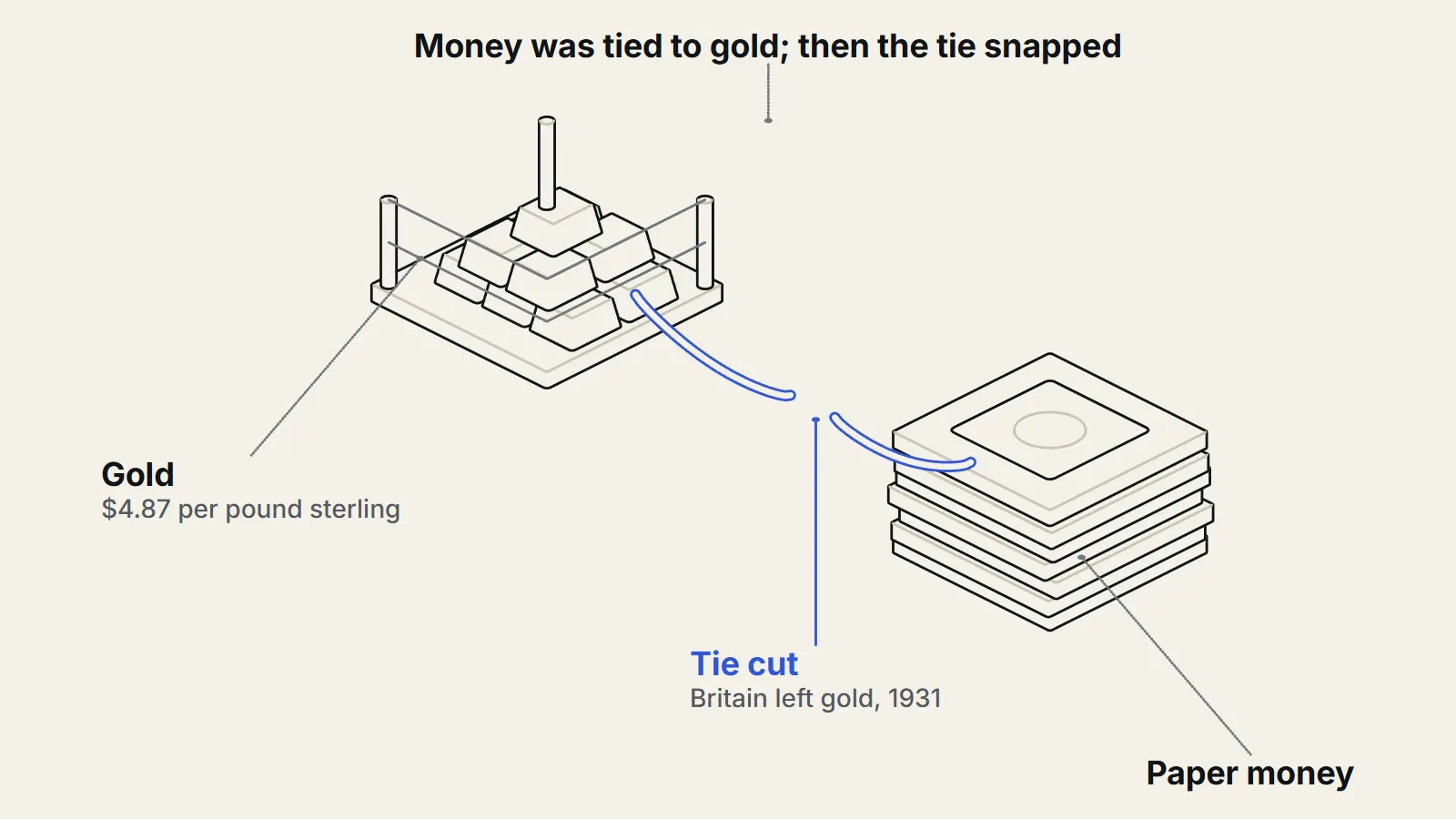
Under a gold standard, a government fixes the value of its currency to a set amount of gold and promises to swap one for the other at that price. The gold standard spread across most of the world by 1913, then came apart in stages: war suspended it in 1914, the Great Depression (https://therealigned.com/story/what-caused-the-great-depression) pushed countries off it in the early 1930s, and the United States ended dollar convertibility to gold in 1971. The common thread in why it ended is that fixed gold prices left governments little room to respond to wars, bank runs (https://therealigned.com/story/bank-runs-explained) and slumps.
How did the gold standard work and why did it spread?
Each country fixed how much gold its currency contained, and notes and coins could be converted at that price. Two countries on gold therefore had a fixed exchange rate between them, called the mint parity. The dollar-sterling parity was about $4.87 per pound1. Exchange rates could drift only within narrow limits set by the cost of shipping gold, because traders would send gold across the Atlantic whenever the rate strayed too far.1
The textbook adjustment worked through gold flows. A country running a trade deficit (https://therealigned.com/story/what-a-trade-deficit-is-and-isnt) lost gold, its money supply shrank, prices and incomes fell, its exports became cheaper and its imports fell. The same text notes that wages and prices were often slow to fall, so the adjustment could bring unemployment. Central banks were expected to help by raising interest rates when gold flowed out, but in practice many offset gold flows instead.1
The system spread in the 1870s. Britain had been effectively on gold for more than a century and Germany joined in 1871; the United States was on a dual legal and effective gold standard from 1879. By 1913 it covered most of the world, apart from China, Persia and parts of Latin America. A large part of its appeal was credibility: convertibility was so trusted that the risk of a currency being repriced was close to zero.1
Why did the gold standard constrain countries in downturns?
Fixed gold parity meant a government could not freely expand money to fight a slump. The reasoning was simple: if a country eased policy, gold could flow out, and enough outflow would force it off gold. An economic history encyclopedia calls these constraints "golden fetters". It reports that countries often held back from expansion for exactly that reason, and it reports the argument, made by some economists, that the constraint worsened the Depression and spread it between countries.1
The link between countries was direct. The Federal Reserve's own history says that under the international gold standard, interest rates and monetary policies were tied across nations, so its rate increases in 1928 and 1929 triggered recessions abroad. It adds that some officials thought defending gold by raising rates and cutting money and credit was a better course than helping failing banks. The money supply fell nearly 30 percent from fall 1930 to winter 19332.2
How was the gold standard abandoned?
- 1914War begins; most gold-standard countries make convertibility ineffective by regulationSource 1 (opens the source in a new tab)
- 1925Britain returns to gold at its prewar parity, leaving sterling overvalued by roughly ten percentSource 1 (opens the source in a new tab)
- September 1931Britain abandons the gold standard and the pound falls sharplySource 1 (opens the source in a new tab)
- 1933 to 1934The United States leaves gold; the Gold Reserve Act is signed on January 30, 1934Source 3 (opens the source in a new tab)
- August 15, 1971President Nixon suspends the dollar's convertibility into goldSource 4 (opens the source in a new tab)
The interwar version was more fragile than the one before 1914. The United States lifted its gold export embargo in 1919 and restored convertibility in 1922. Britain returned to gold in 1925 at its prewar parity, which left sterling overvalued by roughly ten percent. In May 1931 a run on Austria's largest commercial bank spread to Germany, which imposed exchange controls in July. Confidence in sterling collapsed in mid-July, and in September Britain abandoned the gold standard. Many countries followed. The United States held on until 1933, and a bloc led by France stayed on gold until around the end of 1936.1
The United States left in stages, and the second step was in 1934. The Gold Reserve Act, signed on January 30, 1934, transferred ownership of monetary gold in the country to the Treasury, which paid holders $35 an ounce, and it prohibited the Treasury and financial institutions from redeeming dollars for gold.3 The older price had been $20.67 an ounce, set by the Gold Act of 1900. A modified link survived for decades afterward. Under the Bretton Woods system the dollar stayed convertible to gold at $35 an ounce, and other currencies had fixed exchange rates against the dollar.4
That link broke in 1971. A surplus of dollars had built up, and the United States did not have enough gold to cover the dollars in circulation at $35 an ounce. Traders expected a devaluation and repeatedly sold dollars. On August 15, 1971, President Richard Nixon suspended the dollar's convertibility into gold4, froze prices and wages for 90 days and added a 10 percent tariff on dutiable imports. An agreement that December reset exchange rates around a devalued dollar but did not last; by March 1973 European Community members were floating their currencies against it.4
What is disputed about the gold standard?
The first dispute is whether the classical system really worked as the textbook says. The encyclopedia entry argues that central banks often offset gold flows instead of following the supposed rules, and that under fixed exchange rates the gold flows were too small to drive the predicted adjustments.1 On that reading, the system's stability owed more to its credibility than to automatic adjustment.
The second is whether leaving gold was a clean escape. Barry Eichengreen and Jeffrey Sachs argued in a 1984 working paper that depreciation helped the countries that did it, and that if many countries had devalued together, recovery would have come faster. They provisionally concluded that individual devaluations had negative effects on other countries, which makes them "beggar-thy-neighbor" policies.5 So leaving gold could help the country that did it while hurting its trading partners.
What is not known?
The sources used here establish the sequence of events and the constraint, but they do not settle how much of the Depression was due to gold rather than to other causes, and they say nothing about how a gold standard would perform in a modern economy. Estimates of the effects of leaving gold in the 1930s come from a small set of countries and years, and historians still debate how to weigh the roles of banking panics, trade barriers and monetary policy.
Key takeaways
- A gold standard fixes a currency to a weight of gold, which also fixed exchange rates among countries on gold.
- It was credible and widely adopted by 1913, but it limited governments' ability to ease policy in downturns.
- Countries left in stages: war in 1914, Britain in 1931, the United States in 1933 and 1934, and dollar convertibility ended in 1971.
- Historians still dispute how much it caused the Depression and how well the classical system actually adjusted.
Sources
- 1Gold Standard (EH.Net Encyclopedia) (opens the source in a new tab) · EH.Net Encyclopedia, ed. Robert Whaples, 2008 · Essay · https://eh.net/encyclopedia/gold-standard/
- 2The Great Depression (opens the source in a new tab) · Federal Reserve History (Federal Reserve Board), 2013 · Primary source · https://www.federalreservehistory.org/essays/great-depression
- 3Gold Reserve Act of 1934 (opens the source in a new tab) · Federal Reserve History (Federal Reserve Board), 2013 · Primary source · https://www.federalreservehistory.org/essays/gold-reserve-act
- 4Nixon and the End of the Bretton Woods System, 1971-1973 (opens the source in a new tab) · Office of the Historian, U.S. Department of State, 2024 · Primary source · https://history.state.gov/milestones/1969-1976/nixon-shock
- 5Exchange Rates and Economic Recovery in the 1930s (NBER Working Paper 1498) (opens the source in a new tab) · National Bureau of Economic Research, 1984 · Paper · https://econpapers.repec.org/paper/nbrnberwo/1498.htm