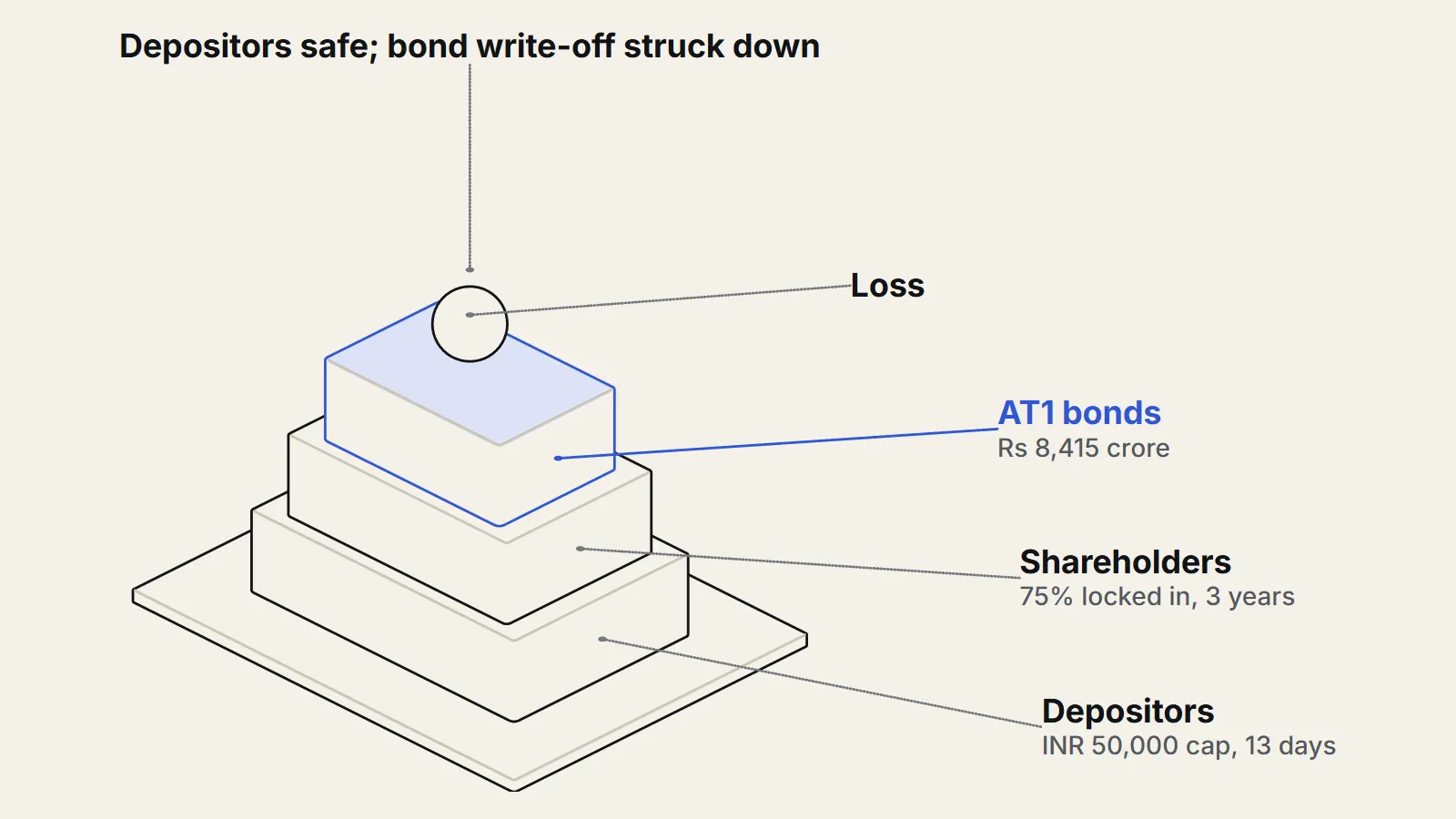
The Yes Bank reconstruction scheme, notified by India's government on 13 March 2020 (https://taxguru.in/rbi/yes-bank-limited-reconstruction-scheme-2020.html), decided who paid for the bank's failure: depositors were protected, new capital came in at Rs 10 per share1, and existing shareholders were locked in rather than wiped out.1 The fight that has not ended is over a fourth group, holders of Yes Bank AT1 bonds. On 15 October 2026 the Supreme Court upheld a ruling that the write-off of their Rs 8,415 crore2 was not authorised.2 This piece answers that news item, which we saw trending in India on 15 and 16 October 2026. We explain the history and the mechanism only. We do not discuss share prices, and nothing here is investment, tax or legal advice.
Why was Yes Bank placed under a moratorium?
A bank pays out deposits on demand but holds only part of them as cash, so it depends on confidence (our explainer on how banks create money (https://therealigned.com/story/how-banks-create-money) shows why, and what is money (https://therealigned.com/story/what-is-money-and-why-does-it-work) covers the trust behind it). Yes Bank lost that confidence. According to a case summary from Yale's New Bagehot Project, its deposits fell from INR 2.1 trillion in September 2019 to INR 1.1 trillion by 31 March 20203, and its core capital ratio was 0.62 percent in December 2019 against a required 7.4 percent.3 The Ministry of Finance, the same summary says, cited a "rapidly deteriorating financial position" (https://newbagehot.yale.edu/node/439) and the interest of depositors.3
The Yes Bank moratorium began on 5 March 2020, when the central government used section 45 of the Banking Regulation Act, 1949, to freeze the bank's payments, a legal pause that ran until 3 April 2020.41 The Reserve Bank of India (RBI) superseded the board and appointed an administrator.2 Depositors could withdraw at most INR 50,000, with higher limits for emergencies such as medical treatment.3
How did the Yes Bank reconstruction scheme work?
Under section 45 the government can approve a scheme that rebuilds a failing bank. The RBI published a draft (https://www.rbi.org.in/Scripts/BS_PressReleaseDisplay.aspx?prid=49479) on 6 March 2020 and took comments until 9 March.4 The final scheme, notified on 13 March 2020, named the State Bank of India (SBI) as the investor bank. After the new shares were issued, SBI had to hold between 26 and 49 percent of the equity and could not go below 26 percent for three years. Shares were issued at Rs 10 each, made up of Rs 2 face value and an Rs 8 premium.1 Eight banks together put in INR 100 billion (Rs 10,000 crore), and the RBI offered an emergency liquidity facility of INR 600 billion.3 The moratorium ended early, at 6 pm on 18 March 2020, after 13 days.3
Who lost money: depositors, shareholders or AT1 bondholders?
A rescue has to decide who absorbs the loss. As our piece on who really pays taxes (https://therealigned.com/story/who-really-pays-taxes) shows for taxes, the party a rule names is not always the one who ends up bearing the cost. The notified text left deposits and other liabilities on the same terms.1 Depositors lost nothing, and the Yale summary quotes the RBI Governor saying that depositors in India have never lost money in a bank failure.3 Existing shareholders kept their shares but now owned a smaller slice of a bigger bank, because new shares were issued, and 75 percent of the shares of holders with 100 or more shares were locked in for three years1.1 In plain terms, they could not sell most of their holding for that time. The lock-in ended on 13 March 2023.3
| Group | Treatment in March 2020 |
|---|---|
| Depositors | Continued on the same terms; withdrawals capped at INR 50,000 for 13 days |
| Existing shareholders | Kept shares, diluted by the new issue; 75 percent of larger holdings locked in for three years |
| SBI and other investors | New shares at Rs 10; SBI between 26 and 49 percent |
| AT1 bondholders | Draft said a full write-down; the notified text is silent; the administrator wrote them down on 14 March |
What are AT1 bonds, and what happened to them?
AT1 bonds were the odd case. They are a form of bank capital, and their terms said they could be written down when capital fell below a trigger. The RBI's draft scheme said they would be written down permanently and in full.4 The notified scheme of 13 March did not mention them.1 On 14 March 2020 the administrator wrote down the two series anyway, Rs 3,000 crore issued in December 2016 and Rs 5,415 crore in October 2017.5
What did the Supreme Court decide on the Yes Bank AT1 bonds?
On 15 October 2026 the Supreme Court ruled on the AT1 bonds. The appeals were brought by Yes Bank, the RBI and the Union of India, and a bench of Justices Dipankar Datta and Augustine George Masih dismissed them, leaving in place the Bombay High Court judgment of 20 January 2023 that had set the write-off aside.2 Reports of the ruling say the court held that the administrator had no power to write off the bonds unless the scheme allowed it, and that a general saving clause could not supply a power the final scheme had left out.5 The same report says the court stressed that it was not rejecting AT1 write-downs in general, only the way this one was done.5 Read the case reports at LawChakra (https://lawchakra.in/supreme-court/yes-bank-at1-write-off/) and ThePrint (https://theprint.in/judiciary/yes-bank-at-1-bonds-why-sc-ruled-against-rs-8415-cr-write-off-and-called-rbi-mere-bystander/3073802/); we have not read the full judgment, which was still awaited when we looked.
- 5 March 2020Moratorium imposed; board supersededSource 2 (opens the source in a new tab)
- 13 March 2020Final scheme notified without a write-off clauseSource 1 (opens the source in a new tab)
- 14 March 2020Administrator writes down the AT1 bondsSource 2 (opens the source in a new tab)
- 20 January 2023Bombay High Court quashes the write-offSource 2 (opens the source in a new tab)
- 3 March 2023Supreme Court stays that orderSource 2 (opens the source in a new tab)
- 15 October 2026Supreme Court dismisses the appealsSource 2 (opens the source in a new tab)
What is the case for the write-down, and what is not known?
Much remains unknown. The reports we found do not say whether or how the written-off bondholders will be compensated or restored, and Yes Bank has said any liability would be recognised in the relevant reporting period.2 Coupons on the bonds are reported to remain payable under their terms.5 The effect on the bank's capital is also not known, and the full reasoning will only be clear from the judgment. This piece cannot say what the ruling means for any holder, and it is not a view on whether a given share or bond is a good or bad holding.
Key takeaways
- A moratorium is a legal pause on a failing bank, and in March 2020 it lasted 13 days for Yes Bank.
- The reconstruction scheme protected depositors, issued new shares at Rs 10 and locked in most existing holdings for three years.
- The AT1 write-off of Rs 8,415 crore was left out of the notified scheme, and the Supreme Court on 15 October 2026 upheld the ruling that it was not authorised.
- What happens to the bondholders next is not yet known from the reports we found.
Sources
- 1Yes Bank Limited Reconstruction Scheme, 2020 (G.S.R. 174(E)) (opens the source in a new tab) · Ministry of Finance (text via TaxGuru), 2020 · Law · https://taxguru.in/rbi/yes-bank-limited-reconstruction-scheme-2020.html
- 2Supreme Court Upholds Bombay HC Verdict Quashing Yes Bank AT1 Bond Write-Off Worth Rs 8,415 Crore (opens the source in a new tab) · LawChakra, 2026 · Reporting · https://lawchakra.in/supreme-court/yes-bank-at1-write-off/
- 3India: Yes Bank Moratorium, 2020 (opens the source in a new tab) · The New Bagehot Project (Yale), 2025 · Report · https://newbagehot.yale.edu/node/439
- 4Draft scheme of reconstruction of Yes Bank Ltd (press release 2019-2020/2028) (opens the source in a new tab) · Reserve Bank of India, 2020 · Primary source · https://www.rbi.org.in/Scripts/BS_PressReleaseDisplay.aspx?prid=49479
- 5Yes Bank AT-1 bonds: why SC ruled against Rs 8,415 cr write-off (opens the source in a new tab) · ThePrint, 2026 · Reporting · https://theprint.in/judiciary/yes-bank-at-1-bonds-why-sc-ruled-against-rs-8415-cr-write-off-and-called-rbi-mere-bystander/3073802/