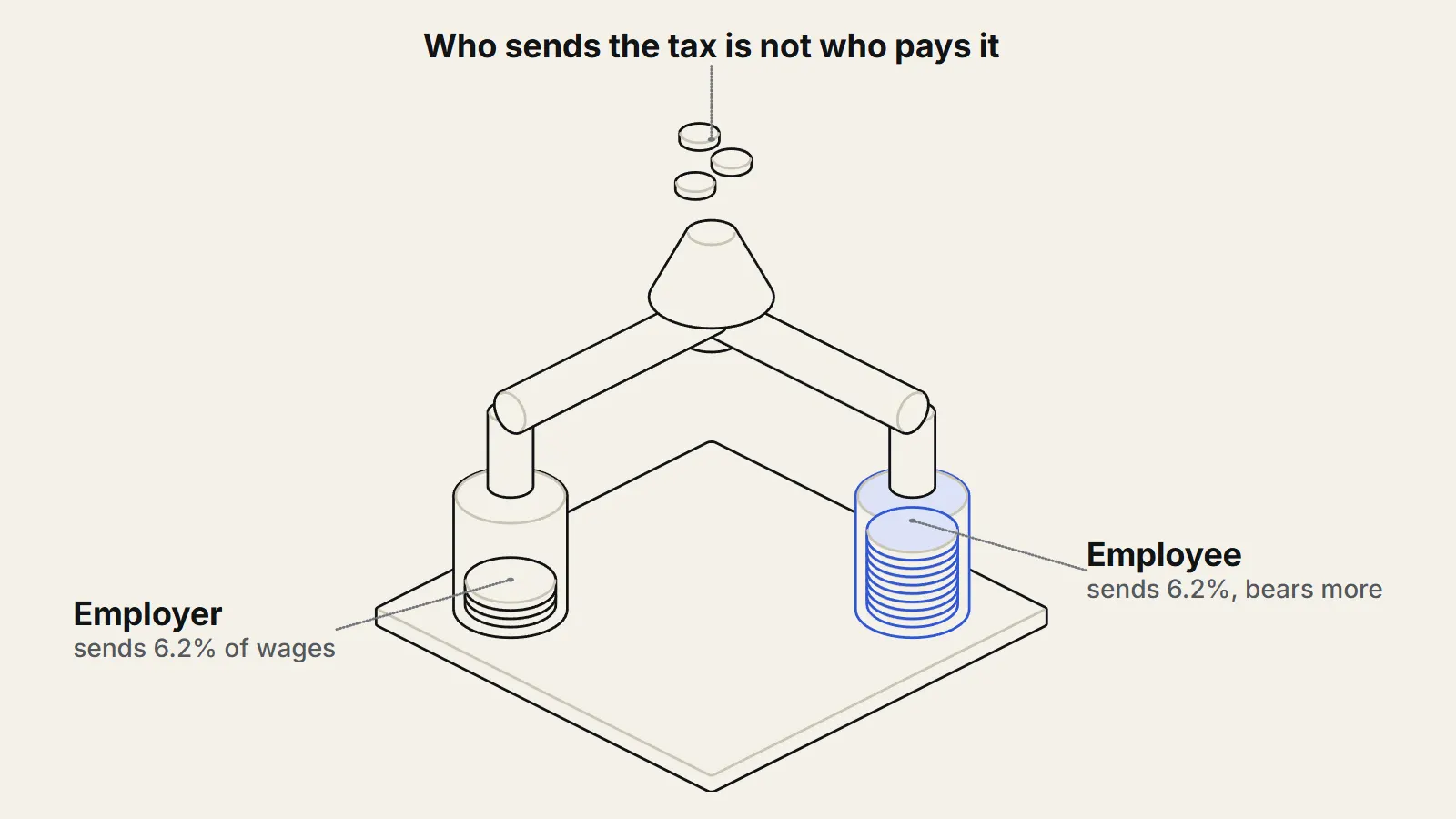
Who really pays taxes is not always the person who writes the cheque. Economists separate the statutory incidence of a tax, meaning who the law requires to send the money to the government, from its economic incidence, meaning who ends up with less money or pays higher prices because of it. The two can differ a lot. A tax on an employer may be borne by workers, a tax on a company may be borne by its owners, and a sales tax may be split between shoppers and sellers. How the split works depends on how easily each side can change what it does.
What is the difference between who pays a tax and who bears it?
Think of a tax as a wedge between what a buyer pays and what a seller keeps. Whichever side the law taxes, the wedge is the same size. What matters is who moves more when the wedge appears. If buyers can easily walk away, sellers must cut their price to keep sales, so sellers bear more of the tax. If sellers can easily stop selling, prices rise and buyers bear more. In short, the side with fewer alternatives carries more of the burden.
This is why the label on the tax bill tells you little. It is also why incidence is hard to measure. The burden is spread through wages, prices and returns on investment, and none of those is stamped with a tax receipt. Researchers have to infer it from models and from natural experiments, where a tax changes for one group and not for a similar group.
Who bears the payroll tax?
In the United States, the Social Security tax is split on paper: employers pay 6.2 percent1 of wages and employees pay another 6.2 percent, with Medicare adding 1.45 percent each. Social Security tax applies only up to a wage cap, set at $184,500 for 2026.1 The IRS publishes the rates on its payroll tax topic page (https://www.irs.gov/taxtopics/tc751).
The textbook view is that the split on paper does not matter. If workers cannot easily change how much they work, they end up bearing both halves, because employers offer lower wages to cover their share. One leading paper calls this the received wisdom in public economics, and notes that it is the assumption behind the official statistics on how US federal taxes are distributed.2
A large test came from Sweden. A paper in the American Economic Review studied a cut in the employer payroll tax for workers aged 26 or younger, from about 31 percent to about 15 percent. If the textbook were right, young workers' take-home wages would have risen relative to slightly older workers. Instead, the authors found no effect on net-of-tax wages2 of the young workers, and youth employment rose by 2 to 3 percentage points. Firms with many young workers expanded and raised pay for all their staff, young and old, which the authors read as firms sharing a windfall with employees.2 The authors' own summary is in the working-paper abstract (https://www.nber.org/papers/w23976).
Who bears the corporate income tax?
A company is a legal entity, so it cannot bear a tax itself. A Congressional Research Service overview notes that the burden must fall on people: shareholders and other owners of capital, workers through lower pay and benefits, or customers through higher prices. The US corporate rate is a flat 21 percent.3
Official scorekeepers have to pick a split. The Congressional Budget Office now assumes 75 percent falls on owners of capital and 25 percent on workers3, in proportion to labor income. The Joint Committee on Taxation uses a similar long-run split, and the Treasury moved to 82 percent capital and 18 percent labor in 2012.3 The source is CRS report R47519 (https://www.everycrsreport.com/reports/R47519.html).
The share that reaches workers is the part economists argue about. Open-economy models, where capital can move across borders, can put most of the burden on labor, because investment leaves a high-tax country and workers have less equipment to work with. The CRS report says those results depend on highly mobile capital and highly substitutable products. Statistical studies often find a substantial labor share, but the report says weaknesses in the methods leave them open to doubt.3 Customers, by contrast, are generally not found to bear the corporate tax.
Who bears sales taxes and VAT?
A sales tax or value-added tax (VAT, a sales tax collected at each stage of production) looks like the easy case: the shopper pays it at the till. The shopper does pay it, but a change in the tax does not always change the shelf price by the same amount. France offers a clean test. In 2009 the government cut the VAT on sit-down restaurant meals. Two economists, Youssef Benzarti and Dorian Carloni, compared restaurants with similar firms that were not cut. They found that firm owners kept more than 55 percent of the cut4, while customers, suppliers and employees shared the rest, with customers gaining least.4 The paper is in the American Economic Journal: Economic Policy (https://www.aeaweb.org/articles?id=10.1257%2Fpol.20170504).
A tax cut does not automatically reach shoppers, and by the same logic a tax rise may not fully reach them either. Prices are sticky, restaurants compete on more than price, and owners may absorb some changes. Which way the split falls depends on the market.
What is disputed, and what is not known?
Several things remain open. The labor share of the corporate tax has no agreed figure, and the agencies themselves use different ones. How long it takes for wages to adjust after a payroll tax change is uncertain, and results from Sweden and France may not carry over to the United States or to other periods. Incidence also depends on the whole tax system and on what the revenue pays for, which a single-tax study cannot capture.
This piece describes how burdens are shared, not what any tax ought to be. Whether a particular split is fair is a question of values, not of measurement.
Key takeaways
- Statutory incidence is who the law makes pay; economic incidence is who ends up worse off. They often differ.
- The side of a market that can adjust least tends to carry more of a tax.
- The textbook says workers bear the whole payroll tax, but a Swedish payroll tax cut for the young did not raise their take-home wages.
- Agencies assume about 75 percent of the corporate tax falls on owners of capital and 25 percent on workers, and the labor share is still debated.
- A French restaurant VAT cut went mostly to firm owners, so a lower tax does not automatically mean lower prices.
Sources
- 1Topic no. 751, Social Security and Medicare withholding rates (opens the source in a new tab) · Internal Revenue Service, 2026 · Primary source · https://www.irs.gov/taxtopics/tc751
- 2Payroll Taxes, Firm Behavior, and Rent Sharing: Evidence from a Young Workers' Tax Cut in Sweden (opens the source in a new tab) · American Economic Review 109(5), 2019 · Paper · https://www.nber.org/papers/w23976
- 3An Overview of the Corporate Income Tax System (opens the source in a new tab) · Congressional Research Service, 2023 · Report · https://www.everycrsreport.com/reports/R47519.html
- 4Who Really Benefits from Consumption Tax Cuts? Evidence from a Large VAT Reform in France (opens the source in a new tab) · American Economic Journal: Economic Policy 11(1), 2019 · Paper · https://www.aeaweb.org/articles?id=10.1257%2Fpol.20170504