Royal Mail job cuts of up to 2,500 head office and support roles were reported on 6 and 7 October 2026, and we noticed the story on 15 October. This piece answers that news item. Why is Royal Mail cutting jobs? The company points to two causes: letter volumes that have fallen by more than 70 percent from their peak, and the changes to its universal service rules that followed a 2025 decision by the regulator, Ofcom.1 This is a UK story, written as of 16 October 2026. It explains the figures and is not advice on investing, employment or law.
What are the Royal Mail job cuts?
Royal Mail proposes to cut up to 2,500 head office and support jobs by the end of 20272, reported as hitting its head office on Farringdon Road in London and its support functions. The company employs more than 131,000 people, so 2,500 would be about 1.9 percent of the workforce (our calculation).2
The company says the plan is subject to consultation and would rely on natural attrition and voluntary redundancy, with no compulsory redundancies and no cuts to frontline delivery and processing roles such as posties and drivers.2 Formal consultation is under way with the Communication Workers Union (CWU) and Unite CMA.1 The chief executive, Alistair Cochrane, said the changes “remove duplication” and let the company invest further in its service. The CWU says the proposals affect about 200 of its members’ jobs, in administration and revenue protection.2 Sky News described the plan as the first major organisational change since the investment group EP Group bought Royal Mail’s parent company for almost £3.6 billion.2
Why is Royal Mail cutting jobs?
The short answer is that its oldest product has shrunk. Ofcom, the UK communications regulator, says people and businesses have moved to digital alternatives, and that letter volumes reached their highest point around 2005 and have fallen since.3 Falling Royal Mail letter volumes mean less revenue to cover the cost of running the network, and Royal Mail head office jobs are one of the costs a firm can review.
How many letters does Royal Mail deliver now?
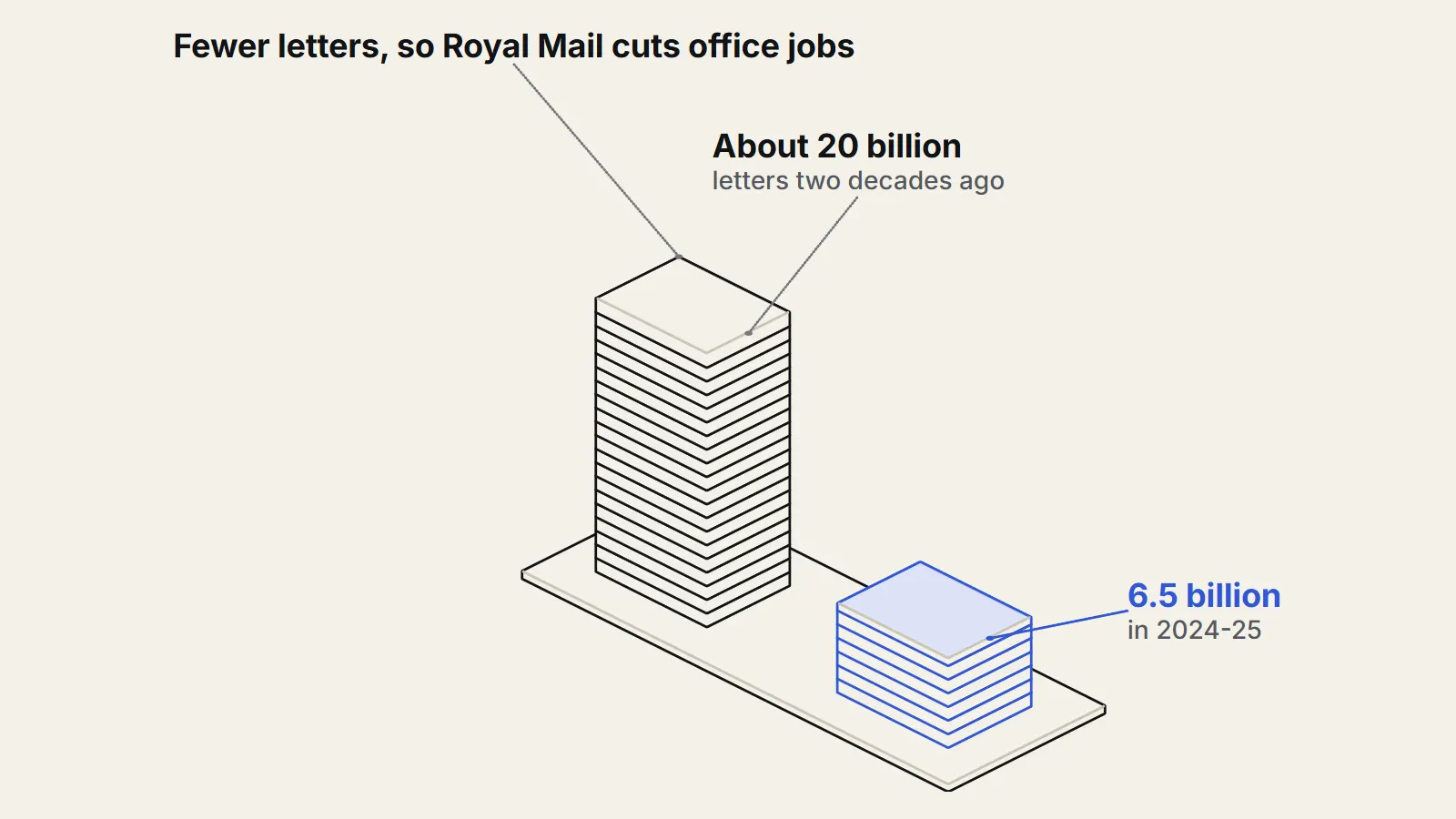
Ofcom’s figures give the scale. It says Royal Mail delivered 20 billion letters 20 years ago.4 Ofcom’s count of letters to UK addresses shows 6.6 billion in 2023/24, against 14.3 billion in 2011/125.5 In 2024-25 addressed letter volumes were 6.5 billion, down 2.0 percent on the year and a slower fall than the 9.0 percent drop in 2023-24.6 A fall from about 20 billion to 6.5 billion is roughly two thirds (our calculation). The company’s “more than 70 percent” figure may use a different peak or measure; we could not find its basis.
Fewer letters do not cut costs in step, because a delivery round still has to reach every address. Ofcom notes that the number of delivery points rose from 28 million in 2008 to 32 million, so each letter carries more of the fixed cost of a round.3 Ofcom also says Royal Mail’s letter revenues fell from £6.9 billion in 2008 to £3.7 billion in 2023/24, and that the company made losses of £348 million in 2023/24 and £419 million in 2022/23.5 Price rises have softened the blow: in 2024-25 Royal Mail’s addressed letter volumes, leaving out election mail, fell 4 percent while their revenue rose 6 percent, and its measured profit margin was close to break-even at -0.2 percent, against about -6 percent a year earlier.6 Raising prices is one way a business covers fixed costs; our guide to what causes inflation (https://therealigned.com/story/what-causes-inflation) explains how costs feed into prices more widely.
Parcels pull the other way. Ofcom estimates that UK parcel volumes rose 7.1 percent to 4.2 billion items in 2024-25.6 The company also says demand for faster and more convenient parcel services keeps growing.1
What is the universal service obligation?
The universal service obligation (USO) is the set of delivery duties the regulator places on Royal Mail so that every UK address gets a postal service at a uniform price; Ofcom’s summary of the rules includes one price for delivery anywhere in the UK.4 Since 2011 the USO has required First and Second Class letters to be delivered six days a week.5 Ofcom said reform was needed to make the service sustainable, limit unnecessary price rises and improve reliability.
Under the 2025 decision, from 28 July 2025 Second Class letters can be delivered on alternate weekdays5, Monday to Friday, still within three working days of collection, while First Class stays next working day from Monday to Saturday. Targets were lowered too: First Class next-day delivery from 93 to 90 percent, and Second Class three-day delivery from 98.5 to 95 percent. Ofcom estimated annual net savings of between £250 million and £425 million if Royal Mail realised them.5
The new targets apply from 1 April 2026. Results so far fall short even of the old ones: in 2025/26, 75.7 percent of First Class mail arrived the next working day7, against a then-target of 93 percent, and 90.2 percent of Second Class mail arrived within three working days, against 98.5 percent. Ofcom announced an investigation on 1 June 2026, after fining Royal Mail £21 million in October 2025 for missing both targets in 2024/25. Details are on Ofcom’s investigation page (https://www.ofcom.org.uk/post/royal-mail/ofcom-investigates-royal-mails-202526-delivery-performance).7
Will the job cuts fix the problem?
Whether the cuts are right is a judgement, so we set out both sides. The case for them is that when letter revenue has nearly halved, overheads have to shrink too, and the company says it is removing duplicated work. Staff costs are a large part of the picture: Ofcom reported that people costs rose in 2024-25, mainly because of a 2 percent pay award for frontline staff.6 For how pay is set against output, see our explainer on why wages rise (https://therealigned.com/story/why-wages-rise).
Cuts to office roles are not unique to the post. For another example of office work under pressure, see our piece on call center jobs and AI (https://therealigned.com/story/call-center-jobs-ai).
What is not known about the Royal Mail redundancies?
Several things are open. The reports we opened give no figure for the saving, and we could not open the company’s own release, so the details come from press reports of it (Sky News and Home of Direct Commerce, both listed below). It is not yet known which teams will lose roles, how many people will take voluntary redundancy, or what the consultation with the unions will change. We also could not confirm how the “more than 70 percent” fall is measured. Read the regulator’s own account in Ofcom’s reform announcement (https://www.ofcom.org.uk/post/royal-mail/reforming-the-postal-service-so-it-delivers-what-people-need) and the news report on Sky News via Yahoo (https://uk.finance.yahoo.com/news/royal-mail-expected-cut-2-135000601.html).
Key takeaways
- Royal Mail proposes to cut up to 2,500 head office and support jobs by the end of 2027, under 2 percent of its 131,000 staff, through attrition and voluntary exits.
- Ofcom counts 14.3 billion letters in 2011/12, 6.6 billion in 2023/24 and 6.5 billion addressed letters in 2024-25.
- Since 28 July 2025 Second Class letters can be delivered on alternate weekdays, but 2025/26 delivery results still missed the old targets.
- The saving from the head office plan has not been published in the reports we opened, and the delivery network is a separate cost.
Sources
- 1Royal Mail proposes up to 2,500 head-office and support-role cuts (opens the source in a new tab) · Home of Direct Commerce, 2026 · Reporting · https://homeofdirectcommerce.com/news/royal-mail-proposes-up-to-2500-head-office-and-support-role-cuts/
- 2Royal Mail to cut up to 2,500 jobs (opens the source in a new tab) · Sky News via Yahoo Finance UK, 2026 · Reporting · https://uk.finance.yahoo.com/news/royal-mail-expected-cut-2-135000601.html
- 3Review of the universal postal service and other postal regulation: Statement (opens the source in a new tab) · Ofcom, 2025 · Primary source · https://www.ofcom.org.uk/siteassets/resources/documents/consultations/category-1-10-weeks/consultation-review-of-the-universal-postal-service-and-other-postal-regulation/statement-docs/statement-review-of-the-universal-postal-service-and-other-postal-regulation.pdf?v=403573
- 4Protecting the postal service for the future (opens the source in a new tab) · Ofcom, 2025 · Primary source · https://www.ofcom.org.uk/post/royal-mail/protecting-the-postal-service-for-the-future
- 5Reforming the postal service so it delivers what people need (opens the source in a new tab) · Ofcom, 2025 · Primary source · https://www.ofcom.org.uk/post/royal-mail/reforming-the-postal-service-so-it-delivers-what-people-need
- 6Post monitoring report: postal services in the financial year 2024-25 (opens the source in a new tab) · Ofcom, 2025 · Report · https://www.ofcom.org.uk/siteassets/resources/documents/postal-services/monitoring-reports/2024-25/post-monitoring-report---postal-services-in-the-financial-year-2024-25.pdf?v=408465
- 7Ofcom investigates Royal Mail's 2025/26 delivery performance (opens the source in a new tab) · Ofcom, 2026 · Primary source · https://www.ofcom.org.uk/post/royal-mail/ofcom-investigates-royal-mails-202526-delivery-performance