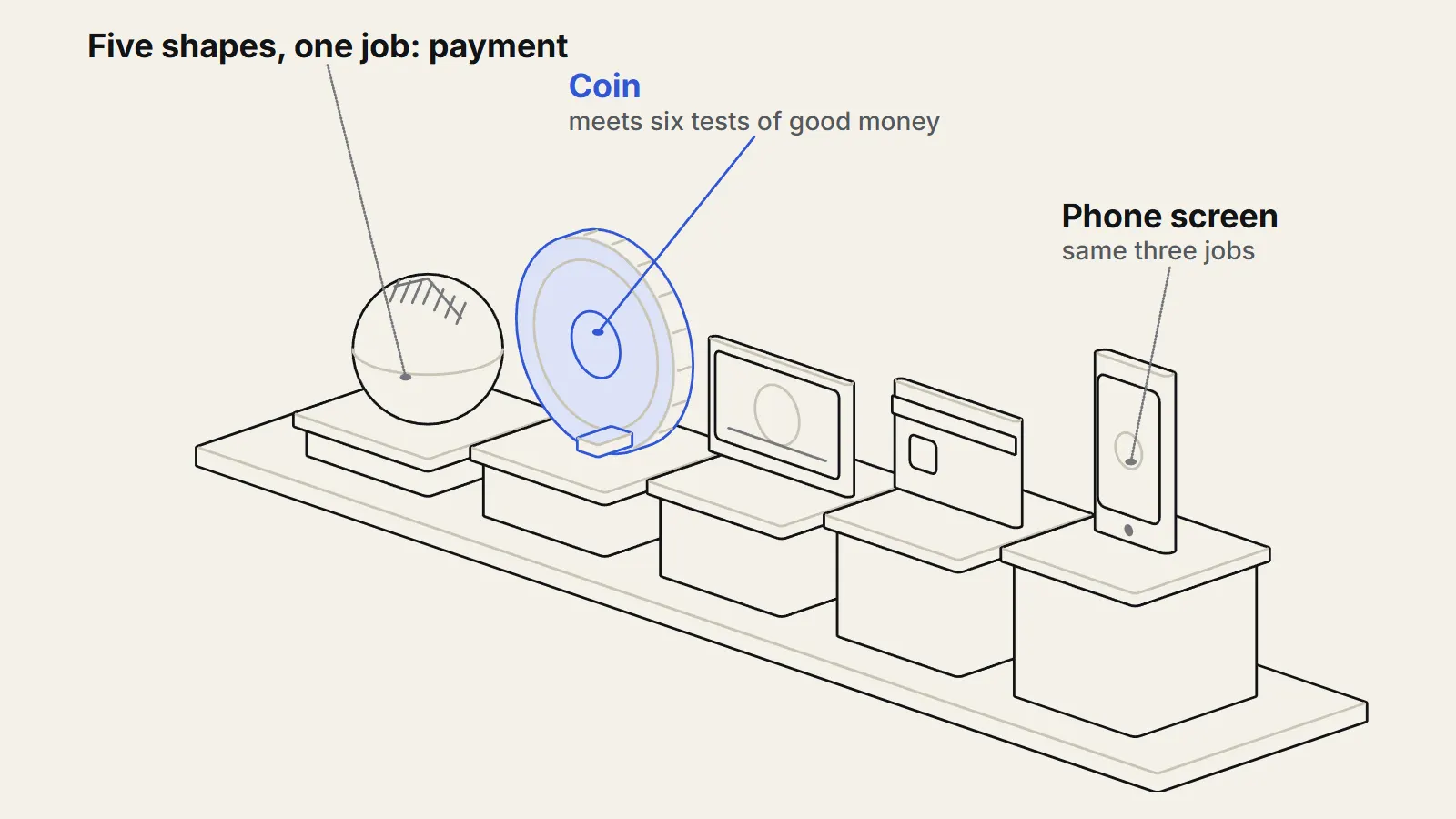
Money is anything that people widely accept as payment for goods and services or to settle debts1.1 That is a definition by use, not by material: seashells, gold coins, paper notes and bank balances have all qualified at different times. Money works because it does three jobs, making trade easier, giving prices a common unit and holding value over time, and because people trust that others will accept it. Understanding why it works explains why its form can change so completely while its role stays the same.
What is money, and what does it do?
Start with the world before money, where people had to barter. Barter needs what economists call a double coincidence of wants: you must find someone who has what you want and also wants what you have. The nineteenth-century economist William Stanley Jevons stated that problem clearly, and in the Dallas Fed's account he defined money's role as a medium of exchange that solves it.1
The first job is as a medium of exchange. Because sellers accept it, you do not need a trading partner who happens to want your goods. The second is as a unit of account. When every price is quoted in one unit, such as the dollar or the peso, you can compare an item with any other at a glance; in a barter society each item would need a price in terms of every other item. The third is as a store of value: it lets you earn now and spend later.1 The Philadelphia Fed's teaching materials add that money encourages specialisation, because it lowers the time and effort of trade.2
What makes something work as money?
The Philadelphia Fed lists six characteristics of good money: it should be divisible, portable, acceptable, scarce, durable and stable in value.2 Several of these show up in an example the Dallas Fed describes. In prisoner-of-war camps during World War II, prisoners used cigarettes as money1, pricing other goods in cigarettes and accepting them as payment.1 Milk, the guide says, was unlikely to emerge as a currency there, because even with refrigeration its shelf life is short.
Durability is also about purchasing power, not only the physical object. The Dallas Fed notes that the average US bill lasts several years in circulation and keeps most of its ability to buy goods over time, which is what a store of value needs. It adds that holding currency pays no return.1 The Philadelphia Fed also says money must be relatively scarce and hard to obtain, and it answers the question of what gives money value simply: people are willing to accept it as final payment.2
How have forms of money changed?
The Bank of England lists gold, feathers, cowrie shells, stone wheels and even teeth among past forms. In ancient Egypt, grain stored in warehouses was moved between accounts to settle debts, and in the 1500s goldsmiths issued receipts for stored gold that became precursors to banknotes.3 The Dallas Fed groups these developments into three types. Commodity money has value in itself, like gold or wheat, but its supply depends on the commodity, and its price swings affect every other price. Representative money is paper that promises a set amount of a commodity, such as a receipt for gold. Fiat money (https://therealigned.com/story/fiat-vs-commodity-money) is money by decree: governments declare it acceptable for payment and for settling debts, and its value comes from people's willingness to take it.1
Today's money is mostly electronic. The Bank of England says about 96 percent of money in the UK is held electronically as bank deposits3 and roughly 4 percent as physical cash.3 Its 2014 article describes the three main forms as currency, bank deposits and central bank (https://therealigned.com/story/what-a-central-bank-does) reserves, each an IOU from one part of the economy to another, and says money is special because everyone trusts it will be accepted by others in exchange for goods and services.4 In the United States, the Philadelphia Fed's lesson puts the answer to what backs the currency simply: people's trust that it is worth something.2
What is disputed about what counts as money?
Fiat money has a well-known weakness: it depends on how well governments manage it. The Dallas Fed notes that if too much is made available, inflation can follow, and that when money supply growth gets out of hand it can end in economic collapse and the abandonment of the money.1 Commodity money avoids that risk but has the limits noted above, so the trade-off is real rather than one-sided.
A newer dispute is whether digital assets such as Bitcoin count as money. A St. Louis Fed lesson plan tests them against the three functions and concludes that, at present, they do not parallel fiat money: they are used as a medium of exchange by a relatively small community, swing widely in value and so struggle as a store of value, and need converting into dollars, which makes them poor as a unit of account.5 The lesson says "at this point in time", so it is a judgment about current use, not a claim that no such asset could ever work. The same lesson notes that the number of businesses and people using cryptocurrency is small but growing.
What is not known?
None of the sources here forecast how money will change next. They do not say whether cash will continue to shrink beyond the 4 percent figure, whether privately issued digital assets will ever meet the tests above, or how much trust in a currency can fall before it is abandoned. The history shows that forms of money have changed repeatedly, from commodities to receipts to bank balances. What has been constant is the reliance on acceptance by others.
Key takeaways
- Money is anything widely accepted as payment, and it is defined by its jobs: medium of exchange, unit of account and store of value.
- Good money tends to be divisible, portable, acceptable, scarce, durable and stable in value.
- Forms have moved from commodities to receipts for them to fiat money; in the UK about 96 percent is now held as bank deposits.
- Fiat money rests on trust and good management, and whether new digital forms can meet the same tests is still disputed.
Sources
- 1Money (Everyday Economics) (opens the source in a new tab) · Federal Reserve Bank of Dallas, 2013 · Report · https://www.dallasfed.org/~/media/documents/educate/everyday/money.pdf
- 2Functions and Characteristics of Money (lesson) (opens the source in a new tab) · Federal Reserve Bank of Philadelphia, 2013 · Report · https://www.philadelphiafed.org/-/media/frbp/assets/institutional/education/lesson-plans/functions-and-characteristics-of-money-lesson.pdf
- 3What is money? (opens the source in a new tab) · Bank of England, 2025 · Primary source · https://www.bankofengland.co.uk/explainers/what-is-money
- 4Money in the modern economy: an introduction (opens the source in a new tab) · Bank of England Quarterly Bulletin, 2014 · Paper · https://www.bankofengland.co.uk/quarterly-bulletin/2014/q1/money-in-the-modern-economy-an-introduction
- 5Fiat Money and Cryptocurrency: What Is Money? (lesson) (opens the source in a new tab) · Federal Reserve Bank of St. Louis Economic Education, 2025 · Report · https://www.federalreserveeducation.org/resources/lessons/lesson--fiat-money-and-cryptocurrency.pdf