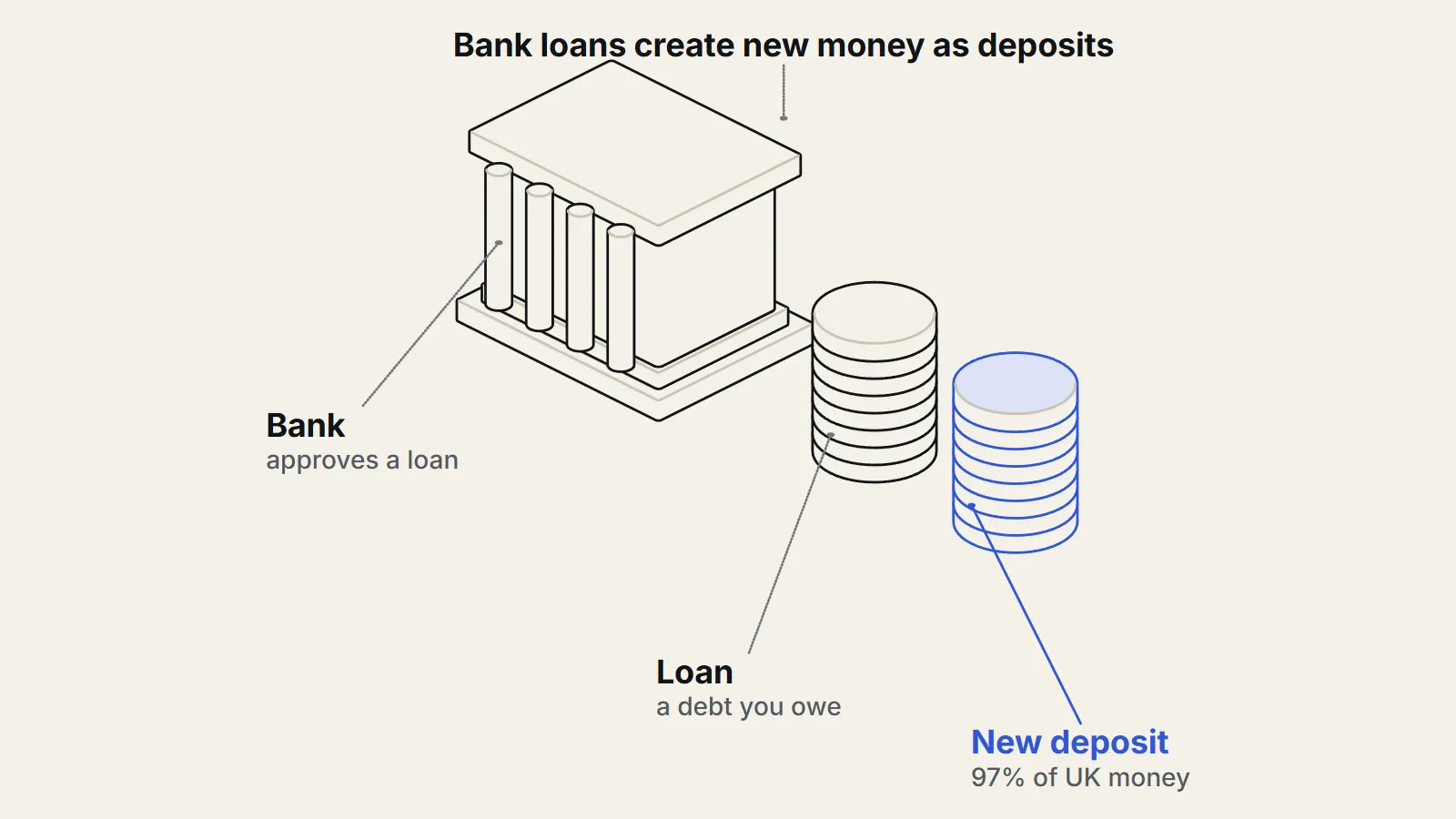
Banks create money when they lend. A bank that approves a loan does not hand over money that was sitting in a vault or take it from another saver. It types a new number into the borrower's account, and that new deposit is money. This is how banks create money in a modern economy, according to the Bank of England's 2014 explanation (https://www.bankofengland.co.uk/quarterly-bulletin/2014/q1/money-creation-in-the-modern-economy), and it reverses the sequence many textbooks describe.1 This piece explains the mechanism, what limits it, and what we do not know.
How do banks create money when they make a loan?
Suppose you take out a mortgage of 200,000 pounds. The bank does not usually give you banknotes. It credits your account with a deposit of that size and records a loan, which you owe back. Both sides of the bank's balance sheet grow by the same amount at the same moment. Your deposit is the bank's debt to you; your loan is your debt to the bank. When you pay the seller, the deposit moves to the seller's bank, but the total amount of deposit money in the economy stays higher than before.
This matters because deposits are most of what people call money. The Bank of England found that bank deposits made up 97 percent of broad money in the UK at December 20131, with the rest being currency such as notes and coins.1 Bank deposits are IOUs from commercial banks. Notes and coins are mostly IOUs from the central bank (https://therealigned.com/story/what-a-central-bank-does).
The process also runs in reverse. Repaying a bank loan destroys money1, just as making one creates it.1 The Bank of England's public explainer puts the same point in simple terms: a loan creates new money, and that money is deleted when the loan is repaid.2 Money is not wealth, and a new loan does not make the borrower richer. It adds an asset (the deposit) and a debt of the same size.
Do banks lend out the deposits that savers place with them?
Not in the way the common story says. The popular picture treats a bank as a go-between: savers deposit money, the bank lends it on. The Bank of England calls this a misconception. When a household saves more, those deposits come at the expense of deposits that would otherwise have gone to firms in payment for goods, so saving does not by itself raise the funds a bank can lend.1 Deposits are a bank's liability, a record of what it owes, so they are not something it could lend out as if they were assets.
A second common belief is the money multiplier: the central bank supplies reserves (the money banks hold at the central bank), and banks multiply them into many times as many loans. The Bank of England says this is not an accurate description of how money is created. Reserves are not a binding constraint on lending, and the central bank does not fix their quantity; it sets the price of reserves, which means interest rates.1 Banks decide how much to lend based on profitable opportunities, and the reserves they need follow, rather than lead.
The United States offers a clear example. The Federal Reserve Board (https://www.federalreserve.gov/monetarypolicy/reservereq.htm) cut reserve requirement ratios to zero percent, effective March 26, 20203, which removed reserve requirements for all depository institutions.3 If a fixed reserve ratio were the brake on lending, removing it would remove the brake.
What limits how much money banks can create?
The Bank of England names three sets of limits.1 First, banks themselves. A bank must lend profitably in a competitive market. To make extra loans it usually has to cut its loan rates, and the new deposit may leave for a rival bank, so it must pay more to attract funds. Banks must also manage credit risk (borrowers who do not repay) and liquidity risk (depositors withdrawing quickly), and regulators require capital and liquidity buffers.
Second, the people who receive the new money. If the seller of a house uses the proceeds to repay their own mortgage, the new deposit is destroyed almost at once. If instead the money is spent and passed on, it can add to demand in the economy. Third, and ultimately, monetary policy: by setting interest rates, the central bank influences how much households and firms want to borrow.1
What is disputed about this explanation?
The Bank of England presents the core point, that loans create deposits, as how money is actually created. The argument is over emphasis. A single bank cannot create money without limit, because it needs to fund its lending and settle payments with other banks, which is why central bank guidance stresses that a bank needs enough reserves to pay other banks when borrowers spend.2 The Bank of England's own paper allows that the multiplier model can be a useful way to introduce the subject but says it is not an accurate description of how money is created in reality.1
There is also a difference between one bank and the whole system. If every bank expands lending together, each loses fewer deposits to rivals because it gains deposits from the others' lending. The brakes then come mainly from regulation, risk and the interest rate. The Bank of England notes that a broad improvement in conditions, or a belief that lending has become safer, can lead many banks to lend more at once, and that if that belief is wrong the financial system can become more fragile.1
What is not known?
This piece rests on central bank descriptions of how the system works. Those explain mechanisms well but do not settle how large the effect of lending on prices and output is in any given year. The share of money held as deposits also changes over time, and the 97 percent figure is a UK number from late 2013, so it should not be read as a constant or as a figure for other countries. How strongly bank lending drives inflation, as opposed to responding to the economy, is still a matter of research and debate.
Key takeaways
- Banks create money by lending: a new loan comes with a new deposit of the same size.
- Repaying a loan destroys the money that the loan created.
- Banks do not first collect savings and then lend them; reserves and deposits follow lending decisions.
- The limits are profitability, risk and capital rules, how recipients use the money, and the central bank's interest rate.
- Whether the older multiplier story is a useful teaching tool is debated, but the Bank of England says it is not how money creation works.
Sources
- 1Money creation in the modern economy (opens the source in a new tab) · Bank of England Quarterly Bulletin, 2014 · Paper · https://www.bankofengland.co.uk/quarterly-bulletin/2014/q1/money-creation-in-the-modern-economy
- 2How is money created? (opens the source in a new tab) · Bank of England, 2019 · Reporting · https://www.bankofengland.co.uk/explainers/how-is-money-created
- 3Reserve Requirements (opens the source in a new tab) · Federal Reserve Board, 2020 · Primary source · https://www.federalreserve.gov/monetarypolicy/reservereq.htm