- Place
- Switzerland
- Years
- 2011–2015
- Policy
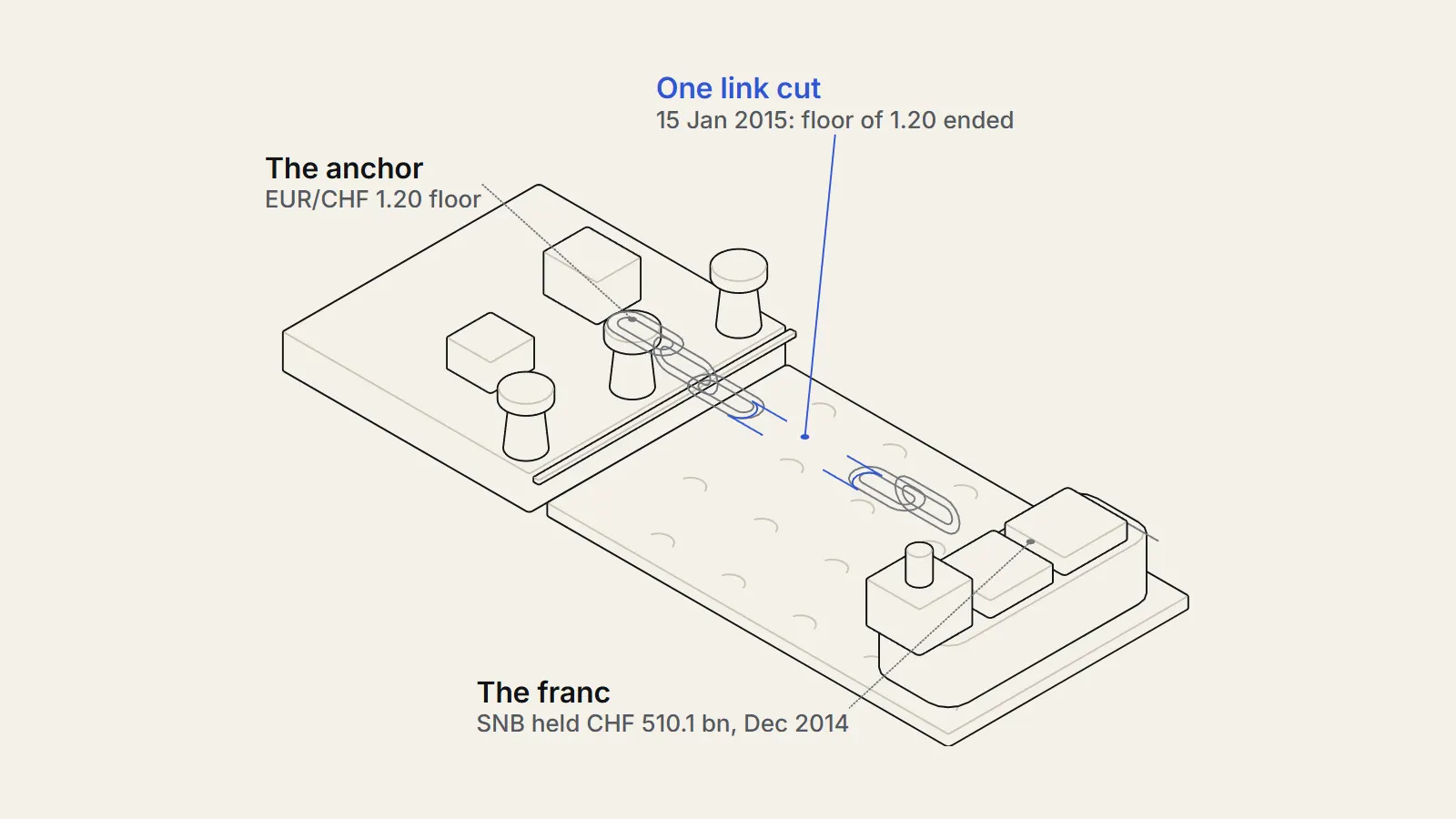
- The Swiss National Bank held the franc at no more than CHF 1.20 per euro from September 2011, then on 15 January 2015 ended the floor and cut its sight deposit rate to -0.75 percent.
- Outcome
- The euro fell from 1.201 to 1.028 francs on the ECB reference rate in a day; Swiss inflation was -1.14 percent in 2015 and the SNB reported a CHF 23 billion loss, while growth stayed positive.
The Swiss franc shock of 2015 began on 15 January 2015, when the Swiss National Bank (SNB) abruptly discontinued the minimum exchange rate of CHF 1.20 per euro5 and cut its deposit rate to -0.75 percent. The euro lost about 14 percent against the franc on the ECB reference rate in a day, Swiss shares fell sharply, prices turned negative and growth slowed, though the economy did not collapse. Whether the exit was necessary, and whether it needed to be a surprise, is still debated.
Before
Why a safe-haven currency needed a floor
In the summer of 2011 the world looked unsafe and Switzerland looked safe. SNB Chairman Thomas Jordan, in a speech of April 2015 (https://www.snb.ch/public/asset/en/www-snb-ch/publications/communication/speeches/2015/ref_20150424_tjn/publications0_en/ref_20150424_tjn.en.pdf), later described a global outlook that was deteriorating, a European debt crisis that was escalating again and a protracted US debate over the debt ceiling, with demand for Swiss francs soaring.6 The franc rose very sharply against all major currencies, and by August 2011 it was, in Jordan’s words, "by any measure, massively overvalued".6
A strong currency hurts an exporting economy and lowers import prices, so the worry was deflation (https://therealigned.com/story/inflation-vs-deflation) as well as lost sales. On 6 September 2011 the SNB announced that it would no longer tolerate a euro-franc rate below 1.207, that it would enforce the minimum "with the utmost determination" and that it was prepared to buy foreign currency in unlimited quantities.7 The release called the overvaluation an acute threat to the Swiss economy with a risk of deflation.7
A floor of 1.20 means that one euro can never buy fewer than 1.20 francs. ABC News explained the mechanism: to make the cap work the SNB pledged to buy unlimited quantities of foreign currency using francs, which raised the supply of francs and the demand for the currency it bought.8
The floor worked as a price. On the ECB reference rate, the monthly average euro-franc rate was 1.1203 in August 2011 and 1.2005 in September, and it stayed between 1.2011 and 1.2418 in every month from January 2012 to December 2014.1 A currency pinned this precisely does not come free: the central bank (https://therealigned.com/story/what-a-central-bank-does) must absorb whatever the market wants to sell.
The SNB’s own balance sheet shows the absorption. Its foreign currency investments were CHF 196.8 billion in June 2011, CHF 305.3 billion in September 2011, CHF 432.2 billion in December 2012 and CHF 510.1 billion in December 2014.3 Jordan described the floor as an exceptional and temporary measure that served the economy well: production and employment recovered faster than in many other countries, and GDP grew by about 2 percent on average over the past two years.6
Jordan traces the persistence of demand for francs to the balance of payments. Switzerland runs a current account surplus and had built foreign assets of about CHF 3.5 trillion by the end of 2012, around 85 percent of them in foreign currencies, but after the financial crisis Swiss investors invested less abroad and repatriated some holdings, which pushed up demand for francs.6 The gap between interest rates abroad and in Switzerland had narrowed to almost zero by the end of 2014, which made the franc more attractive again.6
The decision
15 January 2015: the SNB ends the floor
The pressure came from abroad. According to Jordan, through 2014 the United States was moving towards an exit from expansionary policy while the euro area was heading towards more easing, so the euro fell against the dollar and the franc, which also weakened against the dollar, drifted towards its floor against the euro.6 At that stage, he says, the euro’s weakness had not yet cast doubt on the floor, and at the mid-December policy assessment the SNB left policy unchanged.6
Shortly afterwards the Russian crisis escalated, and Jordan says the SNB had to make very substantial interventions to enforce the floor.6 On 18 December 2014 it introduced negative interest on sight deposits above an exemption threshold, and reaffirmed "its commitment to the minimum exchange rate", which it would continue to enforce with the utmost determination.2 The quiet that followed, Jordan says, was "the calm before the storm", as expectations of further euro-area easing grew in January.6
The SNB’s judgement was that the floor could no longer be held at a bearable cost. Jordan said it could only be enforced through permanent interventions of rapidly increasing size, which would have expanded the balance sheet potentially to several times Swiss GDP and made it hard to conduct monetary policy later.6 On 15 January the SNB discontinued the floor (https://www.snb.ch/public/asset/en/www-snb-ch/publications/communication/press-releases/2015/pre_20150115/publications0_en/pre_20150115.en.pdf) and cut the sight deposit rate by 0.5 points to -0.75 percent, moving the Libor target range to between -1.25 and -0.25 percent.5
Negative interest was the companion tool. Jordan explains that charging banks on their sight deposits makes it substantially more expensive to hold Swiss francs compared with other currencies, which is meant to cushion the end of the floor and counter a tightening of monetary conditions.6
- Policy divergence: monetary policy in the major currency areas was moving apart, and the euro had fallen sharply against the dollar.
- Rising cost of defence: enforcing the floor needed ever larger currency purchases.
- Balance sheet risk: holdings of foreign currency could have grown to a level several times Swiss GDP.
- Timing: waiting would have raised pressure through speculation and made the eventual losses larger.
It would have been irresponsible to maintain the minimum exchange rate even longer and thoughtlessly accept the high costs of this policy, without considering its sustainability.
— Thomas Jordan, SNB Chairman, speech of 24 April 2015
The release itself stressed that the floor had been temporary. It said the measure "protected the Swiss economy from serious harm" and that the economy had used the period to adjust, and it promised to stay active in the currency market if necessary.5 In his remarks at the short-notice press conference, Jordan added that the sight deposit rate would fall to -0.75 percent from 22 January.9
- 6 Sep 2011SNB sets a floor of CHF 1.20 per euro and promises unlimited purchasesSource 7 (opens the source in a new tab)
- 18 Dec 2014Negative interest introduced; floor reaffirmed with utmost determinationSource 2 (opens the source in a new tab)
- 15 Jan 2015Floor discontinued; sight deposit rate cut to -0.75 percentSource 5 (opens the source in a new tab)
- 22 Jan 2015The -0.75 percent rate takes effectSource 9 (opens the source in a new tab)
- Mar 2015IMF mission expects growth of about three-quarters of a percent and inflation near -1.5 percent by late 2015Source 10 (opens the source in a new tab)
- 24 Apr 2015Chairman Jordan explains the exit to shareholdersSource 6 (opens the source in a new tab)
- Jul 2015SNB puts its first-half loss at CHF 50.1 billionSource 11 (opens the source in a new tab)
- 8 Jan 2016SNB reports a provisional loss of CHF 23 billion for 2015Source 11 (opens the source in a new tab)
The strongest case against the way the floor ended
Today’s SNB action is a tsunami for the export industry and for tourism, and finally for the entire country.
— Nick Hayek, chief executive of Swatch Group, to Reuters, 15 January 2015, quoted by ABC News
The market reaction to the Swiss franc shock of 2015 supports the claim of surprise. ABC reported that the Swiss market index ended 8.6 percent lower and that Credit Suisse and UBS fell more than 10 percent.8 A Swiss-based commentator, Matthew Allen, called it a complete surprise to markets, manufacturers and the tourist industry.8
Academic work agrees that the shock was unexpected. Von Schweinitz, Tonzer and Buchholz describe the removal as a surprise to markets and as driven by the SNB’s concern for the independence of its monetary policy, not by stock prices.12 Their synthetic-matching design, which compares Switzerland with a weighted group of countries not hit by the shock, finds an immediate and permanent fall in Swiss asset prices.12
| Date | What the SNB said about the floor |
|---|---|
| 6 Sep 2011 | Will no longer tolerate EUR/CHF below 1.20; will enforce it with the utmost determination; ready to buy foreign currency in unlimited quantities |
| 18 Dec 2014 | Reaffirms its commitment to the minimum exchange rate of CHF 1.20; will continue to enforce it with the utmost determination |
| 15 Jan 2015 | The floor was exceptional and temporary; enforcing it is no longer justified; the SNB will remain active in the currency market if necessary |
The cost to the central bank was also real. The SNB reported a provisional loss of CHF 23 billion for 201511, made up of about CHF 20 billion on foreign currency positions and CHF 4 billion on gold, after a first-half loss of CHF 50.1 billion put forward in July.11 The figures given do not add up exactly and the article does not explain the difference, so we treat them as approximate.
What happened
What the Swiss franc shock 2015 did to the franc, prices and growth
The franc jumped on the day of the Swiss franc shock 2015. The ECB reference rate (https://data-api.ecb.europa.eu/service/data/EXR/D.CHF.EUR.SP00.A?startPeriod=2015-01-08&endPeriod=2015-01-30&format=csvdata) was 1.201 francs per euro on 14 January and 1.028 on 15 January1, a fall of 14.4 percent in the euro on our calculation, and reached 0.9816 on 23 January before recovering to 1.0468 on 30 January.1 ABC reported that the euro briefly fell as far as 0.78 francs in trading before settling close to parity.8
The franc did not return to 1.20. The monthly average was 1.0940 in January 2015, 1.0379 in April, 1.0827 in December 2015 and 1.0750 in December 2016.1 Jordan said in April that the franc was once again significantly overvalued overall and that a correction was to be expected over time.6
Share prices fell hardest in the exposed sectors. The Swiss market index ended the day 8.6 percent lower8, and Credit Suisse and UBS dropped more than 10 percent.8 The academic estimate is a permanent loss of asset value, with an aggregate exchange-rate elasticity of about -0.75 and sector elasticities from -0.55 to -1.35, the industrial, financial and consumer goods sectors affected most.12
Prices fell and growth eased. Swiss consumer price inflation was -0.01 percent in 2014 and -1.14 percent in 2015 on World Bank data, and growth was 2.54 percent in 2014, 1.45 percent in 2015 and 1.91 percent in 2016.4 The IMF mission had expected growth of around three-quarters of a percent in 2015 and inflation of about -1.5 percent by late 2015, and Jordan expected growth of just under 1 percent.106
| Date | CHF per EUR |
|---|---|
| 14 January 2015 | 1.2010 |
| 15 January 2015 | 1.0280 |
| 16 January 2015 | 1.0128 |
| 21 January 2015 | 0.9997 |
| 23 January 2015 | 0.9816 |
| 26 January 2015 | 1.0014 |
| 30 January 2015 | 1.0468 |
Unemployment edged up. The modelled World Bank series was 4.83 percent in 2014, 4.80 percent in 2015 and 4.92 percent in 2016, a small change.4 We stress that forecasts, estimates and revised data come from different vintages, so a gap between the IMF forecast and the later outturn is not necessarily a forecasting error.
The central bank paid too
The SNB’s balance sheet kept growing after the exit. Foreign currency investments were CHF 510.1 billion in December 2014, CHF 593.2 billion in December 2015 and CHF 696.1 billion in December 2016, and sight deposits of domestic banks went from CHF 328.0 billion to CHF 384.8 billion in January 2015 and CHF 402.3 billion in December 2015.3 The series mixes new purchases with changes in market value, so it cannot tell us how much the SNB bought.
The loss was largely a valuation loss that moved with currencies. In July 2015 the bank had put the first-half loss at CHF 50.1 billion, and, according to the NZZ newspaper, a stronger dollar later helped cut it to CHF 23 billion for the year.11 The SNB still planned a dividend of CHF 15 per share and a CHF 1 billion distribution to the federal government and cantons.11
What economists still disagree on
Was the Swiss franc shock 2015 avoidable? Where economists differ
The sharpest disagreement about the Swiss franc shock of 2015 is whether the exit had to be a surprise. Jordan’s answer is that waiting would have made things worse: holding off would have increased pressure through mounting speculation, and the turmoil would have been no less severe while the damage to the economy and the SNB’s balance sheet would have been greater.6 On that logic a warning would have been a gift to speculators.
The critics’ answer is that a promise is worth what it costs to break. The SNB had told markets on 18 December that it would enforce the floor with the utmost determination, and four weeks later it ended it.25 The SNB says the circumstances changed, as the euro fell and the euro area headed towards more easing, and the paper by von Schweinitz and co-authors treats the policy change as unexpected, which is what lets them measure its effect.612
A second disagreement is over the counterfactual. We know the SNB expected a balance sheet that could grow to several times Swiss GDP, but we do not know whether that would have happened, whether it would have been manageable, or what interest rates and inflation would have been had the floor stayed.6 Jordan’s forecast is a forecast, not a fact.
A further point concerns independence. Von Schweinitz and co-authors write that the floor made monetary policy less independent, because it forced the SNB to accumulate large foreign currency reserves and to put more francs into the market.12 On that reading the exit bought back control of policy at the price of the shock.
A third concerns the floor’s record. The SNB says it served the economy well, with GDP growth of about 2 percent a year on average over the previous two years, and the World Bank series shows growth of 1.84 percent in 2013 and 2.54 percent in 2014.64 Inflation, however, was slightly negative in 2012 and 2013 and about zero in 2014 on the same series, which shows that a floor did not deliver positive inflation.4 That is not proof of failure, since a floor may have prevented something worse, which we cannot observe.
The cost of the shock is also hard to isolate. The IMF mission expected the growth slowdown and recommended further easing and keeping the policy rate negative, but its figures are forecasts made in March 2015 and the World Bank series we report is a later vintage with revisions.104 Share-price effects can be measured with a synthetic control, as von Schweinitz and co-authors do, but employment and investment effects are harder to separate from the global slowdown of 2015.12
Finally, the central bank’s losses are a matter of accounting. The CHF 23 billion loss came largely from valuation changes on foreign currency positions and depended on the dollar’s path, so another date for the year-end would have given another number.11 The reporting we opened does not break the loss down into what was realised and what was not.
Would a pre-announced, gradual exit, or keeping the floor with unlimited purchases, have left Switzerland better off than the surprise exit of January 2015, and how could anyone tell?
Lessons
Key takeaways
- A currency floor is a promise of unlimited purchases, and the SNB’s foreign holdings rose from CHF 197 billion in June 2011 to CHF 510 billion in December 2014 to keep it.
- The exit came on 15 January 2015 and the euro lost 14.4 percent against the franc on the reference rate in a day.
- On current data growth stayed positive and unemployment barely moved, but inflation fell to -1.14 percent in 2015 and the SNB reported a CHF 23 billion loss.
- Economists disagree on whether the surprise was necessary, and the data cannot separate it from the wider global slowdown.
What carries over is the trade-off between credibility and cost: a floor holds only while its owner can afford it, and a central bank that must leave faces a choice between warning markets and surprising them. What does not carry over is the size of the Swiss balance sheet relative to its economy, or the safe-haven demand that Jordan traces to the current account surplus and repatriated investments. A larger economy with a smaller external surplus would face different limits, and the sources we opened do not tell us which.
Sources
- 1ECB euro foreign exchange reference rates: Swiss franc per euro (daily and monthly averages) (opens the source in a new tab) · ECB Data Portal (SDMX API, series EXR.D.CHF.EUR.SP00.A and EXR.M.CHF.EUR.SP00.A), 2026 · Primary source · https://data-api.ecb.europa.eu/service/data/EXR/D.CHF.EUR.SP00.A?startPeriod=2015-01-08&endPeriod=2015-01-30&format=csvdata
- 2Swiss National Bank introduces negative interest rates (press release, 18 December 2014) (opens the source in a new tab) · Swiss National Bank, 2014 · Primary source · https://www.snb.ch/public/asset/en/www-snb-ch/publications/communication/press-releases/2014/pre_20141218/publications0_en/pre_20141218.en.pdf
- 3SNB balance sheet items, monthly (data portal cube snbbipo): foreign currency investments, total assets, sight deposits of domestic banks (opens the source in a new tab) · SNB data portal (published 2026-09-30), 2026 · Primary source · https://data.snb.ch/api/cube/snbbipo/data/csv/en?fromDate=2011-06&toDate=2016-12&dimSel=D0%28D%2CT0%2CGB%29
- 4World Development Indicators, Switzerland: consumer price inflation, GDP growth, unemployment (opens the source in a new tab) · World Bank Indicators API (data updated 2026-10-08), 2026 · Dataset · https://api.worldbank.org/v2/country/CHE/indicator/FP.CPI.TOTL.ZG?format=json&date=2009%3A2019
- 5Swiss National Bank discontinues minimum exchange rate and lowers interest rate to -0.75% (press release, 15 January 2015) (opens the source in a new tab) · Swiss National Bank, 2015 · Primary source · https://www.snb.ch/public/asset/en/www-snb-ch/publications/communication/press-releases/2015/pre_20150115/publications0_en/pre_20150115.en.pdf
- 6SNB monetary policy after the discontinuation of the minimum exchange rate (speech, 24 April 2015) (opens the source in a new tab) · Swiss National Bank, 2015 · Primary source · https://www.snb.ch/public/asset/en/www-snb-ch/publications/communication/speeches/2015/ref_20150424_tjn/publications0_en/ref_20150424_tjn.en.pdf
- 7Swiss National Bank sets minimum exchange rate at CHF 1.20 per euro (press release, 6 September 2011) (opens the source in a new tab) · Swiss National Bank, 2011 · Primary source · https://www.snb.ch/public/asset/en/www-snb-ch/publications/communication/press-releases/2011/pre_20110906/publications0_en/pre_20110906.en.pdf
- 8Swiss central bank shocks traders by uncapping franc (opens the source in a new tab) · Australian Broadcasting Corporation, 16 January 2015, 2015 · Reporting · https://www.abc.net.au/news/2015-01-16/swiss-central-bank-shocks-traders-by-uncapping-franc/6020684
- 9Thomas Jordan: The rationale for discontinuing the minimum exchange rate and lowering interest rates (opening remarks, 15 January 2015) (opens the source in a new tab) · Swiss National Bank, via BIS central bankers’ speeches, 2015 · Primary source · https://www.bis.org/review/r150116a.htm
- 10Switzerland: Concluding Statement of the IMF 2015 Article IV Mission (23 March 2015) (opens the source in a new tab) · International Monetary Fund, 2015 · Report · https://www.imf.org/en/news/articles/2015/09/28/04/52/mcs032315
- 11SNB reports CHF23 billion loss (opens the source in a new tab) · swissinfo.ch, 8 January 2016, 2016 · Reporting · https://www.swissinfo.ch/eng/business/balance-sheet_snb-reports-chf23-billion-loss/41881084
- 12Monetary policy through exchange rate pegs: The removal of the Swiss franc-Euro floor and stock price reactions (accepted manuscript, 31 July 2020) (opens the source in a new tab) · Academic working paper, accepted manuscript, 2020 · Paper · https://gvschweinitz.org/pdf/publication/Schweinitz-Tonzer-Buchholz_20_Monetary%20policy%20through%20exchange%20rate%20pegs_final%20accepted.pdf