- Place
- United Kingdom
- Years
- 1990–1992
- Policy
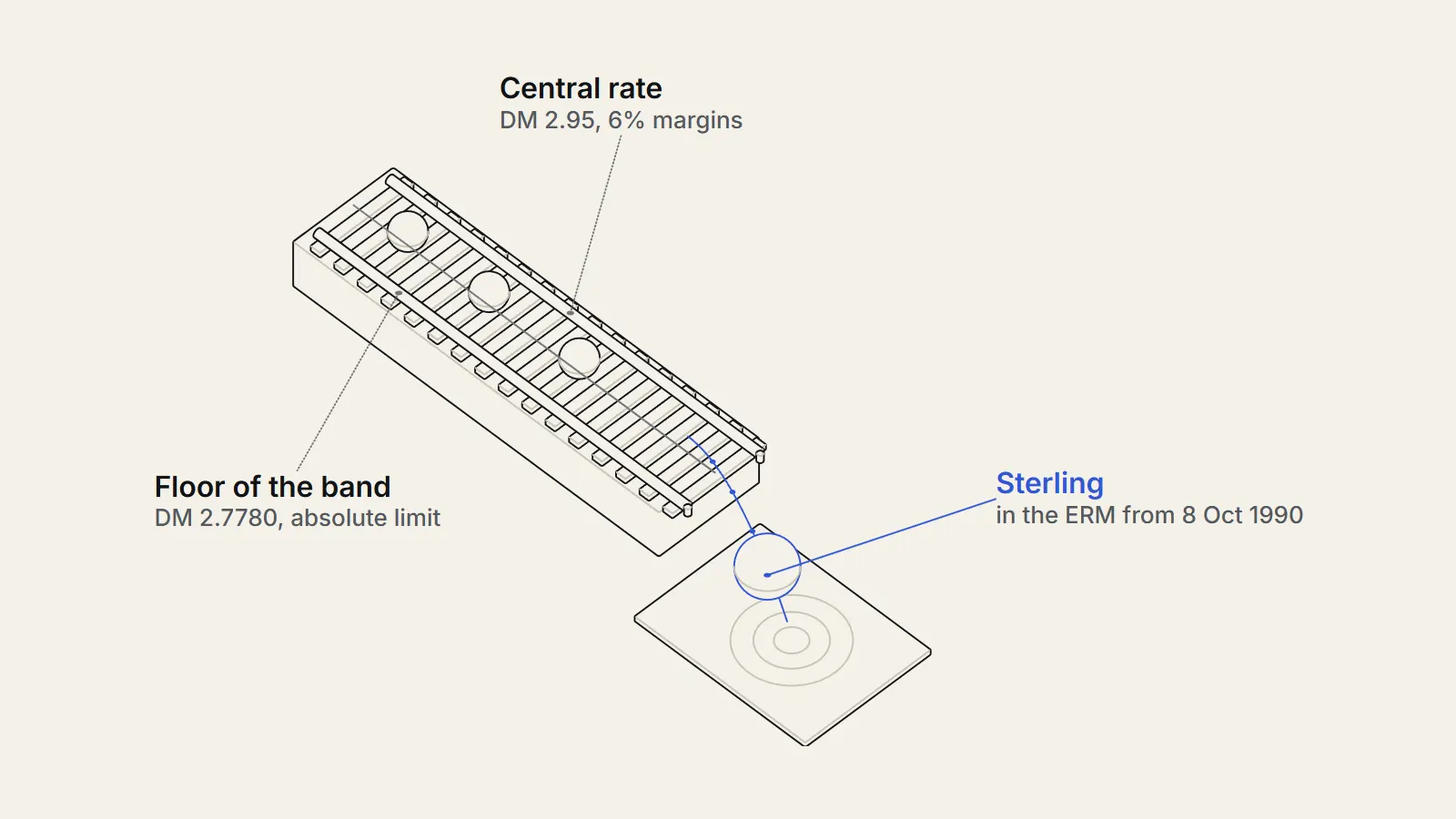
- Sterling joined the ERM at DM 2.95 in October 1990; on 16 September 1992 the Bank of England raised rates from 10 to 12 percent, announced 15 percent and bought sterling heavily before membership was suspended.
- Outcome
- Sterling fell from DM 2.78 to DM 2.51 within two weeks; UK inflation fell from 8.06 percent in 1990 to 2.56 percent in 1993 and growth returned to 3.49 percent.
Black Wednesday 1992, which fell on 16 September, was the day Britain was forced out of the European exchange rate mechanism (ERM). The Bank of England raised interest rates twice and, by one estimate, spent $22.6 billion of reserves3, yet sterling stayed on its floor of DM 2.7780 and the government suspended membership that evening. Within two weeks the pound was at DM 2.51, and inflation and growth later improved, which is why the episode is still argued over.
Before
Why Britain joined the ERM, and at what rate
Sterling entered the exchange rate mechanism on Monday 8 October 1990 at a central rate of DM 2.954, with room to move 6 percent either side, as Chancellor John Major told the House of Commons (https://api.parliament.uk/historic-hansard/commons/1990/oct/15/exchange-rate-mechanism) a week later.4 The ERM was the European system in which currencies were held within bands against one another, so that a country with higher inflation could borrow the credibility of a low-inflation neighbour.
The purpose was anti-inflationary. Major called membership "an additional discipline" and "in no sense a soft option", and warned firms that if they failed to contain costs they would not be bailed out by a devaluation.4 Naef reaches the same reading from the record: the UK joined mainly to subdue inflation, not as a pro-European project.5
Labour supported entry but pressed the Chancellor on conditions Margaret Thatcher had set in 1989. John Smith recalled that she had said the country must "first get our inflation down" before joining, and put the Madrid conditions to the Chancellor.4 In his statement Major had said that policy was reducing inflationary pressures, with monetary growth falling sharply and the prospect of a substantial reduction in inflation over the coming year.4
Inflation was the problem. In the parliamentary debate after the crisis Major said inflation had been rising towards 11 percent when Britain joined and was down to nearly 3.5 percent, and that interest rates fell from 15 to 10 percent during membership.6 The Bank of England agrees on the rates: base rates were cut from 15 to 10 percent in the first eighteen months, and the interest-rate gap with Germany narrowed to less than 20 basis points.1
Then the German problem arrived. The Bank’s account of the summer of 1992 says German monetary growth stayed rapid after reunification and the Bundesbank raised its discount rate by 75 basis points to 8.75 percent on 16 July.1 Because the deutschmark anchored the system, tight German policy spread to members whose economies needed the opposite.7
Britain was in recession. World Bank figures show GDP growth of 0.78 percent in 1990 and -1.29 percent in 1991, and inflation of 8.06 percent in 1990.2 The Bank noted in the autumn that domestic recovery "continued to prove elusive" and that real interest rates were rising as the inflation outlook improved, because the ERM constrained nominal rates from falling below German ones.1
- German rates: the Bundesbank discount rate went up to 8.75 percent in July, and money growth stayed above target.
- The dollar: the US Federal Reserve cut its discount rate on 2 July and the dollar fell to a seventeen-month low, pushing the deutschmark, and so the whole ERM grid, upwards.
- Maastricht doubts: opinion polls ahead of the French referendum of 20 September raised the odds of a general realignment.
- Weak British demand: recovery had not come, so higher rates were hard to justify at home.
The decision
Black Wednesday 1992: the day the defence failed
Pressure on sterling built through August and early September 1992. The Bank began overt purchases of sterling for deutschmarks on 26 August, when sterling was barely a pfennig above its absolute ERM limit of DM 2.7780, and on 3 September the government announced it would borrow the equivalent of ECU 10 billion in foreign currency to sell for sterling.1 Finland abandoned its markka peg on 8 September and the lira was effectively devalued by 7 percent over the weekend of 12 to 13 September.1
The Bundesbank’s answer was small. On 14 September it cut its discount rate by 50 basis points and its Lombard rate by 25, less than the market had hoped, and pressure on sterling rose after reports on 16 September that its president thought the weekend realignment should have been wider, reports that were later denied.1 Eichengreen and Naef say the pressure on sterling exploded with the publication of that interview.3
Then the defence ran in two steps. On the morning of 16 September the Bank raised the minimum lending rate from 10 to 12 percent8, and a few hours later it announced a rise to 15 percent that it never put into effect.8 At the same time it bought sterling on a huge scale, and Eichengreen and Naef (https://www.nber.org/system/files/working_papers/w29488/w29488.pdf) estimate it spent $22.6 billion of reserves that day.3
Major described the two tools in the same order. He said the only response to the attack was to defend the pound with foreign exchange reserves and then to raise interest rates, and that this was what the government did before the severity of the attack forced it out of the mechanism.6
The Bank’s own explanation for the limits of a rate defence is worth reading closely. It says a defensive rise in interest rates was unlikely to be seen by the foreign exchange market as credible because it was so far from the needs of the domestic economy.1 Naef adds that the government was reluctant to raise rates earlier because of mortgage costs and the recession.5
Sterling still closed on its floor. On 16 September it was DM 2.7784, a hair above the limit of DM 2.7780, and that evening the government suspended membership of the mechanism.1 Major told Parliament eight days later that "there was no choice" and that no mechanism could have survived the attack.6
No mechanism could have survived the market’s attack on the scale that occurred last Wednesday.
— John Major, Prime Minister, House of Commons, 24 September 1992
A cut followed within days. Major told MPs that outside the mechanism it had been possible to cut base rates by a full percentage point that week, and the Bank says it was able to signal such a cut later in September.61 Eichengreen and Wyplosz note that Britain, after more than two years of high interest rate policy, cut its discount rate in half as soon as it was out of the system, with no change of government and no change of Chancellor.9
- 8 Oct 1990Sterling enters the ERM at DM 2.95 with 6 percent marginsSource 4 (opens the source in a new tab)
- 16 Jul 1992Bundesbank raises its discount rate by 75 basis points to 8.75 percentSource 1 (opens the source in a new tab)
- 26 Aug 1992Bank of England begins overt buying of sterling for deutschmarksSource 1 (opens the source in a new tab)
- 3 Sep 1992Government announces ECU 10 billion of foreign currency borrowingSource 1 (opens the source in a new tab)
- 8 Sep 1992Finland abandons its peg to the ECUSource 1 (opens the source in a new tab)
- 12 to 13 Sep 1992Lira effectively devalued by 7 percentSource 1 (opens the source in a new tab)
- 16 Sep 1992Rates raised from 10 to 12 percent, a rise to 15 percent announced; membership suspended that eveningSource 8 (opens the source in a new tab)
- 20 Sep 1992French voters narrowly approve the Maastricht TreatySource 1 (opens the source in a new tab)
- 24 Sep 1992Parliament recalled; Major says base rates were cut by a point that weekSource 6 (opens the source in a new tab)
- Oct 1992Government announces an inflation target of 1 to 4 percentSource 10 (opens the source in a new tab)
The strongest case against defending the pound
Our exchange rate could be sustained only by interest rates that were so high that they were squeezing the life out of the economy.
— Peter Shore MP, House of Commons, 24 September 1992
Shore (https://api.parliament.uk/historic-hansard/commons/1992/sep/24/economic-policy) went on to ask the government whether it believed the country would have been better off had it held DM 2.95 with 15 percent interest rates and "the squandering of reserves", and whether anyone proposed to rejoin at that rate.6 He argued that unemployment had grown by well over a million in the two years of fixed rates.6
Labour leader John Smith took the political line, calling the withdrawal "humiliating" and noting that the pound had been devalued by more than 13 percent.6 The Bank of England’s data for the following weeks bear out the scale of that fall: DM 2.6100 on 18 September and DM 2.5095 on 30 September, against DM 2.8131 on 14 September.1
The costs of the Black Wednesday 1992 defence were also large in themselves. On a gross basis Eichengreen and Naef put the reserves spent on 16 September at $22.6 billion.3 Naef gives the net loss as about $4.91 billion5, and the Treasury’s own 1997 estimate, as reported by Central Banking, was an opportunity cost of 3.3 billion pounds.511
What happened
What Black Wednesday 1992 changed: sterling, rates and the economy
Sterling fell. The Bank’s table shows the pound at DM 2.7784 on 16 September, DM 2.6100 on 18 September and DM 2.5095 on 30 September, and its sterling index from 90.5 to 85.5 and then 83.7.1 The Bank’s first Inflation Report puts the fall against the dollar between 15 September and the end of December at almost 20 percent, and a further 4.5 percent by early February, with a 14 percent fall against the deutschmark.10
Market interest rates spiked and then fell. At the close of business on 16 September the one-month sterling interbank rate was 27 percent and the three-month rate 16 percent; two days later they were 10.19 and 9.63 percent, and by 30 September the three-month rate was 8.97 percent.1
The shock spread. The peseta was devalued by 5 percent on the same night, the Bank reports, and the Swedish central bank raised its marginal lending rate to 500 percent on 16 September, according to Buiter and co-authors and the Bank.18 Britain’s own return to the mechanism was postponed indefinitely three days later, and Major told MPs he did not expect Britain to go back soon, or into the same mechanism.86
| Date | DM per pound | US dollars per pound | Sterling index (ERI) | 3-month rate (%) |
|---|---|---|---|---|
| 1 July | 2.8970 | 1.9132 | 93.2 | 10.03 |
| 14 September | 2.8131 | 1.8937 | 91.6 | 10.22 |
| 16 September | 2.7784 | 1.8467 | 90.5 | 16.00 |
| 18 September | 2.6100 | 1.7435 | 85.5 | 9.63 |
| 30 September | 2.5095 | 1.7770 | 83.7 | 8.97 |
Then came the economy after Black Wednesday 1992. On World Bank data UK inflation fell from 7.46 percent in 1991 to 4.59 percent in 1992, 2.56 percent in 1993 and 2.22 percent in 1994, while GDP growth went from -1.29 percent in 1991 to 1.29, 3.49 and 4.95 percent in the next three years.2 The Bank’s Inflation Report said underlying inflation of 3.7 percent in December was just below the top of the new target range.10
A new anchor: the inflation target
The government replaced the exchange rate with a target for inflation. After the suspension, the Bank of England says, the commitment to price stability was embodied in a target range of 1 to 4 percent a year10 for retail price inflation excluding mortgage interest, announced in October 1992.10 The Chancellor then invited the Bank to produce a regular report on progress, and the Report of early 1993 was the first.10
The Bank was cautious. Its central projection for underlying inflation over the next two years was in the 3 to 4 percent range, with the main risk being a further fall in sterling and faster pass-through of the depreciation already seen.10 Unemployment kept rising for a while: on the modelled World Bank series it was 9.77 percent in 1992 and peaked at 10.35 percent in 1993 before falling to 6.2 percent in 1998.2
What economists still disagree on
Was Black Wednesday 1992 avoidable? Where economists differ
Economists still disagree about why sterling could not hold on Black Wednesday 1992. Eichengreen and Naef note that three decades on there is no consensus, and list the main accounts: German reunification, the Bundesbank’s refusal to cut rates, weak competitiveness in other countries, and the falling dollar.3
The German explanation says reunification raised German demand and required a higher price of German goods relative to others, and with the Bundesbank resisting inflation the only adjustment was through exchange rates, according to the account cited by Eichengreen and Naef.3 Buiter, Corsetti and Pesenti report a simulation by Hughes Hallett and Ma in which defending the British and Italian parities pushes real interest rates in Germany and France to levels not seen since the late 1970s and produces a persistent recession, though they say such simulations should be read with reservations.8
The competitiveness explanation says sterling entered too high. Eichengreen and Naef report that some accounts blame an overvalued pound at entry, while Shore made that case in the Commons.36 Ray Whitney, a Conservative MP, answered that The Economist had judged the pound "correctly" valued at DM 2.95 on a purchasing-power test and somewhat undervalued at its floor of DM 2.78, and he blamed German unification and the cheap dollar.6 We cannot settle that from the sources we opened, because purchasing-power tests and competitiveness measures can differ.
A third account is self-fulfilling. Eichengreen and Wyplosz argue that until summer 1992 expectations of a smooth transition to monetary union had stabilised the system, and that doubts about Maastricht let an attack succeed that would otherwise not have.9 They offer Britain as an illustration: in their reasoning a country driven out of the system loses its incentive to keep up the austerity needed to qualify for monetary union, which is why it cut its discount rate in half.9
Naef emphasises policy choices on the day. He argues that the government’s reluctance to raise rates early turned a small tension into a crisis, and that a counterfactual model suggests Britain would still have faced pressure without Schlesinger’s remarks but much less.5 He also notes that France, which stayed in the mechanism, reversed its losses within about a month and made a profit of over 1 billion francs.5
Even the bill is disputed. The reserves spent were $22.6 billion, the net loss is put at about $4.91 billion, and the Treasury’s opportunity cost was 3.3 billion pounds, according to different sources that use different counterfactuals.3511 The Central Banking article we opened breaks off before explaining the method fully, so we treat the pound figure as indicative.
The data after the exit cannot, on their own, settle whether leaving was good policy. Inflation fell and growth returned, but these series also reflect world demand, lower German and US interest rates and domestic fiscal policy, none of which we can separate with the sources we opened. The World Bank unemployment series is a modelled estimate.2
Would Britain have been better off never joining the ERM, joining at a lower rate, or leaving earlier, and how much of the later recovery was due to the exit itself?
Lessons
Key takeaways
- Black Wednesday was a day when a promise to hold a currency within a band failed: about $22.6 billion of reserves were spent and rates were announced at 15 percent, yet sterling stayed on its floor.
- Sterling fell from DM 2.78 to DM 2.51 in two weeks, and three-month market rates were back below 10 percent within two days.
- The exit was followed by an inflation target of 1 to 4 percent, with inflation of 2.56 percent in 1993 and growth of 3.49 percent.
- Economists still disagree on whether German reunification, an overvalued entry rate or a self-fulfilling attack was the main cause.
What carries over from Black Wednesday 1992 is the logic of the trade-off: a fixed rate is only as strong as a government’s willingness to accept the interest rates and recession it requires. What does not carry over is the exact setting, a band set in 1990, a reunified Germany and unfinished plans for monetary union. A small open economy today with free capital flows would face similar pressure, but the sources we opened do not tell us how a different regime would have fared.
Sources
- 1Operation of monetary policy (Bank of England Quarterly Bulletin, November 1992) (opens the source in a new tab) · Bank of England, 1992 · Primary source · https://www.bankofengland.co.uk/-/media/boe/files/quarterly-bulletin/1992/operation-of-monetary-policy-qb-1992-q4.pdf
- 2World Development Indicators, United Kingdom: consumer price inflation, GDP growth, unemployment (opens the source in a new tab) · World Bank Indicators API (data updated 2026-10-08), 2026 · Dataset · https://api.worldbank.org/v2/country/GBR/indicator/FP.CPI.TOTL.ZG?format=json&date=1988%3A1998
- 3Imported or Home Grown? The 1992-3 EMS Crisis (NBER Working Paper 29488) (opens the source in a new tab) · National Bureau of Economic Research, 2021 · Paper · https://www.nber.org/system/files/working_papers/w29488/w29488.pdf
- 4Exchange Rate Mechanism, House of Commons statement of 15 October 1990 (HC Deb vol 177 cc928-42) (opens the source in a new tab) · UK Parliament, Historic Hansard, 1990 · Primary source · https://api.parliament.uk/historic-hansard/commons/1990/oct/15/exchange-rate-mechanism
- 5Britain’s Last Currency Crisis (chapter 14 of An Exchange Rate History of the United Kingdom, 1945-1992) (opens the source in a new tab) · Cambridge University Press, 2022 · Study · https://www.cambridge.org/core/books/an-exchange-rate-history-of-the-united-kingdom/britains-last-currency-crisis/6FD5886C9916AB79D66EFEE6A22381B7
- 6Economic Policy, House of Commons debate of 24 September 1992 (HC Deb vol 212 cc2-116) (opens the source in a new tab) · UK Parliament, Historic Hansard, 1992 · Primary source · https://api.parliament.uk/historic-hansard/commons/1992/sep/24/economic-policy
- 7General assessment (Bank of England Quarterly Bulletin, November 1992) (opens the source in a new tab) · Bank of England, 1992 · Primary source · https://www.bankofengland.co.uk/quarterly-bulletin/1992/q4/general-assessment
- 8Interpreting the ERM Crisis: Country-Specific and Systemic Issues (Princeton Studies in International Finance 84) (opens the source in a new tab) · Princeton University, International Finance Section, 1998 · Paper · https://ies.princeton.edu/pdf/S84.pdf
- 9The Unstable EMS (opens the source in a new tab) · Brookings Papers on Economic Activity 1993(1), 1993 · Paper · https://www.brookings.edu/wp-content/uploads/1993/01/1993a_bpea_eichengreen_wyplosz_branson_dornbusch.pdf
- 10Inflation Report (Bank of England Quarterly Bulletin, February 1993) (opens the source in a new tab) · Bank of England, 1993 · Primary source · https://www.bankofengland.co.uk/-/media/boe/files/quarterly-bulletin/1993/inflation-report-qb-1993-q1.pdf
- 11Treasury papers reveal Black Wednesday losses (opens the source in a new tab) · Central Banking (Incisive Media), 10 February 2005, 2005 · Reporting · https://www.centralbanking.com/central-banking/research/1423141/treasury-papers-reveal-black-wednesday-losses