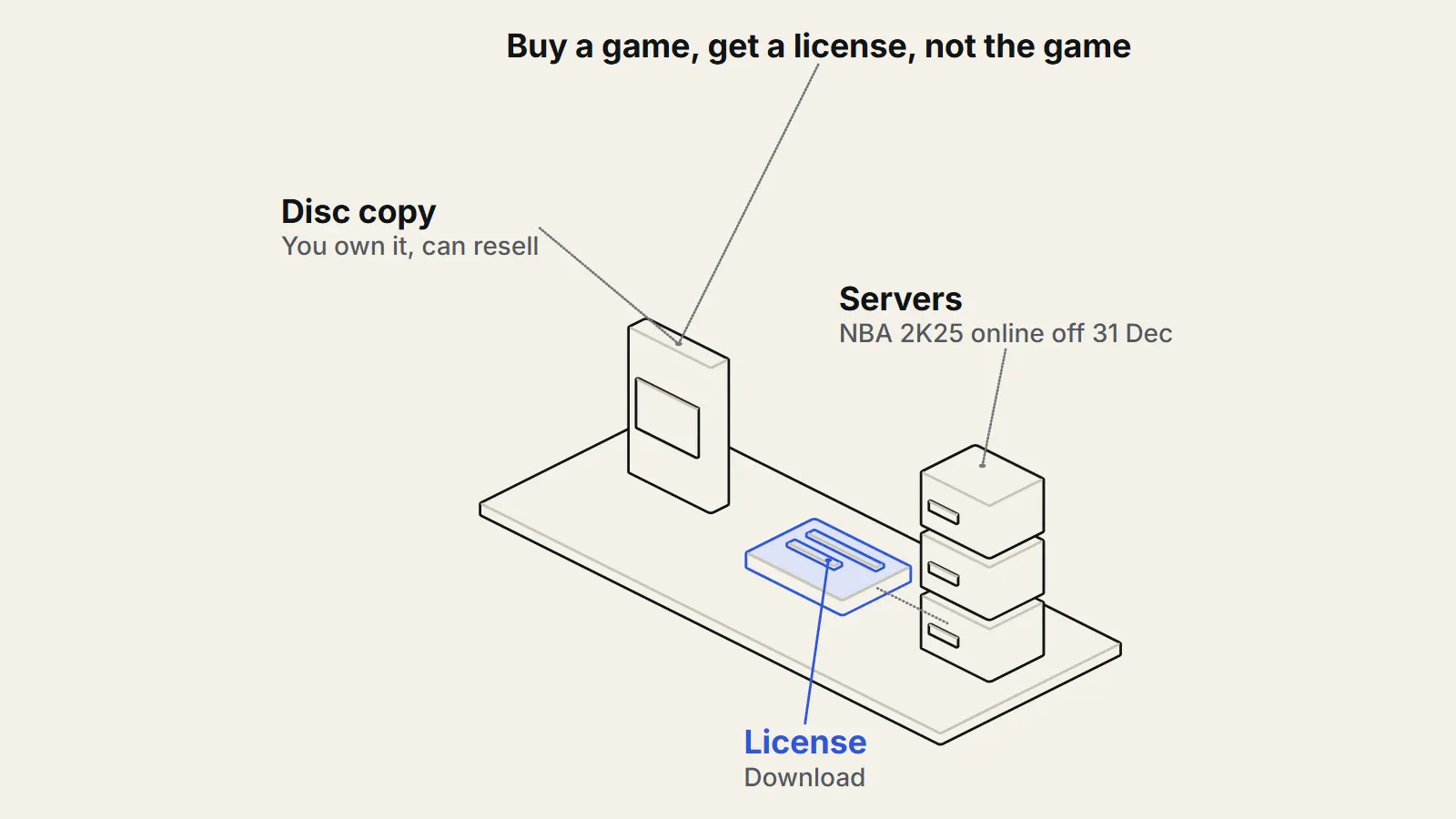
Digital game ownership, for most games sold as downloads, means a license to play rather than ownership of a copy. On 15 October 2026, US Representative Ritchie Torres, a New York Democrat, announced plans to introduce the Power to the Players Act1, which would direct the Federal Trade Commission (FTC) to write rules so that buying a video game means owning it.1 This piece answers that news item, which we saw on 15 and 16 October 2026. As of 16 October 2026 the bill has not been formally introduced in Congress. We explain what the law says now, what the bill would change and what is still unknown. This is explanation, not legal advice.
Do you own the digital games you buy?
Do you own your digital games? Under the terms most stores use, the answer is usually no. Take Steam, a major PC game store. Its subscriber agreement, last updated on 10 September 2026, says: "The Content and Services are licensed, not sold."2 The same agreement bars users from selling or transferring copies of the content to other parties without the company's written consent, and says subscriptions are not transferable.2
We opened only Steam's terms, so we cannot say how every store words its own. The pattern matches what Torres's release describes: digital games are often sold as revocable licenses rather than owned outright.1 With a video game license, the seller's terms rather than the rules of property decide what you may do with the game, including whether you can resell it. Selling access instead of an object is a familiar business model; our explainer on how startups actually make money (https://therealigned.com/story/how-startups-actually-make-money) looks at subscriptions and marketplaces.
What is the first sale doctrine, and why does it not cover downloads?
The first sale doctrine lets you resell, lend or give away a book or a disc you bought. In US law it sits in section 109(a) of the Copyright Act, which says the owner of a particular copy lawfully made under the Act may sell or otherwise dispose of that copy without the copyright owner's permission.3 The full text is on the US Copyright Office site (https://www.copyright.gov/title17/92chap1.html). A boxed game disc is such a copy. A download is different because moving a file means making a new one.
Courts have treated it that way for music. In Capitol Records v. ReDigi, a case about reselling digital music files, the Second Circuit ruled on 12 December 2018 that the service infringed the reproduction right4, and neither first sale nor fair use protected it. The Supreme Court declined to hear the case on 24 June 2019.4 That case concerned music, not games, and we did not find a court ruling on resale of downloaded games. Its reasoning is why first sale is not a safe assumption for any download.
What happens when game servers shut down?
Many modern games need the publisher's servers for online modes. When the servers are turned off, the game can stop working even though the buyer still holds the files. The announcement's example is NBA 2K25. The release says its standard edition retailed for $69.99, that it will be removed from digital storefronts on 30 October and that its online servers will shut down on 31 December, about two years after release.1 Kotaku gives 1 January 2027 for the servers,5 so we follow the official release.
The problem is not new. Ubisoft had delisted The Crew by 14 December 2023 and shut its servers on 31 March 2024. Two days later, on 2 April 2024, Ross Scott started the Stop Killing Games campaign.6 Its European petition ended with 1,294,188 valid signatures6.6 On 16 June 2026 the European Commission replied that it cannot propose a legal obligation to keep video games playable after they stop being provided commercially, because existing EU consumer law already provides important safeguards. It promised talks with industry and consumer groups by the end of 2026 on a code of conduct for games reaching the end of their life.7 The details are on the Commission's reply page (https://citizens-initiative.europa.eu/stop-destroying-videogames-commissions-reply-european-citizens-initiative_en).
What would the Power to the Players Act do?
From the release, the bill would do four things:1
- Direct the FTC to write regulations protecting consumers' ability to own and play the video games they buy.
- Make buying a game mean owning it, rather than holding a license.
- Require games with online features to offer an offline mode before their supporting servers shut down.
- Preserve consumers' ability to resell their games.
Consumers must have the right to own, the right to play, and the right to transfer the games they buy.
— Rep. Ritchie Torres, quoted from his 15 October 2026 announcement as reported by Kotaku.
Kotaku reports that the bill covers games only and excludes other digital media such as movies and music, although Torres hopes it could become a model for them.5 The release, as far as we could read it, does not describe how the FTC rules would be enforced.1 We have not seen bill text, and Engadget says it asked Torres for a draft.8
Will the Power to the Players Act become law?
No one can say yet. Kotaku reports that the bill still has to be formally introduced, would face a long committee process, and that Torres did not confirm any cosponsors or Republican support.5 Engadget points to a state precedent: California's Protect Our Games Act, AB 1921, passed the State Assembly 43 to 16 but stalled in committee in June 2026 with 4 votes for, 3 against and 4 abstentions, though the committee agreed to reconsider it.9 Torres calls the issue one of affordability and a return to the historical norm of buying and playing games.5 Whether a $69.99 price buys something lasting is a separate question from why prices rise; for that, see our guides to what causes inflation (https://therealigned.com/story/what-causes-inflation) and what inflation actually measures (https://therealigned.com/story/what-inflation-measures-and-what-it-misses).
What are the strongest objections?
What is not known about digital game ownership rules?
Several basics are still open, and we will not guess at them:
- What the bill text says, since it has not been published or introduced as far as we could find.
- How resale of a downloaded copy would work, given the ReDigi reasoning about new copies.
- Whether the rules would reach games already sold, which the release does not say.
- How much an offline mode would cost publishers; we found no estimate.
- Whether the bill gains cosponsors from either party.
Key takeaways
- Most downloaded games are sold under a license, and the seller's terms decide whether you can resell or keep playing.
- First sale protects a lawfully made copy you own; courts have not extended it to resold digital files.
- The Power to the Players Act, announced on 15 October 2026, would direct the FTC to require ownership, offline modes and resale rights, but it is not yet introduced.
- Its biggest open questions are legal authority, scope and cost, and similar efforts in California and the EU have not become binding rules.
Sources
- 1Rep. Torres Announces Power To The Players Act, Legislation to Ensure Gamers Own Their Games (opens the source in a new tab) · Office of Rep. Ritchie Torres, 2026 · Primary source · https://ritchietorres.house.gov/posts/rep-torres-announces-power-to-the-players-act-legislation-to-ensure-gamers-own-their-games
- 2Steam Subscriber Agreement (opens the source in a new tab) · Valve Corporation, 2026 · Primary source · https://store.steampowered.com/subscriber_agreement/
- 3Copyright Law of the United States, Chapter 1 (Section 109) (opens the source in a new tab) · US Copyright Office, 2024 · Law · https://www.copyright.gov/title17/92chap1.html
- 4Capitol Records v. ReDigi (opens the source in a new tab) · Copyright Alliance, 2019 · Reporting · https://copyrightalliance.org/copyright-cases/capitol-records-v-redigi/
- 5Rep. Ritchie Torres Announces Congressional Legislation To Protect Video Game Ownership (opens the source in a new tab) · Kotaku, 2026 · Reporting · https://kotaku.com/rep-ritchie-torres-announces-congressional-legislation-to-protect-video-game-ownership-2000746395
- 6Stop Killing Games (opens the source in a new tab) · Wikipedia, 2026 · Reporting · https://en.wikipedia.org/wiki/Stop_Killing_Games
- 7Stop Destroying Videogames: Commission's reply to the European citizens' initiative (opens the source in a new tab) · European Commission, 2026 · Primary source · https://citizens-initiative.europa.eu/stop-destroying-videogames-commissions-reply-european-citizens-initiative_en
- 8NY congressman to introduce bill protecting video game ownership (opens the source in a new tab) · Engadget, 2026 · Reporting · https://www.engadget.com/2288193/ny-congressman-to-introduce-bill-protecting-video-game-ownership/
- 9California bill to preserve online games fails committee vote (opens the source in a new tab) · Engadget, 2026 · Reporting · https://www.engadget.com/2205041/california-bill-to-preserve-online-games-fails-committee-vote/