UK military readiness is the question of whether Britain's armed forces could do what they may be asked to do, from evacuating citizens to fighting a large war, and the honest answer depends on which kind of readiness is meant, from operational to warfighting readiness. This piece answers a news item we saw trending on 15 and 16 October 2026, when the topic returned to the headlines, including a report of a three-day wargame that tested how the NHS would treat mass casualties from an overseas conflict.1 Below, as of 17 October 2026, we set out what the term means, what the official numbers show, where analysts disagree and what nobody can yet measure. We do not take a side on defence policy.
What does UK military readiness mean?
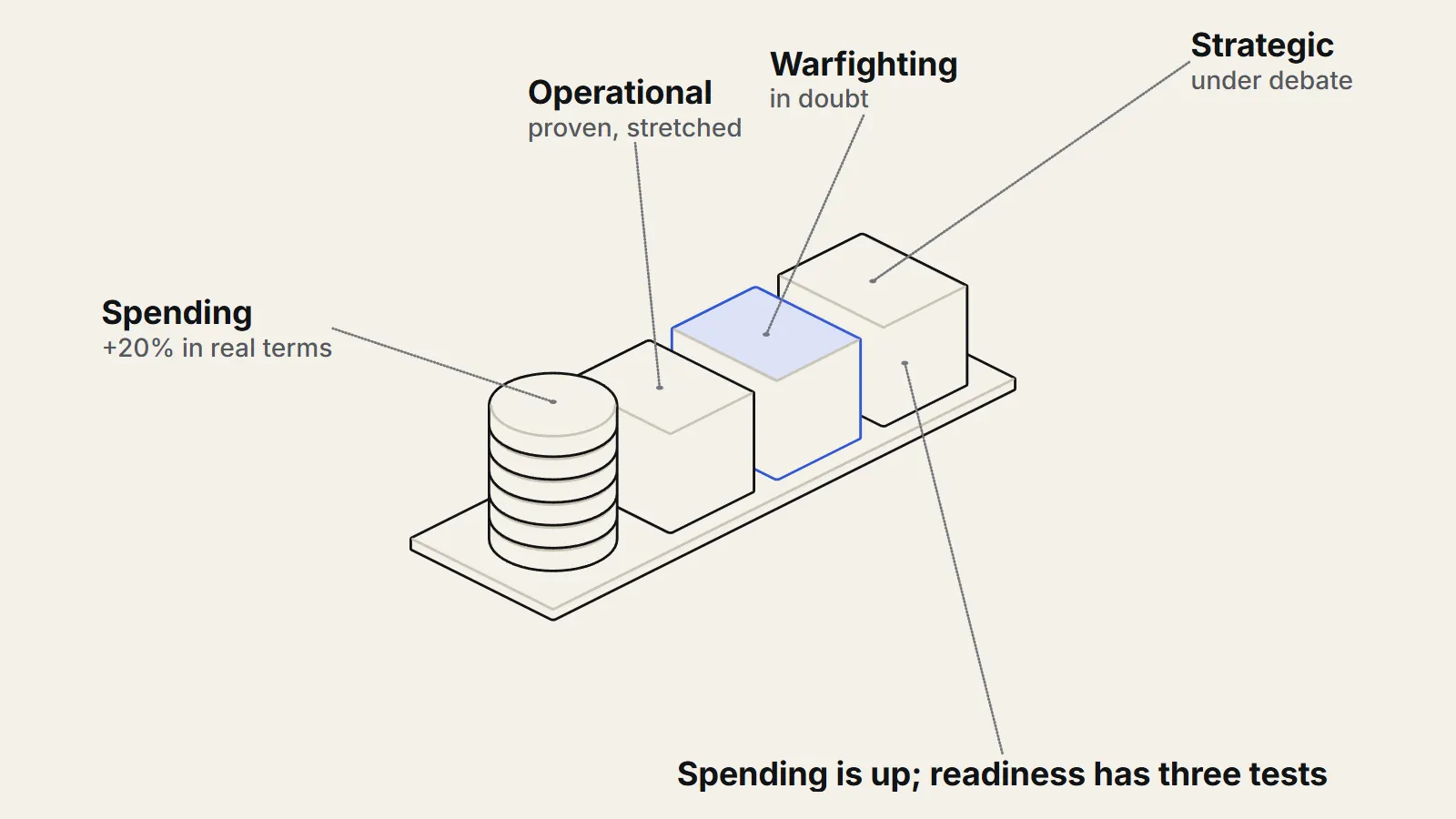
The word covers at least three different things. Dr Anisa Heritage of the Royal Military Academy Sandhurst, writing in a personal capacity, summarises the House of Commons Defence Committee's 2024 report "Ready for War?" this way: operational readiness, meaning the ability to run today's tasks, was proven but overstretched; warfighting readiness was in doubt; and strategic readiness was "more of a concept under debate".2
What is warfighting readiness?
The government has made warfighting readiness its headline aim. The National Audit Office (NAO), the public spending watchdog, defines it in its September 2026 overview of the Ministry of Defence (MoD) as the armed forces' ability to deploy, fight and sustain armed conflict at scale.3 The 2025 Strategic Defence Review put the idea at the centre of policy, and in 2025-26 the MoD added "warfighting" to its list of principal risks.3
Readiness also comes in tiers. The Defence Investment Plan (https://assets.publishing.service.gov.uk/media/6a44e989167a99cf0018da38/The_Defence_Investment_Plan.pdf), published in June 2026, singles out High Readiness Forces, including 16 Air Assault Brigade and the UK Commando Force, as the units meant to deploy anywhere in the world, from evacuations to warfighting.4 A force can be ready for one task and not for another. In the documents we opened, we did not find a single published score for overall readiness.
Readiness is not only a matter for soldiers. The Stafford wargame assumed that deterrence had failed and that wounded personnel would be flown home, so civilian hospitals would have to treat them. Surgeon General Maj Gen Phil Carter put the premise plainly: "casualties are coming back to the United Kingdom".1
How much does the UK spend on defence, and what counts?
There is more than one total. The Institute for Government (IfG) shows three for recent years: £55 billion on the narrowest MoD measure, £58 billion on a United Nations-based definition, and £64.5 billion on NATO's definition for calendar 20245, which counts items such as military pensions.5 The gap is about what is counted, not about money going missing.
On NATO's measure, UK defence spending was estimated at 2.4% of GDP for 2025, about £65.8 billion, according to Full Fact's explainer on UK defence spending (https://fullfact.org/news/uk-gdp-defence-spending/) of 15 January 2026. NATO's 2% guideline dates from 2006, and the UK has met it every year since.6 The promises ahead are higher. The Defence Investment Plan repeats a commitment to spend 3.5% of GDP on defence by 20354 and 3% in the next Parliament.4
Is UK defence spending turning into readiness?
UK defence spending is an input, not a measure of readiness. The NAO's figures show where recent growth went: capital spending, on equipment and buildings, rose 63% in real terms3 between 2020-21 and 2025-26, from £14.2 billion to £23.1 billion, while day-to-day spending rose 4%, from £37.3 billion to £38.9 billion. Most of the overall increase came in the first two years of that period.3
People are a second input. The NAO reports that armed forces personnel numbers rose by 423 in 2025-26 while civilian staff fell by 471, and that the average number of MoD employees stayed broadly stable over six years.3 Recruitment and retention depend partly on what the labour market pays, a link we explain in why wages rise (https://therealigned.com/story/why-wages-rise).
Equipment is a third. In March 2026, of the 20 MoD projects in the Government Major Projects Portfolio, eight were rated red, ten amber and two were exempt from public reporting.3 On stockpiles, the Defence Investment Plan puts £11.1 billion into munitions and weapons and commits to at least six new energetics factories, which make explosive materials, by 2030.4
Looking ahead, the NAO projects that total MoD spending limits will rise 18% in real terms, from £62 billion to £73.3 billion, by 2029-30, including the extra funding in the Defence Investment Plan.3 "Real terms" means adjusted for price rises, which is why the figures depend on the inflation measure used; our guide to what causes inflation (https://therealigned.com/story/what-causes-inflation) explains how those rises arise. The bill is met from taxes and borrowing, and we cover who carries it in who really pays taxes (https://therealigned.com/story/who-really-pays-taxes).
Is the UK ready for war? Where analysts disagree
Heritage argues that the UK has become a small, high-end force, and that the alternative would be a larger reserve-based model with rapid mobilisation and stockpiles. She notes that only one of six Type 45 destroyers could deploy to the Mediterranean at short notice, cites an estimated £17 billion gap between promised funding and the cost of the defence programme plus the Review's 62 recommendations, and expects that putting warfighting first by 2030 will mean scaling back other commitments.2
The spending target itself is also disputed. The IfG calls the 2% guideline symbolically important but "somewhat arbitrary", says meeting it does not guarantee the right capabilities, and notes the Defence Committee's finding that governments have at times reclassified some spending as defence to meet it.5 It adds that nuclear powers carry heavy costs, which helps explain why the UK spends a higher share of GDP than Germany with fewer troops.5
What is not known?
Four things stay open. First, we found no single published measure of overall readiness, so claims that the forces are "ready" or "not ready" rest on judgements about particular tasks. Second, nobody can yet say whether 3.5% of GDP will be reached by 2035: the Plan notes that NATO allies will review the trajectory and spending in 2029.4 Third, the MoD said in the Plan that it would publish a workforce plan in autumn 2026 setting out the planned size and structure of its workforce, and as of 17 October we have not seen it.3 Fourth, the Stafford wargame's findings are not published in the report we read, which says more exercises are planned in the coming months.1
This piece explains public information and is not advice of any kind. If you want to check the figures, the NAO overview (https://www.nao.org.uk/wp-content/uploads/2026/09/department-overview-2025-26-mod.pdf) and the IfG explainer (https://www.instituteforgovernment.org.uk/explainer/uk-defence-spending) are the places to start.
Key takeaways
- UK military readiness has at least three meanings: operational, warfighting and strategic, and they are judged differently.
- Official figures show a 20% real-terms rise in MoD spending limits since 2020-21, with the biggest rise in capital spending.
- Defence spending totals differ by definition, from £55 billion to £64.5 billion, so always check what is counted.
- Analysts disagree on whether the UK needs a different force shape, and on how much a spending target says about readiness.
- No single published score exists in what we opened, so the question is judged task by task.
Sources
- 1UK military and NHS wargame tests Britain's readiness to treat mass casualties in a future war (opens the source in a new tab) · Forces News, 2026 · Reporting · https://www.forcesnews.com/services/tri-service/uk-military-and-nhs-wargame-tests-britains-readiness-treat-mass-casualties
- 2How can warfighting readiness be balanced with other operations? (opens the source in a new tab) · Britain's World (Council on Geostrategy), 2026 · Essay · https://www.britainsworld.org.uk/p/the-memorandum-12-2026
- 3Ministry of Defence 2025-26: Overview (opens the source in a new tab) · National Audit Office, 2026 · Report · https://www.nao.org.uk/wp-content/uploads/2026/09/department-overview-2025-26-mod.pdf
- 4The Defence Investment Plan: Equipping our forces, defending our future (opens the source in a new tab) · UK Government (Ministry of Defence), 2026 · Primary source · https://assets.publishing.service.gov.uk/media/6a44e989167a99cf0018da38/The_Defence_Investment_Plan.pdf
- 5UK defence spending (opens the source in a new tab) · Institute for Government, 2026 · Report · https://www.instituteforgovernment.org.uk/explainer/uk-defence-spending
- 6UK defence spending: explained (opens the source in a new tab) · Full Fact, 2026 · Reporting · https://fullfact.org/news/uk-gdp-defence-spending/