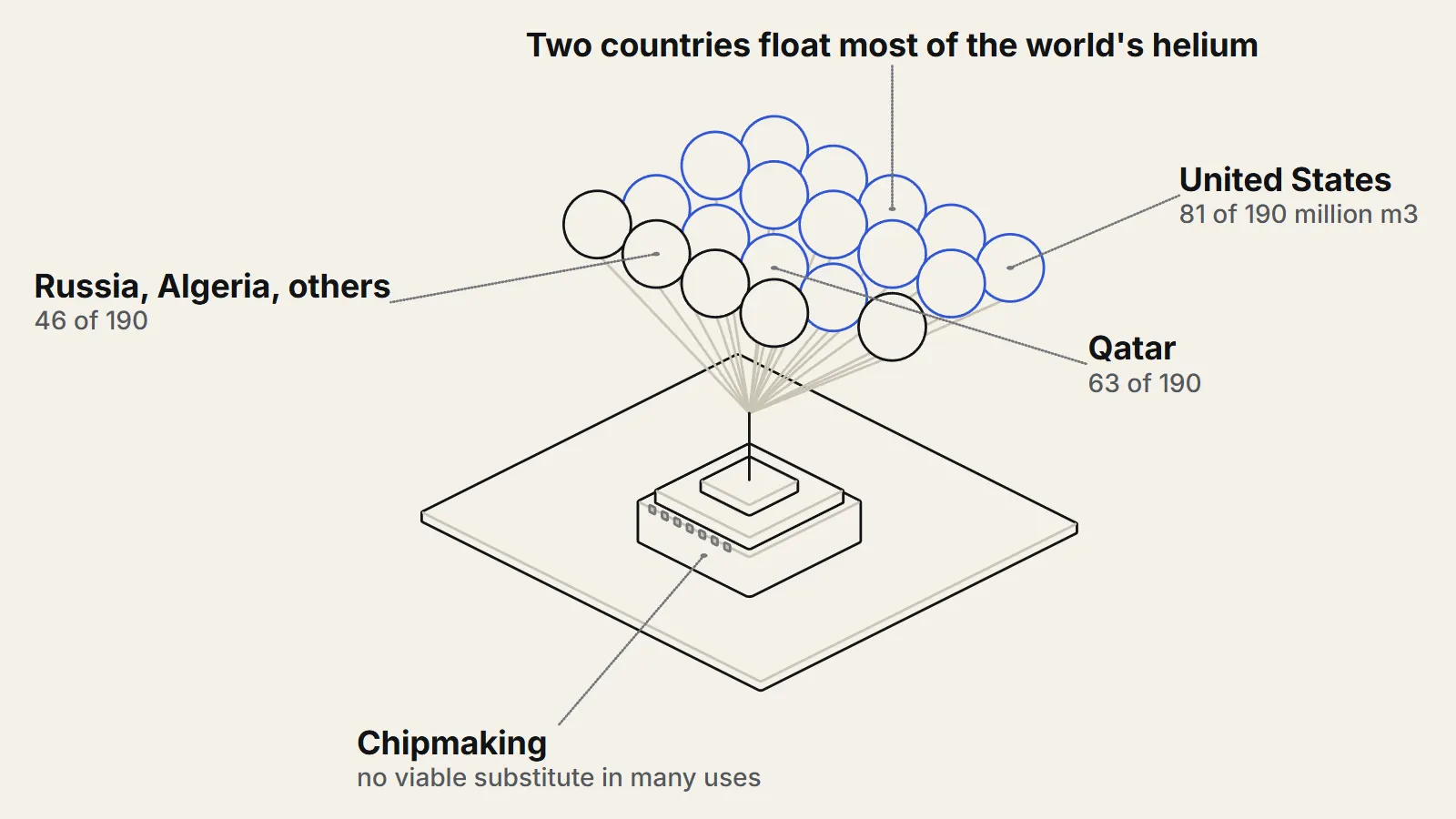
On 23 October 2026 the U.S. Energy Department designated helium a critical material. Secretary Chris Wright made the designation under the Energy Act of 20201. The department says helium is essential to American manufacturing and increasingly exposed to supply-chain risk, with no viable substitutes in many critical applications, including semiconductor production1. The label sounds like a mining story, but helium is a gas, and the world makes it in very few places.
What the helium critical material designation does
Read the Energy Department's announcement (https://www.energy.gov/articles/energy-department-designates-helium-critical-material-strengthen-american-manufacturing) closely and it is more about diagnosis than action. It lists the reasons: global demand growing faster than production, limited refining capacity and lengthy permitting timelines that constrain U.S. output1. The page we read does not spell out specific regulatory effects. CBS News reports that the designation makes more federal financing available to helium producers3. In practice, then, the label is a signal that points federal money and attention at one gas.
Who makes helium
The U.S. Geological Survey (https://pubs.usgs.gov/periodicals/mcs2026/mcs2026-helium.pdf) estimates 2025 world helium production at 190 million cubic metres, of which the United States made 81, Qatar 63, Russia 18 and Algeria 112. The U.S. and Qatar together make about 76% (144 of 190). USGS notes that the U.S. figure includes helium extracted in Canada and purified in the United States. The American market is small in money terms: U.S. sales of 81 million cubic metres were worth about $970 million, at a base price near $12 a cubic metre plus producer surcharges2.
| Producer | 2025 estimate, million cubic metres | Share of world |
|---|---|---|
| United States | 81 | 42.6% |
| Qatar | 63 | 33.2% |
| Russia | 18 | 9.5% |
| Algeria | 11 | 5.8% |
| All others (remainder) | 17 | 8.9% |
| World total | 190 | 100% |
Why helium is hard to replace
USGS's list of uses shows why demand does not disappear when supply tightens. In decreasing order, analytical, engineering, lab and specialty uses take 22%; controlled atmospheres, fiber optics and semiconductors together 17%; lifting gas 17%; MRI 15%; aerospace 9%; welding 8%; diving 5%; leak detection 5%2. Semiconductors are one use inside a larger bucket, not the whole market. Substitution varies by use. USGS says nothing substitutes for helium in cryogenic applications below -429 degrees Fahrenheit, while hydrogen can replace it in some lighter-than-air uses and argon or hydrogen in diving2. Lifting gas and diving mixes can switch; the coldest cooling cannot, though USGS adds that superconductors, including those in MRI, are being developed to run at higher temperatures using nitrogen2.
Why a net exporter can still face supply risk
By USGS's numbers the United States is a net exporter of helium: in 2025 it imported 8 million cubic metres and exported 38 million, and was a net exporter in each year from 2021 to 20252. Being a net exporter does not guarantee every buyer the grade and volume it needs. USGS reports that in 2021 to 2024 Canada supplied 47% of U.S. helium imports, Qatar 28%, Algeria 10% and China 5%2, and CBS News reports that the effective closure of the Strait of Hormuz in February trapped about a third of global helium supply in the Persian Gulf, and strikes in March hit Qatar's Ras Laffan facility3. That one-third matches Qatar's roughly 33% share of world output. The industry has responded at home: six new U.S. helium operations began producing in 2025, and a storage cavern came online in Beaumont, Texas2. USGS also notes that U.S. and EU sanctions banning helium imports from Russia continued into 20252.
If the United States already exports more helium than it imports, what does the label add: new domestic capacity, storage, or mostly financing for producers? The Energy Department's page does not say.
What is not known yet
The Federal Register notice behind the designation was not read for this piece, so its practical consequences are unconfirmed. The Hormuz and Ras Laffan details come from CBS News and were not checked against a second source. USGS figures for 2025 are estimates and will be revised. And a designation changes incentives, not geology: USGS puts recoverable U.S. helium resources at 8.49 billion cubic metres and Qatar's identified deposits at 10.1 billion2, but resources only become supply when plants are permitted and built.
Key takeaways
- The Energy Department designated helium a critical material on 23 October 2026, citing demand, refining limits and permitting delays.
- The U.S. and Qatar make about 76% of world helium by USGS's 2025 estimates.
- Nothing replaces helium in the coldest applications, though some uses can switch gases.
- The U.S. is a net exporter, yet still exposed to supply shocks elsewhere.
Sources
- 1Energy Department Designates Helium as Critical Material to Strengthen American Manufacturing and Supply Chain Security (opens the source in a new tab) · U.S. Department of Energy, 2026 · Primary source · https://www.energy.gov/articles/energy-department-designates-helium-critical-material-strengthen-american-manufacturing
- 2Mineral Commodity Summaries 2026: Helium and Rare Gases (opens the source in a new tab) · U.S. Geological Survey, 2026 · Report · https://pubs.usgs.gov/periodicals/mcs2026/mcs2026-helium.pdf
- 3U.S. designates helium a critical material following 60 Minutes report on supply chain crisis (opens the source in a new tab) · CBS News, 2026 · Reporting · https://www.cbsnews.com/news/helium-critical-material-energy-department-supply-chain/