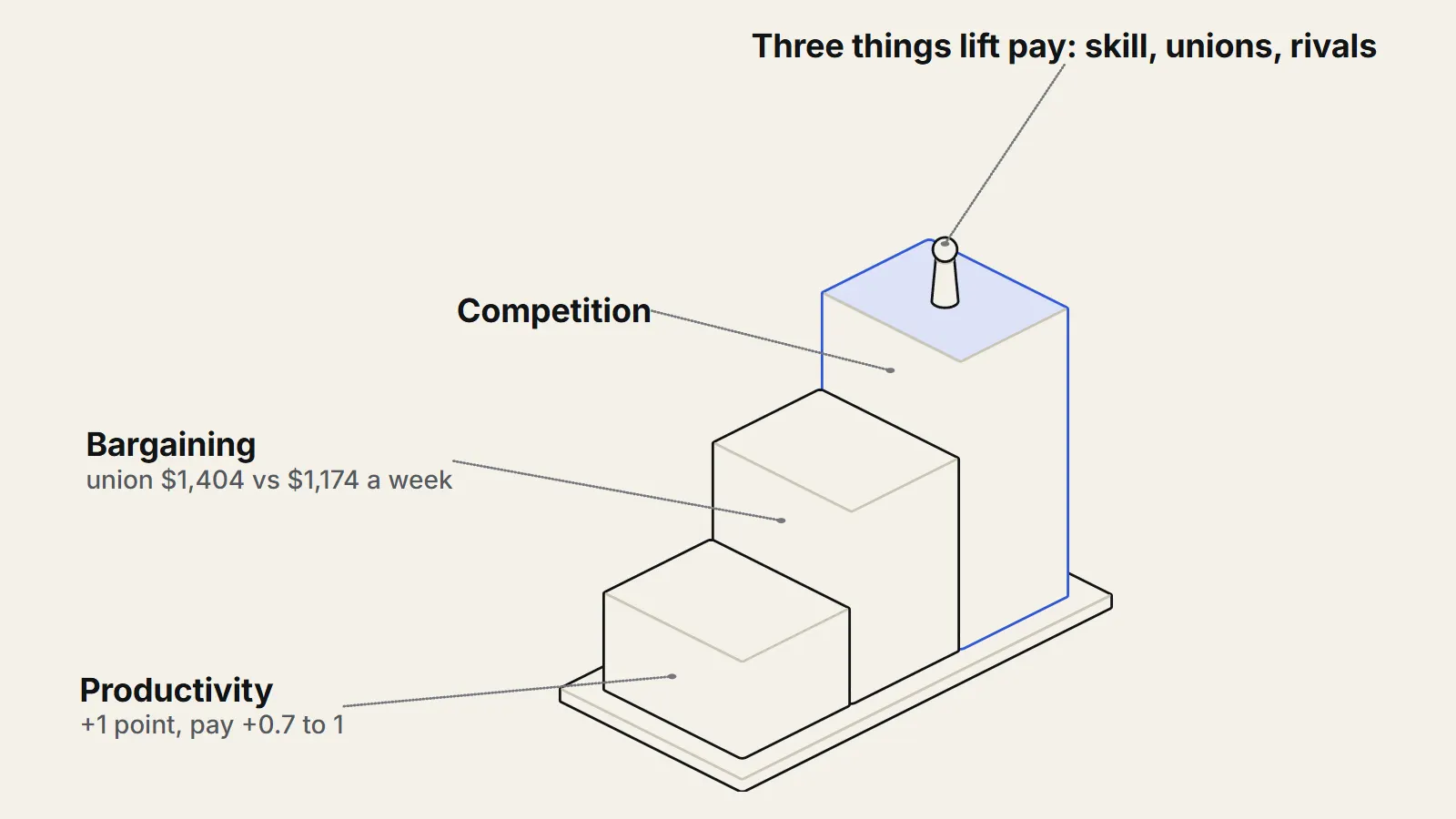
Wages rise for three main reasons that economists weigh differently: workers produce more per hour, workers have more bargaining power, and employers compete harder to hire them. Productivity sets the long-run ceiling on how much an economy can pay. Bargaining power and competition for workers help decide how much of that output reaches pay packets and when. No single explanation covers every period, so this article takes each in turn and says where the evidence is strong and where it is not.
How does productivity raise wages?
Labour productivity measures output per hour of work; the US Bureau of Labor Statistics describes it as comparing the growth in output to the growth in hours worked.1 If a worker with better tools, training or technology produces more in an hour, the employer can pay more for that hour without losing money, and competition among employers pushes pay toward that value. A rise in productivity raises the size of the pie that can be shared.
The link shows up in the data. In a 2017 NBER paper (https://www.nber.org/papers/w24165), Anna Stansbury and Lawrence Summers examined US pay and productivity from 1973 to 2016. They found one percentage point higher productivity growth was associated with 0.7 to 1 percentage point higher growth in median and average compensation2.2 They also found a split: since 1973 median compensation has diverged from average labour productivity, which means typical workers' pay has grown more slowly than output per hour. The authors suggest other factors, unrelated to productivity, have held down typical compensation even as productivity growth raised it.
How does bargaining power change pay?
Bargaining power is a worker's ability to get a larger share of what a job produces, through a union, a scarce skill or a credible outside offer. Unions are the most visible case. In 2025, US union members who worked full time had median usual weekly earnings of $1,404, against $1,174 for nonunion full-time workers, and union membership stood at 10.0 percent of wage and salary workers.3 The Bureau of Labor Statistics warns that these comparisons do not control for many factors that can matter for earnings differences, such as occupation, industry, age, firm size and region. (BLS union release) (https://www.bls.gov/news.release/union2.nr0.htm) So the gap is not a measure of what unions cause. It is a reason to ask how much of the gap comes from bargaining and how much from who is in a union.
How does competition for workers raise wages?
When many employers want the same workers, each has to offer more to keep or hire them. When few employers dominate, the opposite can happen. In a study of more than 8,000 local labour markets defined by job type and place, José Azar, Ioana Marinescu and Marshall Steinbaum found that the average market was highly concentrated under federal merger guidelines, and that moving from the 25th to the 75th percentile of concentration was associated with a 17 percent decline in posted wages4.4 The authors read this as evidence that concentration gives employers wage-setting power; see their NBER working paper (https://www.nber.org/papers/w24147). It is an association based on online job postings, not on wages actually paid.
The reverse case is a tight labour market, where jobs outnumber job seekers. David Autor, Arindrajit Dube and Annie McGrew described an unexpected compression of the US wage distribution after 2020. They linked it in part to greater competition for workers, and found that state-level labour market tightness became strongly predictive of real wage growth among low-wage workers. They estimate that the compression counteracted around one-third of the four-decade rise in aggregate 90/10 log wage inequality5, a measure of the gap between higher and lower earners.5 Their abstract (https://www.nber.org/papers/w31010) also notes rapid nominal wage growth and more job-to-job moves, particularly among young workers without college degrees.
Where does each explanation apply?
The three explanations operate on different time scales. Productivity matters over decades, since no economy can durably pay out much more than it produces. Competition for workers matters over months and years, because pay responds to how hard it is to fill jobs. Bargaining power matters in specific sectors and workplaces, and it can shift the share going to workers for long stretches. A rising wage in one place or period can reflect any combination, so claims about a single cause deserve scrutiny.
Wages also differ from compensation and from real pay. A raise in nominal wages can be erased by price rises, and a worker's total compensation includes benefits. The studies above measure different things, which is part of why their numbers differ.
What is the strongest counterargument?
The challenge to this view is the divergence the same research documents. If productivity alone fixed pay, median compensation would have kept pace with average productivity. Stansbury and Summers found it did not, and they suggest other factors have suppressed typical compensation.2 What those factors are remains contested, and the sources here do not settle it.
What is still not known?
Several questions are open. How much of the gap between productivity and typical pay comes from bargaining, market concentration, measurement or technology is disputed. The union comparison cannot separate the effect of unions from the kind of workers who are union members. The concentration result rests on posted wages. And the post-2020 compression may not last as labour markets cool; the research read here describes what happened, not what will happen.
Key takeaways
- Wages rise through productivity, bargaining power and competition for workers, and the weight of each varies by period and sector.
- In US data, each extra point of productivity growth was associated with 0.7 to 1 point of extra pay growth, yet median pay has lagged average productivity since 1973.
- Union members earn more on average, but the gap is not a measure of what unions cause because worker and job types differ.
- Greater concentration of employers is associated with lower posted wages, and tight labour markets after 2020 raised pay most at the bottom.
- Claims that a single factor explains wage growth should be treated with caution.
Sources
- 1Labor Productivity and Costs (opens the source in a new tab) · US Bureau of Labor Statistics, 2026 · Primary source · https://www.bls.gov/productivity/
- 2Productivity and Pay: Is the Link Broken? (opens the source in a new tab) · National Bureau of Economic Research (Working Paper 24165), 2017 · Paper · https://www.nber.org/papers/w24165
- 3Union Members - 2025 (opens the source in a new tab) · US Bureau of Labor Statistics, 2026 · Primary source · https://www.bls.gov/news.release/union2.nr0.htm
- 4Labor Market Concentration (opens the source in a new tab) · National Bureau of Economic Research (Working Paper 24147), 2017 · Paper · https://www.nber.org/papers/w24147
- 5The Unexpected Compression: Competition at Work in the Low Wage Labor Market (opens the source in a new tab) · National Bureau of Economic Research (Working Paper 31010), 2023 · Paper · https://www.nber.org/papers/w31010