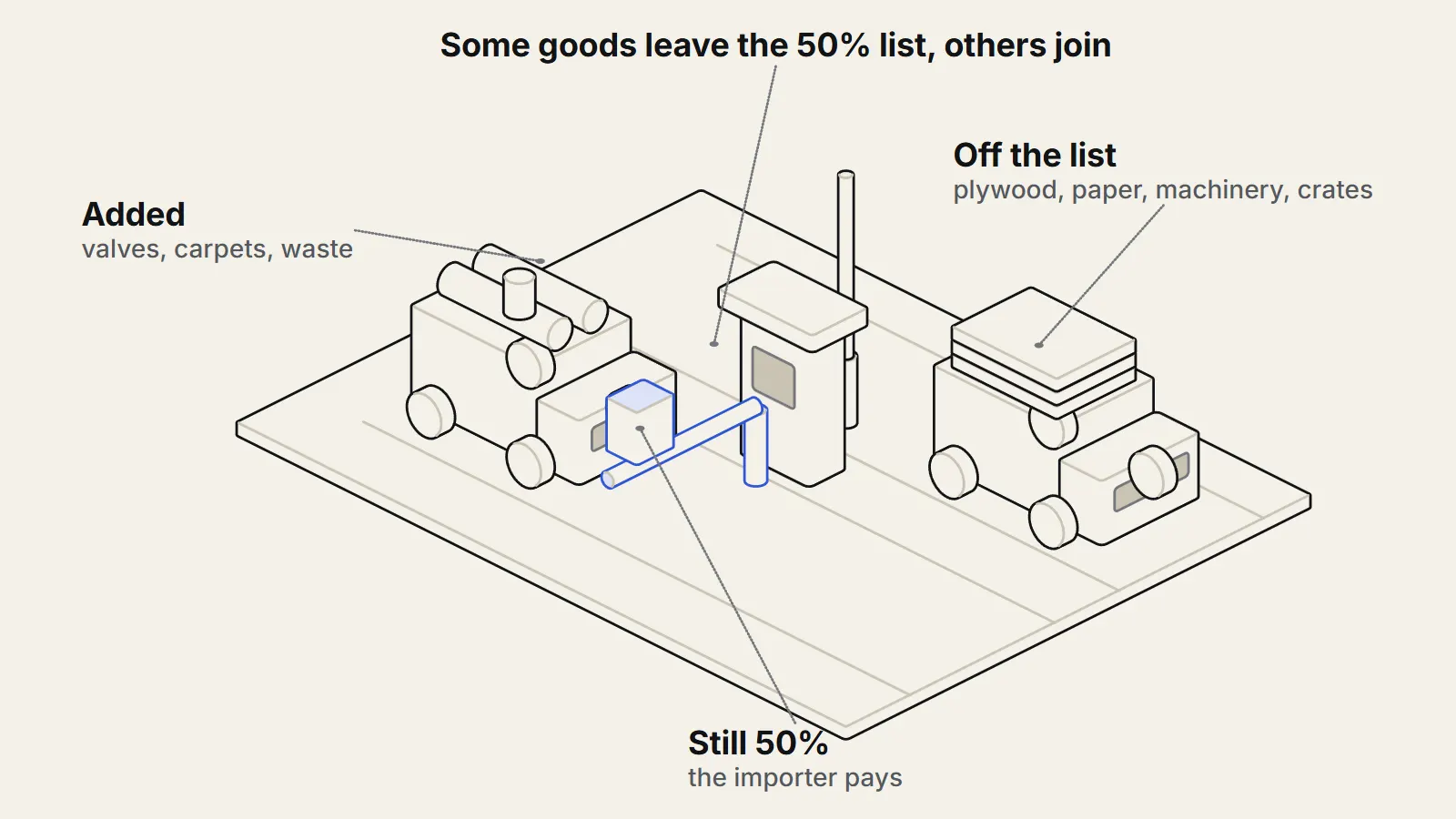
On 23 October 2026 President Trump signed a proclamation that changes which Canadian goods face the Section 338 tariffs. From 30 October, plywood sheets, some paper products, certain machinery and refrigeration equipment, and certain packing crates and boxes come off the list, while certain valves, carpets and waste products are added1. The tariffs apply whether or not a good qualifies under USMCA, and they stack on top of Section 232 tariffs1. The 50% rate dates from July. What changed this week is the list.
What Section 338 means for the Canada tariffs
Section 338 is part of the Tariff Act of 1930. It lets the President proclaim extra duties on a country's goods when that country discriminates against U.S. commerce. The extra duty may offset the disadvantage but cannot exceed 50 percent of the goods' value, and it takes effect 30 days after the proclamation3. If the discrimination continues, the same law lets the President bar the country's goods from entry altogether3. You can read the text at 19 U.S. Code 1338 (https://www.law.cornell.edu/uscode/text/19/1338).
Because it works through proclamations, the list can be edited the same way. The White House fact sheet (https://www.whitehouse.gov/fact-sheets/2026/10/fact-sheet-president-donald-j-trump-further-modifies-canadian-products-subject-to-tariffs-under-section-338/) for this week's change says Section 338 lets the President amend an earlier proclamation when the public interest requires it1. That is why a tariff regime can be narrowed in one place and widened in another without a new law.
How the Canada tariffs began
Three proclamations signed on 20 July 2026 added a 50% tariff on many Canadian goods2. The White House gave its reasons in July (https://www.whitehouse.gov/fact-sheets/2026/07/fact-sheet-president-donald-j-trump-imposes-additional-tariffs-on-canada/): Canadian car quotas and tariffs, provincial bans on U.S. alcohol and dairy tariff-rate quotas. Energy, potash, Section 232 products, fish and critical minerals were excluded2. The October fact sheet says the scope was first announced on 20 July and modified on 8 September1, so this week's edit is the latest of several.
Canada did not stand still. AP reports that Canada retaliated with tariffs of 15% to 50% on American products, matching the U.S. measures dollar for dollar4, and that in September Trump banned about $1 billion of Canadian imports, including alcoholic beverages, dairy and motorcycles4. The import-ban power sits in the same section of the 1930 law.
Why the list changed
The politics are in the open. AP reported that the move was seen as helping Senator Susan Collins of Maine, who is in a tight race. Collins said she asked trade negotiator Jamieson Greer and Commerce Secretary Howard Lutnick for relief, citing Maine blueberry growers who need Canadian harvesting boxes4. The White House gives a different frame: it says the action protects U.S. farmers, manufacturers and workers and restores reciprocity in trade1.
The July fact sheet puts numbers on that case: U.S. motor vehicle exports to Canada fell about 22%, or $5.6 billion, and U.S. alcoholic beverage exports fell about 81%, or $582 million, in the periods it cites2. These are the administration's own figures, and we have not been able to check the periods or how much of each fall is due to Canadian policy rather than other causes.
Who pays a tariff?
A tariff is a tax collected at the border. AP's report is plain on the legal point: U.S. importers, not foreign countries, pay the tariffs4. Who bears the cost in the end depends on the product. An importer can absorb it, raise prices, or push its supplier to cut theirs, and economists disagree about the mix. Households feel prices. In an AP-NORC poll of 2,140 U.S. adults taken 24 to 28 September, 65% said they blame Trump's policies more than outside factors for persistently high prices4.
What is still unknown
The fact sheet names product categories, not tariff codes. The annex to the proclamation decides which exact goods move, and importers will have to check it before 30 October. This piece uses the White House summary of the changes because the annex was not available when it was written. The fact sheet also does not state how much trade the changes cover.
Key takeaways
- From 30 October some Canadian goods leave the 50% Section 338 list and others join it.
- Section 338 caps the extra duty at 50% of a good's value and works through presidential proclamations.
- U.S. importers pay the tariff at the border, though who bears the cost is debated.
- The annex, not the fact sheet, decides which exact products move.
Sources
- 1Fact Sheet: President Donald J. Trump Further Modifies Canadian Products Subject to Tariffs Under Section 338 (opens the source in a new tab) · The White House, 2026 · Primary source · https://www.whitehouse.gov/fact-sheets/2026/10/fact-sheet-president-donald-j-trump-further-modifies-canadian-products-subject-to-tariffs-under-section-338/
- 2Fact Sheet: President Donald J. Trump Imposes Additional Tariffs on Canada (opens the source in a new tab) · The White House, 2026 · Primary source · https://www.whitehouse.gov/fact-sheets/2026/07/fact-sheet-president-donald-j-trump-imposes-additional-tariffs-on-canada/
- 319 U.S. Code 1338 - Discrimination by foreign countries (Tariff Act of 1930, Section 338) (opens the source in a new tab) · Legal Information Institute, Cornell Law School, 1930 · Law · https://www.law.cornell.edu/uscode/text/19/1338
- 4Trump, seeking to help Maine Sen. Susan Collins, exempts some Canadian imports from his 50% tariffs (opens the source in a new tab) · Associated Press via ABC News, 2026 · Reporting · https://abcnews.com/US/wireStory/trump-seeking-maine-sen-susan-collins-exempts-canadian-137524223