- Place
- Australia and India
- Years
- 2026–2026
- Policy
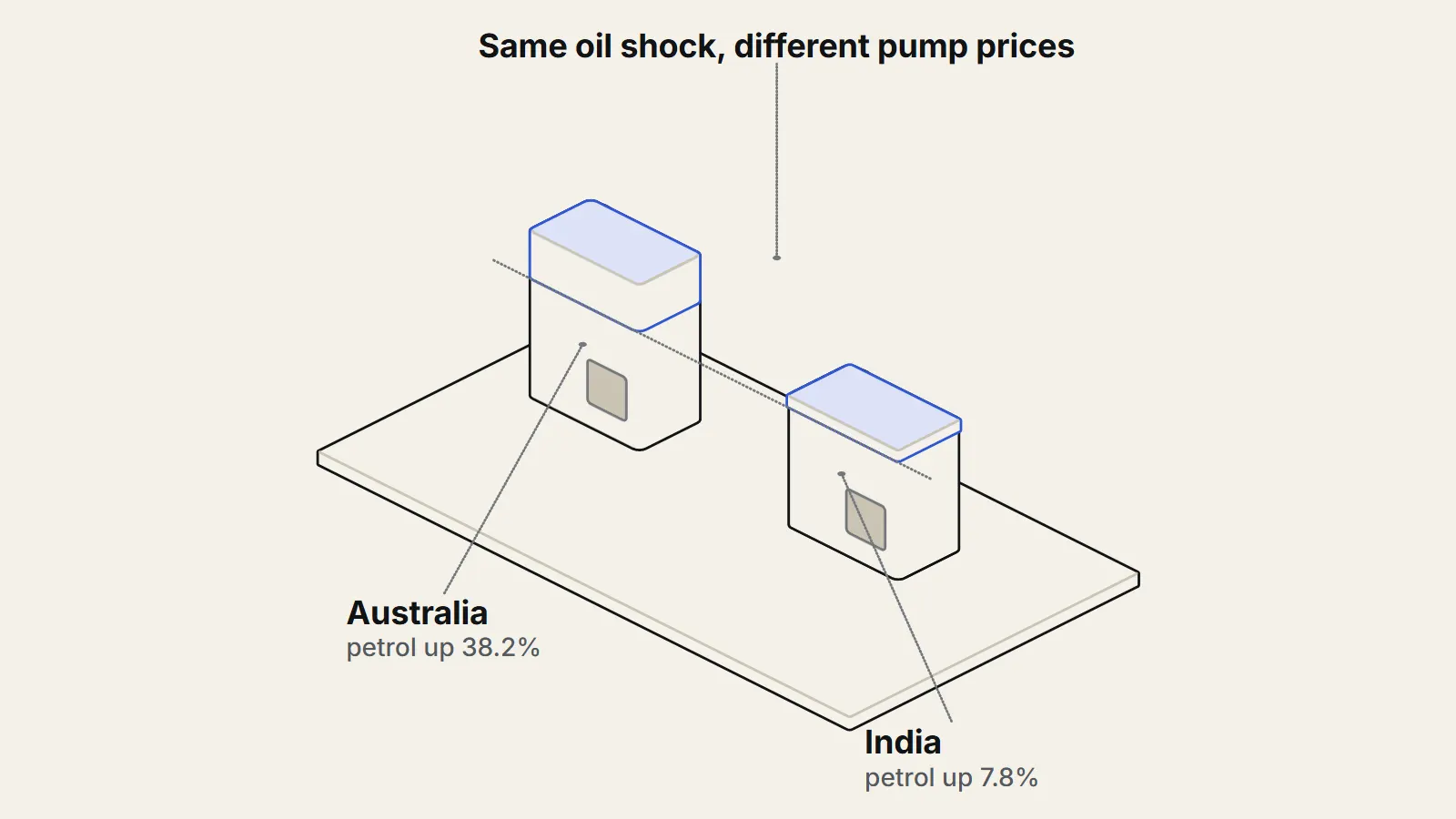
- Australia halved fuel excise for three months, then tapered it to 2 August; India cut excise by Rs 10 a litre but held pump prices until May.
- Outcome
- Australian petrol rose 38.2% and CPI reached 4.3%; Delhi petrol rose 7.8% but oil companies lost Rs 18,150 crore and LPG use fell.
Two import-dependent countries faced the same oil shock in 2026 and made different choices. Australia let pump prices follow the market and cushioned them for four months with a temporary excise cut. India cut a tax too, but held the pump price for about two months and let its state oil companies absorb losses, then raised it by about 8%. By 21 October Australian pump prices were 65 cents a litre above their February level for petrol and 100 cents for diesel1; Delhi petrol was Rs 7.35 higher2. Neither choice avoided shortages: Australia's came in March and India's in cooking gas.
Before
Two countries that import most of their fuel
The shock began when the Iran war disrupted shipping through the Strait of Hormuz in 2026. Both countries depend on imports, though in different forms. India's crude oil import dependence was 88.7% in 2025-264. Australia imports about 90% of its refined fuel needs5, and has two refineries left. Those are different measures, one of crude and one of refined products.
Their pump prices are built differently too. Australia's fuel excise is a fixed charge per litre, about 52.6 cents before GST on our arithmetic from the 26.3 cent halving. Delhi petrol's price on 1 October included central excise of Rs 11.90 a litre, a dealers' commission and Rs 16.59 of state VAT4. A given rise in the crude price therefore moves the two pump prices by different proportions, so the comparison below is of policy choices and outcomes, not a clean experiment.
Stocks differed too. Australia's minimum stockholding cover averaged 37 days of petrol, 32 days of diesel and 30 days of jet fuel in the March quarter1.
The decision
What did each government decide?
Australia acted first on the tax. On 30 March the Government announced a halving of fuel excise for three months from 1 April, cutting costs by 26.3 cents a litre, and a zero heavy-vehicle road user charge6. The ACCC describes the 32 cents seen at the pump as that 26.3 cents plus a 5.7 cent equivalent from states and territories giving up GST on fuel7. The Treasurer extended the relief at 16 cents a litre from 1 July to 2 August8 and it ended at midnight on 2 August. The 12 May Budget added a A$14.8 billion fuel package, including a A$3.2 billion fuel security reserve and a higher stockholding target for diesel and jet fuel9.
The cost is reported differently. The ministers put the cost of the first three months at A$2.55 billion10, and the Budget release gives A$2.9 billion for the excise and road user charge relief9. The sources do not agree on a single figure, so we give both.
India chose to hold prices. On 27 March the Petroleum Ministry cut central excise on petrol and diesel by Rs 10 a litre but left retail prices unchanged11, so the cut helped the oil companies' finances rather than lowering pump prices. Delhi petrol and diesel were then raised in four steps from mid-May, reaching Rs 102.12 and Rs 95.20 by 24 to 25 May, and have been unchanged since2.
- 27 March 2026India cuts central excise by Rs 10 a litre with unchanged pump prices.Source 11 (opens the source in a new tab)
- 30 March 2026Australia announces a three-month excise halving and a zero road user charge.Source 6 (opens the source in a new tab)
- 12 May 2026Australia's Budget adds a A$14.8 billion fuel package.Source 9 (opens the source in a new tab)
- Mid to late May 2026India raises Delhi petrol and diesel in four steps.Source 2 (opens the source in a new tab)
- 2 August 2026Australia's excise relief ends.Source 12 (opens the source in a new tab)
The case against cutting the price
Many economists argued against both approaches, for the same reason: a price held down hides the signal that makes people use less when supply is tight. In Australia the argument came from economists and business groups.
It might be good politics, that's for others to judge, but it's not good economics.
— Saul Eslake, economist, ABC News, 30 March 2026
Analysts disagreed on whether to cut at all, and several said diesel, which feeds freight, farming and mining, was the harder problem than petrol13.
What happened
What happened in Australia
Prices spiked first. The Bureau of Statistics reported automotive fuel prices up 32.8% in March, the largest monthly rise since the series began in 201714. On 24 March more than 500 service stations had run out of at least one fuel15. Pump prices peaked on 31 March at 257.2 cents a litre for petrol and 322.4 cents for diesel16, according to ACCC figures summarised by IndexBox.
The excise cut then took effect. By 24 June petrol was 157.1 cents, below its February level, and diesel 180.1 cents, near it16, as reported. After the relief ended and oil prices rose again, petrol was 236.2 cents and diesel 276.6 cents on 21 October1, with no relief in place. Stocks on 20 October were 39 days of petrol, 31 of diesel and 28 of jet fuel, against a March-quarter average of 37, 32 and 301, so they had not been rebuilt, and 105 of 8,167 reporting sites, about 1.3%, were out of one or both fuels on 23 October1.
Inflation followed the price. Headline CPI was 4.3% in the 12 months to September, with automotive fuel up 23.6%3. The Reserve Bank expected the excise cut to lower year-ended inflation in April by about 0.5 percentage points17, a forecast rather than a measured result. The Bank raised its cash rate to 4.60% on 29 September and said it would raise it again if needed18.
What happened in India
The pump price barely moved, but the costs did. Public-sector downstream oil companies earned a profit after tax of Rs 77,281 crore in 2025-26 and lost Rs 18,150 crore in April to June 20264. The Finance Ministry's September review says the limited pass-through of higher global energy prices helped contain the shock and protect household purchasing power19. ICRIER estimated in April that holding petrol and diesel prices costs about 0.58% of GDP a year20, an estimate on stated assumptions rather than an outcome.
Demand did not fall. Kpler calls India the clearest exception among major markets on petrol and diesel demand, citing incomplete pass-through21. The shortage appeared elsewhere: India's LPG consumption fell 15.5% from April to September, from 16,219 to 13,705 thousand tonnes4. Kpler forecasts India's LPG demand falling about 100,000 barrels a day in 2026 and recovering only about 60,000 in 202721. India's consumer price inflation was 5.54% in September22, and the Reserve Bank raised its repo rate to 5.50% on 7 October, noting that the pass-through of high energy prices is still continuing23.
What economists still disagree on
Who disagrees, and about what
In Australia the argument is about the excise cut. Economists criticised it, as above. The Opposition has argued for a discount paired with spending cuts, while the Treasurer said the budget cannot afford to do that forever24. The Treasurer said the relief was never meant to be permanent12.
In India the argument is about holding the price. ICRIER argues that maintaining current pricing is increasingly unsustainable if high oil prices persist, and favours gradual pass-through with support for the vulnerable20. An IMF policy note, as reported, warns against generalised subsidies and price caps25. The Finance Ministry credits limited pass-through for protecting households19.
On the facts there is also disagreement. We could not confirm the full cost of the Australian cut, which is reported as A$2.55 billion and A$2.9 billion, and the Indian cost has no official all-in figure. Several Australian price figures come from summaries of ACCC reports because the ACCC's own pages were not accessible to us.
Will either country rebuild stocks and change its approach before the next shock? Australia's relief has ended and its stocks are no higher; India's prices are unchanged since May.
Lessons
Key takeaways
- Cheap fuel is not secure fuel: Australia's cut lowered prices but shortages came from tight stocks and panic buying, and India's held prices did not prevent an LPG shortfall.
- Holding a price moves the cost rather than removing it: to oil company losses and lost excise in India, and to forgone revenue and a heavier inflation and rate path in Australia.
- Temporary relief ends: Australia's ended as oil rose again, leaving prices high and no relief, while India raised its price in one go in May.
- Stocks before the crisis matter more than prices during it, and neither country had much.
Related on The Realigned: our research on how $120 oil reaches the Indian pump (https://therealigned.com/research/petrol-price-india-120-oil-who-pays), the 1970s Great Inflation (https://therealigned.com/story/1970s-great-inflation) and what inflation actually measures (https://therealigned.com/story/what-inflation-measures-and-what-it-misses).
Primary documents: the Australian Prime Minister's release (https://www.pm.gov.au/media/fuel-excise-halved-three-months) and PPAC's Snapshot of India's oil and gas data (https://ppac.gov.in/download.php?file=rep_studies%2F1792155544_Snapshot_of_India_Oil_and_Gas_Sept_2026_V3.pdf).
Sources
- 1Fuel statistics (opens the source in a new tab) · Department of Climate Change, Energy, the Environment and Water, 2026 · Primary source · https://fuelplan.gov.au/fuel-statistics
- 2PPAC: Retail selling price of petrol and diesel in metro cities (daily, posted 27 October 2026) (opens the source in a new tab) · PPAC (Indian Oil prices), 2026 · Primary source · https://ppac.gov.in/uploads/page-images/1793079220_PP_9_a_DailyPriceMSHSD_Metro_27.10.2026.pdf
- 3CPI rose 4.3% in the year to September 2026 (opens the source in a new tab) · Australian Bureau of Statistics, 2026 · Primary source · https://www.abs.gov.au/media-centre/media-releases/cpi-rose-43-year-september-2026
- 4PPAC: Snapshot of India's Oil and Gas data, October 2026 (September 2026 data) (opens the source in a new tab) · PPAC, 2026 · Primary source · https://ppac.gov.in/download.php?file=rep_studies%2F1792155544_Snapshot_of_India_Oil_and_Gas_Sept_2026_V3.pdf
- 5Drivers brace for petrol price hikes as fuel excise cut comes to end (opens the source in a new tab) · ABC News, 2026 · Reporting · https://www.abc.net.au/news/2026-08-02/fuel-excise-cut-ending/106987482
- 6Fuel excise halved for three months (joint media release, 30 March 2026) (opens the source in a new tab) · Prime Minister of Australia, 2026 · Primary source · https://www.pm.gov.au/media/fuel-excise-halved-three-months
- 7ACCC statement on fuel prices and excise restoration (29 June 2026) (opens the source in a new tab) · ACCC via Mirage News, 2026 · Primary source · https://www.miragenews.com/accc-to-monitor-fuel-prices-amid-excise-1700649/
- 8Second reading speech, Treasury Laws Amendment (Fuel Excise Relief No. 2) Bill 2026 (opens the source in a new tab) · Treasurer of Australia, 2026 · Primary source · https://ministers.treasury.gov.au/ministers/jim-chalmers-2022/speeches/second-reading-speech-treasury-laws-amendment-fuel-excise
- 9Strengthening Australia's fuel resilience (12 May 2026) (opens the source in a new tab) · Treasurer of Australia, 2026 · Primary source · https://ministers.treasury.gov.au/ministers/jim-chalmers-2022/media-releases/strengthening-australias-fuel-resilience
- 10Economists warn cutting fuel excise could keep inflation higher for longer (opens the source in a new tab) · ABC News, 2026 · Reporting · https://www.abc.net.au/news/2026-03-30/economists-warn-fuel-excise-cut-impacts-economy/106511336
- 11Govt cuts excise duty on petrol, diesel by Rs 10/litre, taxes diesel, ATF exports (opens the source in a new tab) · PSU Watch (reporting the Petroleum Ministry release), 2026 · Reporting · https://psuwatch.com/newsupdates/govt-cuts-excise-duty-on-petrol-diesel-by-rs-10litre-taxes-diesel-atf-exports
- 12Fuel discount to be scrapped despite potential escalation of war in Iran (opens the source in a new tab) · ABC News, 2026 · Reporting · https://www.abc.net.au/news/2026-07-29/fuel-excise-discount-ends-iran-war-oil-prices/106971298
- 13Energy analysts raise concerns on fuel excise cut, divided on whether it will 'temper' inflation (opens the source in a new tab) · ABC News, 2026 · Reporting · https://www.abc.net.au/news/2026-04-14/fuel-excise-cut-questioned-as-iran-war-continues/106559252
- 14CPI rose 4.6% in the year to March 2026 (opens the source in a new tab) · Australian Bureau of Statistics, 2026 · Primary source · https://www.abs.gov.au/media-centre/media-releases/cpi-rose-46-year-march-2026
- 15Australia's diesel standards lowered for six months as hundreds of petrol stations run out of certain fuels (opens the source in a new tab) · ABC News, 2026 · Reporting · https://www.abc.net.au/news/2026-03-24/diesel-standards-relaxed-as-fuel-shortages-revealed/106491960
- 16IndexBox summaries of ACCC weekly fuel reports (June 2026) (opens the source in a new tab) · IndexBox (reproducing ACCC report data), 2026 · Reporting · https://www.indexbox.io/blog/accc-fuel-report-excise-cut-partial-restoration-and-price-trends-as-of-june-2026/
- 17Statement on Monetary Policy, May 2026 (opens the source in a new tab) · Reserve Bank of Australia, 2026 · Primary source · https://www.rba.gov.au/publications/smp/2026/may/economic-conditions.html
- 18Media conference: monetary policy decision, 29 September 2026 (opens the source in a new tab) · Reserve Bank of Australia, 2026 · Primary source · https://www.rba.gov.au/speeches/2026/mc-gov-2026-09-29.html
- 19Monthly Economic Review, September 2026 (opens the source in a new tab) · Department of Economic Affairs, Ministry of Finance, 2026 · Primary source · https://dea.gov.in/files/monthly_economic_report_documents/MERSept2026.pdf
- 20The Fiscal Cost of Holding Down Fuel Prices in India After the Middle East War (Policy Brief 68) (opens the source in a new tab) · ICRIER (Sanjeev Gupta and Pratik Tiwary), 2026 · Paper · https://icrier.org/pdf/India-piece-on-fiscal-costs-of-higher-oil-prices.pdf
- 21Refined products demand to fall 2.4 mbd in 2026 before an uneven 2027 recovery (opens the source in a new tab) · Kpler, 2026 · Report · https://www.kpler.com/blog/refined-products-demand-to-fall-2-4-mbd-in-2026-before-an-uneven-2027-recovery
- 22Press release on the Consumer Price Index (base 2024) for September 2026 (opens the source in a new tab) · Ministry of Statistics and Programme Implementation, 2026 · Primary source · https://www.pib.gov.in/PressReleseDetailm.aspx?PRID=2322244&lang=2®=48
- 23Monetary Policy Statement 2026-27: Resolution of the Monetary Policy Committee, 5 to 7 October 2026 (opens the source in a new tab) · Reserve Bank of India, 2026 · Primary source · https://www.rbi.org.in/scripts/BS_PressReleaseDisplay.aspx?prid=63742
- 24Chalmers lowers expectations for fuel discounts after high inflation result (opens the source in a new tab) · ABC News, 2026 · Reporting · https://abc.net.au/news/2026-10-28/chalmers-downplays-further-fuel-discounts-amid-high-inflation/107319372
- 25IMF flags fiscal risks for India as oil prices rise (opens the source in a new tab) · Business Today (reporting an IMF policy note), 2026 · Reporting · https://www.businesstoday.in/latest/economy/story/imf-flags-fiscal-risks-for-india-as-oil-prices-rise-532532-2026-05-20