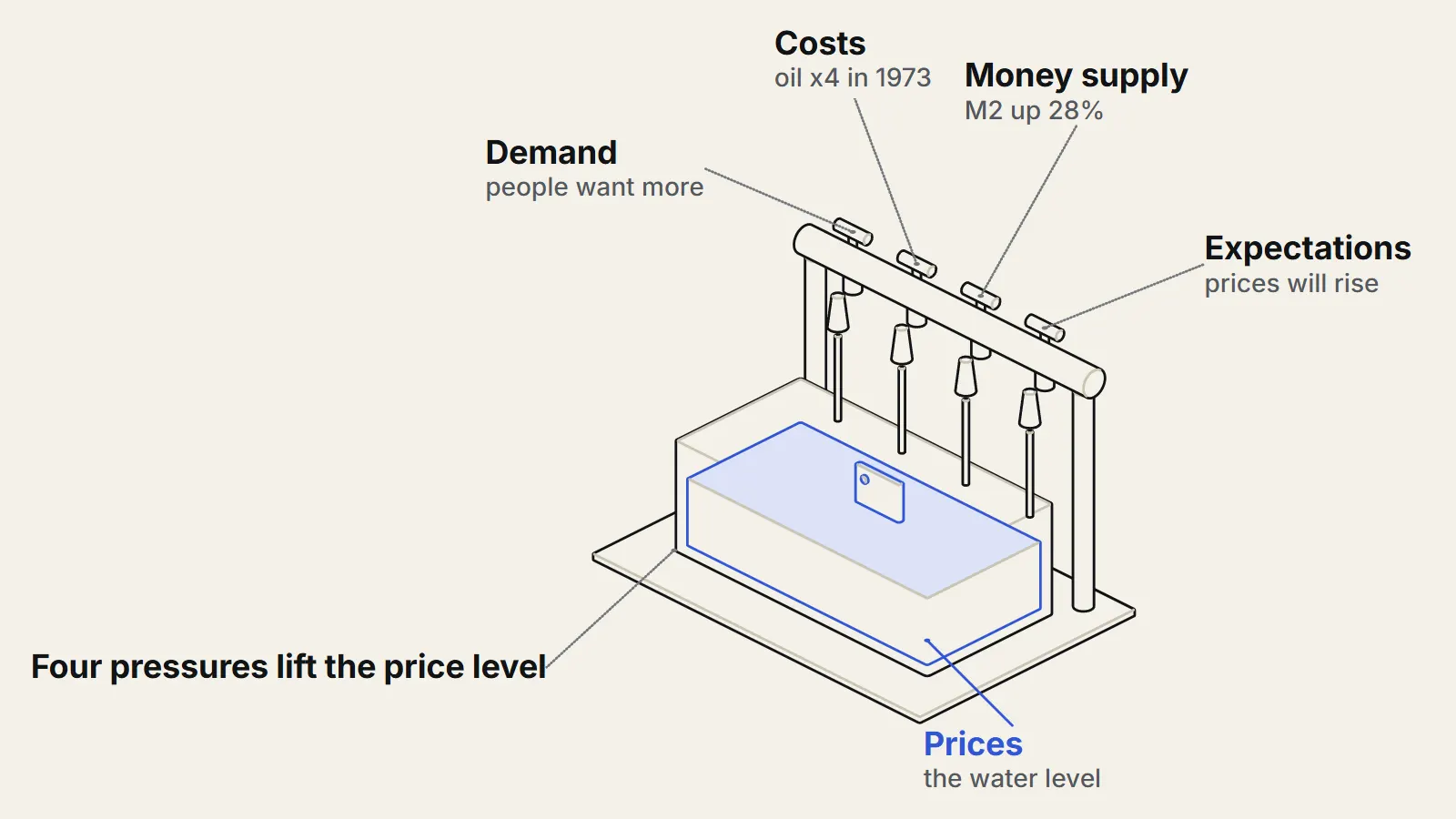
Inflation is a general rise in prices across an economy, and economists do not trace it to a single cause. So what causes inflation? The usual answer lists four explanations: demand growing faster than supply (demand-pull), rising production costs (cost-push), what households and firms expect prices to do next, and growth in the quantity of money. Which one matters most depends on the episode, and in most real cases several work at once.
What is demand-pull inflation?
Demand-pull inflation arises when total spending on goods and services outruns what the economy can produce. Spending can come from consumers, businesses, the government or foreign buyers. When firms cannot make enough to meet it, they raise prices and margins, and they may pay more to hire workers. Those higher incomes then feed more spending, so the pressure spreads across many sectors.1 The Cleveland Fed adds that rising incomes and lower borrowing costs are common sources of the extra spending.2
This is why central bank (https://therealigned.com/story/what-a-central-bank-does)s raise interest rates when inflation is high. The Bank of England, for example, explains that higher rates make borrowing dearer and saving more attractive, so people spend less and prices tend to rise more slowly.3 The tool works on demand, which matters for the next explanation, where demand is not the problem.
What is cost-push inflation?
Cost-push inflation starts on the supply side. Something makes it more expensive to produce goods, and firms pass the cost on. Typical triggers are energy prices, bad harvests, higher transport costs and a weaker currency that makes imports dearer.1 The Cleveland Fed also lists wage growth that is not matched by gains in output per worker.2
The best-known example is the 1970s. The Reserve Bank of Australia notes that after the October 1973 OPEC oil embargo, oil prices quadrupled1, and the decade brought stagflation (https://therealigned.com/story/stagflation-explained): weak output together with high inflation.1 Higher interest rates cannot make more oil appear, which is why cost shocks are harder for central banks to handle than demand surges.
How do expectations keep inflation going?
Expectations are what people believe about future price rises. If workers expect prices to climb, they ask for bigger pay rises; if firms expect higher costs, they raise prices sooner. The belief can then help produce the result. The Cleveland Fed calls the loop a wage-price spiral, and says that expectations tied firmly to the central bank's goal, which the Fed announced as 2 percent in 2012, make it less likely.2
Economists call expectations "anchored" when people trust that inflation will return to target even after a spell of high readings. The Reserve Bank of Australia says that if they come unanchored, high inflation tends to persist. Because expectations cannot be observed directly, policymakers read surveys and the prices of government bonds to gauge them.1
Is inflation always about the quantity of money?
Milton Friedman's famous line held that inflation is always and everywhere a monetary phenomenon. The idea, known as the quantity theory of money, is that prices rise in the long run when the money supply grows faster than the economy's output. It remains influential, and it is the strongest argument that the other three explanations are, at root, ways money growth gets expressed in prices.
The counterargument comes from recent experience. After the 2008 crisis, the Federal Reserve expanded its balance sheet sharply, and many commentators predicted high inflation. John Williams, then president of the San Francisco Fed, pointed out in 2012 that the monetary base rose about 200 percent while M2 rose only 28 percent4, and that inflation averaged under 2 percent over four years.4 In his account, banks held reserves instead of lending them, and because the Fed paid interest on reserves, the usual multiplier from reserves to broader money was close to zero at the margin.4 Money growth, in other words, had to be measured at the right level, and it was the broad measure and spending that mattered.
Which explanation dominates in practice?
The answer changes by episode. A 2023 study by Ben Bernanke and Olivier Blanchard looked at the US inflation that began in 2021. Using a model of prices, wages and expectations, they concluded that most of the surge was the result of shocks to prices given wages5, such as commodity prices and sector-specific spikes tied to supply constraints, rather than an overheated labour market.5 They also found that product-market shocks fade faster than the effects of a tight labour market, which are more persistent.5
This fits the wider pattern. A supply shock such as an oil embargo can start a burst of inflation, strong demand can sustain it, and expectations and wage setting decide whether it fades or settles in. The explanations are better read as parts of one chain than as rival theories, even though economists still argue about the weight of each link. Read the 2023 study in full at the National Bureau of Economic Research (https://www.nber.org/papers/w31417) to see how the authors split the pieces.
What do economists not know?
Several things remain unsettled. Expectations are hard to measure, so how quickly they unanchor, and what level of inflation triggers it, is debated. The weight of demand versus supply in any single episode depends on the model used, and the 2023 study is one estimate, not a final verdict. And the role of money growth is disputed: the quantity theory looks strongest over long periods, but the Fed's post-2008 experience shows that the link can break when banks and households hold on to new money rather than spend it.
The San Francisco Fed speech (https://www.frbsf.org/news-and-media/speeches/williams-speeches/2012/07/williams-monetary-policy-money-inflation/) and the Reserve Bank of Australia explainer (https://www.rba.gov.au/education/resources/explainers/causes-of-inflation.html) are good places to read more. This article explains mechanisms and evidence. It is not advice on any financial decision.
Key takeaways
- Inflation has several causes: demand outrunning supply, higher costs, expectations and money growth.
- Interest rates mainly work on demand, so supply shocks are harder for central banks to offset.
- Expectations can make inflation persist because workers and firms act on what they think will happen.
- Money growth matters over long periods, but the 2008 experience shows the link is not mechanical.
- Which explanation dominates depends on the episode, and economists still disagree about the weights.
Sources
- 1Causes of Inflation (opens the source in a new tab) · Reserve Bank of Australia, 2024 · Primary source · https://www.rba.gov.au/education/resources/explainers/causes-of-inflation.html
- 2What Causes Inflation? (opens the source in a new tab) · Federal Reserve Bank of Cleveland, 2024 · Primary source · https://www.clevelandfed.org/center-for-inflation-research/inflation-explained-your-guide-to-inflation-basics/what-causes-inflation
- 3What is inflation? (opens the source in a new tab) · Bank of England, 2025 · Primary source · https://www.bankofengland.co.uk/explainers/what-is-inflation
- 4Monetary Policy, Money, and Inflation (opens the source in a new tab) · Federal Reserve Bank of San Francisco, 2012 · Primary source · https://www.frbsf.org/news-and-media/speeches/williams-speeches/2012/07/williams-monetary-policy-money-inflation/
- 5What Caused the US Pandemic-Era Inflation? (opens the source in a new tab) · National Bureau of Economic Research, 2023 · Paper · https://www.nber.org/papers/w31417