Summary
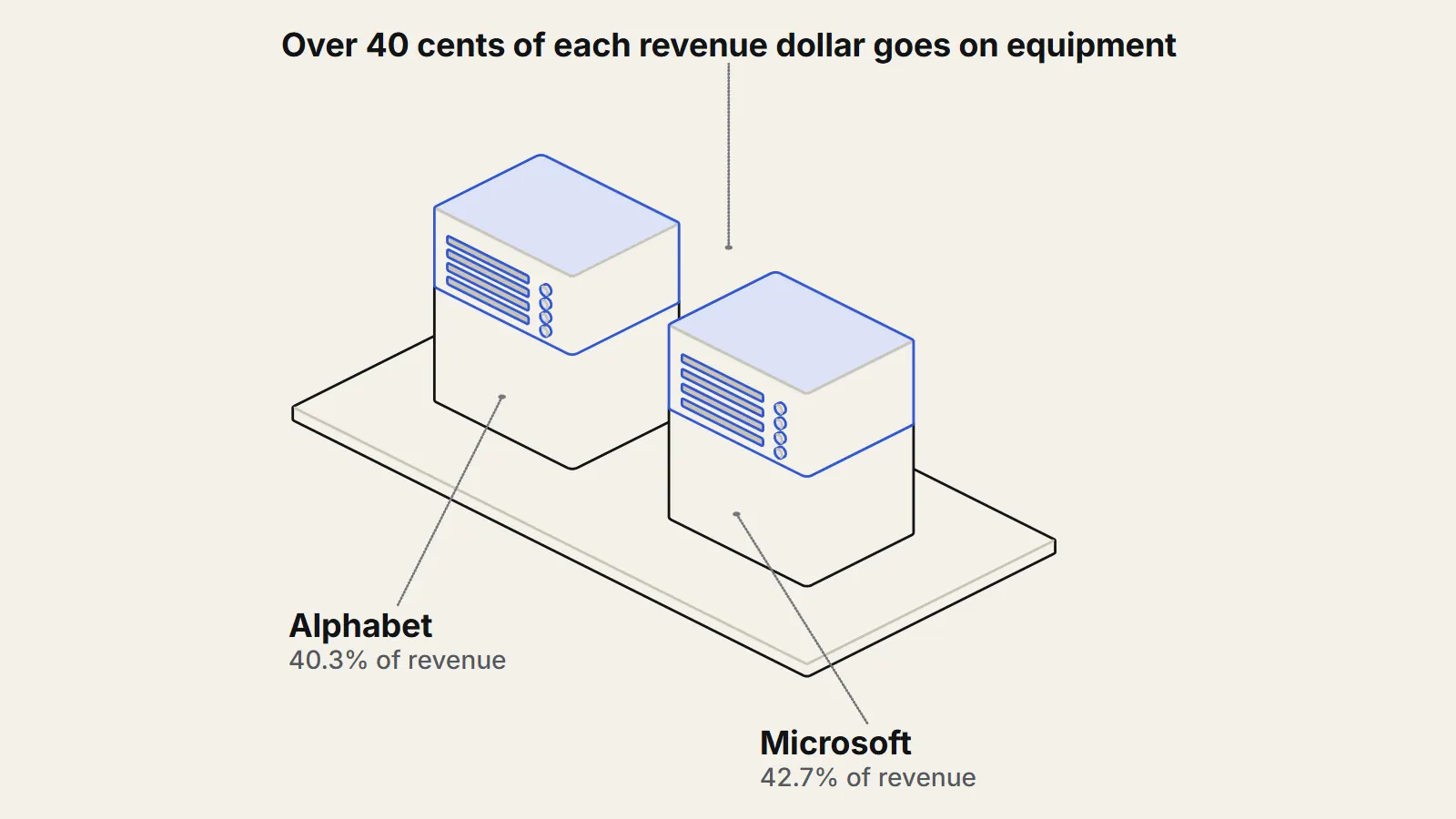
We read the latest quarterly filings of Alphabet, Microsoft and Meta. Alphabet spent $51,355 million on property and equipment in the quarter to 30 September 2026, 40.3% of its $127,577 million revenue, and its free cash flow was negative $9,065 million1. Microsoft spent $39,367 million, 42.7% of its $92,279 million revenue2, and stayed free-cash-flow positive3. Over the latest year Alphabet's headcount rose to 204,7571, while Microsoft had about 223,000 full-time employees, down from about 228,0004 and Meta's fell 15%5. Central banks and the IMF warn about valuations and debt; the companies point to backlogs. This is information, not investment advice.
The question
How much are the big AI spenders spending, and how is it paid for?
Microsoft, Alphabet and Meta are building data centres and buying chips and servers on a scale with few precedents. The numbers moved in the last two weeks as the companies reported. The questions are simple. How much is capital expenditure, or capex, as a share of what they earn? Is it paid for from the cash the business generates, or from borrowing and selling shares? And what has happened to headcount while the spending rose?
Two terms. Capex is money spent on long-lived assets such as buildings, servers and chips. Free cash flow is operating cash flow minus capex: the cash left after the spending.
Data
Which records did we use?
We used the companies' own filings with the US Securities and Exchange Commission: earnings releases (8-K), quarterly reports (10-Q) and annual reports (10-K). SEC data are public, and the quarterly figures that are not printed in a release are derived by subtracting year-to-date totals in the filings' machine-readable data7. Alphabet's official call transcript is used for its outlook. Microsoft's call figures come from a third-party transcript and are labelled as such. Amazon had not filed when we checked, so it is not included.
| Latest quarter, $ million | Alphabet (Q3 2026) | Microsoft (Q1 FY27) | Meta (Q3 2026) |
|---|---|---|---|
| Revenue | 127,577 | 92,279 | 64,601 |
| Operating income | 40,576 | 45,915 | 12,988 (after a $9.9bn legal charge) |
| Cash capex | 51,355 | 39,367 | 33,942 |
| Cash capex, % of revenue | 40.3% | 42.7% | 52.5% |
| Free cash flow | -9,065 | about 18,600 | -2,120 (company figure) |
| Headcount | 204,757 | about 223,000 (at 30 June) | 66,775 |
Method
How did we compare the companies?
Microsoft's fiscal year ends in June, so we aligned its quarters to the calendar quarter in which they end. We used the cash capex line for each company, which is purchases of property and equipment. Microsoft also acquires equipment through finance leases that do not appear in that cash line, and Meta defines its own capex measure to include finance-lease principal, so the totals each company quotes are higher. We state which measure we use each time.
Where a company gives a figure on a call that we cannot reconcile to its filing, we say so rather than choose one. For example, Microsoft's finance chief gave a broader figure of $45.2 billion for the quarter including finance leases, which does not match the filing's cash line plus the lease additions8, so we use the filing.
Findings
How much of revenue goes on equipment?
A large and rising share. Alphabet's capex was $51,355 million in the September 2026 quarter against $23,953 million a year earlier1, and Microsoft's cash additions to property and equipment were $39,367 million against $19,394 million3. Both more than doubled in a year (our arithmetic: about 114% and 103%). Meta's cash capex was $33,942 million5, against $18,829 million a year earlier by our derivation from the filings.
As a share of revenue, Alphabet's capex was 14.8% in the September 2024 quarter6 and 40.3% two years later. Microsoft's was about 23% and then 42.7%. For a full year, Microsoft's cash additions to property and equipment were $115,948 million in fiscal 2026, $64,551 million in 2025 and $44,477 million in 20244.
Is it paid for from cash flow?
For Alphabet, no longer. Its operating cash flow of $42,290 million was below its capex in the third quarter, leaving free cash flow of negative $9,065 million1. Over nine months operating cash flow was $127,149 million against capex of $131,953 million9. In the same nine months, Alphabet raised $85,222 million of debt, $42,870 million from selling common stock and $19,063 million from preferred stock, and did not repurchase shares, against $39,810 million of repurchases in 20259.
Microsoft is in a different position. Its operating cash flow of $58,000 million exceeded its capex, leaving about $18.6 billion3, though that is down from about $25.7 billion a year earlier (our arithmetic from the filings). Meta reported free cash flow of negative $2.12 billion for the quarter and raised $24,910 million of long-term debt in the first nine months5.
What are they buying, and what do they say?
Alphabet says most of its spending is servers and networking equipment: about 65% of its third-quarter technical-infrastructure investment, with a useful life of about six years, and the rest data centres10. Short asset lives matter, because they raise annual depreciation. Alphabet's depreciation was $8,369 million against $5,611 million a year earlier, up about 49% while revenue rose about 25%1 (our arithmetic). Microsoft's depreciation expense was $34.3 billion in fiscal 2026, $22.0 billion in 2025 and $15.2 billion in 20244.
We continue to expect our CapEx to increase significantly in 2027, and we'll provide further details on our Q4 call.
— Anat Ashkenazi, Alphabet chief financial officer, Q3 2026 call
Alphabet kept its 2026 capex guidance at $195 billion to $205 billion10. Meta narrowed its 2026 range to $135 billion to $145 billion5. Microsoft's finance chief said capex for the next quarter would be over $50 billion8, per a third-party transcript.
Both Alphabet and Microsoft point to demand. Alphabet reports Google Cloud revenue growth of 103%1. Microsoft's 10-Q reports a commercial remaining performance obligation of $677 billion, up 73%, and leases not yet commenced, mainly data centres, of $364.6 billion3. Those are contracts and commitments, not revenue already earned. Microsoft's own annual report says its AI capital investments are in advance of fully developed revenue streams4.
What happened to headcount?
Microsoft had about 223,000 full-time employees at 30 June 20264, against about 228,000 a year earlier11. On 26 October it offered voluntary exits to a reported 60,000 people; Microsoft says AI is not driving the offer12. We covered what is confirmed in a separate piece on Microsoft's layoffs and voluntary exit offer (https://therealigned.com/story/microsoft-layoffs-voluntary-exit-offer-confirmed). Meta's headcount of 66,775 is down 15% from a year earlier, by the company's figure5. Alphabet went the other way: 204,757 employees against 190,167 a year earlier1.
The pattern is spending rising fast at all three and headcount falling at two of them. That is a correlation in the filings, not proof that spending replaced staff, and Alphabet's rise shows the link is not universal.
Is it a bubble, or a build-out?
Official bodies are cautious. The Bank for International Settlements says the largest hyperscalers' AI spending is outpacing their earnings and free cash flow, and warns of over-commitment13. Its March review says hyperscaler bond issuance topped $100 billion in 2025 and that off-balance-sheet structures are economically akin to debt14. The Bank of England's Financial Policy Committee said AI valuations fell sharply in July and could face a sharper repricing, and noted rising debt financing of AI investment15. The IMF names an AI-related market correction as one of its salient risks16.
The market's reaction was not uniform. Reuters reported that Alphabet shares sold off sharply after the results, with attention on its cash burn18. Share prices change daily, and this piece does not predict them.
Limitations
What are the limits?
Capex definitions differ. We use the cash line for property and equipment, which excludes Microsoft's non-cash finance-lease additions and uses Meta's cash figure rather than its own broader measure. The finance chief's $45.2 billion for Microsoft's quarter could not be reconciled to the filing, and the call's "calendar year" figure of about $170 billion did not name the year, so we do not use it.
Microsoft's call figures come from a third-party transcript. Alphabet's contractual commitments are given as $924 billion plus $152 billion on the call and $802.1 billion in the 10-Q, and we could not reconcile them. Single-quarter figures that are not printed in releases are derived by subtraction. Alphabet's cloud growth and backlog figures are company statements, not audited results.
The studies we cite are warnings and estimates, not forecasts of what will happen, and the IMF's full stability report was not opened; we used its summary blog. Headcount dates differ between companies. This is a descriptive comparison, so nothing here shows whether the spending will earn a return.
Will free cash flow turn positive at Alphabet as revenue catches up with capex, or will 2027's "significant" increase widen the gap? The next filings will show.
Conflicts
Conflicts of interest
The Realigned has no commercial relationship with any company or institution cited here and holds no position in their shares. This piece is information, not investment, financial, legal or tax advice. Our wider coverage includes arguments for markets and price signals; we have reported the companies' own statements as theirs.
Sources
- 1Alphabet 8-K Exhibit 99.1: Q3 2026 results (28 October 2026) (opens the source in a new tab) · Alphabet Inc. / SEC EDGAR, 2026 · Primary source · https://www.sec.gov/Archives/edgar/data/0001652044/000165204426000080/googexhibit991q32026.htm
- 2Microsoft 8-K Exhibit 99.1: first quarter results (28 October 2026) (opens the source in a new tab) · Microsoft Corporation / SEC EDGAR, 2026 · Primary source · https://www.sec.gov/Archives/edgar/data/789019/000119312526436122/msft-ex99_1.htm
- 3Microsoft 10-Q for the quarter ended 30 September 2026 (opens the source in a new tab) · Microsoft Corporation / SEC EDGAR, 2026 · Primary source · https://www.sec.gov/Archives/edgar/data/789019/000119312526436133/msft-20260930.htm
- 4Microsoft Form 10-K for the year ended 30 June 2026 (opens the source in a new tab) · Microsoft Corporation / SEC EDGAR, 2026 · Primary source · https://www.sec.gov/Archives/edgar/data/789019/000119312526323660/msft-20260630.htm
- 5Meta 8-K Exhibit 99.1: third quarter 2026 results (21 October 2026) (opens the source in a new tab) · Meta Platforms, Inc. / SEC EDGAR, 2026 · Primary source · https://www.sec.gov/Archives/edgar/data/1326801/000162828026066700/meta-09302026xexhibit991.htm
- 6Alphabet 8-K Exhibit 99.1, Q2 2026 results, with earlier quarters (opens the source in a new tab) · Alphabet Inc. / SEC EDGAR, 2026 · Primary source · https://www.sec.gov/Archives/edgar/data/0001652044/000165204426000066/googexhibit991q22026.htm
- 7SEC EDGAR XBRL company data (Microsoft CIK 789019, Meta CIK 1326801) (opens the source in a new tab) · U.S. Securities and Exchange Commission, 2026 · Primary source · https://data.sec.gov/api/xbrl/companyconcept/CIK0000789019/us-gaap/PaymentsToAcquirePropertyPlantAndEquipment.json
- 8Microsoft Q1 FY2027 earnings call transcript (Motley Fool, third-party) (opens the source in a new tab) · The Motley Fool (third-party transcript), 2026 · Reporting · https://www.fool.com/earnings/call-transcripts/2026/10/29/microsoft-msft-q1-2027-earnings-call-transcript/
- 9Alphabet 10-Q for the quarter ended 30 September 2026 (opens the source in a new tab) · Alphabet Inc. / SEC EDGAR, 2026 · Primary source · https://www.sec.gov/Archives/edgar/data/1652044/000165204426000084/goog-20260930.htm
- 10Alphabet Q3 2026 earnings call transcript (official PDF) (opens the source in a new tab) · Alphabet Investor Relations, 2026 · Primary source · https://s206.q4cdn.com/479360582/files/doc_events/2026/Oct/28/2026_Q3_Earnings_Transcript.pdf
- 11Microsoft Form 10-K, year ended 30 June 2025 (opens the source in a new tab) · Microsoft / SEC EDGAR, 2025 · Primary source · https://www.sec.gov/Archives/edgar/data/789019/000095017025100235/msft-20250630.htm
- 12Microsoft offers voluntary buyouts to a quarter of its workforce (opens the source in a new tab) · KUOW, 2026 · Reporting · https://www.kuow.org/technology/2026-10-26/microsoft-offers-voluntary-buyouts-to-a-quarter-of-its-workforce
- 13BIS Annual Economic Report 2026, chapter I (opens the source in a new tab) · Bank for International Settlements, 2026 · Report · https://www.bis.org/publications/aer-2026/progress-peril
- 14BIS Quarterly Review, March 2026: Financing the AI infrastructure boom (opens the source in a new tab) · Bank for International Settlements, 2026 · Report · https://www.bis.org/publ/qtrpdf/r_qt2603u.htm
- 15Financial Policy Committee Record, meeting of 25 September 2026 (opens the source in a new tab) · Bank of England, 2026 · Primary source · https://www.bankofengland.co.uk/financial-policy-committee-record/2026/september-2026
- 16Global Financial Markets Face Rising Risks From AI, Bond Yields, and Cyberattacks (opens the source in a new tab) · International Monetary Fund, 2026 · Report · https://www.imf.org/en/blogs/articles/2026/10/12/global-financial-markets-face-rising-risks-from-ai-bond-yields-and-cyberattacks
- 17Morgan Stanley: AI Market Trends 2026 (opens the source in a new tab) · Morgan Stanley Research, 2026 · Report · https://www.morganstanley.com/insights/articles/ai-market-trends-institute-2026
- 18Asian shares fall as Alphabet earnings miss drags Wall St futures lower (Reuters) (opens the source in a new tab) · Reuters via Investing.com, 2026 · Reporting · https://www.investing.com/news/economy-news/asian-shares-fall-as-alphabet-earnings-miss-drags-wall-st-futures-lower-4981378
Plain-language version
The short version
Microsoft, Alphabet and Meta are spending huge sums on AI equipment and data centres. For Alphabet and Microsoft it is now more than 40 cents of every dollar they earn. Microsoft still has cash left over after the spending. Alphabet does not: it has been paying for part of it with borrowing and by selling shares. At Microsoft and Meta the number of employees fell over the last year, while at Alphabet it rose.
Banks and the IMF warn that prices and borrowing could unwind. The companies say customers have committed. Nobody can know yet. This is information about public filings, not advice about buying or selling shares.
Key takeaways
- Alphabet and Microsoft each spent more than 40% of quarterly revenue on equipment in the September 2026 quarter.
- Alphabet's free cash flow was negative $9,065 million; it raised debt and equity to fund the gap, while Microsoft remained free-cash-flow positive.
- Headcount fell at Microsoft and Meta and rose at Alphabet, so the filings do not show a single pattern.
- Central banks and the IMF warn about valuations and debt; the companies cite backlogs and contracts as evidence of demand.