- Place
- India
- Years
- 2019–2026
- Policy
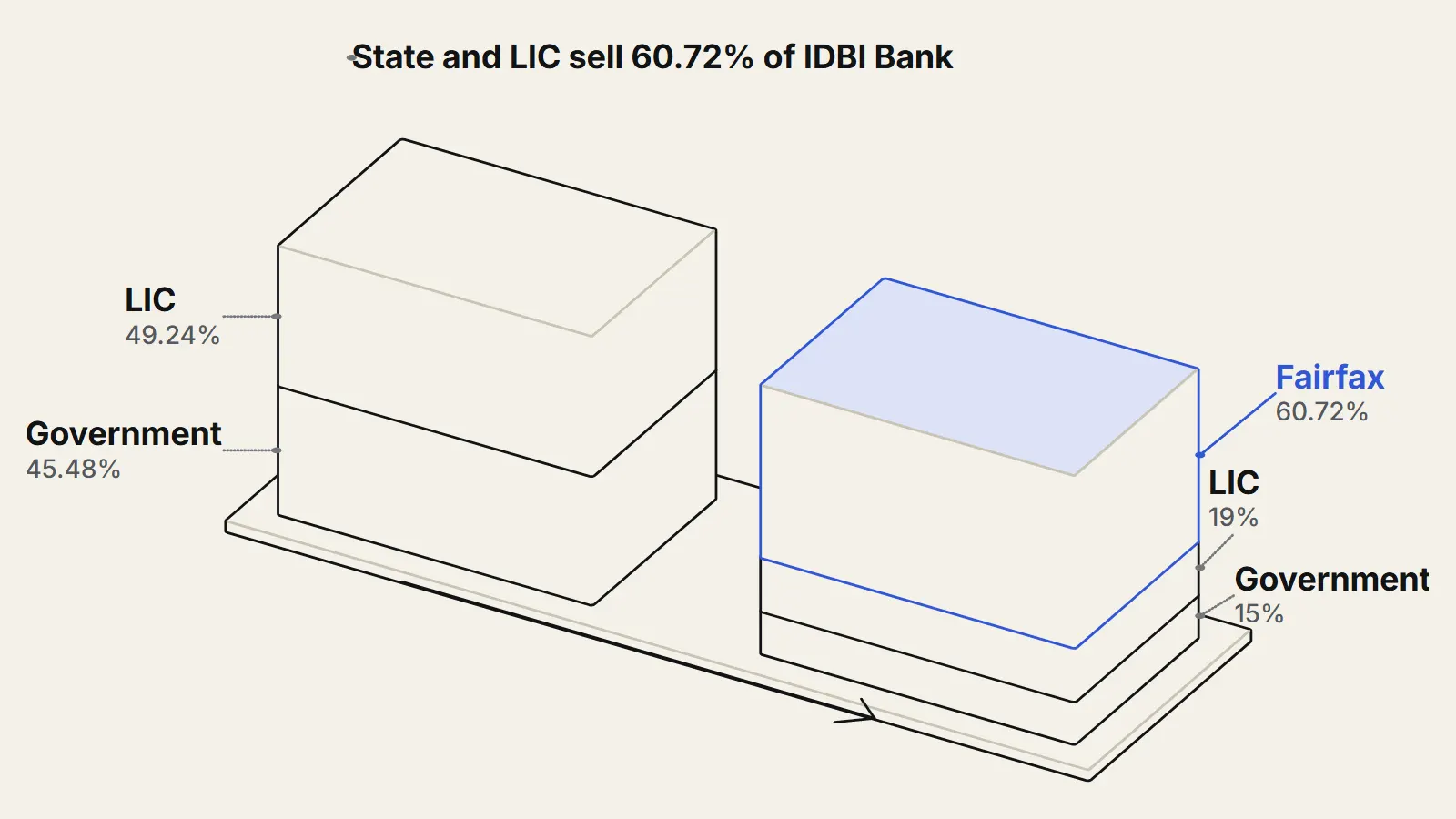
- The Cabinet Committee on Economic Affairs approved on 14 October 2026 the sale of 60.72% of IDBI Bank, held by the government and LIC, to Canada Inc, a Fairfax Financial Holdings company, for ₹52,878.08 crore at ₹81 per share. The sale is subject to RBI approval.
- Outcome
- IDBI Bank's gross NPA ratio fell from 27.47% in FY19 to 2.32% in FY26, and standalone net profit moved from a loss of ₹15,116 crore to a profit of ₹9,513 crore. The sale has not closed, so its effect under the new owner is not yet measured.
IDBI Bank privatisation is the sale of a controlling stake in a bank that the government and the Life Insurance Corporation of India (LIC) own together.4 On 14 October 2026 the Cabinet Committee on Economic Affairs (CCEA) approved the sale of 60.72 percent of IDBI Bank to Canada Inc, a Fairfax Financial Holdings company, for ₹52,878.08 crore, at ₹81 per share3.3 The sale is expected to close by 31 March 2027, subject to approval from the Reserve Bank of India (RBI).5
This IDBI Bank privatisation case study covers how IDBI Bank got into trouble, why the government chose to sell, how the sale was run, the strongest case against it, and what the numbers show since 2019. Where the evidence is thin we say so, and we separate what officials say from what the records show.
Before
From development bank to bank
IDBI was set up in 1964 under the IDBI Act, 1964, and was at first wholly owned by the Reserve Bank of India. The Industrial Development Bank (Transfer of Undertaking and Repeal) Act, 2003 repealed that Act and turned the institution into a limited company, IDBI Ltd. In September 2004 the RBI recognised it as a scheduled bank.4
In 2005 the commercial banking arm, IDBI Bank, was merged into IDBI. In 2006 IDBI took over United Western Bank in a rescue, which raised its branch count from 195 to 425.4
The bad-loan crisis
A bank earns most of its money from loans, so when borrowers stop repaying, the bank has a problem. Loans that are no longer being repaid as agreed are called non-performing assets (NPAs), and the bank must set aside provisions against them, which cut into profit and capital.
Capital is the bank's own money, the cushion that absorbs losses before depositors or lenders are exposed. When losses eat into that cushion, a bank must raise new capital, slow its lending, or both. Because of that link, a rise in bad loans is a problem for the bank's owners long before it is a problem for its customers.
The bank's own figures show the scale. In FY19, the year to March 2019, IDBI Bank reported a standalone net loss of ₹15,116.30 crore2 against total income of ₹25,371.53 crore.2 Its gross NPA ratio was 27.47 percent, against 27.95 percent a year earlier, and its net NPA ratio fell to 10.11 percent from 16.69 percent.2
| Measure | FY19 (year to March 2019) | Year earlier |
|---|---|---|
| Standalone net loss | ₹15,116.30 crore | Not in our sources |
| Total income | ₹25,371.53 crore | Not in our sources |
| Gross NPA ratio | 27.47% | 27.95% |
| Net NPA ratio | 10.11% | 16.69% |
The standalone figure is the bank's own accounts without its subsidiaries. The consolidated figure includes the group's subsidiaries, and the gap between the two is small in FY19.2
The regulator had acted earlier. In May 2017 the RBI placed IDBI Bank under its Prompt Corrective Action (PCA) framework because of a surge in its non-performing assets and a negative return on assets. Under PCA the bank faced restrictions on its business, including curbs on lending and branch expansion.6
At 31 December 2016 the bank's net NPAs stood at ₹20,949 crore, or 9.61 percent of advances.6 We could not reconcile the return-on-assets figure for the same quarter across the sources we checked, so we leave it out.
The gross NPA ratio peaked at 31.78 percent in September 2018, when the net NPA ratio was 17.30 percent. Large corporate borrowers had defaulted after aggressive lending in the mid-to-late 2000s, and Kingfisher Airlines was among the prominent cases.7
Between 2010 and 2020 the government infused around ₹25,000 crore into the bank.7 The government's share of the 2019 infusion, ₹4,557 crore, falls inside that period.8
The chart shows selected years only. We leave out FY22 because two sources give different figures for March 2022, and we could not settle which is right. The FY20 and FY21 profit figures and the FY21 NPA ratio come from a Business Today report of May 2021.9
A bank with large losses has less capital to absorb the next shock, and less room to lend. That is the mechanism behind the PCA rules: the regulator limits what a weak bank can do until its capital and asset quality recover.
Two figures from the table need a short explanation. Gross NPAs are all the loans that are no longer being repaid as agreed. Net NPAs are the same figure after the provisions the bank has set aside, so the net ratio is always lower, and the gap between the two shows how much of the damage the bank had already booked.
Rescued by LIC and the state
LIC became the bank's controlling shareholder in January 2019. It completed the acquisition of a 51 percent controlling stake on 21 January 2019, with a total investment of ₹21,624 crore.24
More capital followed. In September 2019 the Union Cabinet approved a one-time infusion of ₹9,300 crore. LIC's share was 51 percent, or ₹4,743 crore, and the government's share was 49 percent, or ₹4,557 crore.8
The bank was not the only public lender that needed help. Between FY17 and FY21 the government recapitalised public sector banks in India with ₹3,10,997 crore, of which ₹34,997 crore came from the budget and ₹2,76,000 crore through recapitalisation bonds, a Lok Sabha written reply by Minister of State for Finance Bhagwat Karad said.10
That scale matters for the IDBI Bank privatisation debate. Public money went into state-owned banks in large amounts, and whether that was the right use of the money is a question the later parts of this case study take up.
The decision
Why is IDBI Bank being privatised?
The intention to cut the government's stake in IDBI goes back to the Budget for 2016-17. In it, Finance Minister Arun Jaitley said: “Government will take it forward and also consider the option of reducing its stake to below 50 per cent.”11 The Budget for 2021-22, presented on Monday 1 February 2021, announced that two public sector banks and one general insurance company would be privatised, besides IDBI Bank. The speech did not name the two banks.12
Money is the other reason on the record. The Centre had budgeted ₹80,000 crore from disinvestment and asset monetisation for FY27, and it had raised ₹62,124 crore by 10 September 2026. Of that, ₹55,757 crore came from disinvestment and ₹6,367 crore from asset monetisation.13
The government's share of the IDBI sale is expected to bring around ₹26,000 crore, and the same report says total receipts could rise to around ₹88,000 crore if the transaction closes within FY27.13 These are estimates. The receipts depend on the price and on the deal closing, and the sale has not closed.
The buyer must also pass the RBI's tests. Potential bidders received security clearance from the Home Ministry and underwent the RBI's fit-and-proper assessment in July 2024.14
Fit and proper is the RBI's test of whether a prospective investor is suitable to own a bank. The test is applied before a buyer can sign, so the RBI's approval is the step that decides whether a deal can proceed at all.
How the IDBI Bank stake sale worked
The formal process opened with expressions of interest. The government issued the Preliminary Information Memorandum on 7 October 2022, inviting interest in the 60.72 percent held by the government (30.48 percent) and LIC (30.24 percent).3 Five parties submitted expressions of interest, four qualified, and two submitted techno-financial bids.3
The Cabinet Committee on Economic Affairs had approved strategic disinvestment, including transfer of management control, in principle in May 2021.14 Financial bids were invited in January 2026, and Fairfax and Emirates NBD submitted financial offers in February 2026.14
The first round did not close the deal. The discovered bid of ₹75 per share fell short of the ₹94.42 reserve price, so the bids were rejected.15 The government paused the process in March 2026 after bids fell below the reserve price, and it revived the exercise in April 2026.14
The government invited revised best offers in May 2026.15 Both bidders submitted revised offers in July 2026.14 The benchmark was ₹75.99 per share, the average of two independent valuations.3 The valuations used March 2026 accounts and two methods: a market multiple method against public sector bank peers, and an asset valuation method.15
Two terms need explaining. A reserve price is the minimum a seller will accept, so bids below it are turned down. Transfer of management control means the buyer takes over how the bank is run, not just a share of its profits.
The CCEA's approval on 14 October 2026 covered the 60.72 percent stake, for ₹52,878.08 crore, according to Business Today. The winning bid of ₹81 per share was above the ₹75.99 benchmark.3
The service conditions will be fully protected.
— DIPAM Secretary Arunish Chawla
Business Today reported the remark on 16 October 2026.16
- 2016-17 BudgetFinance Minister says the government will consider reducing its IDBI stake below 50 percentSource 11 (opens the source in a new tab)
- 1 Feb 2021Budget 2021-22 announces privatisation of two public sector banks and one general insurer, besides IDBI BankSource 12 (opens the source in a new tab)
- May 2021CCEA approves strategic disinvestment of IDBI Bank in principle, including transfer of management controlSource 14 (opens the source in a new tab)
- 7 Oct 2022Preliminary Information Memorandum issued; expressions of interest invited for 60.72%Source 3 (opens the source in a new tab)
- Jul 2024Potential bidders receive Home Ministry security clearance and the RBI's fit-and-proper assessmentSource 14 (opens the source in a new tab)
- Jan 2026Government invites financial bidsSource 14 (opens the source in a new tab)
- Feb 2026Fairfax and Emirates NBD submit financial offersSource 14 (opens the source in a new tab)
- Mar 2026Process paused after bids fall below the reserve priceSource 14 (opens the source in a new tab)
- Apr 2026Government revives the disinvestment exerciseSource 14 (opens the source in a new tab)
- Jul 2026Revised financial bids invited and received from both biddersSource 14 (opens the source in a new tab)
- 14 Oct 2026CCEA approves sale of 60.72% to Canada Inc for ₹52,878.08 croreSource 3 (opens the source in a new tab)
- 31 Mar 2027Expected completion, subject to RBI approvalSource 5 (opens the source in a new tab)
| Holder | Before the sale | After the sale (as announced) |
|---|---|---|
| Government of India | 45.48% (30 Sept 2025) | 15% |
| LIC | 49.24% (30 Sept 2025) | 19%, to be cut to 15% |
| Canada Inc (Fairfax Financial Holdings company) | 0% | 60.72% |
| Public and other holders | 5.28% (our calculation) | 5.28% (our calculation), or about 9.28% once LIC is at 15% |
Is IDBI Bank a private bank?
As of 24 October 2026, no. The government and LIC own IDBI Bank together, and the sale to Fairfax has not closed.4 On 14 October 2026 the CCEA approved the sale of 60.72 percent of the bank to Canada Inc, a Fairfax Financial Holdings company.3 The sale is expected to close by 31 March 2027, subject to RBI approval.5 After it, the government would hold 15 percent and LIC 19 percent.3
What the IDBI Bank privatisation still needs
The sale is conditional. Fairfax must give the RBI its technical documents and present its eligibility. The share purchase agreement is executed only after regulatory approval.5 After the agreement is signed, the buyer must make an open offer to minority shareholders.17
An open offer is an invitation to the other shareholders to sell their shares to the buyer on set terms, so that small holders are not left behind when control changes hands. The reporting we opened does not give the offer price, size or timing, so we cannot say what minority holders would receive.
LIC's stake is the other moving part. The regulator has directed LIC to bring its residual holding down from 19 percent to 15 percent after the divestment.17 Tribune reporting gives no deadline for that cut.5 Outlook Business reports two years under RBI norms, which we set out below.18
The same step adds about 4 percentage points to the public float, which the government says will be available to retail investors. On our calculation, public and other holders would then hold about 9.28 percent, up from about 5.28 percent.17
The government expects completion by 31 March 2027, subject to RBI approval. Business Today reports that the deal “would hopefully be closed” before the end of the current financial year, a hope rather than a firm date.517
Taken together, the record shows an IDBI Bank privatisation that went through several rounds, a first round that did not clear the reserve price, and a second round that the government accepted. The sale is still subject to the RBI, the agreement, the open offer and LIC's cut, so the record can describe the decision but not yet its results.
What the bank unions argue against the IDBI Bank sale
The strongest case against the sale comes from the bank unions, and it is worth stating in full. The United Forum of Bank Unions (UFBU) groups seven unions and says it represents 90 percent of the banking workforce. Its members wore black badges on 16 October 2026, two days after the Cabinet approval of 14 October.19
The 2003 assurance is central to the argument against IDBI Bank privatisation. AIBOC's writer prints it as: “Government shall at all times maintain not less than 51% equity holding in IDBI as a Banking Company.” The writer attributes it to Finance Minister Jaswant Singh in Parliament in December 2003.20 We could not open the parliamentary record, so we give the wording as the writer printed it and have not checked it against the official debate.
The finance ministry answers the 2003 point from the statute. It says that during the 2003 debate the government moved an amendment to restrict the dilution of its stake, and that the amendment was rejected and is not in the Act. On 17 December 2018 the Delhi High Court, in All India IDBI Officers' Association v. Union of India, said: “there is no ambiguity in the language of the IDBI Repeal Act, 2003 and there is no scope to read any provision into the said enactment which proscribes the government from reducing or divesting its stake in IDBI Ltd.”11
The court also said that promissory estoppel could not be invoked to stop the government reducing its stake.11 The unions' point concerns what was said in Parliament, while the ministry and the court point to what the Act contains.
The unions object to the buyer as well as the price. The UFBU said the deal “amounts not only to privatisation but also to ‘foreignisation’ of the bank.”21
Government talks about Atmanirbhar but this important bank with huge public savings is being sold to a foreign investor.
— United Forum of Bank Unions (UFBU), quoted by Business Today, 15 October 2026
The price is the second line of attack. The United Forum of IDBI Bank Officers and Employees said the public “deserves evidence that a national asset is not being transferred at a throwaway price.”19 The approval rests on a valuation. As Business Today reports (https://www.businesstoday.in/amp/latest/corporate/story/centre-approves-fairfax-financials-rs52878-crore-bid-for-60-72-stake-in-idbi-bank-561590-2026-10-14), the ₹81 winning bid is above the ₹75.99 fair value, the average of two independent valuations3. On our calculation, ₹81 is about 6.6 percent above ₹75.99.3
The government's answer, as the AIBOC piece reports it, is that IDBI's service conditions will not change. The same writer points to CSB Bank, which Fairfax already controls, as a warning about foreign ownership. We could not confirm the claims the writer makes about CSB's workforce from a source we opened, so we leave them out.20
The strongest research on the other side is about public banking in general, not about this sale. Burgess and Pande, in the American Economic Review (https://ideas.repec.org/a/aea/aecrev/v95y2005i3p780-795.html), write that the rural branch expansion programme “significantly lowered rural poverty, and increased non-agricultural output.”22 The paper studies what opening branches in unbanked places did in the 1970s and 1980s. It does not test whether a bank that is already profitable should be sold in 2026, so we use it to show the best case for public banking, not to settle the sale.
Who paid for the recovery?
The AIBOC writer’s argument is about who carried the risk. The article describes LIC as India’s policyholders and says they paid ₹21,624 crore for 51 percent of the bank in January 2019.20 It adds that LIC and the government put in ₹9,300 crore more in September 2019. On this view, the public funded the recovery, and a sale hands the gain to a buyer.20
The “already profitable” argument rests on three years of results. IDBI reported a net profit of ₹5,634 crore in FY24, up 55 percent and an all-time high at the time.23 It reported ₹7,515 crore in FY25 and ₹9,513 crore in FY26, up 27 percent on FY25.1 The writer’s point is that the bank now earns money, so a sale passes profits to a new owner that the public helped build.
The other side can read the same figures. The profits came after the ₹9,300 crore capital injection in 2019 from LIC and the government.20 Both sides can cite the same numbers and still disagree about who should own the bank that produces them.
The writer dates the 2003 assurance precisely. The Finance Minister is said to have given it in the Lok Sabha on 8 December 2003 and in the Rajya Sabha on 15 December 2003.20 We have not checked the official debates, so the dates are the writer’s, not ours.
The foreign-control argument is about ownership, not price. The buyer is Fairfax Financial Holdings of Toronto, and the unions say a bank holding large public savings should not pass to a foreign owner at all.20 That is a claim about who owns the bank, so a higher bid does not answer it.
What happened
The IDBI Bank turnaround in numbers
IDBI Bank made large losses in the late 2010s. Its standalone net loss was ₹15,116.30 crore in FY19, and its gross NPA ratio, the share of loans that had turned bad, was 27.47 percent.2 Its profit rose to ₹3,645 crore in FY23, the highest to that point.24 In FY26 it reported a net profit of ₹9,513 crore, up 27 percent on FY251.1
The gross NPA ratio was 2.32 percent at March 2026, and the net NPA ratio was 0.15 percent.1 The recovery came while LIC and the government still owned the bank. The sale was approved after the recovery, not before it.
The same Business Standard review gives a capital adequacy ratio of 26.65 percent at March 2026, with deposits of ₹3.47 trillion (up 12 percent) and net advances of ₹2.54 trillion (up 16 percent) for the year.7 By June 2026 the net NPA ratio was 0.16 percent and the capital adequacy ratio was 26.92 percent.15
What happens to the IDBI Bank share price?
The share price moved sharply after the approval. IDBI Bank shares closed at about ₹90 on 14 October 2026, above the ₹81 bid.15 Ascendants reports a fall of more than 7 percent on 15 October, and says the ₹81 deal price was below the previous day's market close, which helps explain why the announcement did not lift the stock.25
The chart sets the ₹81 bid against the ₹75.99 fair value and against the stock's valuation-period range of ₹61.01 to ₹118.38 per share.3 The range is wide, so one day's price is a weak guide to what the bank is worth. This is not investment advice.
Has bank privatisation in India improved banking?
The evidence from India is indirect. Between 2015 and 2020 the public sector banks' share of loans fell from 74.28 percent to 59.8 percent, while private banks rose from 21.26 percent to 36.04 percent, according to RBI data as reported by ThePrint.26 Deposits moved the same way, with the public sector share falling from 76.26 percent to 64.75 percent.26
These figures show who gained market share. They do not show what a sale does to one bank once its owner changes, which is the question the IDBI sale raises. Market share and bank performance are different tests, and the IDBI sale has not closed, so its effects under a new owner are not yet measured.
How the wider banking sector recovered
IDBI was not the only bank in trouble. The government recapitalised public sector banks with ₹3,10,997 crore over the five financial years FY17 to FY21, a Lok Sabha reply said in February 2022.10 About ₹34,997 crore came from the budget, and ₹2,76,000 crore came from recapitalisation bonds.10
The bad-loan problem was sector-wide.
The Reserve Bank’s Financial Stability Report put gross NPAs at 2.8 percent for public sector banks in March 2025, down from 3.7 percent in March 2024. Private banks stood at 2.8 percent, stable on the year.27 The overall ratio was 2.3 percent of total loans at 31 March 2025.27
Public sector banks earned a combined record ₹1,78,364 crore in FY25, up 26 percent on FY24’s ₹1.41 lakh crore. State Bank of India alone earned ₹70,901 crore, up 16 percent.28 IDBI’s turnaround is one case within that shift, and the figures alone do not show its cause.
The comparison matters for one reason. IDBI’s gross NPA ratio fell from 27.47 percent in FY19 to 2.32 percent in FY26.21 The sector’s ratio also fell after March 2018.29 The recovery was not limited to IDBI, which matters for judging the sale.
What is still to happen in the IDBI Bank sale?
The IDBI Bank privatisation is not finished. The winning bidder must provide its documents to the Reserve Bank of India, and the share purchase agreement is signed only after the RBI clears the buyer.5 Completion is expected by 31 March 2027, subject to RBI approval.5
After the agreement is signed, the buyer must make an open offer to minority shareholders. Business Today reports that about 4 percent more of the bank will be available to retail investors as LIC cuts its stake from 19 percent to 15 percent.17
Outlook Business reports the DIPAM Secretary as saying that invested capital will be locked in for three years, that the IDBI brand name will stay the same, and that LIC must bring its stake down to 15 percent within two years under RBI norms.18 Finshots reports a five-year lock-in under RBI promoter rules, which we could not match to the deal terms, so we give the official three-year figure and flag the difference.30
What does the sale mean for the government’s budget?
The IDBI Bank privatisation is also a fiscal event. The Centre budgeted ₹80,000 crore for FY27 from disinvestment and asset monetisation combined, and it had raised ₹62,124 crore by 10 September 2026.13 That total is ₹55,757 crore from disinvestment and ₹6,367 crore from asset monetisation.13
The government’s 30.48 percent stake is estimated to bring around ₹26,000 crore. With that, the total could reach around ₹88,000 crore, about ₹8,000 crore above the target.13 That estimate assumes the deal closes within FY27, so it is a projection, not a receipt.
What economists still disagree on
Five myths about IDBI Bank privatisation
Five claims come up again and again in the debate over IDBI Bank privatisation. We tested each one against the pages we opened. Some hold only in part, and we say so.
| Myth | What the record shows | Verdict |
|---|---|---|
| The price was a throwaway | ₹81 is above both valuers (average ₹75.99) and the rejected ₹75 bid, but below the ~₹90 market price and the old ₹94.42 reserve | Disputed |
| Deposits become unsafe once a bank changes owner | The RBI keeps regulating the bank, and ₹5 lakh deposit insurance applies uniformly to all insured banks | Not supported |
| Foreigners will control the bank | Fairfax gets 60.72% of equity, but its votes are capped at 26%, it needs RBI approval, and must cut equity to 26% within 15 years | Partly true |
| State banks are worse lenders | Public banks' gross NPA ratio fell faster since 2018; in September 2025 it was 2.50% (private 1.73%), but slippage was lower (0.8% vs 1.8%) | Partly true |
| The sale breaks a promise to Parliament or the law | A 2018 Delhi High Court ruling found no bar in the 2003 Act on reducing the stake; unions still cite a 2003 assurance | Not supported in law; promise disputed |
Myth 1: The price was a throwaway
Naresh Biyani of Capwise puts the bid at about 1.2 times book value and about nine times the previous year's profit.15
Vishwanathan Iyer of Great Lakes says more valuation detail is needed to judge whether ₹81 is a bargain. The government did not use the market price, which is volatile and thinly traded.15
Myth 2: Deposits become unsafe once a bank changes owner
Cover was raised from ₹1 lakh to ₹5 lakh from 4 February 202031, and at the end of March 2022, 97.9 percent of accounts were fully protected.31
The bank stays regulated and supervised by the RBI, and the ownership change does not by itself alter existing deposits or loans.7 Lakshmi Vilas Bank’s deposit rates stayed at the old bank’s rates until further notice after its merger into DBS.32
Myth 3: Foreigners will control the bank
Fairfax must cut its equity to 26 percent within 15 years under the RBI's 2020 framework, and the sale needs prior RBI approval under Section 12B.33
The voting cap limits Fairfax's votes, not its equity, and the sources we opened do not say how the board will be composed, so we cannot judge how much influence the buyer will have.33
Myth 4: State banks are worse lenders
In September 2025 the gross NPA ratio was 2.50 percent for public sector banks and 1.73 percent for private banks, and public banks' ratio has fallen more since March 2018.29
The Financial Stability Report put public sector banks at 2.8 percent in March 2025, the same as private banks. Public sector banks had been at 3.7 percent a year earlier27. That report is for a different date, so we do not combine it with the September 2025 figures.27 For how the regulator handled one large rescue, see our YES Bank reconstruction story (https://therealigned.com/story/yes-bank-reconstruction-scheme).
Myth 5: The sale breaks a promise to Parliament or the law
The finance ministry says a 2003 amendment limiting dilution was rejected and is not in the Act; the court found no bar on reducing the stake.11
Unions still cite a 2003 assurance to Parliament that the government would keep at least 51 percent of IDBI, so the promise is disputed.19
Should the government hold a stake in banks?
The broadest evidence against state ownership comes from La Porta and co-authors (https://ideas.repec.org/a/bla/jfinan/v57y2002i1p265-301.html). Across countries, higher government ownership of banks in 1970 was associated with slower later financial development and lower growth of income per head and productivity.34 The authors read the results as support for political theories of state ownership. The data are cross-country and measure bank ownership in one year, 1970, so the study cannot show what a single sale would do.
India offers a closer test. Cole found that government-owned banks raised agricultural credit by 5 to 10 percentage points in election years, with the largest increases in districts where the race was close.35 The pattern was absent in non-election years and in private bank lending, and the election-year credit booms did not measurably change agricultural output.
Burgess and Pande make the case for public banking. From 1977 to 1990 India required banks to open four branches in unbanked locations for each new branch in a banked one.22 Their estimates show that the rural branch programme significantly lowered rural poverty and increased non-agricultural output. It is the best evidence we found that a state-directed rule reached people who had no bank.
None of these studies tests this sale. Cole and Burgess and Pande study state lending in India's past, La Porta's data start in 1970, and the two privatisation papers below cover other countries. The approval is conditional on the RBI's fit-and-proper assessment and a compliance roadmap, which is a test set by the regulator rather than the owner.3 The studies can inform the owner question, but they do not settle it.
Two papers on bank privatisation itself add to the picture. A 2005 paper finds that privatisation usually improves bank efficiency, and that the gains are greater when the government fully relinquishes control, when banks go to strategic investors, when foreign banks may take part, and when the government does not restrict competition.36
Its conclusion is direct: “Continued state ownership, even of minority shares, harms the performance of privatized banks.”36 In 1999 government-controlled banks held more than 30 percent of banking assets in a quarter of developing countries with data, against 2 of 20 developed countries.36
A World Bank working paper studies Nigeria, which divested 14 banks, more than half of banking assets, in the early 1990s.37 Nine privatised banks improved in a panel of Nigerian banks from 1990 to 2001: before privatisation they performed significantly worse than private banks, and privatisation effectively closed that gap, but they gained nothing beyond other private banks.37 Banks with continuing minority government ownership performed poorly.37
The paper's introduction adds that Mexico's early-1990s bank privatisation went badly enough to prompt re-nationalisation after the Tequila crisis, and that its performance improved only after a second round in the late 1990s that encouraged foreign ownership.37 Early privatisations in the Czech Republic and Poland kept large state stakes and discouraged foreign owners.37
Both papers flag continuing state ownership as a drag, and neither studies this sale. For the IDBI Bank privatisation, the open question is the residual stake: after the sale the government would hold 15 percent and LIC 19 percent, 34 percent together.33 The regulator has directed LIC to cut its holding to 15 percent.17 The research does not settle whether that residual stake is the kind of minority ownership these papers describe.
What do bank unions want, and what has their resistance done?
The unions have resisted before. The clearest example is the bank unions strike of 15 and 16 March 2021, when the United Forum of Bank Unions, an umbrella of nine unions at the time, struck for two days against the plan to privatise two public sector banks.38 The unions claimed about 10 lakh participants. Branches of private banks such as ICICI, HDFC and Axis stayed open.38 We did not find a source that shows the strike changed the government’s plan.
On 16 October 2026 the unions of the United Forum of Bank Unions wore black badges and called for the sale to be rolled back. The forum calls the deal foreignisation as well as privatisation, and it objects to a foreign buyer for a bank that holds large public savings.1921 Its other concerns are the price, a 2003 assurance to Parliament that the government would keep at least 51 percent of the bank, and the bank’s profits. The officers’ forum asks for public evidence on the price.19
Here is what the evidence shows on the IDBI Bank privatisation. The price and profit figures can be checked against the approval report and the results pages, and we checked them. The 2003 assurance is quoted by an AIBOC writer, who attributes it to a statement in Parliament in December 2003.20 We could not open the parliamentary record, so we have not confirmed the wording, and the finance ministry says a 2003 amendment limiting dilution was rejected and is not in the Act.11 The government's position, as that writer reports it, is that service conditions will not change, and the DIPAM Secretary's remark in the decision section says they will be fully protected. The unions' claim to represent 90 percent of the banking workforce is their own figure, and no source we opened gives employee or job numbers for the IDBI sale. The same writer makes claims about wages and contracts at CSB Bank that we could not check, so we leave them out.
Would IDBI have kept improving under LIC and the state, and is a strategic foreign owner the best way to keep it improving?
Lessons
What the IDBI case teaches public sector banks
Key takeaways
- The turnaround came before the sale. IDBI Bank went from a standalone net loss of ₹15,116 crore in FY19 to a net profit of ₹9,513 crore in FY26, under the shareholders who are now selling.
- The price is the number to test. ₹81 per share was above the ₹75.99 average valuation and below the close of about ₹90 on 14 October 2026.
- Depositors are protected by deposit insurance and by the regulator. The cover is ₹5 lakh per depositor, in force since 4 February 2020.
- Ownership alone does not decide bank health. In September 2025 public sector banks had a higher gross NPA ratio than private banks, 2.50 percent against 1.73 percent, but a lower slippage ratio, 0.8 percent against 1.8 percent.
- The research says the degree of exit matters. Continuing minority state ownership was linked with weaker performance in two privatisation studies, but neither studies this sale.
What carries over to other public sector banks in India is the checklist, not the verdict. A sale needs a stated benchmark, a valuation the public can read, and a fit-and-proper test by the regulator before the deal closes. Cole’s election-year evidence and Burgess and Pande’s branch evidence suggest that how a state bank lends matters as much as who owns it. The two privatisation papers add that the degree of exit matters as well as the change of owner.
What does not carry over is the IDBI history itself. The bank had a disputed 2003 assurance, a 2019 change of control to LIC, and a turnaround that began before the sale, and the sale has not closed. Our figures describe one bank in one country, so other public sector banks need their own evidence before the same conclusions apply.
Sources
- 1IDBI Bank annual report FY 2025-26: record profit, robust asset quality and sustained growth (opens the source in a new tab) · ScanX, 2026 · Reporting · https://scanx.trade/stock-market-news/companies/idbi-bank-annual-report-fy-2025-26-record-profit-robust-asset-quality-and-sustained-growth/43942302
- 2IDBI Bank net loss widens to Rs 15,013 crore in FY19 on higher provisions (opens the source in a new tab) · Business Today, 2019 · Reporting · https://www.businesstoday.in/latest/corporate/story/idbi-bank-net-loss-widens-to-rs-15013-crore-fy19-higher-provisions-198487-2019-05-30
- 3Centre approves Fairfax's Rs 52,878 crore bid for 60.72% stake in IDBI Bank (opens the source in a new tab) · Business Today, 2026 · Reporting · https://www.businesstoday.in/amp/latest/corporate/story/centre-approves-fairfax-financials-rs52878-crore-bid-for-60-72-stake-in-idbi-bank-561590-2026-10-14
- 4IDBI Bank (opens the source in a new tab) · Wikipedia, 2026 · Reporting · https://en.wikipedia.org/wiki/IDBI_Bank
- 5IDBI Bank stake sale expected to be completed by March 2027, subject to RBI approval (opens the source in a new tab) · Tribune India, 2026 · Reporting · https://www.tribuneindia.com/news/business/idbi-bank-stake-sale-expected-to-be-completed-by-march-2027-subject-to-rbi-approval/
- 6IDBI Bank slumps after RBI invokes prompt corrective action (opens the source in a new tab) · The Week, 2017 · Reporting · https://theweek.in/news/biz-tech/idbi-bank-slumps-after-rbi-invokes-prompt-correction-action.html
- 7The fall and rise of IDBI Bank: from bad loan crisis to the Fairfax deal (opens the source in a new tab) · Business Standard, 2026 · Reporting · https://www.business-standard.com/industry/banking/the-fall-and-rise-of-idbi-bank-from-bad-loan-crisis-to-the-fairfax-deal-126101401304_1.html
- 8Govt, LIC infuse over Rs 9,000 crore into IDBI Bank (opens the source in a new tab) · Goodreturns, 2019 · Reporting · https://www.goodreturns.in/news/2019/09/03/govt-lic-infuse-over-rs-9-000-crore-in-idbi-bank-1037897.html
- 9IDBI Bank share gains 5 per cent after lender turns profitable in FY21 (opens the source in a new tab) · Business Today, 2021 · Reporting · https://www.businesstoday.in/markets/story/idbi-bank-share-gains-5-per-cent-after-lender-turns-profitable-in-fy21-295008-2021-05-04
- 10Govt recapitalised PSBs with Rs 3.10 lakh crore capital infusion over last five years: minister (opens the source in a new tab) · Devdiscourse (PTI), 2022 · Reporting · https://www.devdiscourse.com/article/business/1913634-govt-recapitalised-psbs-with-rs-310-lakh-cr-capital-infusion-over-last-five-years-min
- 11IDBI Bank sale to Fairfax: FinMin cites 2003 law, Delhi HC judgment (opens the source in a new tab) · Business Standard, 2026 · Reporting · https://www.business-standard.com/industry/banking/idbi-bank-sale-to-fairfax-finmin-cites-2003-law-delhi-hc-judgment-126101700233_1.html
- 12Privatisation is here: these two public sector banks could be the first ones to be sold (opens the source in a new tab) · ThePrint, 2021 · Reporting · https://theprint.in/economy/privatisation-is-here-these-two-public-sector-banks-could-be-the-first-ones-to-be-sold/596960/
- 13Government beats disinvestment target FY27: IDBI Bank sale (opens the source in a new tab) · Kotak Neo, 2026 · Reporting · https://www.kotakneo.com/news/market-news/government-beat-disinvestment-target-fy27-idbi-bank-sale/
- 14IDBI Bank stake sale for 52,878 crore: how nine-year journey from RBI restrictions to Fairfax takeover unfolded (opens the source in a new tab) · Free Press Journal, 2026 · Reporting · https://www.freepressjournal.in/business/idbi-bank-stake-sale-for-52878-crore-how-nine-year-journey-from-rbi-restrictions-to-fairfax-takeover-unfolded
- 15Why was IDBI Bank sold at ₹81 a share? (opens the source in a new tab) · Business Standard, 2026 · Reporting · https://www.business-standard.com/companies/news/why-was-idbi-bank-sold-at-rs-81-a-share-understanding-the-valuation-126101500541_1.html
- 16IDBI Bank sale to close by fiscal end after RBI clearance: DIPAM Secretary (opens the source in a new tab) · Business Today, 2026 · Reporting · https://www.businesstoday.in/latest/economy/story/idbi-bank-sale-to-close-by-fiscal-end-after-rbi-clearance-dipam-secretary-562102-2026-10-16
- 17Additional 4% public float in IDBI Bank to be available for retail investors once LIC pares stake (opens the source in a new tab) · Business Today, 2026 · Reporting · https://www.businesstoday.in/india/story/additional-4-public-float-in-idbi-bank-to-be-available-for-retail-investors-once-lic-pares-stake-561951-2026-10-16
- 18IDBI Bank gets new owner as Fairfax wins 60.72% stake (opens the source in a new tab) · Outlook Business, 2026 · Reporting · https://www.outlookbusiness.com/corporate/idbi-bank-gets-new-owner-as-fairfax-wins-6072-stake-sale
- 19IDBI Bank sale to Fairfax faces union resistance; black-badge protest on October 16 (opens the source in a new tab) · Business Today, 2026 · Reporting · https://www.businesstoday.in/industry/banks/story/idbi-bank-sale-to-fairfax-faces-union-resistance-black-badge-protest-on-october-16-561910-2026-10-15
- 20Promised to Parliament, sold to Toronto: AIBOC leader writes on IDBI stake sale to Fairfax (opens the source in a new tab) · The Kanal, 2026 · Essay · https://thekanal.in/en-IN/details/promised-to-parliament-sold-to-toronto-aiboc-leader-writes-on-idbi-stake-sale-to-fairfax-29081
- 21UFBU opposes IDBI Bank sale, demands rollback of foreign investor deal (opens the source in a new tab) · The Kanal, 2026 · Reporting · https://thekanal.in/en-IN/details/ufbu-opposes-idbi-bank-sale-demands-rollback-of-foreign-investor-deal-99256
- 22Do Rural Banks Matter? Evidence from the Indian Social Banking Experiment (opens the source in a new tab) · American Economic Review 95(3): 780-795, 2005 · Paper · https://ideas.repec.org/a/aea/aecrev/v95y2005i3p780-795.html
- 23IDBI Bank reports 55% rise in profits on YoY basis (opens the source in a new tab) · Business Minutes, 2024 · Reporting · https://www.businessminutes.in/2024/05/idbi-bank-reports-55-rise-in-profits-on-yoy-basis.html
- 24IDBI Bank Q4 results: net profit rises 64%, dividend of Rs 1 per share announced (opens the source in a new tab) · Business Today, 2023 · Reporting · https://www.businesstoday.in/industry/banks/story/idbi-bank-q4-results-net-profit-rises-64-dividend-of-rs-1per-share-announced-379394-2023-04-29
- 25IDBI Bank sale to Fairfax, Rs 52,878 crore deal: share price explained (opens the source in a new tab) · Ascendants, 2026 · Reporting · https://ascendants.in/my-money/idbi-bank-sale-fairfax-52878-crore-deal-share-price-explained/
- 26In just 5 years, private banks have narrowed public sector's huge lead in loans, deposits (opens the source in a new tab) · ThePrint, 2020 · Reporting · https://theprint.in/economy/in-just-5-years-private-banks-have-narrowed-public-sectors-huge-lead-in-loans-deposits/550570/
- 27Scheduled commercial banks asset quality improves; gross NPAs fall to 2.3%: RBI (opens the source in a new tab) · All India Radio (newsonair), 2025 · Reporting · https://www.newsonair.gov.in/scheduled-commercial-banks-asset-quality-improves-gross-npas-fall-to-2-3-rbi
- 28Public sector banks log record 1.78 lakh crore profit in FY25 (opens the source in a new tab) · Free Press Journal, 2025 · Reporting · https://www.freepressjournal.in/business/public-sector-banks-log-record-178-lakh-crore-profit-in-fy25-up-26-from-last-year-sbi-leads-surge
- 29Gross NPAs of Scheduled Commercial Banks (SCBs) for domestic operations reach a historic low of 2.15% as of September, 2025 (opens the source in a new tab) · Press Information Bureau, Ministry of Finance, 2026 · Primary source · https://www.pib.gov.in/PressReleasePage.aspx?PRID=2225442®=3&lang=1
- 30IDBI Bank is finally being sold (opens the source in a new tab) · Finshots, 2026 · Reporting · https://finshots.in/markets/idbi-bank-is-finally-being-sold/
- 31Measures taken by the Government to protect the interest of investors/account holders in the bank (opens the source in a new tab) · Press Information Bureau, Ministry of Finance, 2022 · Primary source · https://www.pib.gov.in/PressReleasePage.aspx?PRID=1849973®=48&lang=2
- 32Amalgamation of Lakshmi Vilas Bank with DBS Bank India Limited (opens the source in a new tab) · DBS Group (newsroom), 2020 · Primary source · https://www.dbs.com/newsroom/Amalgamation_of_Lakshmi_Vilas_Bank_with_DBS_Bank_India_Limited
- 33What RBI rules say on foreign ownership and control (opens the source in a new tab) · Business Standard, 2026 · Reporting · https://www.business-standard.com/companies/news/idbi-bank-fairfax-deal-what-rbi-rules-say-on-foreign-ownership-and-control-126101500482_1.html
- 34Government Ownership of Banks (opens the source in a new tab) · Journal of Finance 57(1): 265-301, 2002 · Paper · https://ideas.repec.org/a/bla/jfinan/v57y2002i1p265-301.html
- 35Fixing Market Failures or Fixing Elections? Agricultural Credit in India (opens the source in a new tab) · American Economic Journal: Applied Economics 1(1): 219-50, 2009 · Paper · https://www.aeaweb.org/articles?id=10.1257%2Fapp.1.1.219
- 36Bank privatization in developing countries: A summary of lessons and findings (opens the source in a new tab) · Journal of Banking & Finance, 2005 · Paper · https://www.sciencedirect.com/science/article/abs/pii/S0378426605000440
- 37Bank Privatization and Performance: Empirical Evidence from Nigeria (opens the source in a new tab) · World Bank Policy Research Working Paper 3511, 2005 · Paper · https://documents1.worldbank.org/curated/en/255841468780948667/pdf/wps3511.pdf
- 38Nationwide strike impacts banking services of PSU banks (opens the source in a new tab) · Tribune India, 2021 · Reporting · https://www.tribuneindia.com/news/business/nationwide-strike-impacts-banking-services-of-psu-banks-225506