No single cause explains the Great Depression, but most economists agree on the main mechanism: a shock that began as an ordinary downturn in 1929 became a catastrophe because the money supply collapsed, banks failed in waves, and countries on the gold standard (https://therealigned.com/story/the-gold-standard-and-why-it-ended) were unable or unwilling to fight deflation. The leading accounts differ on which link mattered most, with Milton Friedman and Anna Schwartz stressing money, Ben Bernanke credit, and Barry Eichengreen the gold standard. They are better seen as pieces of one chain than as rivals.
How did the Great Depression start?
According to the Federal Reserve history essay (https://www.federalreservehistory.org/essays/great-depression), the expansion of the 1920s ended in August 19291. In 1928 and 1929 the Fed had raised interest rates to curb speculation in securities, which slowed the U.S. economy. 1 The essay also lists a stock market (https://therealigned.com/story/how-the-stock-market-works) crash in 1929, but it places the main weight on what followed: from the fall of 1930 to the winter of 1933, the money supply fell by nearly 30 percent, and average prices fell by a similar amount. 1
What did Friedman and Schwartz argue about money?
Friedman and Schwartz's 1963 history of U.S. money argued that the collapse of 1929 to 1933 was driven by monetary forces. Bernanke, who later led the Fed, summarised their view in a 2002 speech (https://www.federalreserve.gov/boarddocs/speeches/2002/20021108/default.htm): banking panics were made far worse by institutional weaknesses and by bad doctrine, and the Fed was excessively passive and made many poor decisions. 2 The Fed's own history agrees that the failure to stop the fall in the money supply was among its most serious omissions, and says the Fed did not act as lender of last resort during the panics partly because its governors disagreed among themselves. 1 Bernanke told Friedman and Schwartz that the Fed had been to blame and apologised on its behalf. 2
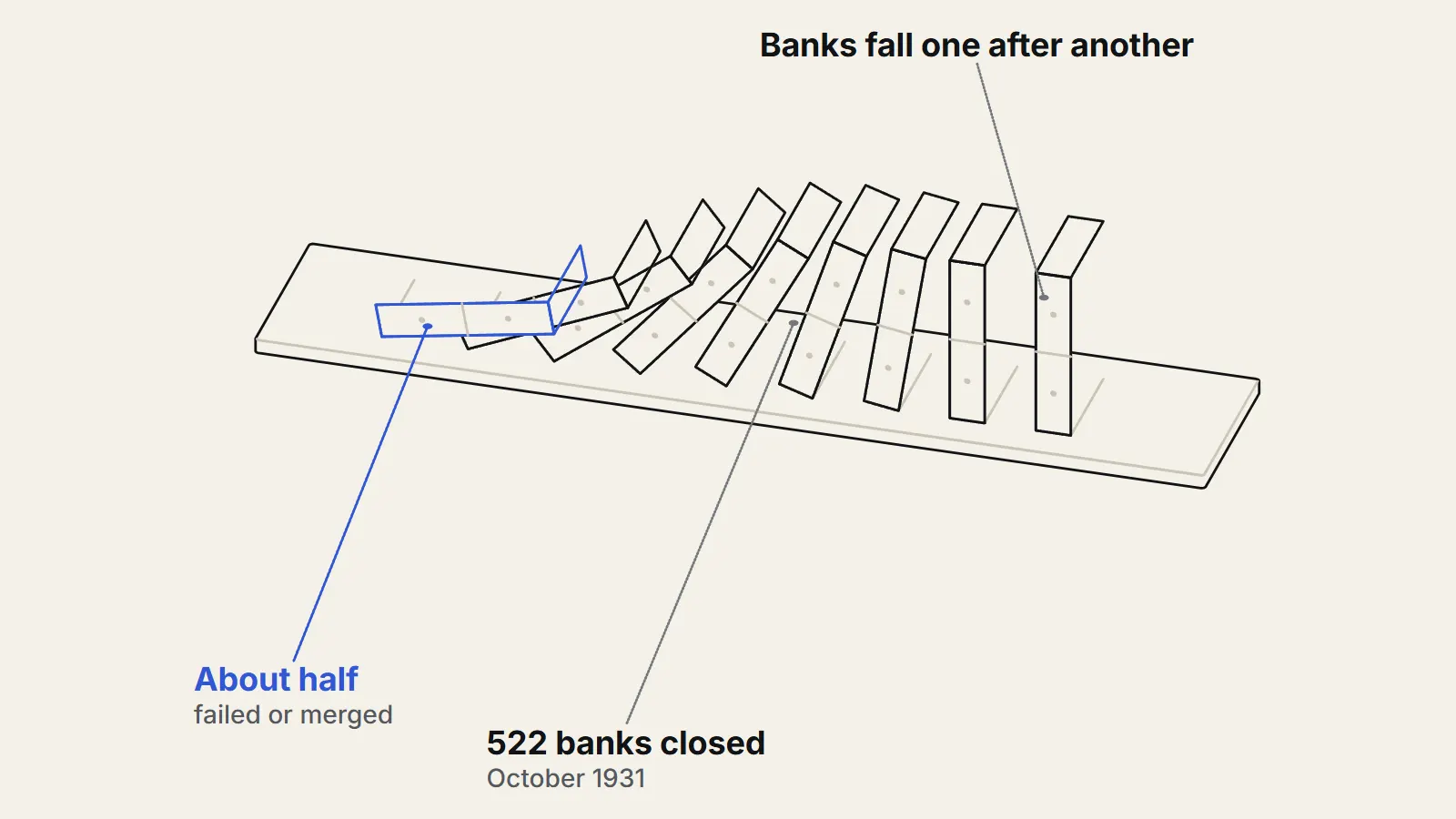
The scale of the bank failures was large. Bernanke noted that something close to half of all U.S. commercial banks failed or merged during the Depression decade, and that in October 1931 alone 522 commercial banks2 closed. 2 By March 1933 the commercial banking system had collapsed, and President Roosevelt declared a national banking holiday. 1
How did the gold standard make things worse?
Under the gold standard, countries fixed the value of their currencies to gold, so their policies were tied together. The Fed's history says that this link spread the Fed's rate increases and recession around the world. 1 Eichengreen and Temin argue that the gold standard turned an unexceptional downturn into the Great Depression, because central banks (https://therealigned.com/story/what-a-central-bank-does) put preserving gold convertibility ahead of output and jobs. 3 In October 1931, to protect the dollar's gold value, the Fed raised interest rates in what they call the sharpest increase in its short history, which drained gold from other countries. 3
The timing of recovery supports the idea. According to Bernanke, countries that stayed tied to gold had to match U.S. deflation. Britain left gold in September 1931 and reached its low point in the third quarter of 1932, while France, a leader of the Gold Bloc, did not hit bottom until April 19352. 2
What does the credit channel add?
Bernanke's 1983 paper argued that the financial crisis hurt the economy by more than shrinking the money supply. Damage to banks and to borrowers made it harder to channel credit to those who would use it well, so credit became more expensive and harder to get, and that depressed spending. He saw this as a complement to Friedman and Schwartz and a way to explain why the Depression was so long and so deep. 4 Deflation also raised the burden of existing debts, which the Fed's history lists among the consequences: it raised debt burdens, cut consumption, raised unemployment and forced bankruptcies. 1
Where do economists still differ?
The strongest objection to the monetary and gold-standard stories is that they say less about why the economy turned down in 1929 to begin with. The Fed's essay itself notes that the downturn began after rate rises meant to restrain speculation, but the sources used here do not settle how much the crash, trade policy or fiscal policy mattered, and economists argue over them. Within the monetary view, the disagreement is partly about blame: whether the Fed could have acted on its own, or whether the gold standard left it little room. Eichengreen and Temin argue that one country acting alone could not cut rates without losing gold, and that cooperation, which was tried at the 1933 London conference, went nowhere. 3
There is also a question of how to read the evidence on gold. Countries that left gold earlier tended to recover earlier, but leaving gold was often a sign of crisis and was not enough alone; what the country did next with its monetary policy mattered. That caveat is general reasoning, not a figure from the sources above.
What do we not know?
Economists have not agreed on the relative weights of the three causes, and the sources used here do not give a single number for how much of the output loss each explains. The recovery was also uneven: according to the Fed, a double-dip recession interrupted it in 1937, and full output and employment returned only in 1941 with World War II. 1 Whether a better-run Fed could have avoided the worst under the gold standard rules of the time remains a judgment, not a measurement.
Key takeaways
- The Depression began in 1929 as an ordinary downturn and was deepened by policy failures, not by a single event.
- From fall 1930 to winter 1933 the U.S. money supply fell by nearly 30 percent, and about half of U.S. commercial banks failed or merged over the decade.
- The gold standard tied countries to each other's deflation, and countries that left gold earlier, such as Britain in 1931, reached their low points earlier.
- Friedman and Schwartz, Bernanke and Eichengreen each emphasise a different link, and economists still debate how much weight each deserves.
Sources
- 1The Great Depression (opens the source in a new tab) · Federal Reserve History (Federal Reserve Board), 2013 · Primary source · https://www.federalreservehistory.org/essays/great-depression
- 2On Milton Friedman's Ninetieth Birthday (remarks by Governor Ben S. Bernanke) (opens the source in a new tab) · Board of Governors of the Federal Reserve System, 2002 · Report · https://www.federalreserve.gov/boarddocs/speeches/2002/20021108/default.htm
- 3Fetters of Gold and Paper (opens the source in a new tab) · National Bureau of Economic Research (Working Paper 16202), 2010 · Paper · https://www.nber.org/system/files/working_papers/w16202/w16202.pdf
- 4Nonmonetary Effects of the Financial Crisis in the Propagation of the Great Depression (opens the source in a new tab) · National Bureau of Economic Research (NBER Working Paper 1054), 1983 · Paper · https://www.nber.org/papers/w1054