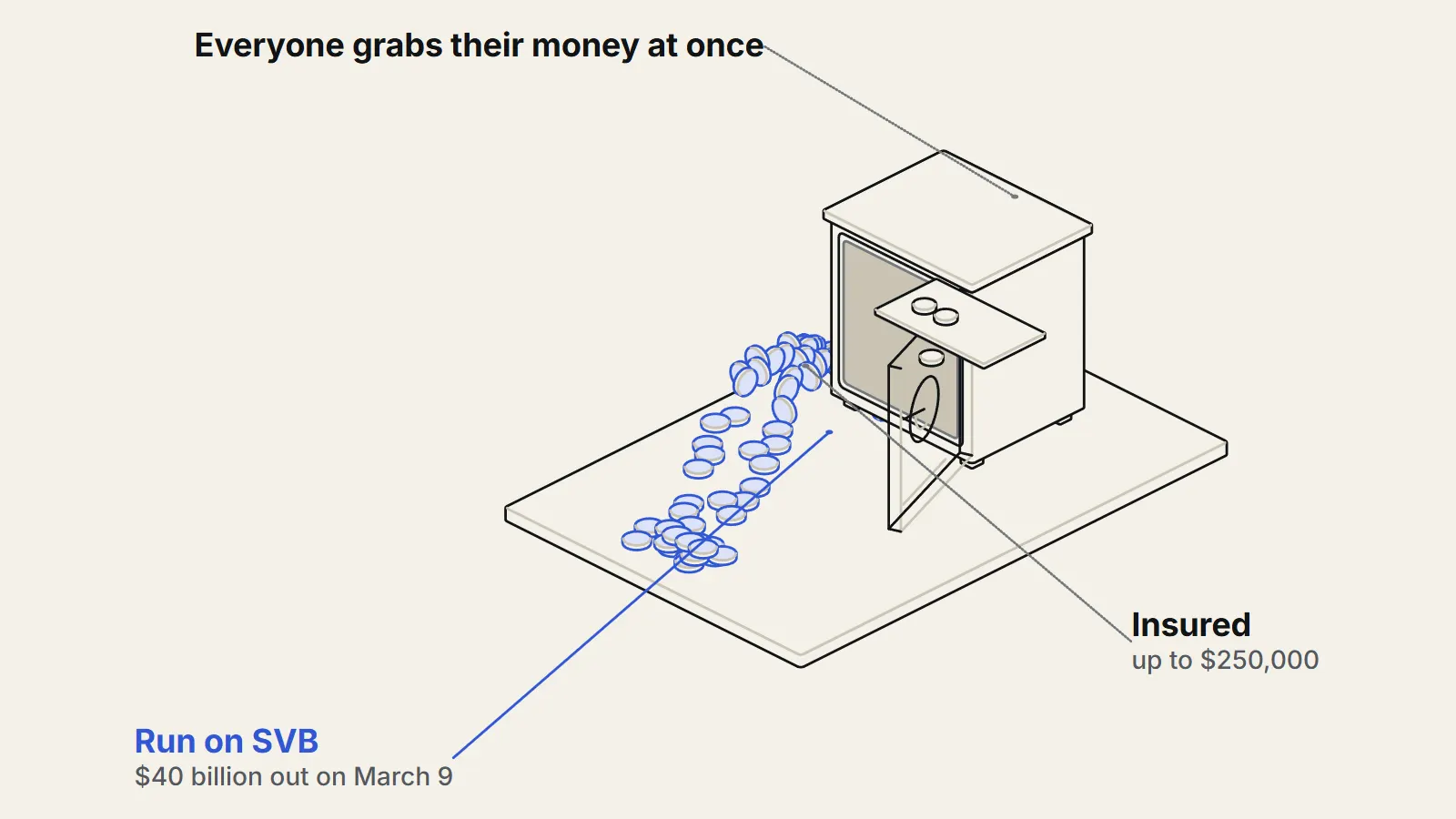
A bank run happens when many depositors try to withdraw their money at once because they fear the bank will fail. A bank can be solvent, meaning its assets are worth more than its debts, and still fail in a run, because most of those assets are loans that cannot be turned into cash quickly. Deposit insurance reduces the problem sharply, but runs have not disappeared: they now tend to involve large uninsured deposits and move far faster than in the past.
Why can a solvent bank fail?
A bank takes deposits that savers can withdraw at any time and lends most of the money for longer periods, to homebuyers or businesses. The Nobel committee (https://www.nobelprize.org/uploads/2022/10/popular-economicsciencesprize2022.pdf) calls this maturity transformation: the bank's assets have long maturities while its liabilities, the deposits, have short ones. 1 That mismatch is useful, because savers get easy access to their money while borrowers get long-term loans. 1 It also means the bank holds only a fraction of deposits as cash.
The economists Douglas Diamond and Philip Dybvig set out the logic in a 1983 model. In their account, a rumour that more savers than the bank can handle are about to withdraw can send depositors rushing to the bank, whether or not the rumour is true. To pay them, the bank must call in loans early and sell assets in fire sales, and the resulting losses may cause it to collapse. 1 The key point is that the run can be self-fulfilling: if you expect others to withdraw, withdrawing first is the sensible move, and the collective result is the failure everyone feared.
What did bank runs do in the 1930s?
The Great Depression (https://therealigned.com/story/what-caused-the-great-depression) showed the scale of the damage. The Nobel background notes that the number of U.S. banks halved in three years in the early 1930s, in many cases because of bank runs. 1 Ben Bernanke, who shared the 2022 prize with Diamond and Dybvig, argued that the collapse of the banking system helps explain why that downturn was not only deep but also long. 1 Once a bank fails, it loses its knowledge of its borrowers, and that knowledge takes time to rebuild elsewhere.
How did deposit insurance change things?
Diamond and Dybvig also proposed a remedy: government deposit insurance. If depositors know the state guarantees their money, they have no reason to rush when rumours start, so the run stops before it begins. In theory the insurance never needs to be used, which is why most countries now run such schemes. 1 In the United States, the FDIC says (https://www.fdic.gov/deposit-insurance) deposits are automatically insured to at least $250,0002 at each insured bank, covering accounts such as checking, savings and certificates of deposit, but not mutual funds, stocks, bonds or crypto assets. 2
Why do bank runs still happen?
Insurance only protects the deposits it covers. Silicon Valley Bank, which failed in March 2023, is the clearest recent example. The Federal Reserve review (https://www.federalreserve.gov/publications/files/svb-review-20230428.pdf) found that at the end of 2022 roughly 94 percent3 of the bank's total deposits were uninsured, so most customers had a real reason to leave at the first sign of trouble. 3 After the bank announced a balance sheet restructuring on March 8, depositors began withdrawing, and on March 9 outflows topped $40 billion3, with management expecting over $100 billion more the following day. California regulators closed the bank on March 10. 3
The Fed said the run appears to have been fueled by social media and by a tight network of venture capital and technology firms that withdrew in a coordinated way. 3 For scale, it noted estimates that when Wachovia failed in 2008 about $10 billion left over eight days, and Washington Mutual lost $19 billion over 16 days. 3 The Fed described the withdrawals as happening at an unprecedented rate. The Nobel background adds that runs on shadow banks, institutions outside regulated banking that also borrow short and lend long, were central to the 2008-09 crisis. 1
What is the case against deposit insurance?
The strongest objection is moral hazard, a problem that arises when someone is protected from a risk and so takes more of it. The Nobel committee notes that deposit insurance does not always work as intended and may encourage banks to engage in risky speculation where taxpayers pay if it goes badly. 1 It also says other rules, such as requirements on bank capital, may be needed, and that how well each works can change over time. 1 So the choice is not between insurance and no insurance but between different mixes of protection and rules. Which mix is best is a policy judgment, not a settled fact.
What do we not know?
The sources used here do not say how a bank can reliably tell a justified withdrawal from a panic in real time, or how large a deposit-insurance limit should be. The Fed's review also looks at only one failure, and one case cannot show that all modern runs look the same. This piece explains the mechanism and does not advise where to keep your money.
Key takeaways
- A bank run happens when depositors fear failure and withdraw together, which forces the bank to sell long-term assets at a loss.
- Diamond and Dybvig showed that a run can be self-fulfilling, so even a healthy bank is vulnerable because it lends long and promises on-demand access.
- Deposit insurance, at least $250,000 per depositor at each FDIC-insured bank in the U.S., is meant to stop runs before they begin.
- Runs still occur where deposits are mostly uninsured: about 94 percent of Silicon Valley Bank's were, and over $40 billion left in one day.
Sources
- 1The laureates explained the central role of banks in financial crises (Popular science background, Prize in Economic Sciences 2022) (opens the source in a new tab) · The Royal Swedish Academy of Sciences, 2022 · Report · https://www.nobelprize.org/uploads/2022/10/popular-economicsciencesprize2022.pdf
- 2Deposit Insurance (FDIC) (opens the source in a new tab) · Federal Deposit Insurance Corporation, 2026 · Primary source · https://www.fdic.gov/deposit-insurance
- 3Review of the Federal Reserve's Supervision and Regulation of Silicon Valley Bank (opens the source in a new tab) · Board of Governors of the Federal Reserve System, 2023 · Report · https://www.federalreserve.gov/publications/files/svb-review-20230428.pdf