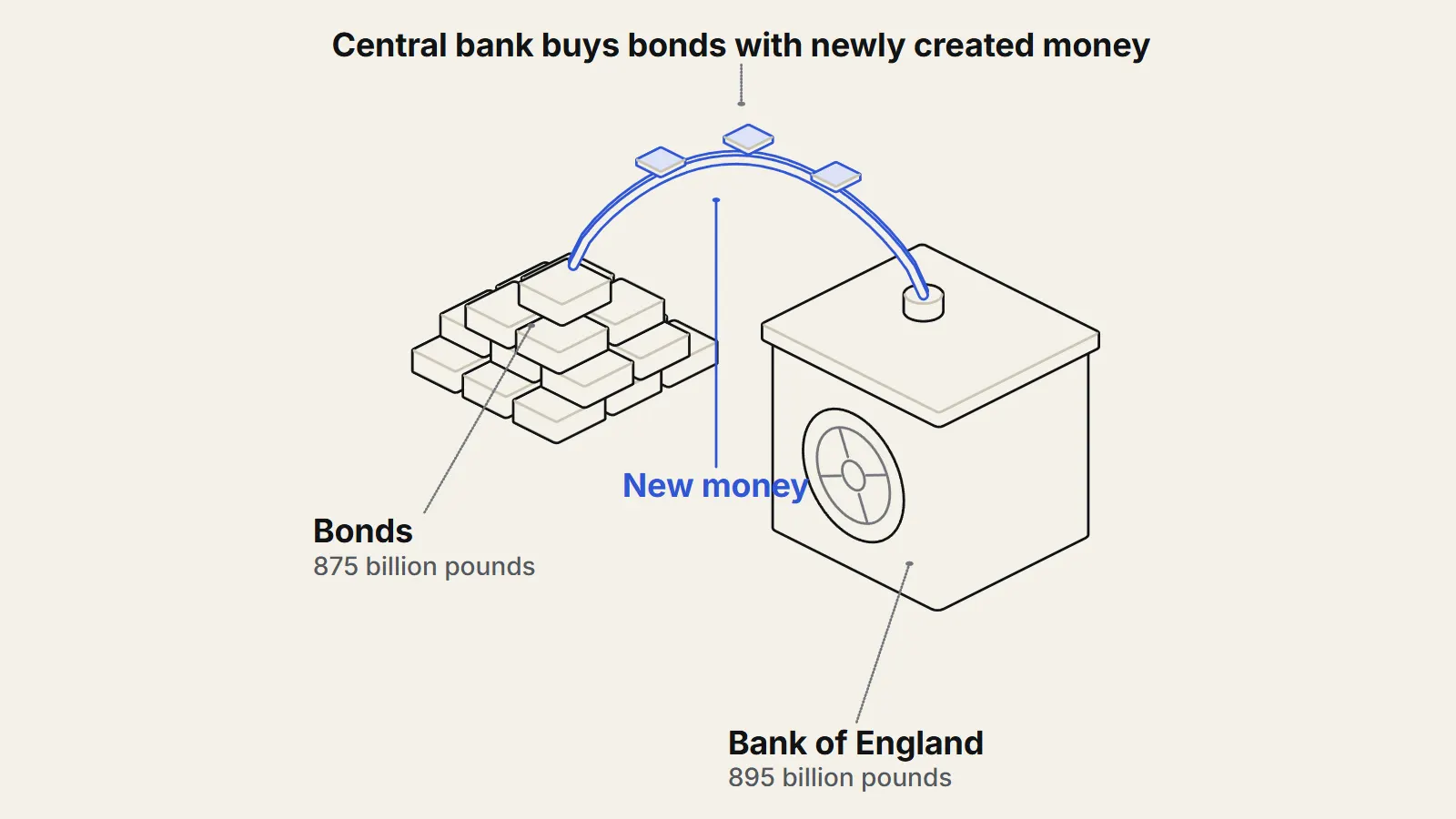
Quantitative easing, or QE, is a policy in which a central bank (https://therealigned.com/story/what-a-central-bank-does) creates new reserves and uses them to buy large amounts of bonds, in order to push down long-term interest rates once its short-term rate cannot fall further. The evidence says it did lower long-term yields: central bank estimates for the United Kingdom and the United States are often put near 100 basis points1, where 100 basis points equals one percentage point. What it did for growth and inflation is harder to pin down, and the research disagrees about how much of the effect came from later rounds.
What is quantitative easing?
Central banks normally steer the economy by moving a short-term interest rate. QE is for the situation where that rate is already near its floor. The Bank of England describes it as one of its tools for meeting a 2 percent inflation target, used mainly when Bank Rate is very low. It creates central bank reserves and uses them to buy government bonds and some corporate bonds.2 By the Bank's count, its purchases total £895 billion2, of which £875 billion was government bonds and £20 billion corporate bonds, and the last announced increase came in November 2020.2
The United States followed a similar path. By December 2008 the Fed had already set its target for the federal funds rate (https://therealigned.com/story/how-the-fed-sets-interest-rates) as low as it could. To ease policy further it bought substantial quantities of medium- and long-maturity assets, including agency debt, agency mortgage-backed securities and Treasuries, in order to lower private borrowing rates.3
How was QE meant to work?
Former Fed chair Ben Bernanke, in a 2020 article, sets out (https://www.brookings.edu/wp-content/uploads/2019/12/Bernanke_ASSA_lecture.pdf) the two arguments for it.4 The first is the portfolio balance effect. If investors have reasons to favour particular kinds of bonds, then changing how many of each are available changes their relative prices. US policymakers saw QE as taking duration risk, the risk of holding long-dated bonds, out of the Treasury market, which pushed investors to bid up remaining long-term Treasuries and close substitutes like mortgage-backed securities and corporate bonds.
The second is signalling. If a central bank is buying bonds, investors tend to expect it will not raise short-term rates while the purchases continue, so QE can reassure them that rates will stay low for a long time.4 The Bank of England adds a household angle: lower yields can feed into mortgage rates and lift asset prices such as shares, both of which support spending.2
What do studies say QE achieved?
The clearest result is on bond yields. A Bank of England working paper on the first UK round, about £200 billion of purchases between March 2009 and January 2010, links it to a fall of roughly 100 basis points5 in long-term government bond yields. Using that as a starting point, the authors estimate a peak boost of about 1½ percent to the level of real GDP and about 1¼ percentage points to annual CPI inflation.5
For the United States, three Federal Reserve Board staff economists estimated in 2017 that the Fed's large-scale asset purchases and its maturity extension programme left the 10-year Treasury yield about 100 basis points lower at the end of 2016. They expected that effect to shrink to about 85 basis points by the end of 2017 and about 24 basis points once the balance sheet normalised.1 Across other studies they report ranges for individual programmes: roughly 20 to 100 basis points for the first round and 12 to 55 for the second.1
The Bank of England's own summary is that research suggests QE has supported its aim of low and stable inflation, with the largest effect probably after the first round in 2009. It also reports that older people gained most from higher asset values and younger people from jobs and income, and concludes QE did not raise inequality overall.2
What is disputed about QE?
The strongest challenge is that later rounds did less. Bernanke notes that event studies found the 10-year Treasury yield fell by only 18 basis points around the second US round, far below the first. One reading is that the early rounds worked mainly because markets were in exceptional distress. If so, he points out, QE would be of limited use in calmer times.4 His own view is that later rounds were largely expected, so their effect was already in prices before announcement, and that the evidence shows the effects were significant and persistent. He also writes that there is room for disagreement.4
There is also a question of who is doing the measuring. The Bank of England and Federal Reserve estimates above come from central bank staff assessing central bank policy. That does not make them wrong, and they use published methods, but readers should know about it. The Fed note's comparison table also lists academic studies, which differ in method and in the programmes they cover, which is partly why the ranges are wide.
What is not known?
The sizes are uncertain even where the direction is not. The Bank of England authors say their estimates vary considerably with the model and assumptions, and they look at only one channel, the fall in long-term rates.5 The Fed staff note assumes Treasury does not change how it funds itself in response, and it relies on forecasts of how the balance sheet will evolve.1 Whether the benefits to growth and inflation held up as purchases were unwound, which the Bank of England began doing in February 2022, is not settled by these sources either.2
Key takeaways
- QE means a central bank creates reserves to buy bonds, mainly when its short-term rate is already close to its floor.
- Studies for the UK and US put the effect on long-term yields near 100 basis points, with wide ranges by programme.
- Estimated effects on growth and inflation are smaller in certainty than the effects on yields, and later rounds appear to have moved yields less.
- Most estimates come from central banks themselves, and the long-run effects of buying and then unwinding are still being studied.
Sources
- 1The Effect of the Federal Reserve's Securities Holdings on Longer-term Interest Rates (opens the source in a new tab) · Board of Governors of the Federal Reserve System (FEDS Notes), 2017 · Paper · https://www.federalreserve.gov/econres/notes/feds-notes/effect-of-the-federal-reserves-securities-holdings-on-longer-term-interest-rates-20170420.html
- 2Quantitative easing (opens the source in a new tab) · Bank of England, 2026 · Primary source · https://www.bankofengland.co.uk/monetary-policy/quantitative-easing
- 3Large-scale asset purchases by the Federal Reserve: did they work? (opens the source in a new tab) · Federal Reserve Bank of New York Economic Policy Review 17(1), 2011 · Paper · https://ideas.repec.org/a/fip/fednep/y2011imayp41-59nv.17no.1.html
- 4The New Tools of Monetary Policy (opens the source in a new tab) · American Economic Review 110(4), 2020 · Paper · https://www.brookings.edu/wp-content/uploads/2019/12/Bernanke_ASSA_lecture.pdf
- 5Assessing the economy-wide effects of quantitative easing (Working Paper No. 443) (opens the source in a new tab) · Bank of England, 2012 · Paper · https://www.bankofengland.co.uk/working-paper/2012/assessing-the-economy-wide-effects-of-quantitative-easing