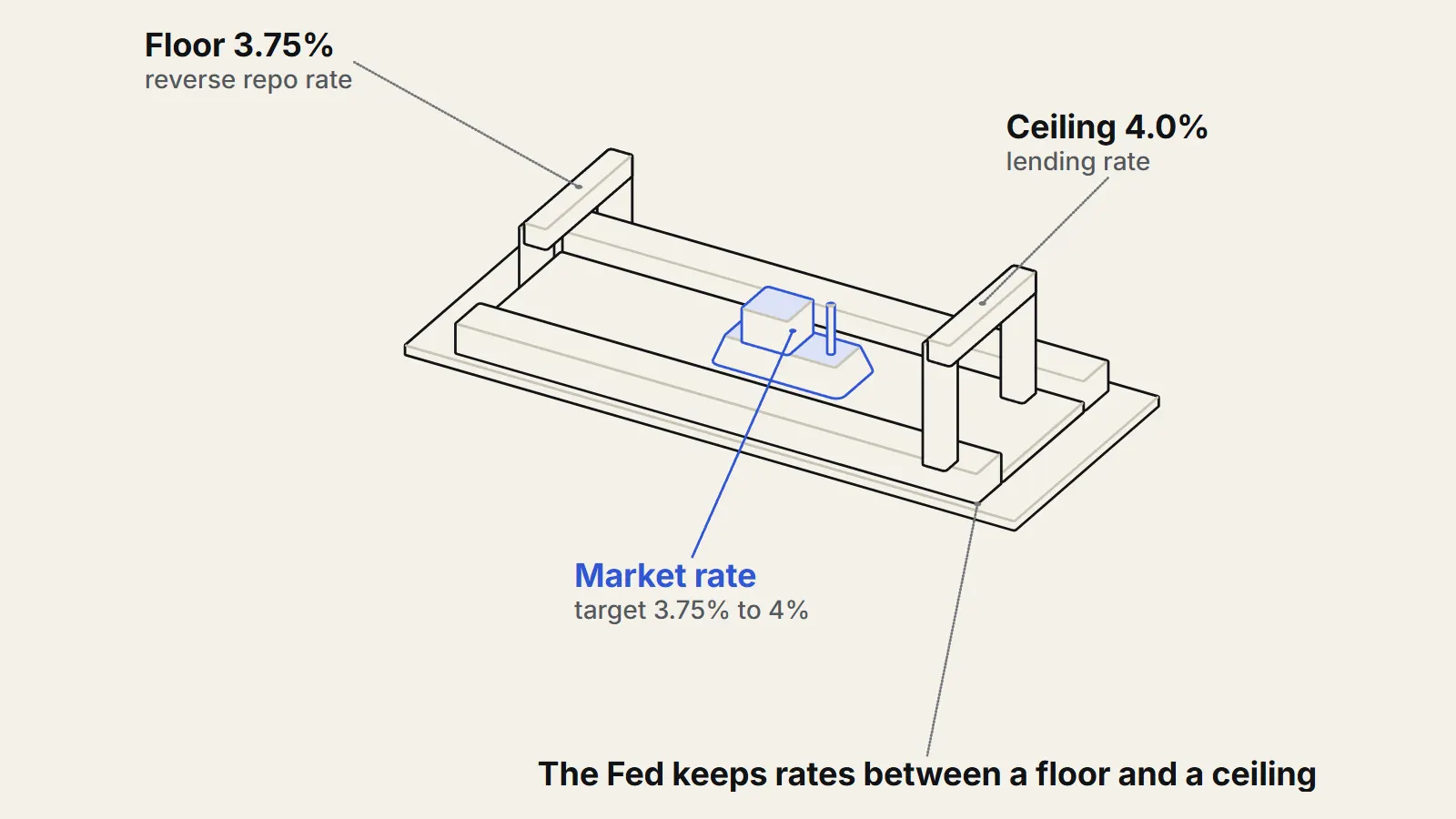
This is how the Fed sets interest rates in practice. The Federal Open Market Committee, the Fed's rate-setting body, announces a target range for the federal funds rate. The Fed then adjusts a small set of rates it controls directly, chiefly the interest it pays banks on their reserves, so that market rates stay inside that range. After its September 2026 decision the range is 3-3/4 to 4 percent1, the rate on reserves is 3.90 percent1 and the overnight reverse repo rate is 3.75 percent.1 The Fed does not dictate the market rate. It builds a corridor around it.
What is the target range for the federal funds rate?
The federal funds rate is what banks and a few other institutions pay to borrow cash from each other overnight, without putting up collateral. The New York Fed publishes the figure each business day, calculated as a volume-weighted median of the overnight transactions reported to it.2 The FOMC does not set that market rate by order. It sets a target range, and in its own words views changes in that range as its primary means of adjusting the stance of monetary policy.3 The actual rate, called the effective federal funds rate, is determined by trading and has stayed within the range most of the time.4
How do the Fed's own rates keep market rates in the range?
The main tool is interest on reserve balances, or IORB. Banks keep reserves in accounts at the Fed, and the Fed pays them a rate on those balances. Only depository institutions can earn it.5 Because a bank can earn that rate risk-free, it has little reason to lend overnight to anyone for much less. Fed Governor Philip Jefferson described it in a 2023 speech (https://www.federalreserve.gov/newsevents/speech/jefferson20230327a.htm) as the Fed's primary tool for adjusting the federal funds rate.4 The Board typically moves IORB whenever the FOMC moves its range, and a higher IORB pushes up a range of short-term rates while a lower one pulls them down.5
Not every lender can earn IORB. Money market funds, for example, cannot, and they are big suppliers of overnight cash. For them the Fed offers the overnight reverse repurchase facility. The Fed sells a security to an eligible counterparty and agrees to buy it back the next day, so the counterparty is in effect lending cash to the Fed overnight. Any lender with access should refuse to lend to others at a rate below the facility's rate, which makes it a floor.6 In the September 2026 notice the offering rate is 3.75 percent, with a limit of $160 billion per day for each counterparty1.1
A ceiling sits on top. Banks in sound condition can borrow from the Fed's discount window (https://www.federalreserve.gov/monetarypolicy/discountrate.htm) at the primary credit rate, which has been set at the top of the target range since March 2020.7 Jefferson notes that stigma limits how much banks use it day to day, which is one reason IORB is the main tool.4 A second ceiling is the standing repo facility, which lends cash against securities; the September 2026 notice sets that rate at 4.0 percent.1
| Fed rate | Level from Sept. 17, 2026 | Role |
|---|---|---|
| Overnight reverse repo | 3.75 percent | Floor, open to money market funds and others |
| Interest on reserve balances | 3.90 percent | Main steering rate for banks |
| Standing repo and primary credit | 4.0 percent | Ceiling, lending against securities or to banks |
Why does the system rely on ample reserves?
Before the global financial crisis, the Fed set the federal funds rate by adding or draining reserves through open market operations, the purchase and sale of securities.8 Today it runs what it calls an ample reserves regime. Reserves are plentiful enough that the market sits on the flat part of banks' demand for them, so small changes in supply barely move the rate. The Fed steers with its administered rates instead.4 Reserve requirements no longer play a role, because they were cut to zero in March 2020.9
The balance sheet matters for keeping reserves ample. Between June 2022 and late 2025 the Fed let securities mature without replacing them, and its holdings fell by more than $2.2 trillion, from 33 percent to 20 percent of nominal GDP. The FOMC stopped that runoff from December 1, 2025, because reserves were nearing the ample level.3 The September 2026 notice says the Fed will buy Treasury bills when appropriate to maintain ample reserves.1
What is disputed or imperfect about this setup?
The fair objection is that the corridor leaks. Jefferson points out that nonbank lenders dominate the federal funds market, so the effective rate has sat below IORB rather than on top of it.4 The discount window is meant to cap rates, but stigma limits it. And in September 2019, strain in funding markets required the Fed to step in with repo operations to keep the federal funds rate in range.4 None of this means the Fed loses control of short-term rates. It means the link between each administered rate and the market is looser in practice than in a textbook diagram.
What is not known?
The level of reserves that counts as ample cannot be read off a chart. The FOMC itself says that after runoff stops, reserves may keep falling for a time, until it judges they are ample.3 How fast and how far a change in the policy rate reaches longer-term rates also varies: Jefferson says it runs through investors' expectations and risk premiums and works with long, variable and uncertain lags.4 So the answer to "how does the Fed set rates" is clear at the overnight end and much less precise further out.
Key takeaways
- The FOMC sets a target range for the federal funds rate; the market determines the actual rate inside it.
- Interest on reserve balances is the main steering tool, with the overnight reverse repo rate as a floor and the discount and standing repo rates as ceilings.
- The system works because reserves are kept ample, so the Fed controls rates by setting administered rates rather than by adjusting reserve supply day to day.
- The corridor is imperfect: the market rate can sit below IORB, and what counts as ample reserves is a judgment.
Sources
- 1Implementation Note issued September 16, 2026 (opens the source in a new tab) · Board of Governors of the Federal Reserve System, 2026 · Primary source · https://www.federalreserve.gov/newsevents/pressreleases/monetary20260916a1.htm
- 2Effective Federal Funds Rate (opens the source in a new tab) · Federal Reserve Bank of New York, 2026 · Dataset · https://www.newyorkfed.org/markets/reference-rates/effr
- 3Policy Normalization (opens the source in a new tab) · Board of Governors of the Federal Reserve System, 2025 · Primary source · https://www.federalreserve.gov/monetarypolicy/policy-normalization.htm
- 4Implementation and Transmission of Monetary Policy (speech by Governor Jefferson) (opens the source in a new tab) · Board of Governors of the Federal Reserve System, 2023 · Paper · https://www.federalreserve.gov/newsevents/speech/jefferson20230327a.htm
- 5Interest on Reserve Balances (IORB) Frequently Asked Questions (opens the source in a new tab) · Board of Governors of the Federal Reserve System, 2026 · Primary source · https://www.federalreserve.gov/monetarypolicy/iorb-faqs.htm
- 6Overnight Reverse Repurchase Agreement Operations (opens the source in a new tab) · Board of Governors of the Federal Reserve System, 2026 · Primary source · https://www.federalreserve.gov/monetarypolicy/overnight-reverse-repurchase-agreements.htm
- 7The Discount Window (opens the source in a new tab) · Board of Governors of the Federal Reserve System, 2024 · Primary source · https://www.federalreserve.gov/monetarypolicy/discountrate.htm
- 8Open Market Operations: Policy Implementation (federal funds target range changes) (opens the source in a new tab) · Board of Governors of the Federal Reserve System, 2022 · Primary source · https://www.federalreserve.gov/monetarypolicy/openmarket.htm
- 9Reserve Requirements (opens the source in a new tab) · Federal Reserve Board, 2020 · Primary source · https://www.federalreserve.gov/monetarypolicy/reservereq.htm