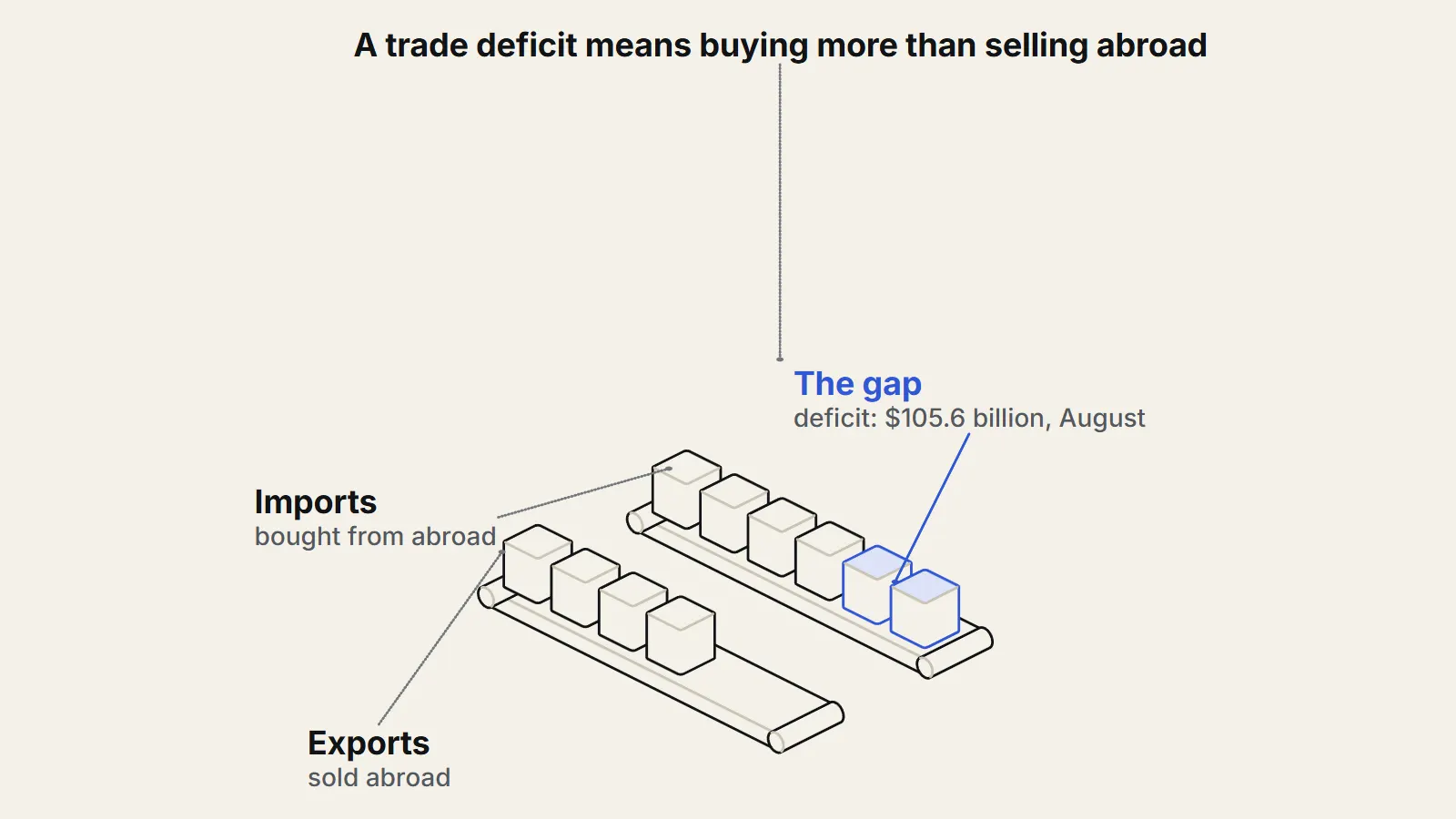
A trade deficit is the amount by which a country's purchases from the rest of the world exceed its sales to it. It measures the gap between imports and exports, nothing more. It is not a bill for what the country owes in the way a business loss is, and it is not a scoreboard of winning or losing. Economists link it to a country's saving and investment: a trade deficit means the country is investing more than it saves and is borrowing the difference from abroad.
What does a trade deficit measure?
The US Bureau of Economic Analysis puts it plainly: the difference between exports and imports (https://www.bea.gov/data/intl-trade-investment/international-trade-goods-and-services) is the trade balance, and a deficit means purchases from abroad exceed sales abroad.1 Its latest release, for August 2026, shows a deficit in goods and services of $105.6 billion1, up from $92.8 billion in July. Within that, the goods deficit was $136.6 billion, partly offset by a $31.0 billion surplus in services.1
Two points are worth fixing early. A trade deficit is a flow over a period, such as a month, not a stock of debt. And the trade balance is one part of the wider current account, which also counts income earned from abroad and transfers.2
How does a trade deficit connect to saving and investment?
The link is an accounting identity. As the St. Louis Fed lays out, GDP is total spending: consumption plus investment plus government spending plus net exports (exports minus imports). Saving is what is left of GDP after consumption and government spending. Put those together and net exports equal saving minus investment.3 A deficit arises when saving falls short of investment, and a surplus when saving exceeds it.3
Here is what that means in plain terms. If a country wants to build more factories, homes and equipment than its own saving pays for, the extra must be financed by foreigners, who lend or invest. Those foreign inflows have a mirror image in the trade accounts: the country takes in more goods than it sends out. The Dallas Fed (https://www.dallasfed.org/research/economics/2025/0904) makes the same point with its own version of the identity, saying that a deficit reflects investment exceeding national saving.2 It adds that deficits can reflect strong investment or government spending financed by global savings, and it notes that during the pandemic public saving fell sharply and foreign inflows helped finance spending.2
Why is a trade deficit not a scoreboard?
A scoreboard counts points for one side. A deficit counts something different. A country can run a deficit because investors abroad see attractive, profitable opportunities there. The Library of Economics and Liberty makes this argument, saying that the deficit is no more unnatural or dangerous than importing coffee when a country is importing capital, and that any real problem lies in the underlying conditions, not in the deficit itself.4 It also points to a period when the US current account moved from a $5 billion surplus in 1981 to a $161 billion deficit in 1987 while employment rose by more than twelve million.4
Nor does a deficit show who is better at making things. The St. Louis Fed notes that it is not mainly manufacturing job losses that deficits explain: it cites research that 85 percent of the 1992 to 2012 fall in goods-manufacturing jobs came from rising productivity and 15 percent from trade deficits.3 Tariffs (https://therealigned.com/story/who-pays-a-tariff) are not a reliable cure either. The Dallas Fed reports a study of 189 countries from 1988 to 2022 that found no statistically significant effect of tariffs on trade balances, and says prohibitive tariffs can cut them but are well beyond recent policy norms.2
When can a trade deficit be a problem?
The Dallas Fed puts it in similar terms: deficits become a concern when they stem from poor policy choices, because accumulated deficits add to external liabilities that eventually must be repaid.2 The St. Louis Fed argues that the US deficit is persistent in part because the dollar is the main global reserve currency, and it traces a widening gap between saving and investment from the mid-1970s.3 So the question is not whether a deficit exists but why: investment that pays off, or saving that has fallen short.
What is not known?
Economists disagree about the main cause of the US deficit. The St. Louis Fed calls the dollar's reserve role the root cause, while others stress a global savings glut, demographics and differences in growth and productivity.32 The identity itself holds by definition, so it cannot say which factor drives which. Nor does it say what level of deficit is too large for a given country. That depends on what the borrowing is used for and on how willing foreigners remain to lend, which is hard to forecast.
Key takeaways
- A trade deficit means imports exceed exports over a period; it is a flow, not a total debt.
- By accounting identity, net exports equal national saving minus investment, so a deficit means investment exceeds saving.
- Deficits can come from strong investment as well as from weak saving, so the number alone does not say whether things are going well.
- A deficit becomes a concern when the borrowing funds poor spending and external liabilities build up.
Sources
- 1International Trade in Goods and Services (opens the source in a new tab) · US Bureau of Economic Analysis, 2026 · Primary source · https://www.bea.gov/data/intl-trade-investment/international-trade-goods-and-services
- 2Are trade deficits good or bad, and can tariffs reduce them? (opens the source in a new tab) · Federal Reserve Bank of Dallas, 2025 · Report · https://www.dallasfed.org/research/economics/2025/0904
- 3Understanding the Roots of the U.S. Trade Deficit (opens the source in a new tab) · Federal Reserve Bank of St. Louis, The Regional Economist, 2018 · Report · https://www.stlouisfed.org/publications/regional-economist/third-quarter-2018/understanding-roots-trade-deficit
- 4Balance of Payments (Concise Encyclopedia of Economics) (opens the source in a new tab) · Library of Economics and Liberty, 2018 · Reporting · https://www.econlib.org/library/Enc/BalanceofPayments.html