- Place
- United Kingdom: Poundland Limited, a discount variety retailer owned 70% by Gordon Brothers and 30% by Pepco
- Years
- 2024–2026
- Policy
- A court-sanctioned restructuring plan (August 2025) cutting rents by up to 75%, set against higher employer National Insurance and National Living Wage costs from April 2025.
- Outcome
- Not in administration on 28 October 2026. Revenue fell 11.8% and adjusted EBITDA to £20.8m in FY2025, net liabilities reached £90.2m, and owner and management disagree on how to sell.
Recent headlines have warned of a Poundland collapse. The record is more precise. When we checked on 28 October 2026, Companies House listed Poundland Limited as active, with no notice of administration in its filing history2. The risk is real, though. Its latest accounts carry a note that funding beyond 29 August 2027 is not secured1, and its owner, Gordon Brothers, said on 27 October that attention must now turn to other active bids3 after the bid preferred by management. What the filings and the cost figures show, and where the explanations differ, is the case below.
Before
Where Poundland stood before the rescue
Poundland is a British discount variety chain that grew on a simple promise: most things cost £1. By 2025 it was part of Pepco Group, which said in June that Poundland made about a third of Group revenue but about a twentieth of Group EBITDA, and employed around 16,000 people across more than 800 stores4. EBITDA is a profit measure before interest, tax and some accounting charges; here it is the company's own adjusted version.
In 2025 the High Court heard why the business needed rescuing. It had about 800 operating stores, 379 of them loss-making at store level before central costs, with around 13,100 store staff and 1,500 in head office and supply chain5. The judge described the cause as an expansion into chilled and frozen food and e-commerce, plus over-renting, an impact the judgment says was "recently compounded by increases to NIC and 'the living wage'"5. That last phrase matters later: costs imposed by government are named, but as an aggravating factor, not the first cause.
The cost backdrop, in numbers
Two changes took effect in April 2025. Employer National Insurance rose from 13.8% above £9,100 a year to 15% above £5,000 a year, while the Employment Allowance rose from £5,000 to £10,5006. The National Living Wage for those aged 21 and over rose to £12.21 an hour7, and in April 2026 it rose another 4.1% to £12.718. For an employee paid £20,000 a year, our own arithmetic puts employer National Insurance at £1,504 before the change and £2,250 after, a 50% rise (Employment Allowance, which helps small employers, is ignored).
| Employer cost | Before | After | When |
|---|---|---|---|
| Employer National Insurance rate | 13.8% | 15% | 6 April 2025 |
| Employer NI threshold (a year) | £9,100 | £5,000 | 6 April 2025 |
| Employment Allowance | £5,000 | £10,500 | 6 April 2025 |
| National Living Wage, 21 and over (an hour) | £12.21 (from April 2025) | £12.71 | 1 April 2026 |
The decision
The decision: sell, then restructure
In June 2025 Pepco Group sold Poundland to a new company owned by Gordon Brothers affiliates for a nominal sum, leaving a £30m secured loan and certain other loans in place4. The new owners then asked the High Court to approve a restructuring plan under Part 26A of the Companies Act 2006, a court-approved deal that can cut what a company owes creditors such as landlords and, in a 'cram-down', bind classes of creditors who voted against it.
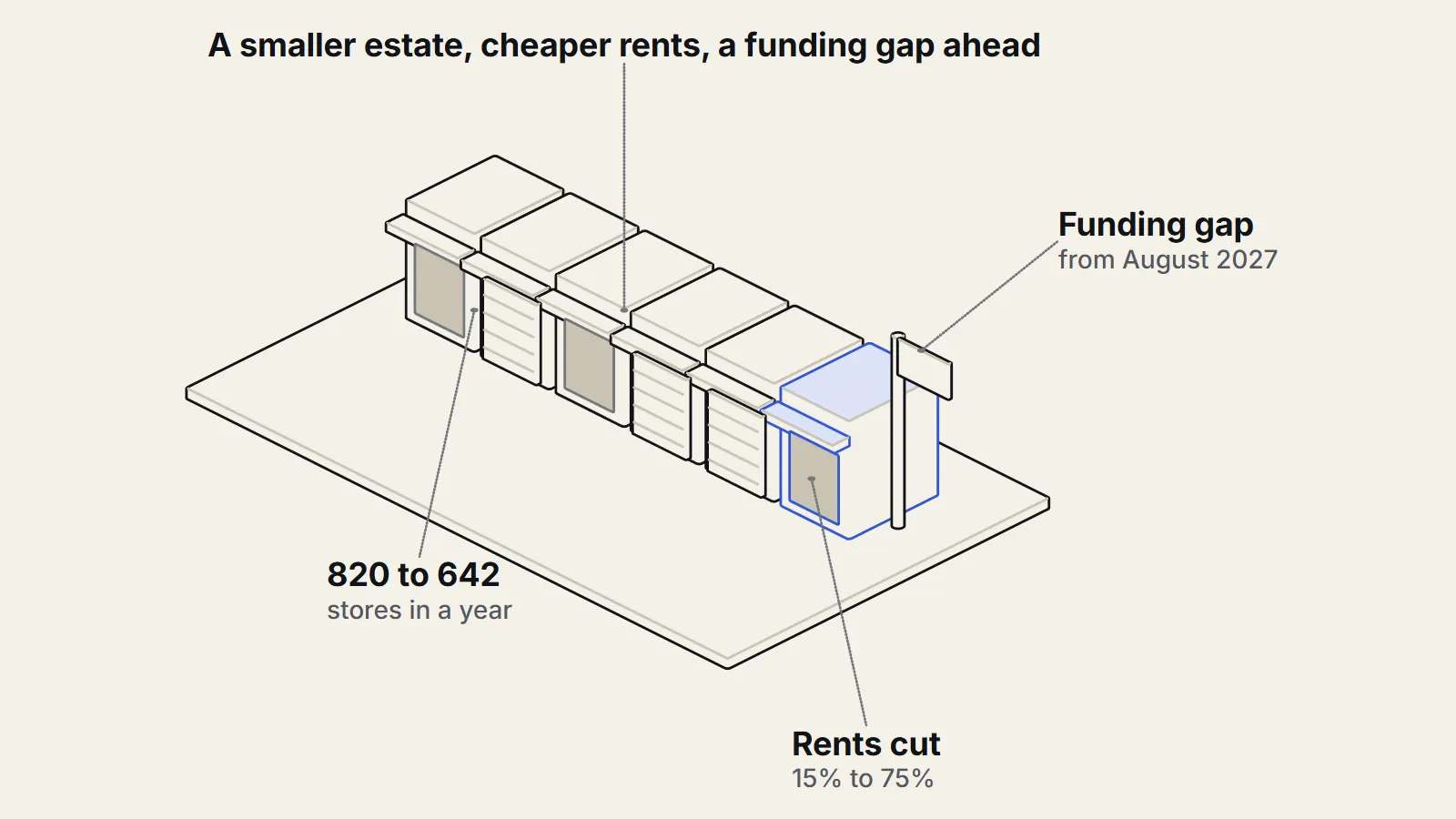
The court sanctioned the plan on 26 August 2025 over landlord opposition. Landlords in classes B1 to B5 took rent cuts of 15%, 30%, 45%, 60% and 75% for 36 months; one class had rent cut to zero and one had leases terminated5. The judgment also records the alternative if the plan failed: an orderly asset-realisation administration with expected total realisations of £85.9m to £91.4m5. The plan came with a working capital facility of £95m running to 1 September 20285.
- June 2025Pepco completes the sale of Poundland to Gordon Brothers affiliates.Source 4 (opens the source in a new tab)
- 26 August 2025High Court sanctions the restructuring plan.Source 5 (opens the source in a new tab)
- 20 August 2026Accounts to September 2025 filed, with a going-concern material uncertainty note.Source 1 (opens the source in a new tab)
- September 2026Gordon Brothers appoints advisers to run a sale; credit insurers withdraw new cover for some suppliers.Source 9 (opens the source in a new tab)
- 27 October 2026Gordon Brothers says attention must turn to other active bids.Source 3 (opens the source in a new tab)
The case that government costs are the main cause
The strongest version of the opposing view comes from the retail industry. The question is whether employer National Insurance and the minimum wage, rather than Poundland's own choices, explain the squeeze.
The Resolution Foundation measured the cost rise but modelled a limited economy-wide job effect, about 85,000 jobs or 0.3%11, so its figures support both a real cost shock and a modest aggregate effect. A free-market case goes further. The Institute of Economic Affairs argued in 2016, in general terms and not about Poundland, that a National Living Wage risks jobs in competitive sectors such as retail12. Neither source examined Poundland's accounts.
What happened
What the accounts show
The first full accounts after the sale, filed on 20 August 2026, cover the 52 weeks to 28 September 2025. Revenue fell 11.8%, from £1,757m (restated) to £1,549m, and adjusted EBITDA fell from £115.5m to £20.8m, as gross margin fell from 37.4% to 31.4%1. The company says the gross margin fall was primarily due to higher product costs from inflation in its supply chain, and the fall in EBITDA largely to lower sales and higher input costs, including wages and salaries1. Loss before tax was £85.2m, and impairment of goodwill, property and right-of-use assets was £166.3m1.
The balance sheet turned: net assets of £29.9m a year earlier became net liabilities of £90.2m, with cash of £30.6m1. The accounts list the National Living Wage, VAT, employer National Insurance and the sugar tax among regulatory risks. They also name competition from value retailers and supermarkets as intensifying1. The restructuring plan cut stores by about a fifth: from 820 in January 2025 to 642 in January 2026, with exits from frozen food and extended chilled lines, closure of the e-commerce site and two distribution centres, and most remaining loss-making stores at zero rent1.
Why the funding gap matters
The directors expect funding to cover the period to the end of FY2027, but a £30m term facility from Gordon Brothers runs to 29 August 2027, replacement funding is not guaranteed, and they state a 'material uncertainty' about the company's ability to continue beyond that date1. That is a formal warning that something has to change, not a statement that the company is insolvent.
Trading since, and the sale
Trading has improved on the company's own account. Poundland reported like-for-like sales growth of 3.3% in the quarter to 27 September 2026, or 6.4% adjusted for the categories it removed13. Like-for-like means sales from the same stores or categories over the same period, to strip out opening and closing shops. Against that, credit insurers were reported to have withdrawn new cover for some suppliers during the sale process, and the paper put the estate at around 600 stores9.
On 27 October, a Gordon Brothers spokesperson said the management-preferred bid from Martin Property Group was no longer the focus and that the process had produced offers for the whole business and for significant viable parts3. Press reports citing Sky News say the dispute turns on a £30m loan and whether the chain is sold whole or in parts14; these are reports, not statements, and they differ on the loan's terms. On the primary record, what happens next turns on the loan, the sale route and the ranking of creditors as much as on wage costs.
What economists still disagree on
Who disagrees, and about what
There are three separate arguments, and they should not be mixed up. The first is about the cause of the decline. Poundland's accounts point to product-cost inflation and lower sales; the court points to over-renting and a failed expansion with government costs compounding them; the British Retail Consortium points chiefly to government costs. A trade-press opinion piece in 2025 argued that inflation against a fixed-price model, an expensive range and stronger discount rivals were the problem15.
The second is about the sale. The shop workers' union Usdaw says Gordon Brothers is pushing the company towards administration despite improving sales, that about 12,000 jobs are at risk and that the owner has failed to engage16. Gordon Brothers says it is acting to resolve uncertainty and has offers for parts of the business. We have not seen a published Gordon Brothers statement of its reasoning for a break-up, so claims about its motives are reported, not confirmed.
The third is about what the failure of discount chains usually means. When Wilko went into administration in August 2023, with about 400 stores and 12,000 jobs at risk, the reported causes included a rescue sale that did not complete, the loss of credit insurance, and competition from value rivals17. Several causes at once is the usual pattern.
a significant part of the leasehold portfolio was over-rented.
— Sir Alastair Norris, High Court, Re Poundland Limited, paragraph 5
Will Poundland be sold whole in a solvent deal, sold in parts, or enter administration? As of 28 October nothing had been filed.
Lessons
Key takeaways
- Poundland was active on Companies House on 28 October 2026, with no administration filing, even as headlines warned of collapse.
- The accounts show revenue down 11.8%, adjusted EBITDA down from £115.5m to £20.8m and net liabilities of £90.2m.
- The record lists several causes: product-cost inflation, over-renting, a failed expansion and, as an aggravating factor, higher employment costs.
- The next step turns on a sale and a £30m loan as much as on wages.
Read the legal status before the headline. Companies House and the Gazette say whether a company is in administration; headlines about risk do not.
A cost shock is a real thing, and so is a bad estate. A single cause is rarely the whole story, and the primary record is where the weights are set.
Facts that may change soon: any notice of administration, any resignation of the new directors, and the sale outcome.
Related on The Realigned: Minimum wage explained (https://therealigned.com/story/minimum-wage-explained), the Seattle minimum wage study (https://therealigned.com/case/seattle-minimum-wage-study) and How taxes work: who really pays? (https://therealigned.com/story/who-really-pays-taxes).
Primary documents: Poundland's filing history at Companies House (https://find-and-update.company-information.service.gov.uk/company/02495645/filing-history) and the High Court judgment (https://caselaw.nationalarchives.gov.uk/ewhc/ch/2025/2755).
Sources
- 1Poundland Limited: full accounts for the 52 weeks to 28 September 2025 (filed 20 August 2026) (opens the source in a new tab) · Companies House, 2026 · Primary source · https://find-and-update.company-information.service.gov.uk/company/02495645/filing-history
- 2Poundland Limited company overview and filing history (02495645) (opens the source in a new tab) · Companies House, 2026 · Primary source · https://find-and-update.company-information.service.gov.uk/company/02495645
- 3Poundland owners push retailer towards insolvency (27 October 2026) (opens the source in a new tab) · City AM, 2026 · Reporting · https://www.cityam.com/poundland-owners-resist-takeover-amid-job-loss-fears/
- 4Pepco Group completes sale of Poundland (12 June 2025) (opens the source in a new tab) · Pepco Group N.V., 2025 · Primary source · https://www.pepcogroup.eu/wp-content/uploads/2025/06/Pepco-Group-announces-sale-of-Poundland-12-June-2025-vF.pdf
- 5Re Poundland Limited [2025] EWHC 2755 (Ch) (opens the source in a new tab) · High Court (Chancery Division), The National Archives, 2025 · Primary source · https://caselaw.nationalarchives.gov.uk/ewhc/ch/2025/2755
- 6Rates and thresholds for employers 2025 to 2026 (opens the source in a new tab) · GOV.UK (HMRC), 2026 · Primary source · https://www.gov.uk/guidance/rates-and-thresholds-for-employers-2025-to-2026
- 7National Minimum Wage and National Living Wage rates (opens the source in a new tab) · GOV.UK, 2026 · Primary source · https://www.gov.uk/national-minimum-wage-rates
- 8The National Minimum Wage in 2026 (Low Pay Commission uprating report) (opens the source in a new tab) · Low Pay Commission, 2026 · Primary source · https://assets.publishing.service.gov.uk/media/69cbe06e024cdf09254f3f92/2026_Uprating_report_v2.pdf
- 9Poundland moves to reassure suppliers after credit insurers pull cover (September 2026) (opens the source in a new tab) · Retail Gazette, 2026 · Reporting · https://www.retailgazette.co.uk/blog/2026/09/poundland-moves-to-reassure-suppliers-after-credit-insurers-pull-cover/
- 10BRC: Retail jobs at risk from rising employment costs (19 February 2026) (opens the source in a new tab) · British Retail Consortium, 2026 · Report · https://brc.org.uk/news-and-events/news/corporate-affairs/2026/ungated/retail-jobs-at-risk-from-rising-employment-costs/
- 11Minimum wage, maximum pressure: the impact of 2025's minimum wage and employer NICs increases (opens the source in a new tab) · Resolution Foundation, 2025 · Report · https://www.resolutionfoundation.org/app/uploads/2025/03/Minimum-wage-maximum-pressure.pdf
- 12National Living Wage will harm both employers and low-skilled employees (Ryan Bourne, 31 March 2016) (opens the source in a new tab) · Institute of Economic Affairs, 2016 · Reporting · https://iea.org.uk/media/national-living-wage-will-harm-both-employers-low-skilled-employees
- 13Poundland hails return to like-for-like sales growth in Q4 (25 September 2026) (opens the source in a new tab) · The Grocer, 2026 · Reporting · https://www.thegrocer.co.uk/news/poundland-hails-return-to-like-for-like-sales-growth-in-q4/724061.article
- 14Poundland owner Gordon Brothers pushes for insolvent sale of chain (27 October 2026) (opens the source in a new tab) · Business Matters (citing Sky News), 2026 · Reporting · https://bmmagazine.co.uk/news/poundland-insolvency-gordon-brothers-solvent-bid/
- 15Even Poundland is struggling. What now for the high street? (10 March 2025) (opens the source in a new tab) · The Grocer (opinion), 2025 · Reporting · https://www.thegrocer.co.uk/comment-and-opinion/even-poundland-is-struggling-what-now-for-the-uk-high-street/701933.article
- 16Union criticises Poundland owners saying retailer is 'being pushed into administration' (13 October 2026) (opens the source in a new tab) · Talking Retail, 2026 · Reporting · https://www.talkingretail.com/news/industry-news/union-criticises-poundland-owners-saying-retailer-is-being-pushed-into-administration-13-10-2026/
- 17Wilko collapses into administration (10 August 2023) (opens the source in a new tab) · Retail Gazette, 2023 · Reporting · https://www.retailgazette.co.uk/blog/2023/08/wilko-collapse-administration/