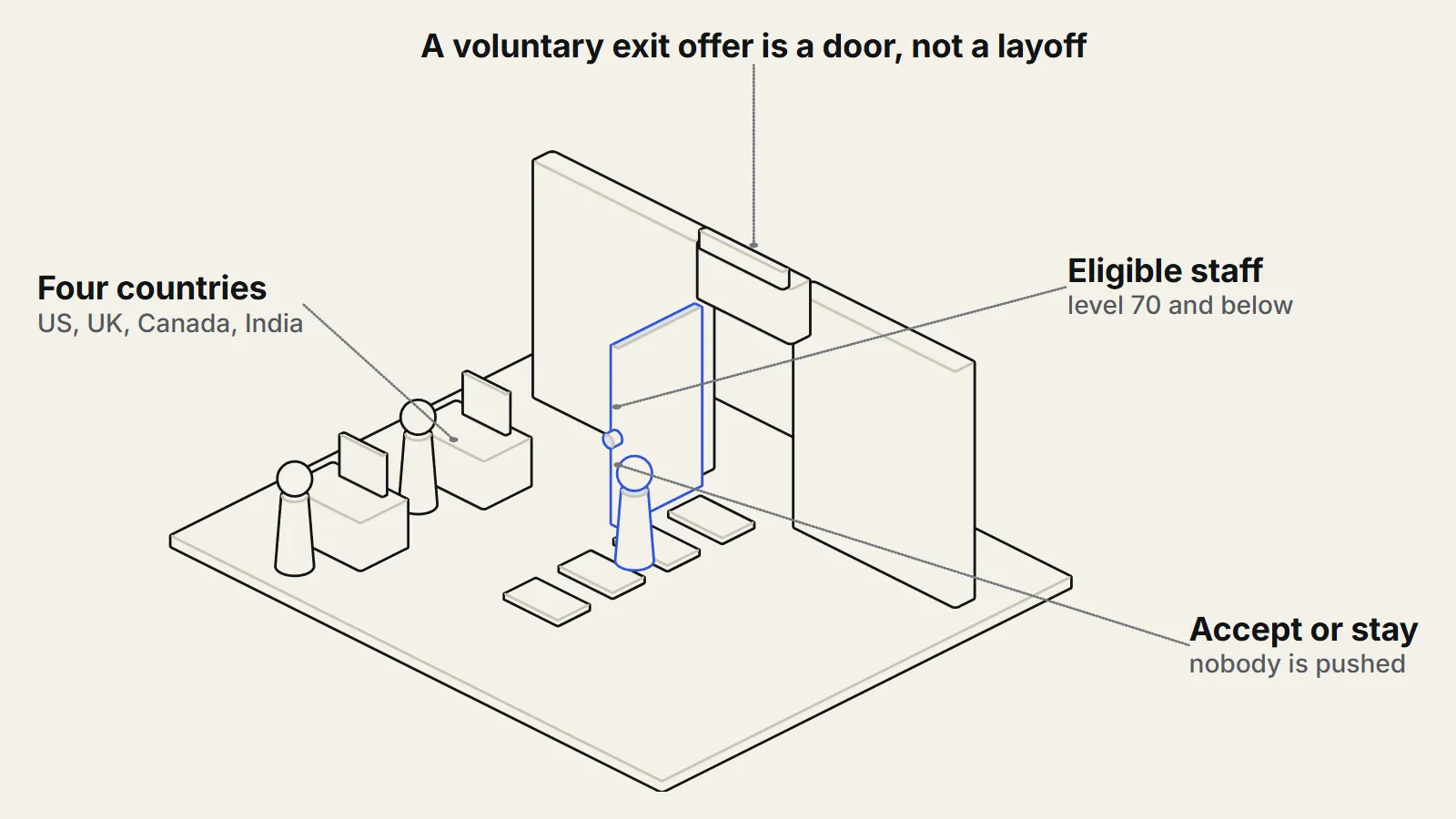
On 26 October 2026 Microsoft announced a "Voluntary Exit Offer" for eligible employees. It is a time-limited, voluntary programme for people at level 70 and below in participating teams in Canada, India, the United Kingdom and the United States1. That makes it different from a layoff: nobody has to accept. Microsoft's post gives no headcount. The figure of about 60,000 people, widely repeated, is a press report rather than part of Microsoft's announcement2. This piece separates what is confirmed from what is only reported.
What has Microsoft confirmed?
Very little in numbers, a good deal in structure. The post says some organisations are offering the programme and some are not1, and that eligible employees would receive their details by email that day. Microsoft confirmed the offer to TechCrunch4. A spokesperson told KUOW the package is comparable to its standard severance and that AI is not driving the offer5. The Register reports that Microsoft says it has no target number and does not describe the offer as a buyout6. The blog post itself does not state a headcount, a deadline, an exit date or package amounts.
What is only reported?
Most of the specifics come from anonymous sources and offer documents seen by journalists, relayed by other outlets. Treat each as reported, not confirmed.
| Detail | In Microsoft's post? | As reported elsewhere |
|---|---|---|
| Number eligible | No | About 60,000 (a press figure; outlets differ on its source) |
| Decision deadline | No | Early December (Reuters via Computerworld); The Register says the window closes 31 December |
| Exit date | No | 31 December 2026 |
| Teams taking part | No list | Reuters and others cite unnamed sources for AI, Copilot, Windows and Xbox teams being included |
| Severance formula | No | Business Insider's reading of offer documents, relayed by SiliconANGLE: about one week of base pay per six months of service for lower levels, with limits |
The scale puts it in context. Microsoft had about 223,000 full-time employees at 30 June 20263, against about 228,000 a year earlier8, so 60,000, if accurate, would be about 27% of them (our division; eligible is not the same as leaving). Microsoft's July memo said more than 30% of those eligible joined the April retirement programme9, and Microsoft expects lower uptake this time5. No acceptance figure exists yet. Business Insider's reading of offer documents, relayed by SiliconANGLE, puts severance at about one week of base pay per six months of service for lower levels, with limits10; Microsoft has not confirmed the formula.
How is a voluntary exit different from a layoff?
A layoff, or reduction in force, is the employer's decision to cut jobs. A voluntary separation programme offers enhanced benefits to people who agree to leave within a set window, usually in return for signing a release of legal claims, and it must be genuinely voluntary11. The differences matter in practice, though the rules vary by country and this is general information, not legal advice.
Notice rules. In the United States, the WARN Act's 60-day notice rules count involuntary job loss, and the Department of Labor guide excludes voluntary departure and retirement12, so people who genuinely choose to leave generally do not count towards the thresholds.
Age protections. For US workers aged 40 and over asked to sign a waiver in a group exit programme, the law requires 45 days to consider it and 7 days to revoke it13.
Unemployment benefits. In Washington state, whether leaving counts as a quit depends on good cause, and severance pay is not deducted from benefits14; how the state treats an accepted exit offer is decided case by case.
India. Microsoft lists India as eligible, but we found no primary source for how many Indian employees are covered, what the India terms are, or how local law and tax treat the payment. Employees should read their own offer letter.
Does the money point to AI?
Microsoft's own filings show a company spending heavily on AI infrastructure while headcount edged down. The table uses cash additions to property and equipment, which excludes finance leases and is lower than the CFO's capital-expenditure figure.
| Fiscal year (to 30 June) | Revenue | Operating income | Additions to property and equipment | Full-time employees |
|---|---|---|---|---|
| FY2024 | 245,122 | 109,433 | 44,477 | not used |
| FY2025 | 281,724 | 128,528 | 64,551 | about 228,000 |
| FY2026 | 331,839 | 155,237 | 115,948 | about 223,000 |
Cash additions to property and equipment rose from $64.6 billion to $115.9 billion between FY2025 and FY20263, about 2.6 times the FY2024 level (our arithmetic), while the CFO said total headcount declined 2% year on year15. As a share of revenue those additions were 18.1%, 22.9% and 34.9% in the three years (our arithmetic). Operating income still grew 21% in FY20263, so this is not a company in financial distress.
Does that mean the offer is about AI? Microsoft says no. In July it said the roughly 4,800 roles it eliminated were "not being replaced by AI"9, and a spokesperson told KUOW that AI is not driving the buyouts5. The Reuters report, from a single anonymous source, links the offer to cutting costs and funding AI investment; that is reported, not confirmed. The filings show both trends happening at once, which is not the same as showing one caused the other.
What does research say about AI and jobs?
The evidence is mixed and mostly about hiring, not firing. Stanford researchers using payroll data through June 2026 found no widespread displacement, but employment of workers aged 22 to 25 in the most AI-exposed occupations was about 19% below a comparison group, mainly through reduced hiring; they call the results descriptive, not causal16. The Yale Budget Lab and Brookings found no discernible disruption to the US labour market in the 33 months after ChatGPT's release17, while stressing that this is not a forecast.
There is a sceptical reading of company statements. Oxford Economics said in January that firms do not appear to be replacing workers with AI on a significant scale, and that some may cite AI because it reads better to investors than past over-hiring18. The outplacement firm Challenger, Gray and Christmas counts the same tension: AI was cited for 120,136 of 573,195 announced US job cuts from January to September 2026, but a stated reason is not proof of cause19.
For a worker deciding what to do, the research cuts both ways. Fewer entry-level openings in exposed fields is a real finding, but so is the lack of broad displacement so far, and one company's offer cannot settle it.
What to watch next
- Microsoft was due to report quarterly results after the US market close on 28 October; we had not seen them when we wrote this. Capex, headcount and any comment on the offer would be the points to look for.
- Early December: the reported decision deadline for eligible employees.
- 31 December: the reported exit date for those who accept.
- The next quarterly and annual filings, which will show whether headcount falls again and any one-time charges.
How many will accept, and will the offer be followed by involuntary cuts? Microsoft has not said, and no figure exists.
Related on The Realigned: Why wages rise (https://therealigned.com/story/why-wages-rise), CPI vs wages since 2019 (https://therealigned.com/research/cpi-vs-wages-since-2019) and minimum wage explained (https://therealigned.com/story/minimum-wage-explained).
Primary documents: Microsoft's announcement (https://blogs.microsoft.com/blog/2026/10/26/introducing-a-voluntary-exit-offer/) and Microsoft's 2026 annual report (https://www.microsoft.com/investor/reports/ar26/index.html).
Key takeaways
- Microsoft's Voluntary Exit Offer is confirmed, covers level 70 and below in participating teams in four countries, and is voluntary.
- The 60,000 figure, the deadline, the exit date and the severance formula come from press reports, not Microsoft's post.
- Filings show headcount down about 2% as property and equipment additions grew about 80% in a year, but do not prove a link.
- Research finds weak evidence of broad AI job loss so far and clearer evidence of reduced hiring of young workers in exposed jobs.
Sources
- 1Introducing a Voluntary Exit Offer (opens the source in a new tab) · The Official Microsoft Blog (Amy Coleman), 2026 · Primary source · https://blogs.microsoft.com/blog/2026/10/26/introducing-a-voluntary-exit-offer/
- 2Microsoft announces 'Voluntary Exit Offer' reportedly covering 60,000 employees (opens the source in a new tab) · MyNorthwest, 2026 · Reporting · https://mynorthwest.com/local/microsoft-offers-exit-offer/4290545
- 3Microsoft 2026 Annual Report (Form 10-K, year ended 30 June 2026) (opens the source in a new tab) · Microsoft Corporation, 2026 · Primary source · https://www.microsoft.com/investor/reports/ar26/index.html
- 4Microsoft offers buyouts to around 60,000 employees, reports say (opens the source in a new tab) · TechCrunch, 2026 · Reporting · https://techcrunch.com/2026/10/26/microsoft-offers-buyouts-to-around-60000-employees-reports-say/
- 5Microsoft offers voluntary buyouts to a quarter of its workforce (opens the source in a new tab) · KUOW, 2026 · Reporting · https://www.kuow.org/technology/2026-10-26/microsoft-offers-voluntary-buyouts-to-a-quarter-of-its-workforce
- 6Microsoft offers parachutes to 60k employees if they jump by the end of the year (opens the source in a new tab) · The Register, 2026 · Reporting · https://www.theregister.com/cxo/2026/10/26/microsoft-offers-parachutes-to-60k-employees-if-they-jump-by-the-end-of-the-year/5305538
- 7Microsoft offers exits to thousands, including employees on AI and Copilot teams (opens the source in a new tab) · Computerworld, 2026 · Reporting · https://www.computerworld.com/article/4241056/microsoft-offers-exits-to-thousands-including-employees-on-ai-and-copilot-teams.html
- 8Microsoft Form 10-K, year ended 30 June 2025 (opens the source in a new tab) · Microsoft / SEC EDGAR, 2025 · Primary source · https://www.sec.gov/Archives/edgar/data/789019/000095017025100235/msft-20250630.htm
- 9The latest in our company transformation (opens the source in a new tab) · The Official Microsoft Blog, 2026 · Primary source · https://blogs.microsoft.com/blog/2026/07/06/the-latest-in-our-company-transformation/
- 10Microsoft offers voluntary buyouts to 60,000 employees amid AI investments (opens the source in a new tab) · SiliconANGLE, 2026 · Reporting · https://siliconangle.com/2026/10/26/microsoft-offers-voluntary-buyouts-to-60000-employees-amid-ai-investments/
- 11Rethinking Workforce Reductions: Considering Voluntary Separation Programs (opens the source in a new tab) · Morgan Lewis (employment lawyers), 2026 · Report · https://www.morganlewis.com/pubs/2026/02/rethinking-workforce-reductions-considering-voluntary-separation-programs
- 12Employer's Guide to Advance Notice of Closings and Layoffs (WARN) (opens the source in a new tab) · US Department of Labor, 2003 · Primary source · https://www.dol.gov/sites/dolgov/files/ETA/layoff/pdfs/_EmployerWARN2003.pdf
- 13Older Workers Benefit Protection Act of 1990 (opens the source in a new tab) · US Equal Employment Opportunity Commission, 1990 · Primary source · https://www.eeoc.gov/history/older-workers-benefit-protection-act-1990
- 14Washington ESD: You quit your job; WAC 192-190-045 (opens the source in a new tab) · Washington State Employment Security Department, 2026 · Primary source · https://esd.wa.gov/get-financial-help/unemployment-benefits/basic-eligibility-requirements/you-quit-your-job
- 15Microsoft Q4 2026 earnings call transcript (opens the source in a new tab) · MarketBeat (third-party transcript of the 29 July 2026 call), 2026 · Report · https://www.marketbeat.com/earnings/reports/2026-7-29-microsoft-co-stock/
- 16Canaries in the Coal Mine? Six Facts about the Recent Employment Effects of Artificial Intelligence (revised August 2026) (opens the source in a new tab) · Stanford Digital Economy Lab, 2026 · Paper · https://digitaleconomy.stanford.edu/news/canariesaug26/
- 17Evaluating the Impact of AI on the Labor Market: Current State of Affairs (opens the source in a new tab) · Yale Budget Lab with Brookings, 2025 · Paper · https://budgetlab.yale.edu/research/evaluating-impact-ai-labor-market-current-state-affairs
- 18Evidence of an AI-driven shakeup of job markets is patchy (opens the source in a new tab) · Oxford Economics, 2026 · Report · https://www.oxfordeconomics.com/wp-content/uploads/2026/01/Evidence-of-an-AI-driven-shakeup-of-job-markets-is-patchy.pdf
- 19Challenger Report, September 2026 (opens the source in a new tab) · Challenger, Gray & Christmas, 2026 · Report · https://www.challengergray.com/wp-content/uploads/2026/10/Challenger-Report-September-2026.pdf