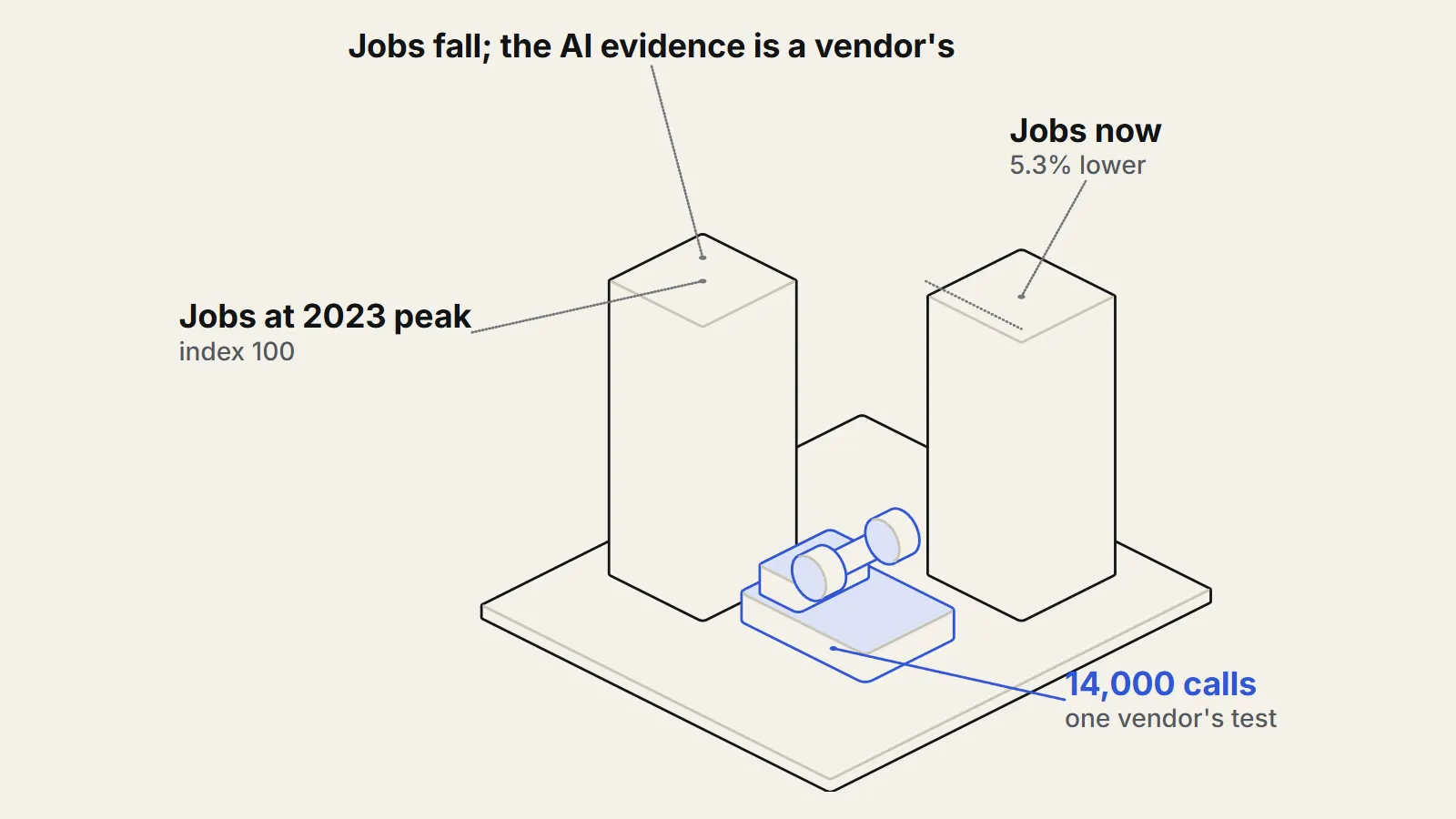
Call center jobs are shrinking worldwide, and a company that sells AI receptionists, a kind of AI voice agent that answers the phone, has just published a comparison of about 14,000 calls in which people did better than software on one key measure. We saw both items on 15 and 16 October 2026 and checked them against the original pages. The short answer: the job decline is real and well measured, but the 14,000-call comparison cannot tell us that AI is failing or that AI is the reason for the decline. Nothing here is advice on work, study or investment; these are numbers to read with care.
Are call center jobs declining, and by how much?
The best count we found comes from Revelio Labs, which tracks job records worldwide. It reports that global call center employment, counted as headcount, is 5.3 percent below its December 2023 peak1.1 Of the 70 quarterly readings it has since 2009, only eight show a year-over-year fall, and all eight are in the most recent eight quarters. The latest quarter fell the fastest. High-income countries turned negative in 2022, and by the last quarter of 2025 growth was negative in every income group. China and Nigeria are named as exceptions that still show growth.1 The investment firm Andreessen Horowitz charted the same data on 9 October 2026 and called AI the probable driver.2
In the United States, the Bureau of Labor Statistics publishes figures for customer service representatives. That is an occupation title, so it is not the same count as call center headcount. It reports 2,666,000 jobs in 20253 and projects a fall of 5 percent by 2035, about 141,800 jobs.3 On automation and jobs, its stated reason is that automation of these tasks is expected to reduce demand, helped by self-service systems and mobile apps. It also expects roughly 289,500 openings a year, because people leave the job or the labour force. A shrinking occupation still hires.
What did the 14,000-call test of AI voice agents measure?
The comparison was published on 15 October 2026 by Bold Agent Kit, which sells AI receptionist software (https://boldagents.co/blog/call-center-jobs-declining-14000-calls-humans-outperform-ai). It covers about 14,000 inbound calls, 6,343 handled by AI agents4 and the remaining 7,657 or so by human receptionists, from clients taking part in the study.4 It reports three results. Humans showed roughly four times stronger intake conversion, meaning more calls ended in a successful intake. AI-handled calls had a 700 percent higher rate of callers hanging up before any progress. And humans missed about 15 percent more calls than the AI agents did.4
Read together, that is a trade-off, not a verdict. Software answers when people are busy or away, so fewer calls go unanswered. Once a call is answered, people turn more of them into a completed intake. The post lists possible reasons, including delays, unexpected questions and callers who prefer a person, but says it did not test any of them.4
Do humans outperform AI on calls? Can we trust the result?
We would treat it as a lead, not as evidence. First, the author sells the product being tested and gains from a debate about AI quality. Second, the post says the design was observational, not a randomised experiment, and that the calls AI took may differ from those people took. Third, it gives no time period and no absolute rates: a result such as "four times stronger" could mean 4 percent against 1 percent or 40 percent against 10 percent, and those are very different businesses. Fourth, it does not define conversion, missed call or no-progress hangup, and it does not name the AI models used.4 The post itself warns that the results should not be read as proof that humans beat every AI system in every industry, and that call complexity, business type and set-up may explain the gaps.
The honest reading is narrow: in this one vendor's clients, on terms it chose not to publish, human receptionists converted more answered calls. That is useful to a business deciding how to staff a phone line, and it is a vendor publishing a result that does not favour its own product. It says very little about call centers as a whole, which also handle complex inquiries such as refunds, not only intake.
Is AI replacing call center jobs?
Not on this evidence. Revelio says the decline is "multifaceted" and that it cannot see which firms replaced workers with chatbots. It lists a post-pandemic hiring correction and cost cutting under higher interest rates as possible factors, then argues those would hit office work broadly, which its data does not show: other white-collar roles kept growing while call centers fell.1 The a16z note agrees on one point: growth began slowing when interest rates rose, slightly before ChatGPT was released, and the author says other explanations are probable too.2 For how rate rises work through the economy, see our guide to what causes inflation (https://therealigned.com/story/what-causes-inflation).
Who gains and who loses when a call center shrinks?
Revelio's data on workers who left shows where they went. About 49.7 percent moved to other customer-service, sales or office and HR jobs, and 10.8 percent reached technical support, customer success or software and data roles, which pay more.1 In the 12 middle-income countries it studied, hiring slowed by more than leaving did, so the squeeze falls hardest on people trying to enter the field. Pay matters here: the BLS median for US customer service representatives was $44,770 in 2025.3 For the general forces behind pay, see why wages rise (https://therealigned.com/story/why-wages-rise), and for how a vendor's incentives shape what it publishes, see how startups actually make money (https://therealigned.com/story/how-startups-actually-make-money).
What do we still not know?
We do not know the share of the decline caused by AI, by rate rises, by a hiring correction and by plain weak demand. We do not know the absolute conversion rates in the 14,000-call comparison, the period it covers or the kind of calls in it. We do not know whether the human advantage on intake holds as models improve. And we do not know whether workers who move on end up better or worse off over several years, because the data follows them for 12 months. The comparison also says nothing about customer satisfaction or revenue per call, which the vendor lists as future work.4
Key takeaways
- Global call center employment is 5.3 percent below its December 2023 peak, and the fall has lasted eight straight quarters.
- The 14,000-call comparison comes from an AI vendor, is observational, and leaves out the time period and absolute rates.
- In that comparison humans converted more answered calls, while AI missed fewer calls.
- The cause of the job decline is not settled: AI, higher interest rates and a hiring correction are all in play.
- US government figures project a 5 percent fall in customer service jobs by 2035, yet hundreds of thousands of openings a year.
Sources
- 1After a Decade of Growth, Global Call Center Employment Is Shrinking (opens the source in a new tab) · Revelio Labs, 2026 · Report · https://www.reveliolabs.com/news/ai-and-work/after-a-decade-of-growth-global-call-center-employment-is-shrinking
- 2This Week in Charts: Are Prediction Markets Politically Biased? (AI Has Come For Call Centers, After All?) (opens the source in a new tab) · Andreessen Horowitz, 2026 · Reporting · https://www.a16z.news/p/this-week-in-charts-are-prediction
- 3Customer Service Representatives: Occupational Outlook Handbook (opens the source in a new tab) · U.S. Bureau of Labor Statistics, 2026 · Primary source · https://www.bls.gov/ooh/office-and-administrative-support/customer-service-representatives.htm
- 4Call Center Jobs Are Declining, but 14,000 Calls Show Humans Still Outperform AI (opens the source in a new tab) · Bold Agent Kit, 2026 · Reporting · https://boldagents.co/blog/call-center-jobs-declining-14000-calls-humans-outperform-ai