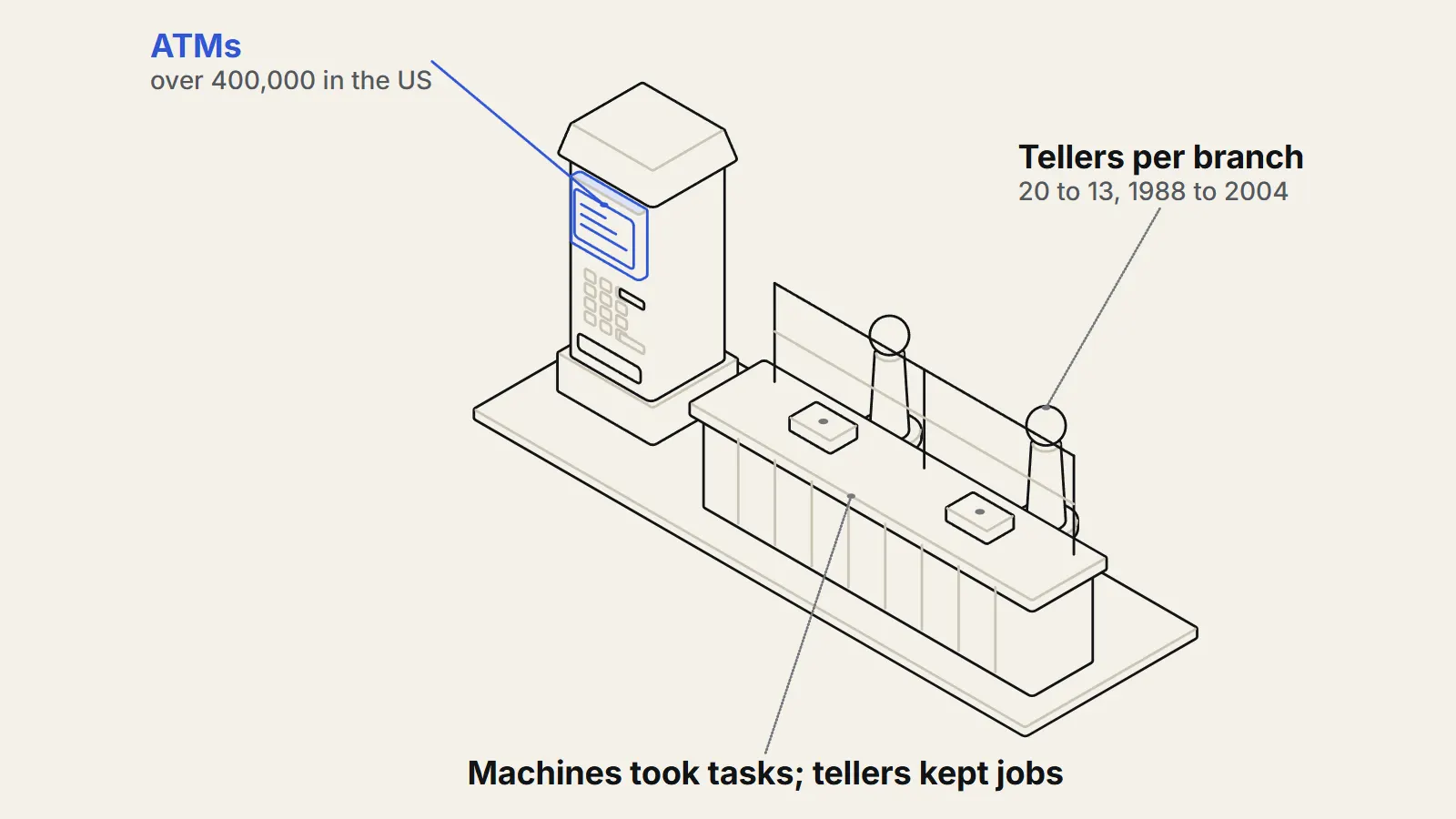
Automation destroys some jobs, but the history of bank tellers shows it does not always reduce the number of jobs in an occupation. After automated teller machines (ATMs) spread across the United States, teller employment did not collapse. It rose modestly for about three decades, because ATMs made branches cheaper to run, so banks opened more of them, and because the remaining tellers took on different tasks. The longer story is less comfortable: the same occupation is now projected to shrink. The lesson is that automation changes tasks first, and whether jobs fall depends on demand, on what machines can do, and on how fast things change.
Did ATMs replace bank tellers?
The economist James Bessen studied this case in a 2015 article in the IMF magazine Finance & Development (https://www.imf.org/external/pubs/ft/fandd/2015/03/bessen.htm). He reports that ATMs were first installed in the 1970s and that banks expanded their use sharply from the mid-1990s, with over 400,000 installed in the United States. In the average urban market, the number of tellers per branch fell from 20 to 13 between 1988 and 20041, while urban bank branches rose 43 percent1 over the same period.1
The economist David Autor summarised the combined effect in a research brief for the MIT Initiative on the Digital Economy. Rather than eliminating bank tellers, he writes, their employment rose modestly from 500,000 to approximately 550,0002 over the 30 years from 1980 to 2010, although tellers declined as a share of overall US employment.2 So fewer tellers worked in each branch, but there were more branches, and the two effects roughly offset each other.
Why did ATMs not destroy teller jobs?
There were two mechanisms. The first was cost. By reducing the cost of operating a branch, ATMs indirectly increased the demand for tellers, in the words of Autor's summary of Bessen.2 When a service gets cheaper, firms may offer more of it. Bessen draws a parallel from the nineteenth century: automation cut the labour needed to weave a yard of cloth by 98 percent, yet factory weaving jobs increased as cheaper cloth drove up demand.1
The second mechanism was a change in tasks. ATMs took over the routine work of dispensing cash and taking deposits. Autor adds that information technology let banks use tellers as salespeople, building relationships with customers and introducing them to credit cards, loans and investment products.2 The job title stayed the same, but the mix of tasks inside it changed.
What does automation history say about tasks versus jobs?
A job is a bundle of tasks. Machines usually take over some tasks, not the whole bundle at once. If the remaining tasks become more valuable, or if cheaper output creates more demand, employment can hold up or even grow. Bessen makes this point across the economy: in his reading, technology has mostly moved workers into other jobs, and manufacturing is the only major occupational group with a persistent net job loss, about 5 million jobs over three decades.1
Autor stresses a condition. Workers benefit when they supply tasks that automation complements, and they do less well if they mainly supply tasks that are substituted. In his words, a teller who can tally currency but cannot provide relationship banking is unlikely to fare well at a modern bank.2 That makes the effect depend on the worker and the job design, not only on the technology.
Does automation take jobs or just change them?
Both can happen. Automation acts on tasks first, so a job often survives with a different mix of tasks, as tellers did when ATMs took over dispensing cash and taking deposits and tellers moved toward relationship banking.2 Jobs fall when machines substitute directly for workers and demand does not expand, as in the industrial robot study.3
Are bank teller jobs disappearing today?
The pattern may be changing. The US Bureau of Labor Statistics (BLS), in its Occupational Outlook Handbook entry for tellers (https://www.bls.gov/ooh/office-and-administrative-support/tellers.htm), reports about 339,200 teller jobs in 2025 and projects a change of -13 percent, or -44,700 jobs, from 2025 to 20354.4 The BLS gives several reasons: bank branches are shrinking because of technological change, fewer customers visit the teller window as they shift to online banking and mobile check deposits, video kiosks let one teller serve more customers, and enhanced ATMs are taking on tasks such as issuing debit cards and detecting counterfeit currency.4
This is not a contradiction of the earlier finding. It suggests that the first wave of ATMs lowered costs and expanded branches, while later technology reduced the need for the branch itself. The same machine type, an ATM, appears in both stories, but the surrounding conditions changed.
Does automation destroy jobs? The strongest case that it does
Economists Daron Acemoglu and Pascual Restrepo studied industrial robots in US local labour markets from 1990 to 2007. In an NBER working paper (https://www.nber.org/papers/w23285) they report large and robust negative effects of robots on employment and wages, with each additional robot per thousand workers lowering the employment-to-population ratio by roughly 0.18 to 0.34 percentage points and wages by roughly 0.25 to 0.5 percent.3 This is a very different finding from the teller case. It suggests that where machines substitute directly for workers and demand does not expand, jobs and pay in the affected areas can fall.
Autor himself warns against over-reading the ATM example. He writes that it should not be taken as paradigmatic, and that technological change is not necessarily employment-increasing or one that yields only winners.2 Bessen likewise notes that the problem for many workers is stagnant wages and a skills mismatch, not mass unemployment.1
What is not known?
Several things are unclear. The teller employment series Autor reports ends in 2010, so it does not show the years since. The studies measure different kinds of machines, from ATMs to industrial robots, so their results are not directly comparable. And neither says what will happen with newer software, such as systems that can write or answer questions, which may substitute for different tasks. Bessen expects artificial intelligence to take over tasks in many occupations, but he does not see it as a reason to predict the end of work.1 That is a judgement about the future, not a measurement, and reasonable researchers disagree.
Key takeaways
- After ATMs spread, US teller employment rose modestly from about 500,000 in 1980 to about 550,000 in 2010, because branches multiplied and teller tasks shifted.
- Automation acts on tasks. Jobs survive when the remaining tasks gain value or when cheaper output raises demand.
- The BLS now projects teller jobs to fall 13 percent from 2025 to 2035, partly because online banking and smaller branch networks reduce demand for the branch itself.
- Studies of industrial robots find negative local effects on employment and wages, so the teller case is not a rule that automation always preserves jobs.
Sources
- 1Toil and Technology (opens the source in a new tab) · Finance & Development, International Monetary Fund, 2015 · Essay · https://www.imf.org/external/pubs/ft/fandd/2015/03/bessen.htm
- 2Why Are There Still So Many Jobs? The History and Future of Workplace Automation and Anxiety (MIT IDE Research Brief 2016.07; JEP 2015) (opens the source in a new tab) · MIT Initiative on the Digital Economy, 2016 · Paper · https://ide.mit.edu/sites/default/files/publications/IDE_Research_Brief_v07.pdf
- 3Robots and Jobs: Evidence from US Labor Markets (NBER Working Paper 23285) (opens the source in a new tab) · National Bureau of Economic Research, 2017 · Paper · https://www.nber.org/papers/w23285
- 4Tellers: Occupational Outlook Handbook (opens the source in a new tab) · U.S. Bureau of Labor Statistics, 2026 · Primary source · https://www.bls.gov/ooh/office-and-administrative-support/tellers.htm