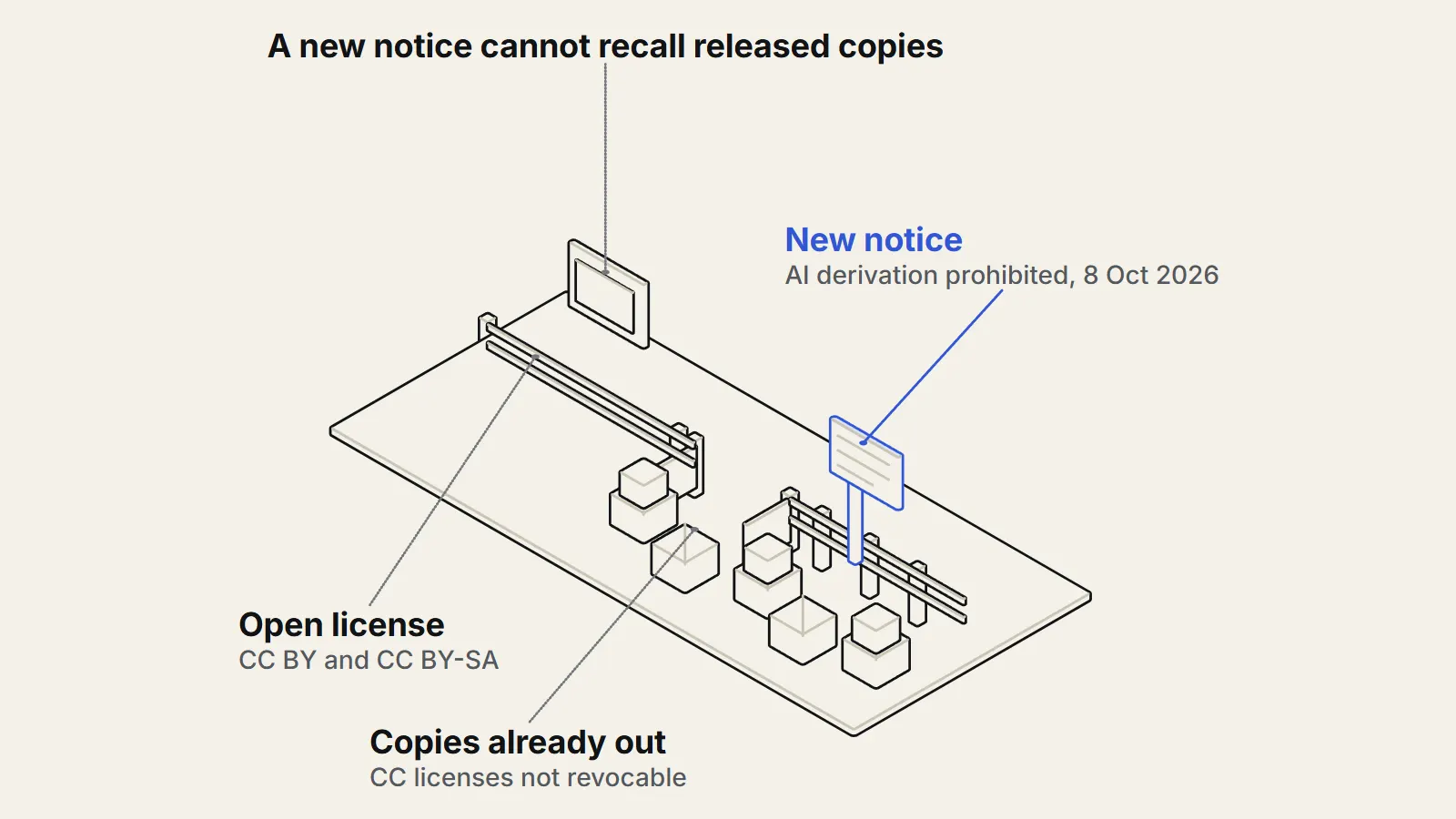
A webcomic artist, David Revoy, published a post on 8 October 2026 saying his art, lore, stories and comics now carry an extra line, "AI derivation prohibited", beside their Creative Commons licenses. We saw it discussed on a developer news forum on 15 and 16 October 2026, and this piece answers it. The question is what a Creative Commons AI notice can do. In short, a license can state what its owner allows, but a new notice cannot call back permissions already granted, and a model will only honor it if the law or a signal requires that. Parts of the law are still unsettled, and this is explanation, not legal advice.1
What did the artist add to his Creative Commons license?
The artist makes the webcomics Pepper&Carrot and MiniFantasyTheater. By his account his work has been under Creative Commons for over ten years, as CC BY for the first and CC BY-SA for the second. He writes that these licenses have no option to prohibit AI-generated derivatives, so he is adding a separate notice beside them and will add it to older works over time.1 He defines the banned use as work where AI is used to "generate or substantially replace" the ideas, the creative process or the visual rendering, and gives a comic prequel and a game with AI graphics as examples. He says he tolerates AI grammar and translation aids that correct human-written text.1
His stated reason is volume. He says that in the week of the post he received more than three requests a day1 from studios, publishers and others asking leave to make AI derivatives, and that a chatbot can already write fan fiction about his characters. He says he relies on European moral rights, which he says must be asserted before they can be enforced, and that some cases may need to go to court. We have not checked those legal claims for any one country.1
Can a Creative Commons license stop AI use?
Creative Commons (CC) says its licenses are not revocable2: once granted they stay in place unless the licensee breaks the terms. A licensor may stop distributing under CC at any time, but anyone who already has a copy may keep redistributing it. CC's FAQ (https://creativecommons.org/faq/)2 also describes the licenses as granting permission for reuse in any situation that needs permission under copyright, and says separate terms and conditions do not become part of the license.2
That bears on the notice. Copies of earlier works released under CC BY or CC BY-SA remain available under those terms, so a line added later sits beside a grant it did not write. We found no court ruling in the pages we opened on whether such a line binds people who rely on the original license, so how it would be read is unknown. New work is different: a creator who has not yet released something can choose other terms from the start. And the license text leaves moral rights outside the grant. CC BY 4.0 (https://creativecommons.org/licenses/by/4.0/legalcode.en) says moral rights, such as the right of integrity, are not licensed, while the licensor agrees not to assert them to the extent needed for others to use the licensed rights.3 How far that leaves room to bar AI derivative works depends on national law, which we have not assessed.
Can a license stop AI training in the EU and the US?
Two questions are often mixed. Derivation means someone makes a new work from yours. Training means a company copies works to build a generative AI model. In the EU, the 2019 copyright directive (https://eur-lex.europa.eu/legal-content/EN/TXT/?uri=CELEX:32019L0790) allows text and data mining unless rights holders have reserved their rights in an appropriate manner, such as machine-readable means4 for content made publicly available online.4 Its recitals add that, for online content, this can include metadata and the terms and conditions of a website or service.4 The US Copyright Office adds that the EU AI Act obliges providers of AI models to identify and honor those opt-outs.5
The United States has no such opt-out in its statute. The Copyright Office's report on generative AI training (https://www.copyright.gov/ai/Copyright-and-Artificial-Intelligence-Part-3-Generative-AI-Training-Report-Pre-Publication-Version.pdf) (a pre-publication version released on 9 May 2025) is the Office's analysis, not a court ruling. It expects some training uses to qualify as fair use and others not5, depending on the facts. It also says that requiring owners to opt out is inconsistent with the principle that consent is needed for uses within their rights, but that if Congress created an exception, an opt-out could preserve some ability to block uses or negotiate terms, with concerns about how well opt-outs work.5
What do supporters and critics argue?
Commenters in the Hacker News discussion (https://news.ycombinator.com/item?id=50011028) of the post gave reasons for the notice: authors should be able to state how their work may be used, and an explicit notice could help show in a later dispute that a use was prohibited.6
The two sides share a premise: creators are being asked for AI permissions at a rate that is hard to answer one by one. They differ on whether a license line is the right tool, or whether the answer lies in law and in machine-readable signals. For another case of publishers setting rules on AI, see our piece on the AI content ban (https://therealigned.com/story/ai-content-ban-why-publishers-ban-ai). For an earlier fight over new machines and who gets paid, see what the Luddites actually wanted (https://therealigned.com/story/luddites-what-they-wanted).
What is not known about AI derivative works and licenses?
Four points remain open in the sources we read. First, whether a notice beside a CC license binds anyone who already holds a copy. Second, how moral rights would apply to AI derivatives in different countries. Third, whether EU courts will treat prose notices as a valid reservation of rights; the US Copyright Office notes there is so far little case law on point in the EU.5 Fourth, how US courts will weigh fair use for training. Creators with a specific work or dispute should ask a lawyer in their own country. For wider context on AI and work, see our look at AI benchmarks and working hours (https://therealigned.com/story/ai-benchmarks-us-working-hours).
Key takeaways
- On 8 October 2026 a webcomic artist added an "AI derivation prohibited" notice beside his CC BY and CC BY-SA licenses, citing more than three permission requests a day.
- CC says its licenses are not revocable, so a new notice cannot call back copies already released under them; whether it binds anyone is untested in the sources we read.
- For training, the EU allows mining unless rights are reserved, with machine-readable means named as one way; the US has no opt-out and treats fair use case by case.
- This explains the question and is not legal advice.
Sources
- 1License update: AI derivation prohibited on all my art, lore, stories, and comics (opens the source in a new tab) · davidrevoy.com, 2026 · Essay · https://www.davidrevoy.com/article1178/license-update-ai-derivation-prohibited-on-all-my-art-lore-stories-and-comics
- 2Creative Commons FAQ (opens the source in a new tab) · Creative Commons, 2025 · Reporting · https://creativecommons.org/faq/
- 3Attribution 4.0 International, Legal Code (opens the source in a new tab) · Creative Commons, 2013 · Law · https://creativecommons.org/licenses/by/4.0/legalcode.en
- 4Directive (EU) 2019/790 on copyright in the Digital Single Market (opens the source in a new tab) · European Parliament and Council, 2019 · Law · https://eur-lex.europa.eu/legal-content/EN/TXT/?uri=CELEX%3A32019L0790
- 5Copyright and Artificial Intelligence, Part 3: Generative AI Training (pre-publication version) (opens the source in a new tab) · US Copyright Office, 2025 · Report · https://www.copyright.gov/ai/Copyright-and-Artificial-Intelligence-Part-3-Generative-AI-Training-Report-Pre-Publication-Version.pdf
- 6License update: AI derivation prohibited on all my art, lore, stories, comics (discussion) (opens the source in a new tab) · Hacker News, 2026 · Reporting · https://news.ycombinator.com/item?id=50011028