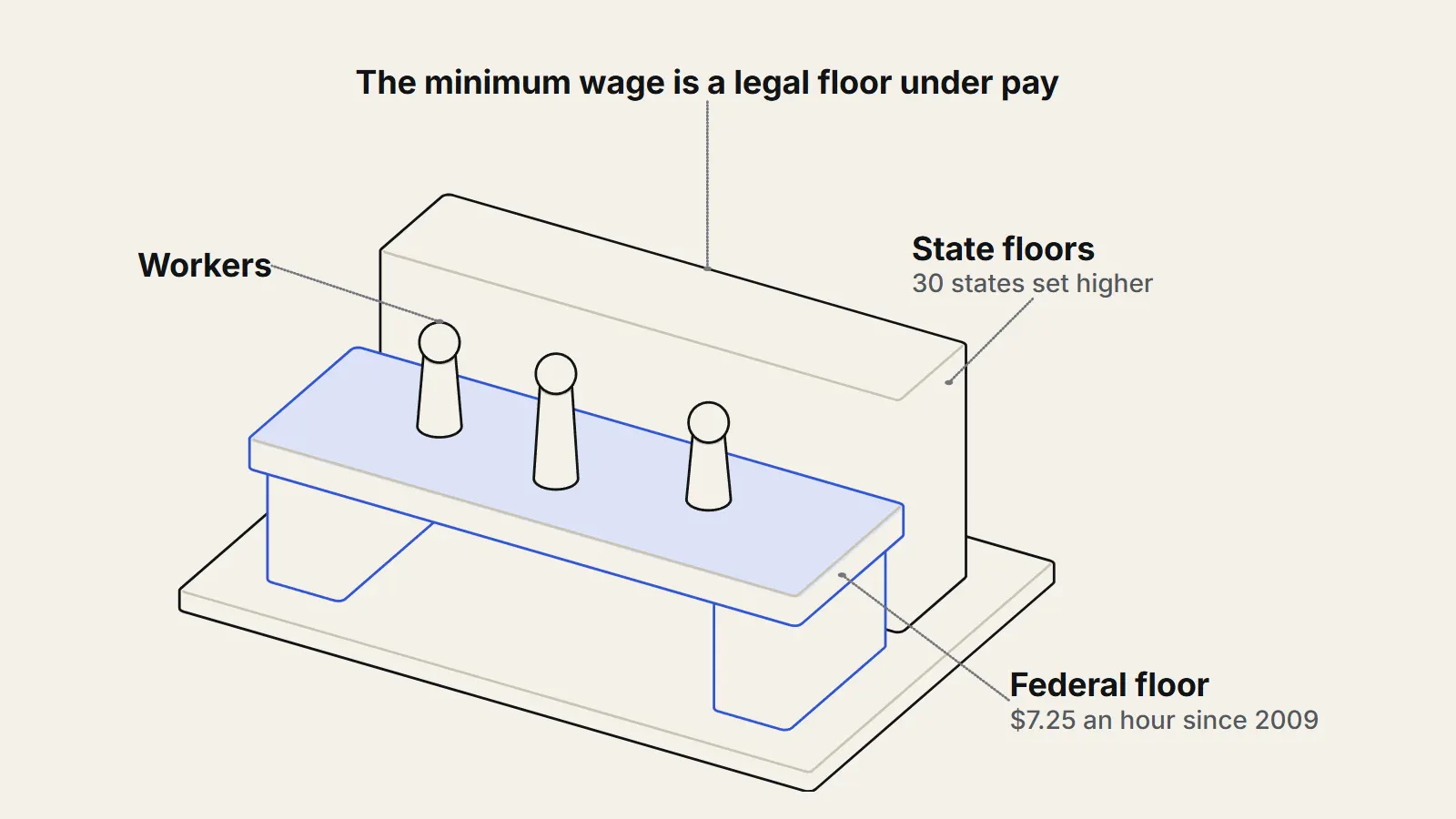
A minimum wage is a legal floor on the hourly pay an employer may offer. In the United States the federal floor has been $7.25 an hour since July 24, 20091, and many states set higher ones.1 What happens to jobs when the floor rises is one of the most studied questions in economics. Some well-known US studies of moderate increases find small or no job losses, while a major review concludes that most studies find negative effects, and projections for very large increases carry wide uncertainty. This article lays out what the minimum wage is, what the main studies found and where economists still disagree.
What is the minimum wage and who does it cover?
The federal minimum comes from the Fair Labor Standards Act. Its coverage has widened over the decades: the Labor Department's history notes the 1961 amendments expanded retail coverage, a 1974 change reached many government and domestic workers, and a 1989 change removed an exemption for small retail firms. Some pay arrangements sit below the headline rate: the 1996 amendments set a youth rate of $4.25 for workers under 20 in their first 90 days and allowed tip credits for qualifying tipped employees.1 The history page gives general information, not a legal reading.
States and cities can set higher floors, and the higher one governs where both apply. On the Labor Department's state table at the time of reading, 30 of the 50 states listed a basic minimum above $7.25, 13 matched it, and 5 had no state minimum wage law, in which case the federal rate applies to covered employers.2 Rates change often, so the current table should be checked directly: state minimum wage laws (https://www.dol.gov/agencies/whd/minimum-wage/state).
What does simple economic theory predict?
The textbook model treats labour like any good with a price. If a floor is set above the wage that would balance the number of workers firms want with the number who want jobs, firms hire fewer, so some workers gain higher pay while others lose jobs or hours. An alternative model describes employers with some power to set wages, for example where a few firms dominate a local labour market or workers face costs in changing jobs. There, a modest floor can raise pay without cutting employment, because the employer was paying less than the worker's worth to the firm. Which model fits depends on the market, which is why economists test it with data.
What did Card and Krueger find?
The study that reopened the debate was a 1994 paper by David Card and Alan Krueger. On April 1, 1992, New Jersey's minimum wage rose from $4.25 to $5.05 an hour, and the authors surveyed 410 fast-food restaurants in New Jersey and eastern Pennsylvania before and after3, treating Pennsylvania, where the floor did not change, as a comparison group. They reported no indication that the rise in the minimum wage reduced employment (https://davidcard.berkeley.edu/papers/min-wage-ff-nj.pdf).3 The method, comparing changes in an affected area with changes in an unaffected one, is called difference-in-differences and became standard in this field. It covered one industry in one region, which is why later studies tried other places and methods.
What does later research find?
Two large bodies of work point in different directions. In a review for the National Bureau of Economic Research, David Neumark and William Wascher found no consensus on the overall effect (https://www.nber.org/papers/w12663) but concluded that most studies, and most of the more credible ones, show negative employment effects, with the strongest effects on the least-skilled groups.4 They called the claim that recent research fails to support the traditional view incorrect.
In a 2019 study, Doruk Cengiz, Arindrajit Dube, Attila Lindner and Ben Zipperer used 138 state-level minimum wage changes between 1979 and 20165 and compared the jobs that disappeared below the new floor with the extra jobs that appeared at or just above it. They found the number of low-wage jobs stayed essentially unchanged over five years, found modest wage spillovers up the wage scale and found some evidence of reduced employment in tradable sectors, meaning industries that sell goods and services across regions.5 The paper in its working-paper form (https://www.nber.org/papers/w25434) also argues that some conventional methods can give misleading results. These estimates are about moderate increases, not every possible floor.
What does the Congressional Budget Office estimate for a $15 federal wage?
For larger increases, the nonpartisan Congressional Budget Office (CBO) provides an estimate. In 2021 it analysed a bill that would raise the federal floor to $15 by June 2025. It estimated that employment would fall by 1.4 million workers, or 0.9 percent6 on average in 2025, while 0.9 million fewer people would be in poverty, and about 17 million workers earning less than $15 would be directly affected.6 CBO said there was a one-third chance that the job loss would be between about zero and 1.0 million, and a one-third chance it would be between 1.0 million and 2.7 million.
The median estimate was 1.0 million, below the mean of 1.4 million, because there was a significant possibility of large reductions. The estimate is one agency's projection with stated uncertainty. The range includes an outcome of about zero.6
What is the strongest case on each side?
The case on the other side is the evidence above: the Card and Krueger comparison and the large multi-state study found little or no loss of low-wage jobs after moderate increases, and wage spillovers raised pay beyond the minimum itself.
What is still not known?
Several questions remain open. The long-run effects on hours, hiring of new workers and business closures are harder to measure than headline employment. Studies of state changes may not transfer to a nationwide floor, and the sources read here do not settle how much of any cost falls on consumers through prices. CBO's range shows how uncertain even a careful projection is for a $15 floor.
Key takeaways
- The federal minimum wage has been $7.25 an hour since July 24, 2009, and many states set higher floors.
- Card and Krueger's 1994 New Jersey study found no sign that a higher minimum reduced fast-food employment, which reopened a long-running debate.
- A 2019 multi-state study found little change in the number of low-wage jobs after 138 state increases, while a major review found most studies show negative employment effects.
- CBO estimated in 2021 that a $15 federal floor would cut employment by 1.4 million on average and reduce poverty by 0.9 million, with a wide range of outcomes.
- Evidence is strongest for moderate increases; effects of very high floors in low-wage regions are less certain.
Sources
- 1History of Changes to the Minimum Wage Law (opens the source in a new tab) · US Department of Labor, Wage and Hour Division, 2024 · Primary source · https://www.dol.gov/agencies/whd/minimum-wage/history
- 2State Minimum Wage Laws (opens the source in a new tab) · US Department of Labor, Wage and Hour Division, 2025 · Primary source · https://www.dol.gov/agencies/whd/minimum-wage/state
- 3Minimum Wages and Employment: A Case Study of the Fast-Food Industry in New Jersey and Pennsylvania (opens the source in a new tab) · American Economic Review 84(4), 1994 · Paper · https://davidcard.berkeley.edu/papers/min-wage-ff-nj.pdf
- 4Minimum Wages and Employment: A Review of Evidence from the New Minimum Wage Research (opens the source in a new tab) · National Bureau of Economic Research (Working Paper 12663), 2006 · Paper · https://www.nber.org/papers/w12663
- 5The Effect of Minimum Wages on Low-Wage Jobs: Evidence from the United States Using a Bunching Estimator (opens the source in a new tab) · National Bureau of Economic Research (Working Paper 25434); published in Quarterly Journal of Economics 2019, 2019 · Paper · https://www.nber.org/papers/w25434
- 6The Budgetary Effects of the Raise the Wage Act of 2021 (opens the source in a new tab) · Congressional Budget Office, 2021 · Report · https://www.cbo.gov/publication/56975