Margaret Hamilton, who led the on-board flight software for NASA's Apollo missions, died on 30 September 2026 at the age of 901. This piece answers that news item, which we saw on 16 October 2026. It asks why Margaret Hamilton's Apollo software still matters to people who never go near a spacecraft. Our answer is that her team wrote programs on the assumption that things would go wrong, and in July 1969 that assumption helped keep the Apollo 11 landing going through the 1202 alarm. Her death was reported by MIT News (https://news.mit.edu/2026/margaret-hamilton-computing-pioneer-dies-1007) and by the Associated Press (https://phys.org/news/2026-10-margaret-hamilton-scientist-nasa-apollo.html).12
Who was Margaret Hamilton and what did she do on Apollo?
According to MIT, Hamilton was the first programmer on Apollo at the MIT Instrumentation Laboratory and the first woman on the project. She started on software for uncrewed missions, moved to the crewed ones, and by 1968 was assistant director of the Command and Service Module team. MIT says more than 400 people worked on Apollo's software.1 The Associated Press adds that she was born on 17 August 1936 in Indiana.2
The laboratory's Apollo guidance work was the first major Apollo contract, awarded on 9 August 1961. In 2016 Hamilton received the Presidential Medal of Freedom for work on asynchronous software, priority scheduling and human-in-the-loop decision capability, and she headed the lab's Software Engineering Division.3 Those three phrases are the technical heart of this story, and the next sections show what they meant in practice.
How much memory did the Apollo guidance computer have?
Peter Adler worked on the lunar module's flight software at MIT. His firsthand account, which NASA hosts in the Apollo Lunar Surface Journal, gives the memory sizes. The Apollo guidance computer in the lunar module held 36,864 words in fixed memory4, which stored nearly all the program code and constants, and only 2,048 words in erasable memory4 for variables and counters.4
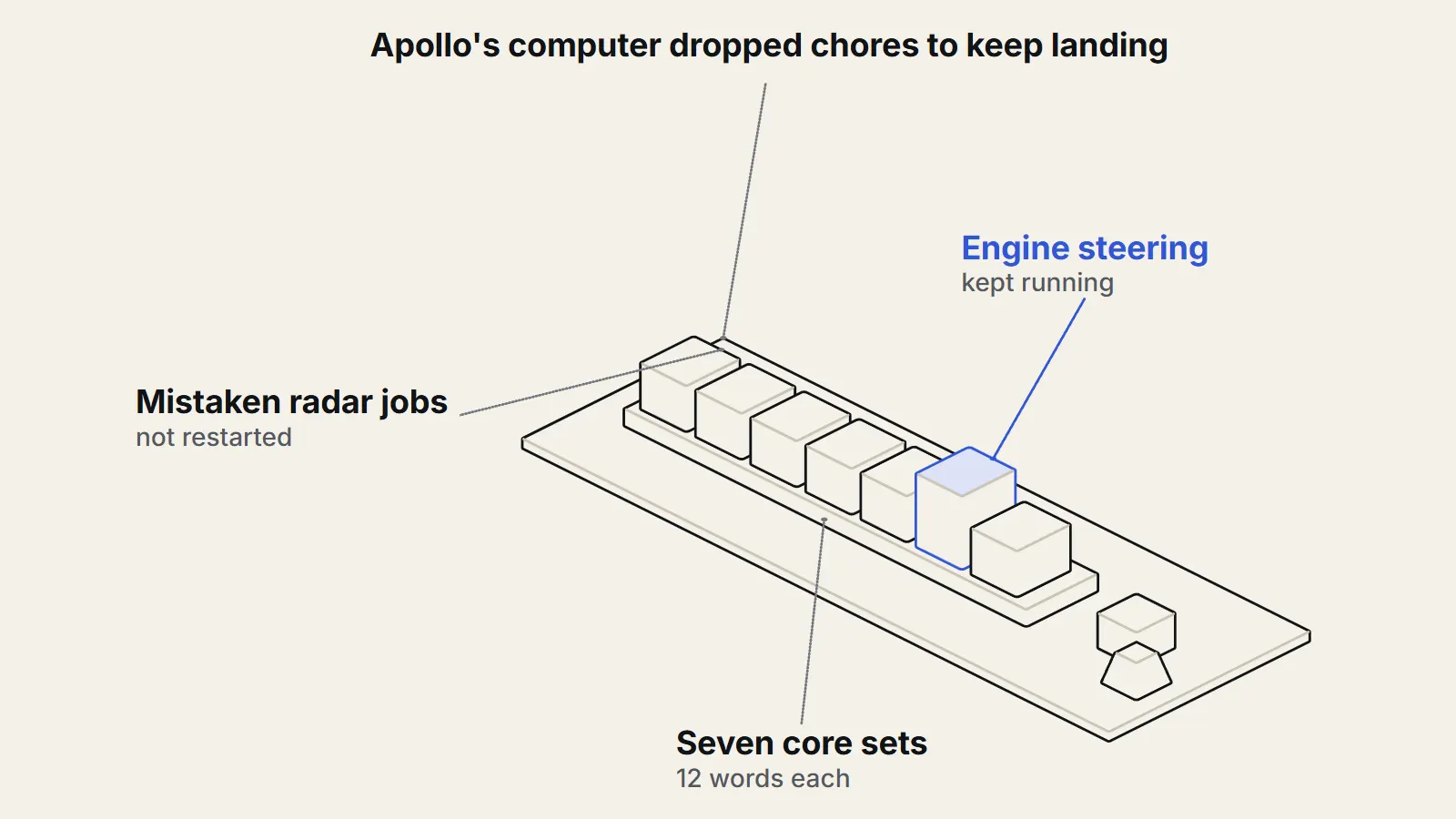
Each running job received a scratch area called a core set, made of 12 erasable locations. Jobs that needed more room could take one of five vector accumulator areas of 44 words each. The computer had seven core sets in all.4 By our arithmetic, seven core sets and five such areas add up to 304 words, about 15 percent of the erasable memory. The machine could therefore juggle only a handful of jobs at once, which made the choice of what to drop a design problem to solve in advance and not a rare accident.
What did the Apollo 8 mistake teach?
MIT's obituary describes an incident during Apollo 8 in 1968, when a pre-launch program was run in flight and erased navigation data. Her team fixed the software, and MIT calls the result an early example of defensive programming: code that expects errors and handles them automatically.1 The lesson is simple to state and was costly to learn. People will sometimes run the wrong program, so the machine has to cope.
What was the 1202 alarm on Apollo 11 in July 1969?
During the Apollo 11 landing the lunar module's computer raised a 1202 alarm. MIT says it came from an overload caused by a hardware switch fault, and that the priority-driven software shut down non-essential background tasks, after which Houston allowed the landing to continue.1 Adler's account explains the mechanics. The radar switches were set wrongly, so the computer kept scheduling jobs to process rendezvous radar data even though no real data existed. Those jobs filled the core sets. When a new job asked for a core set and none was free, the computer raised alarm 12024; when a request needed a vector accumulator area and none was free, it raised alarm 1201.4 The full account is on the NASA account of the Apollo 11 program alarms (https://www.nasa.gov/wp-content/uploads/static/history//alsj/a11/a11.1201-pa.html).
What came next shows how the Apollo guidance computer handled the error. The computer rebooted itself and restarted selected programs near where they had been. It restarted the important ones, such as steering the descent engine, and did not restart all the mistakenly scheduled radar jobs. Adler adds that this restart behaviour had been tested heavily before the software was released, which is why the mission controllers in Houston could be confident that flying on was safe.4
Did Margaret Hamilton coin software engineering, and who else deserves credit?
Obituaries often say Margaret Hamilton coined the term software engineering. MIT's own obituary is more careful. It says she began using the term to set software apart from hardware and other kinds of engineering, while treating all of them as parts of systems engineering.1 We have not traced who first used the phrase and did not find a page we opened that settles it, so we do not say she coined it.
There is also a fair counterpoint to any single-hero story. More than 400 people worked on the software, and the Apollo 11 alarm was survived by a whole system: the code, the testing, and the controllers who decided to continue. Hamilton's role was to lead the team and shape its approach. Giving her credit and giving the team credit do not conflict.1
What do we not know?
The Associated Press report we read does not state a cause of death, and we do not give one.2 The sources we opened say Houston allowed the Apollo 11 landing to continue, but they do not say how much margin was left, so we cannot say how close the alarms came to forcing an abort. We also cannot say how much of today's defensive programming traces to Apollo rather than to other projects.
Readers who want related background on The Realigned can look at how startups actually make money (https://therealigned.com/story/how-startups-actually-make-money) to see how software teams weigh speed against polish, at why wages rise (https://therealigned.com/story/why-wages-rise) for the role of skill and productivity, and at compound interest (https://therealigned.com/story/compound-interest-time-vs-amount) for how small effects pile up over time. This piece is history and explanation, not advice.
Key takeaways
- Margaret Hamilton led Apollo's on-board flight software and died on 30 September 2026, aged 90.
- The lunar module computer had only 2,048 words of erasable memory, so it had to choose which jobs to keep.
- In the 1202 alarm of July 1969 the software dropped needless work and kept steering the descent engine.
- Credit for the term software engineering is less settled than many obituaries imply, and the work was a team effort.
Sources
- 1Margaret Hamilton, computing pioneer who led software development for the Apollo program, dies at 90 (opens the source in a new tab) · MIT News, 2026 · Reporting · https://news.mit.edu/2026/margaret-hamilton-computing-pioneer-dies-1007
- 2Margaret Hamilton, who led a software team for NASA's Apollo program, dies at 90 (opens the source in a new tab) · Phys.org (Associated Press), 2026 · Reporting · https://phys.org/news/2026-10-margaret-hamilton-scientist-nasa-apollo.html
- 3Apollo code developer Margaret Hamilton receives Presidential Medal of Freedom (opens the source in a new tab) · MIT News, 2016 · Reporting · https://news.mit.edu/2016/apollo-code-developer-margaret-hamilton-receives-presidential-medal-of-freedom-1117
- 4Apollo 11 Program Alarms (opens the source in a new tab) · NASA Apollo Lunar Surface Journal, 1998 · Primary source · https://www.nasa.gov/wp-content/uploads/static/history//alsj/a11/a11.1201-pa.html