- Place
- Chile
- Years
- 1973–1990
- Policy
- After the 1973 coup, economists known as the Chicago Boys ran price liberalisation, deficit cuts, privatisation, trade and capital opening, an exchange-rate peg and pension privatisation.
- Outcome
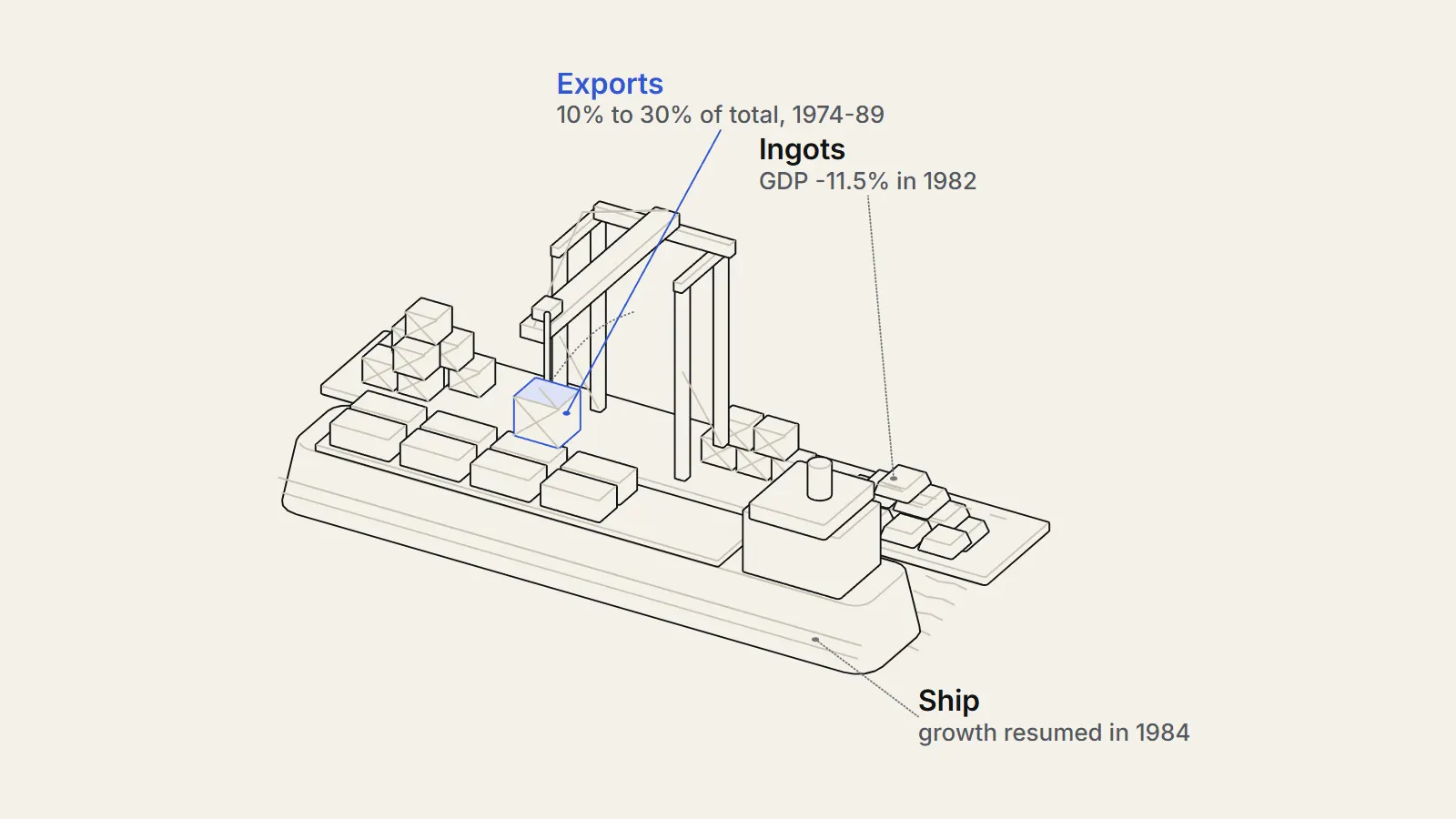
- Inflation fell from 504.7% in 1974 to 9.9% in 1982, but output fell 11.5% in 1982; growth recovered after 1984 and economists dispute how much the reforms explain.
The Chicago Boys, economists trained mostly at the University of Chicago, helped run the Chile economy after the 1973 military coup, and the record they left is mixed.4 Consumer price inflation fell from 504.7 percent in 1974 to 9.9 percent in 19821, but real output then fell 11.5 percent in 1982, and unemployment ran near 20 percent even after counting emergency jobs.12 Growth returned after 1984, and economists still disagree over how much of the later boom the reforms explain.
Before
Deficits, controls and high inflation before 1973
This is an economics-first account. We look at prices, output, jobs and the budget, say what each side claims and show what the numbers can and cannot establish. We do not assess the political or human-rights record of the military government, which other sources cover.
Chile had lived with inflation for decades. Caputo and Saravia (https://bfi.uchicago.edu/wp-content/uploads/The-Case-of-Chile.pdf), an Oxford-based economist and a Central Bank of Chile economist, put average annual inflation at 30 percent between 1960 and 1973 and trace it to fiscal deficits and wage indexation.2 Growth in those years was steady, at about 2 percent a year in output per person.2
The pace changed after Salvador Allende won the presidency in September 1970 with 37 percent of the vote and began nationalising banks and most industries.2 The fiscal deficit rose from 0.5 percent of GDP in 1970 to 7.3 percent in 1971, 11.4 percent in 1972 and nearly 23 percent in 1973.2 The growth of base money went from 66 percent in 1970 to 136 percent in 1971 and 178 percent in 1972.2
In the first year the programme looked successful on its own terms. Real GDP grew 9.4 percent in 1971 and unemployment fell to 3.9 percent, while price controls held measured prices down.2 Andrew Zimbalist, reviewing Sebastian Edwards's book, writes that unemployment stayed very low and growth stayed positive during the 34 months of Allende's government, despite large macroeconomic imbalances.5 Edwards and Cox Edwards add that after a 56 percent minimum-wage rise in the first three months, inflation had cut the real minimum wage to 20 percent below its 1970 level by the second quarter of 1973.6
By 1972 and 1973 the controls stopped working. Output fell 1.2 percent in 1972, and inflation reached almost 255 percent in 1972 and 433 percent on average in 1973 on the alternative price series the authors use.2 Our own caution applies here: the authors say the official price series for 1970 to 1980 is somewhat unreliable, and the World Bank series we chart shows 352.8 percent for 1973.21 The authors read the episode as inflation becoming a fiscal phenomenon, because the state could not borrow after declaring an external-debt moratorium in November 1971 and so financed itself by creating money.2
The decision
What the Chicago Boys did, 1974 to 1981
The armed forces led by General Augusto Pinochet took power in September 1973.2 Many of the economic ideas came from a group popularly called the Chicago Boys. According to González and Prem, they were highly educated economists with close ties to business, in charge of designing and applying economic policy; their plan, a long document known as The Brick, had first been drafted for the right-wing candidate in the 1970 election.4 Its implementation began in 1975 and became more moderate after the 1982 crisis.4
The first instrument was a hard fiscal adjustment. Caputo and Saravia report that the deficit fell from 22.5 percent of GDP in 1973 to 0.4 percent in 19752 through the elimination of subsidies, higher taxes including a value-added tax, a reduction in public employment, and the reprivatisation of firms that needed public funds.2 Prices were liberalised, and the multiple exchange rates, up to six under Allende, were gradually unified.2
Outside economists also played a part. Edwards and Montes show that Milton Friedman visited Chile twice, in 1975 and 1981.7 Zimbalist reports that Edwards credits Friedman's March 1975 meeting with Pinochet, which Arnold Harberger also attended, with driving many austerity and pro-market policies.5 How much one meeting changed policy is Edwards's claim as relayed by a reviewer, and we have not tested it.
The timing was hard. In 1975 output fell about 13 percent as copper prices dropped by around half in real terms, oil prices rose fourfold, and the fiscal adjustment cut aggregate demand by 21 percent.2 Inflation was still 343 percent in December 1975, and the authors point to indexation: salaries and the exchange rate were tied to past inflation.2
Opening the economy and anchoring the peso
From January 1978 the government announced a pre-set rate of devaluation, nicknamed the tablita. The finance minister, Sergio de Castro, set 21.4 percent for 1978 with lower rates to follow, and in June 1979 the peso was fixed to the dollar.2 The idea was that if the exchange rate rose more slowly than prices, expectations of inflation would fall. Inflation was 39 percent at the end of 1979 and 9.5 percent in 1981.2
The exchange-rate anchor came together with an opening of the capital account and a rapid expansion of private banks. Credit to the private sector rose from 7 percent of GDP in 1974 to 80 percent in 1982, much of it in foreign currency.2 Domestic demand grew 11 percent a year in 1979 to 1981 while GDP grew 7.8 percent, and the current account deficit widened from 5.6 percent of GDP in 1979 to 14 percent in 1981.2 Ffrench-Davis gives a figure of 21 percent for the 1981 deficit, so the sources do not agree on the number, though both describe a large gap.8
Two structural reforms followed. Decree Law 3500 (https://aulaprevisional.previsionsocial.gob.cl/pluginfile.php/69/mod_page/content/5/DL-3500_13-NOV-1980.pdf), promulgated on 4 November 1980, created a pension system based on individual capitalisation, run by private fund administrators.9 The state still owed pensions to the old system, and Caputo and Saravia report that the social-security deficit averaged 2.6 percent of GDP in the 1970s and 6.1 percent from 1981 to 1990.2 In the same period, privatisation went in two rounds, one in the 1970s and a second after the 1982 crisis.4
- Sep 1970Allende elected with 37 percent of the voteSource 2 (opens the source in a new tab)
- Nov 1971Government declares a moratorium on external debtSource 2 (opens the source in a new tab)
- Sep 1973Armed forces led by Pinochet take power; inflation averages 433 percent in 1973 on one seriesSource 2 (opens the source in a new tab)
- Apr 1974Year-on-year inflation above 700 percent after prices are freedSource 2 (opens the source in a new tab)
- Mar 1975Friedman meets Pinochet (output falls about 13 percent over 1975)Source 5 (opens the source in a new tab)
- Jan 1978Pre-set devaluation schedule (the tablita) beginsSource 2 (opens the source in a new tab)
- Jun 1979Peso fixed to the dollarSource 2 (opens the source in a new tab)
- 4 Nov 1980Decree Law 3500 creates the individual-capitalisation pension systemSource 9 (opens the source in a new tab)
- Jun 1982Peg abandoned; the peso goes from 39 to 63 per dollar in three monthsSource 2 (opens the source in a new tab)
- 1982 to 1987Central bank buys bank portfolios worth about 25 percent of GDPSource 2 (opens the source in a new tab)
- 1989Central bank granted independenceSource 2 (opens the source in a new tab)
- 1990Return to democracy; per person GDP 12 percent above 1981Source 2 (opens the source in a new tab)
The strongest case against the programme
this crisis was not generated by excessive fiscal deficits
— Caputo and Saravia, The Case of Chile, 2019
That quotation cuts both ways. It means that fiscal discipline, the programme's centrepiece, was not the problem: the government ran a fiscal surplus averaging 4.1 percent of GDP in 1979 to 1981.2 The mistake lay in combining a fixed rate with free capital flows through a poorly regulated financial system.2 Ffrench-Davis makes the same point in a different way, arguing that neoliberal orthodoxy did not foresee liberalised capital markets pushing real rates to an average of 38 percent a year, or trade opening coming with a sustained real appreciation between 1979 and 1982.8
Defenders of the programme and critics inside the market camp also disagree about 1982. ProMarket, a University of Chicago-linked publication, quotes the economist Patricio Meller saying the Chicago Boys made it explicit that a do-nothing policy was the best response when the debt crisis broke out, while Chicago Boys such as Dominique Hachette and Rolf Lüders say their training was empirical rather than ideological.10 Edwards and Montes ask a related question about Friedman himself, whose 1981 visit came shortly before the crisis that an overvalued fixed rate caused.7
What happened
The Chicago Boys and the Chile economy in numbers
Inflation fell, but slowly and unevenly. The World Bank series drops from 504.7 percent in 1974 to 92.0 percent in 1977, 33.4 percent in 1979 and 9.9 percent in 1982, then rises again to 27.3 percent in 1983, the year after the peg ended.1 Caputo and Saravia report that inflation averaged around 20 percent a year from 1982 to 1989.2
Output moved in two boom-and-bust cycles. World Bank data show a 12.3 percent fall in 1975, growth of 11.1 percent in 1977 and 8.4 percent in 1979, then falls of 11.5 percent in 1982 and 4.9 percent in 1983.1 The sources disagree on the size of the falls, and we show the range below.
| Measure | World Bank | Caputo and Saravia | Others |
|---|---|---|---|
| 1975 change in real output | -12.3% | -13% | Ffrench-Davis: -17% |
| 1982 change in real output | -11.5% | -11% | Edwards, via Zimbalist: -14% |
| 1982 unemployment | n/a | nearly 20%, counting emergency jobs | Edwards, via Zimbalist: close to 30% |
| 1974 inflation | 504.7% | 600% | Ffrench-Davis: 370% |
The 1982 crisis was the larger test. Caputo and Saravia say the peg was abandoned in June 1982 and that the peso went from 39 to 63 per dollar in three months. Output fell 11 percent, aggregate demand 19 percent and unemployment reached nearly 20 percent, even counting emergency jobs.2 Private foreign debt had risen from 10.5 percent of GDP in 1975 to 41.8 percent in 1982, and the devaluation left many banks insolvent.2
Chile did not default. The government renegotiated its debt in 1983, 1985 and 1989 and kept servicing it, and the central bank (https://therealigned.com/story/what-a-central-bank-does) rescued the banks by buying risky loan portfolios equal to 30 percent of system loans, or 25 percent of GDP.2 The central bank's operating loss reached 18 percent of GDP in 1985, and the net cost of the portfolio purchases was 6.7 percent of 1983 GDP.2
Recovery, jobs and poverty after 1984
Growth resumed in 1984. On the World Bank series output grew every year from 1984 to 1990, at between 3.6 and 10.4 percent.1 GDP per person fell about 18 percent from 1981 to 1983 by our calculation, and did not return to its 1981 level until 1989.1 Caputo and Saravia put the 1990 level 12 percent above 1981, using their own series.2
Jobs recovered later. Edwards and Cox Edwards report that open unemployment averaged 17.3 percent in 1983 to 19856 and 5.8 percent in 1993 to 1995, while real wages grew more than 5 percent a year in 1988 to 1997 and GDP growth averaged 7.2 percent a year in 1988 to 1997.6 They argue that payroll-tax cuts and decentralised wage bargaining helped, while the job-security reform had no significant effect on aggregate unemployment.6
The World Bank (https://documents1.worldbank.org/curated/en/163201468769141673/pdf/multi0page.pdf), using the CASEN household surveys, found poverty falling from 41 percent of the population in 1987 to 23 percent in 19943, with extreme poverty (indigence) down from 13 percent to 5 percent.3 The same report finds that the Gini coefficient of household income barely moved, from 0.5468 in 1987 to 0.5298 in 1994.3 González and Prem add that top-income data show the top 1 percent's share almost doubled during the regime, and that inequality hit a record high toward the end of the 1980s.4
Two more features of the 1980s deserve mention. Under the Labor Plan of 1980, labour relations followed new rules aimed at reducing the power of unions and decentralising wage bargaining, and payroll taxes were cut as part of the pension reform.6 And export diversification moved quickly: Ffrench-Davis reports that non-traditional exports, including industrial goods, rose from 10 percent of total exports in 1974 to 24 percent in 1980 and 30 percent in 1989.8 Supporters read these as the supply-side payoff of opening the economy, and critics note that the same decade saw wages repressed and unions weakened.
Finally, the central bank became independent in 1989, and since 1991 the budget has averaged a surplus of 0.9 percent of GDP, which Caputo and Saravia link to lower debt and an independent monetary policy.2 They report that output per person rose 153 percent between 1990 and 2016, against 48 percent for Latin America.2
What economists still disagree on
What drove the Chile economy after 1985, and what the data cannot show
The supporters' claim is that market reforms plus fiscal discipline produced one of the best growth records of any reforming economy. Edwards and Cox Edwards describe the 1988 to 1997 record as possibly the most successful among reforming economies of the decade.6 González and Prem report that growth between 1985 and 1998 was among the highest worldwide, which led many to credit the reforms of the 1980s.4
The sceptics' claim is that the attribution is not established. The same survey says early studies pointed to higher productivity, favourable terms of trade and foreign capital, and that the evidence is far from conclusive: the boom could reflect external conditions, policies such as uniform tariffs that would have been adopted without the regime, or recovery from the crisis combined with policies chosen in democracy.4 Zimbalist makes a related criticism of Edwards's book: neoliberalism is not defined, there is no econometric test, and other factors such as countercyclical fiscal policy, foreign investment, copper and lithium exports and industrial policy in wine and salmon are not weighed.5
Ffrench-Davis offers a third reading. He argues that the 1974 to 1989 period was mediocre, at 2.9 percent growth a year, that the 1990s reached 6.4 percent mostly because investment rose under governments that adjusted the earlier reforms, and that the final two years of the military government were shaped by unusually high copper prices.8 He also notes that non-traditional exports grew about 13 percent a year in 1974 to 1989, rising from 10 percent of exports to 30 percent, a figure he calls very significant.8
Privatisation is contested on process more than outcome. A commission of the Chilean Congress summarised the rules as unclear, with scarce information about firms and prices, several sale methods and a flexible legal framework.4 Zimbalist reports that Edwards describes the sales of some firms to associates of the regime at low prices as corrupt.5 González and Prem add that the share of listed firms belonging to business groups rose from about 20 percent before the regime to 70 percent after 1990.4
The data have limits. The 1970s price series is itself unreliable, Ffrench-Davis says the consumer price index was understated month after month in 1976 to 1978, and the sources give different figures for the same crisis year.28 Unemployment depends on whether emergency job programmes count: Ffrench-Davis's table notes a rate of 13.3 percent for 1974 to 1989 without them, against a higher rate with them.8 And poverty and inequality figures rest on different surveys and thresholds, which is why we report them with their source rather than splice them together.
- Agreed in the sources: inflation fell from several hundred percent to under 30 percent a year, the 1982 crash was severe, the banking rescue was costly and Chile did not default.
- Disputed: how much of the post-1985 boom the reforms caused, whether the capital opening and the peg were a mistake of sequence or of the whole approach, and how to weigh a more unequal distribution against falling poverty.
- Not known: whether the same growth would have followed the same policies under a different political regime, and how large the 1982 crash would have been under a floating exchange rate.
Could Chile have reached the 1990s growth rates without the 1982 crash if capital opening had followed, not preceded, a flexible exchange rate, and is there any way to test that?
Lessons
Key takeaways
- Ending a money-financed inflation began with the budget: the deficit fell from 22.5 percent of GDP in 1973 to 0.4 percent in 1975, though inflation took years more to fall.
- Sequence matters: fixing the exchange rate while opening the capital account produced a boom of private borrowing and then a banking collapse, met by rescue purchases equal to about 25 percent of GDP at a net cost of 6.7 percent of 1983 GDP.
- The recovery came with high unemployment for years and persistent inequality, even as poverty fell by almost half in the late 1980s and early 1990s.
- Causal claims about the later boom remain contested, because recovery, copper prices, new policies and democratic governments all overlap in time.
What carries over is the mechanism: a deficit financed by money creates inflation, and ending it takes a fiscal adjustment plus a credible nominal anchor, but the choice and order of anchors can create a new crisis. What may not carry over is the political setting and the scale of Chile's copper revenue. A single country cannot give a controlled experiment, and the data here do not allow a verdict on the programme as a whole.
Sources
- 1World Development Indicators for Chile: GDP growth, consumer price inflation, GDP per capita, Gini index (opens the source in a new tab) · World Bank (WDI database, last updated 2026-10-08), 2026 · Primary source · https://api.worldbank.org/v2/country/CHL/indicator/NY.GDP.MKTP.KD.ZG?format=json&date=1960%3A2000
- 2The Case of Chile (The Monetary and Fiscal History of Chile, 1960-2016) (opens the source in a new tab) · Becker Friedman Institute, University of Chicago (working paper), 2019 · Paper · https://bfi.uchicago.edu/wp-content/uploads/The-Case-of-Chile.pdf
- 3Chile: Poverty and Income Distribution in a High-Growth Economy, 1987-1995 (Report No. 16377-CH, Volume 1) (opens the source in a new tab) · World Bank, Country Management Unit, Argentina, Chile and Uruguay, 1997 · Primary source · https://documents1.worldbank.org/curated/en/163201468769141673/pdf/multi0page.pdf
- 4The Legacy of the Pinochet Regime in Chile (opens the source in a new tab) · Springer, in Roots of Underdevelopment (F. Valencia Caicedo, ed.), 2023 · Paper · https://fagonza4.github.io/legacy.pdf
- 5Review of The Chile Project: The Story of the Chicago Boys and the Downfall of Neoliberalism (Sebastian Edwards, Princeton University Press, 2023) (opens the source in a new tab) · EH.Net (Economic History Association), 2023 · Reporting · https://eh.net/book_reviews/the-chile-project-the-story-of-the-chicago-boys-and-the-downfall-of-neoliberalism/
- 6Economic Reforms and Labor Markets: Policy Issues and Lessons from Chile (opens the source in a new tab) · NBER Working Paper 7646, 2000 · Paper · https://www.nber.org/papers/w7646
- 7Milton Friedman in Chile: Shock Therapy, Economic Freedom, and Exchange Rates (opens the source in a new tab) · Journal of the History of Economic Thought 42(1), pp. 105-132, 2020 · Paper · https://www.cambridge.org/core/journals/journal-of-the-history-of-economic-thought/article/abs/milton-friedman-in-chile-shock-therapy-economic-freedom-and-exchange-rates/D58D1A94977A748FA9A9F154EB002E37
- 8Chile, entre el neoliberalismo y el crecimiento con equidad (Nueva Sociedad 183) (opens the source in a new tab) · Nueva Sociedad (Fundacion Friedrich Ebert), January-February 2003, 2003 · Paper · https://static.nuso.org/media/articles/downloads/3100_1.pdf
- 9Decreto Ley 3500: Establece nuevo sistema de pensiones (opens the source in a new tab) · Ministerio del Trabajo y Prevision Social (text from Biblioteca del Congreso Nacional), 1980 · Primary source · https://aulaprevisional.previsionsocial.gob.cl/pluginfile.php/69/mod_page/content/5/DL-3500_13-NOV-1980.pdf
- 10The Complicated Legacy of the Chicago Boys in Chile (opens the source in a new tab) · ProMarket, Stigler Center, University of Chicago Booth School of Business, 2021 · Reporting · https://www.promarket.org/2021/09/12/chicago-boys-chile-friedman-neoliberalism/