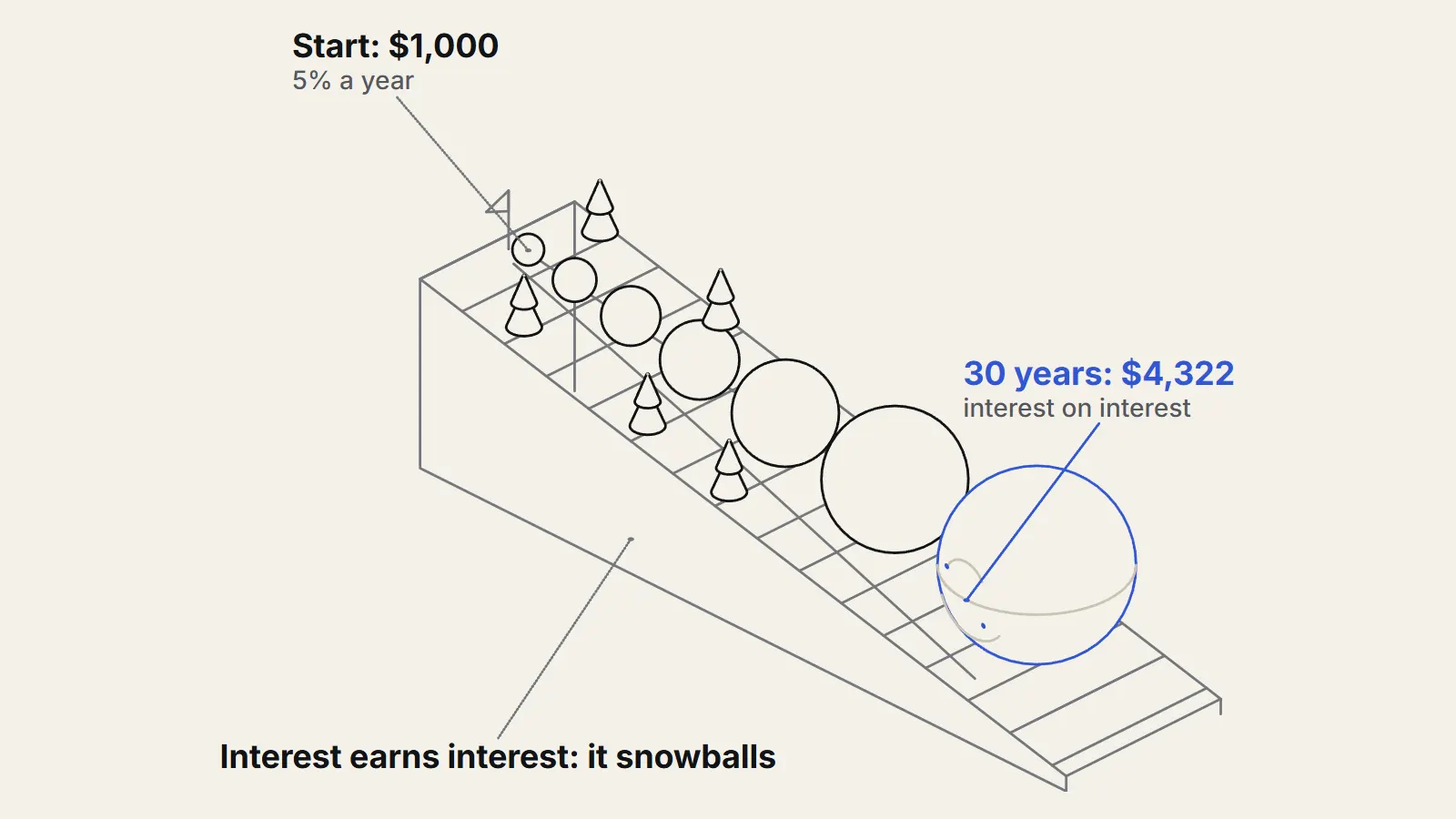
Compound interest is interest earned on interest. Each time interest is paid, it is added to the balance, and the next payment is calculated on the larger total. The result is that growth speeds up the longer money stays invested, which is why time often matters more than the size of any single deposit. This piece explains the arithmetic with worked examples. It is an explanation, not advice, and the numbers use assumed rates, not forecasts.
What is compound interest?
The Federal Deposit Insurance Corporation (https://www.fdic.gov/consumer-resource-center/chapter-5-compound-interest) describes compound interest as interest earned on your principal plus the interest you have already earned.1 The Consumer Financial Protection Bureau (https://www.consumerfinance.gov/ask-cfpb/how-does-compound-interest-work-en-1683/) gives a small example: $1,000 at 5 percent, with interest added once a year, becomes $1,050 after one year and $1,102.50 after two2.2 The second-year interest is $52.50, not $50, because the 5 percent is applied to $1,050.
Simple interest, by contrast, pays the same amount each period because it is always figured on the original sum. Cornell's Legal Information Institute shows how far apart the two can get: $1,000 at 10 percent a month for ten months reaches $2,593.74 with compounding but $2,000 with simple interest3.3 That rate is far higher than a typical savings rate; it is chosen to make the gap visible.
Three things drive the outcome: the rate, the number of periods, and how often interest is added. The CFPB notes that a higher compounding frequency, a higher rate or adding to your principal can each make savings grow faster.2 The FDIC example shows monthly compounding: $100 earning 3 percent interest each month from July to December (a teaching example; the rate is far above real savings rates) ends at $119.41, so $19.41 of interest1 with no new deposits, and each month's interest is larger than the one before.1
How much does time matter in a worked example?
Take a single deposit of $1,000 and assume a constant 5 percent a year, added to the balance each year. This is an assumption for illustration; real returns vary and can be negative. By simple multiplication of 1.05 each year, the balance is about $1,629 after 10 years, $2,653 after 20, $4,322 after 30 and $7,040 after 40. The first ten years add about $629. The last ten add about $2,718, on the same starting deposit, because by then the balance being multiplied is much larger.
| Years | Balance on $1,000 at 5% a year |
|---|---|
| 10 | $1,629 |
| 20 | $2,653 |
| 30 | $4,322 |
| 40 | $7,040 |
What does starting late cost?
Now compare two savers using the same assumed 5 percent, with a deposit at the end of each year. Saver A puts in $1,000 a year for the first 10 years, then stops and leaves the balance alone for another 30 years. Saver B waits 10 years, then puts in $1,000 a year for 30 years. After 40 years, A holds about $54,361 after paying in $10,000. B holds about $66,439 after paying in $30,000.
Two things stand out. A turned each dollar paid in into about $5.44, while B turned each dollar into about $2.21. Early dollars have far longer to grow. But B still ends with more money, because B paid in three times as much. So the honest summary is not that time beats amount in every case. It is that each early dollar is worth much more than a late one, and that waiting raises the amount you must set aside later to reach the same total.
What does the simple story leave out?
Several things weaken the neat curve. Returns are not constant: a savings account pays a stated rate, but stocks and other assets rise and fall, and a bad early stretch can matter a lot. Fees reduce the effective rate every year, and they compound too, so a small yearly percentage can take a large share over decades. Taxes can do the same. Inflation reduces what the final sum buys, so a figure like $66,439 in 40 years will not buy what it buys today. Last, the examples assume steady deposits for decades, which many households cannot do.
The same arithmetic works against borrowers. Interest compounds on unpaid debt in the same way, and the Cornell example above applies equally to a loan, where the balance owed grows faster than a simple-interest calculation would suggest.3 This is why a high-interest debt left unpaid can grow quickly.
What is not known?
The examples here show arithmetic, not what will happen to any person's money. No source used here tells you what rate you will earn, how long you will save, or how fees and taxes will apply to you, and those inputs change the answer more than the formula does. If you want to test different rates and time periods yourself, the CFPB page points to a calculator run by the US Securities and Exchange Commission.2
Key takeaways
- Compound interest is interest on principal plus earlier interest, so growth accelerates over time.
- In our example, $1,000 at an assumed 5 percent a year grows to about $1,629 in 10 years and $7,040 in 40.
- An early saver who paid in $10,000 ended with about $54,361, against about $66,439 for a late saver who paid in $30,000.
- Early dollars do more work, but putting in more money still matters; both time and amount count.
- Real returns vary, and fees, taxes and inflation reduce the result; compounding also works against borrowers.
Sources
- 1Chapter 5: Compound Interest (opens the source in a new tab) · Federal Deposit Insurance Corporation, 2023 · Primary source · https://www.fdic.gov/consumer-resource-center/chapter-5-compound-interest
- 2How does compound interest work? (opens the source in a new tab) · Consumer Financial Protection Bureau, 2023 · Primary source · https://www.consumerfinance.gov/ask-cfpb/how-does-compound-interest-work-en-1683/
- 3Compound interest (opens the source in a new tab) · Legal Information Institute, Cornell Law School, 2025 · Law · https://www.law.cornell.edu/wex/compound_interest