- Place
- Sweden
- Years
- 1985–1996
- Policy
- After deregulation and a credit boom, Sweden guaranteed all bank liabilities on 24 September 1992, set up a Bank Support Authority with open-ended funding and bad banks, and let the krona float on 19 November 1992.
- Outcome
- Unemployment rose from 3.2% to 9.6% and the budget went to a deficit near 12% of GDP, while the banks recovered and estimates of the final cost to taxpayers range from about zero to 2.1% of GDP.
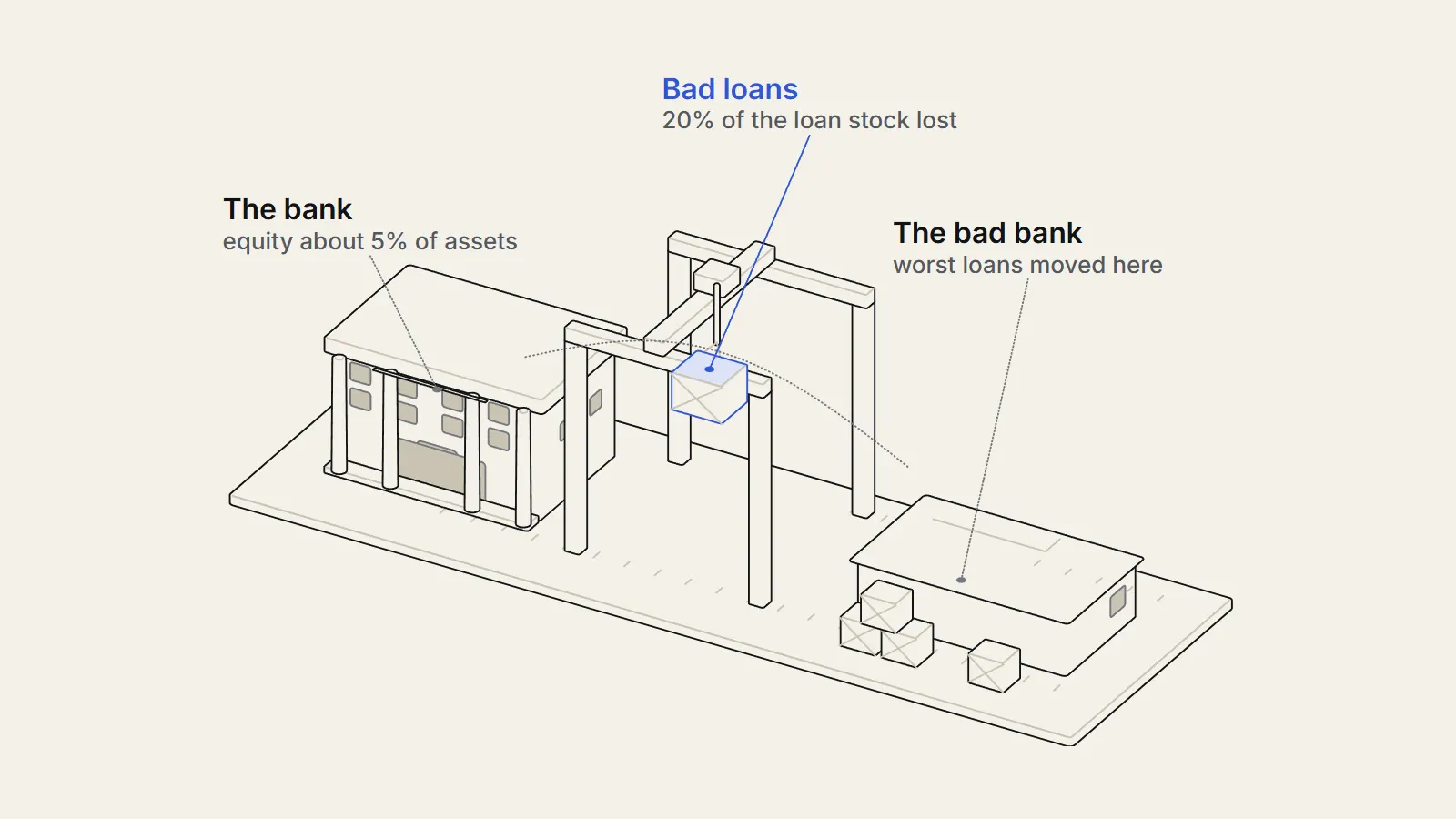
The Sweden banking crisis of the 1990s ended with the state guaranteeing every bank creditor in September 1992, taking over the weakest banks, sending their worst loans to bad banks and letting the krona float two months later. Shareholders were largely left to take losses. The banks recovered within a few years, but output fell for three years, unemployment rose from 3.2 percent to 9.6 percent between 1991 and 1994, and estimates of the final cost to taxpayers run from close to zero to 2.1 percent of GDP.231
Before
A deregulated credit boom
Until the mid-1980s Swedish banks operated under quantity controls on lending, and credit was rationed rather than priced. The main step in deregulation came in November 1985, when the limits on the volume of bank lending were abolished.2 Peter Englund (https://www.bundesbank.de/resource/blob/759002/03689367c8ffa00eee42b65c0d266a13/mL/2015-06-23-stockholm-01-paper-englund-data.pdf), an economist at the Stockholm School of Economics, reports that banks then expanded their lending by 174 percent and mortgage institutions by 167 percent between 1985 and 1990.3
The money went into assets, not into new factories. Housing, commercial property and shares all rose in value, and rising collateral values supported more lending.2 From the deregulation date to the peak on 16 August 1989, the Stockholm share index rose 228 percent3, bank shares 258 percent and real estate shares 372 percent.3 Inflation and a tax system that favoured borrowing meant that real interest rates after tax were negative for many households, which made debt cheap.2
The banks had little cushion. Equity had trended down to about 5 percent of assets from the 1970s, counting hidden reserves.3 They also relied on funding from abroad: more than 40 percent of their lending was in foreign currency, and short-term foreign borrowing was about 40 percent of total bank borrowing.32
Three shocks around 1990
In 1989 the open unemployment rate hit an all-time low of 1.4 percent and the economy was overheated.3 Then several things changed at once. German reunification pushed up interest rates, and the German three-month rate rose from 3.7 percent in December 1987 to 8.5 percent in December 1989.3 A tax reform that took effect in January 1991 cut the rate at which interest could be deducted from 50 percent for most taxpayers to a flat 30 percent, and the real after-tax interest rate faced by households went from minus 1 percent in 1989 to plus 5 percent in 1991.3 Fiscal policy also began to tighten.3
Englund argues that these shocks hit an economy with inflated asset prices and heavy leverage, and that this combination turned an ordinary downturn into a crisis.3 His 1999 paper makes the same point in its abstract: a highly leveraged private sector was hit at the same moment by higher pre-tax interest rates, the tax reform and the European exchange rate crisis.4
GDP grew only 0.9 percent in 1990 and fell 1.1 percent in 1991, while investment fell 9.8 percent in 1991. Property prices dropped 6 percent in 1990 and, by a rough estimate, as much as 40 percent in 1991.3 The loss rate on bank lending was 1.1 percent by the end of 1990, then 3.5 percent by the end of 1991, and at the worst point, in the last quarter of 1992, 7.5 percent.3 Accumulated losses over 1990 to 1996 came to 20 percent of the loan stock at the start of the period.3
The decision
September 1992: guarantee everything except equity
By September 1992 the banking crisis and a currency crisis arrived together. Gota Bank became insolvent on 9 September and was bought by the state-owned Nordbanken for one krona, and the government guaranteed all of Gota's obligations except equity.3 The same day the Riksbank raised its overnight rate to 75 percent, and on 16 and 17 September, after Britain and Italy left the European exchange rate mechanism, it raised it to 500 percent3.3
On 24 September the government and the Social Democratic opposition announced that depositors and other creditors of Swedish commercial banks would be fully protected2 from losses on their claims, in a press release reproduced in Jonung's paper for the European Commission (https://ec.europa.eu/economy_finance/publications/pages/publication14098_en.pdf).2 Englund notes that the agreement with the opposition secured 95 percent of the votes in parliament, and that the guarantee covered all kinds of bank obligations except equity capital.3
The immediate worry was funding from abroad. Jonung, then an economic adviser to the prime minister, writes that the press release was prompted by the fear of losing foreign financing, and that if that funding dried up the Riksbank could not hold the krona rate.2 Englund adds that the guarantee played a crucial role in securing continued international funding for the banks.3 Sweden had no formal deposit insurance at the time.3
It is more important to act early than to get it exactly right.
— A Riksbank staff member involved in the resolution, quoted in Jonung, European Commission Economic Paper 360, 2009
A support authority and two bad banks
In December 1992 Parliament passed legislation setting up a Bank Support Authority and gave it open-ended funding rather than a fixed budget, so that it would not have to return to the Riksdag for more money.2 Banks that wanted help had to open their books. The authority sorted banks into three groups according to whether they could fix their capital themselves, needed temporary help, or were beyond hope.2
Handelsbanken needed no capital, SEB raised capital from its owners, and Foreningsbanken received a guarantee that the state would buy shares if its capital ratio fell below 9 percent, which was never used.2 The two banks beyond hope, Nordbanken and Gotabanken, had roughly 20 percent of all deposits.2 Their bad loans went into asset management companies, Securum for Nordbanken and Retriva for Gotabanken.2 Securum bought loans with a face value of SEK 67 billion at a price of SEK 50 billion, which left Nordbanken with mostly sound loans of SEK 120 billion.3
In short, the aim was to save the banks – not the owners of the banks.
— Lars Jonung, European Commission Economic Paper 360, 2009
Of the SEK 66 billion the government paid out, only SEK 3.1 billion went to the old owners, as an interest subsidy for one bank and the repurchase of shares in Nordbanken.3
Letting the krona float
The peg ended on 19 November 1992, when speculation returned and the Riksbank did not fight back. The krona fell 9 percent the next day and 20 percent by the turn of the year.3 The effective exchange rate had fallen 21 percent by the end of 1993, and the Riksbank cut its policy rate from 12.5 percent in November 1992 to 7.75 percent at the end of 1993.3 In January 1993 the Riksbank announced an inflation target.2
- Nov 1985Quantitative limits on bank lending abolishedSource 2 (opens the source in a new tab)
- 16 Aug 1989Stock market peakSource 3 (opens the source in a new tab)
- Jan 1991Tax reform takes effectSource 3 (opens the source in a new tab)
- May 1991Krona pegged to the ecuSource 2 (opens the source in a new tab)
- 9 Sep 1992Gota Bank insolvent; Riksbank overnight rate raised to 75 percentSource 3 (opens the source in a new tab)
- 16-17 Sep 1992Overnight rate raised to 500 percentSource 3 (opens the source in a new tab)
- 24 Sep 1992Blanket guarantee of bank creditors announcedSource 2 (opens the source in a new tab)
- 19 Nov 1992Krona allowed to floatSource 3 (opens the source in a new tab)
- Dec 1992Parliament sets up the Bank Support AuthoritySource 2 (opens the source in a new tab)
- Jan 1993Riksbank announces an inflation targetSource 2 (opens the source in a new tab)
- Mar 1994Government reports SEK 65 billion of bank support paid outSource 5 (opens the source in a new tab)
- Jul 1996Crisis legislation and blanket guarantee abolishedSource 2 (opens the source in a new tab)
The strongest case against the guarantee
The Cleveland Fed authors put the general point this way: blanket guarantees and unlimited liquidity can bail out investors and erode market discipline.6 They credit Sweden for transparency about losses and for an independent agency, but note that the guarantee came first.6
The risk to taxpayers was real at the time. When Parliament created the Bank Support Authority it chose open-ended funding on purpose, to signal that there was no limit to the financial commitment.2 Nobody knew in 1992 how large the bill would be. By March 1994 the government's own table showed commitments of SEK 90.5 billion5, of which SEK 65.0 billion had been paid out.5
There is also a criticism of the way bad loans were handled. Securum liquidated its loans quickly: bankruptcy was the chosen solution for 70 percent of the companies in its client register, a larger share than for similar firms, and Securum was criticised for taking too hard a line.3 Englund notes that a drawn-out process could have been expensive, and that in some cases viable operations were carried on in a new corporate guise after the old company went bankrupt.3
A third argument concerns the exchange rate. Englund finds an indirect link between the currency defence and the banking crisis: the high interest rates used to hold the krona increased debt burdens and caused credit losses.3 Jonung adds that Sweden defended the peg with a determination no other country showed, partly because of lessons drawn from the five devaluations of the 1970s and early 1980s.2 On that view part of the damage to the banks was a cost of policy, not only of the earlier boom.
What happened
What the Sweden banking crisis of the 1990s cost the economy
The real economy suffered more than the banks did. World Bank data show growth of 2.7 percent in 1989, then declines in 1991, 1992 and 1993, and a return to growth of about 4 percent in 1994 and 1995.1 Jonung and Hagberg measure the loss of real income over 1990 to 1993 at 13.0 percentage points, and the loss of employment over 1990 to 1994 at 16.6 points.7
Unemployment was around 2 percent in 1990 and about 10 percent during 1993 to 1997 in the Jonung, Kiander and Vartia paper.8 The World Bank's modeled series, which starts in 1991, shows 3.2 percent in 1991, 9.6 percent in 1994 and a high of 10.4 percent in 1997, back to 5.5 percent in 2000.1 Jonung writes that only the 1930s crisis caused a bigger loss of real income, and that the cumulative employment loss was larger than in the Great Depression (https://therealigned.com/story/what-caused-the-great-depression).2
The public finances
The budget moved from a surplus of around 4 percent of GDP in 1987 to 1990 to a deficit that peaked at almost 12 percent of GDP in 1993, mostly because of automatic stabilisers such as falling tax revenue and rising benefits.2 Government debt rose from around 40 percent of GDP in 1990 to 75 percent in 1995.3 Englund observes that crises are costly to taxpayers mainly because of the harm to the wider economy and the tax base, not because of the direct bank expenses.3
The bill for the banks
The direct cost is easier to measure than the output loss, though it depends on what is counted and when. In March 1994 the government reported total commitments of SEK 90.5 billion and payments of SEK 65.0 billion, of which SEK 60.2 billion had been charged to the budget.5 A year later the Riksdag committee on industry and trade cited direct support and guarantees of SEK 88 billion, SEK 65 billion of it paid out, and the tax committee put the state's net cost at about SEK 33 billion.9
| Institution | Total committed | Paid out | Charged to the budget |
|---|---|---|---|
| Nordbanken | 16,246 | 16,246 | 16,246 |
| Securum | 35,000 | 24,000 | 23,000 |
| Gota Bank | 23,000 | 20,000 | 20,000 |
| Retriva | 7,300 | 3,800 | 0 |
| All bank support (includes Sparbanken Sverige and Foreningsbanken, not shown) | 90,546 | 65,046 | 60,246 |
Later estimates of the net cost differ by method and date. Englund explains that Jennergren and Naslund closed the books in July 1997, when Securum was dissolved, while Barr and Pierrou ran the calculation to 2013, when the state sold its last Nordea shares, and used a higher discount rate.3 Jonung writes that there is no official estimate of the ultimate fiscal cost, though the outlays were probably recovered when the assets taken over by the state were liquidated.2
- Gross, initial: 3.6 percent of GDP (Jonung, citing Laeven and Valencia).
- Net, books closed in July 1997: SEK 35 billion, 2.1 percent of 1997 GDP (Jennergren and Naslund, cited by Englund).
- Net present value to 2013: 1.5 percent of 1991 GDP (Barr and Pierrou, cited by Englund).
- Net, in the long run: close to zero (Jonung).
- Direct cost to the taxpayer: around 2 percent of GDP (Englund, 1999).
Banks back on their feet
By 1995 all the banks were profitable again, with an average return on equity of 20 percent, and the bank support was formally abolished in 1996.3 Securum had been dissolved by the end of 1997, years ahead of the plan; Englund calls it a success story.3 The recovery was led by exports, which rose 8 percent in volume in 1993 and 13 percent in 1994.3 Between 1992 and 2008 exports roughly doubled as a share of GDP.2
Credit recovered slowly. The stock of bank loans fell 21 percent in current prices between 1990 and 1993, and private investment, which had fallen 35 percent from its 1990 peak, did not return to its pre-crisis level until 1999.3
What economists still disagree on
Was the Sweden banking crisis response skill or luck?
Deregulation itself was pushed through without any serious parliamentary or public debate, Jonung writes in a later paper, and the foremost lesson he draws is the lack of knowledge among policy-makers, bankers, economists and the public about the dynamics that liberalisation sets off.10 The Swedish approach to the crisis is often called a model. Jonung lists seven reasons it worked, among them political unity, the early guarantee, an authority at arm's length, full disclosure and a policy of saving banks but not owners.2 The Cleveland Fed authors agree on transparency and independence, but they warn that the global boom of the 1990s makes it hard to separate good policy from luck.6
Englund's own reading is more cautious. Once the guarantee was in place, he notes, the banks did not need much further support, which may mean the crisis was mainly one of liquidity. But he also says it could reflect a fast recovery of the economy, which depended largely on the depreciation of the krona.3 The tests of the rule that only viable banks would be helped, and that owners would pay, were never very hard for that reason.3
The role of the exchange rate is itself disputed. Englund asks whether an earlier float would have eased the crisis and says the answer is not as obvious as it seems. Borrowers had amortised 73 billion kronor of foreign currency loans between August and November 1992, which limited currency losses, and an earlier devaluation might have set off a more dramatic fall and imported inflation.3 Jonung notes that critics thought the later interest rate cuts too cautious, and that the role of fiscal policy in the crisis is a contested issue.2
- Agreed in the sources: the boom began with deregulation in 1985, the guarantee of 24 September 1992 kept foreign funding in place, and the budget and unemployment effects were large.
- Disputed: how much of the banks' quick recovery came from policy and how much from the krona float and the world economy.
- Disputed: the final cost to taxpayers, which depends on the closing date, the discount rate and what is counted.
- Not known: how the crisis would have gone with an earlier float, or without the blanket guarantee.
If the blanket guarantee had been narrower, would foreign lenders have withdrawn their funding in September 1992, and what would that have meant for the krona and the banks?
Lessons
Key takeaways
- The crisis began with a credit boom after deregulation, thinly capitalised banks and borrowed foreign money, and turned when interest rates, taxes and fiscal policy all changed at once.
- The authorities acted in a set order: guarantee first, then an independent authority, bad banks for the two weakest banks, and shareholders left to bear losses.
- The banks recovered quickly, but the economy paid heavily: output fell for three years, unemployment reached about 10 percent and the budget deficit approached 12 percent of GDP.
- Whether the policy was a model or good fortune is unsettled, and estimates of the net cost run from about zero to 2.1 percent of GDP.
Within five years Finland and Sweden moved from deep deficits to some of the biggest surpluses in Europe, and growth stayed above the EU average, according to the same author.10 What carries over is the sequence and the discipline: a joint political commitment, early action, an agency with money and expertise, and rules that keep owners from being rescued with the banks. Jonung adds that the Swedish model can serve as a template but that attention should be paid to differences in initial conditions, such as institutions, legislation and political conditions.2 What may not carry over is Sweden's starting point: a country with no deposit insurance, with a state-owned bank at the centre of the crisis and with a currency that could be allowed to fall.3
Sources
- 1World Development Indicators: GDP growth (annual %) and unemployment, total (% of labor force, modeled ILO estimate), Sweden (opens the source in a new tab) · World Bank Open Data, 2026 · Primary source · https://api.worldbank.org/v2/country/SWE/indicator/NY.GDP.MKTP.KD.ZG?format=json&date=1988%3A2000
- 2The Swedish model for resolving the banking crisis of 1991-93. Seven reasons why it was successful (opens the source in a new tab) · European Commission, DG ECFIN, Economic Papers 360, 2009 · Paper · https://ec.europa.eu/economy_finance/publications/pages/publication14098_en.pdf
- 3The Swedish 1990s banking crisis: A revisit in the light of recent experience (opens the source in a new tab) · Paper for the Riksbank Macroprudential Conference, Stockholm, 23-24 June 2015, 2015 · Paper · https://www.bundesbank.de/resource/blob/759002/03689367c8ffa00eee42b65c0d266a13/mL/2015-06-23-stockholm-01-paper-englund-data.pdf
- 4The Swedish Banking Crisis: Roots and Consequences (opens the source in a new tab) · Oxford Review of Economic Policy, vol. 15, no. 3, 1999 · Paper · https://elischolar.library.yale.edu/ypfs-documents/232
- 5Redogorelse for vidtagna atgarder for att starka det finansiella systemet (Regeringens skrivelse 1993/94:238) (opens the source in a new tab) · Sveriges riksdag, 1994 · Primary source · https://www.riksdagen.se/sv/dokument-och-lagar/dokument/regeringens-skrivelse/med-redogorelse-for-vidtagna-atgarder-for-att_gh03238/html/
- 6Effective Practices in Crisis Resolution and the Case of Sweden (opens the source in a new tab) · Federal Reserve Bank of Cleveland, Economic Commentary, 2009 · Report · https://www.clevelandfed.org/publications/economic-commentary/2009/ec-20090209-effective-practices-in-crisis-resolution-and-the-case-of-sweden
- 7How costly was the crisis of the 1990s? A comparative analysis of the deepest crises in Finland and Sweden over the last 130 years (opens the source in a new tab) · European Commission, Economic Papers 224, 2005 · Report · https://ec.europa.eu/economy_finance/publications/pages/publication692_en.pdf
- 8The great financial crisis in Finland and Sweden: The dynamics of boom, bust and recovery, 1985-2000 (opens the source in a new tab) · European Commission, Economic Papers 350, 2008 · Report · https://ec.europa.eu/economy_finance/publications/pages/publication13551_en.pdf
- 9Vissa bankfragor (Betankande 1994/95:NU17, Naringsutskottet) (opens the source in a new tab) · Sveriges riksdag, 1995 · Primary source · https://www.riksdagen.se/sv/dokument-och-lagar/dokument/betankande/vissa-bankfragor_gi01nu17/html/
- 10Lessons from the Nordic Financial Crisis (opens the source in a new tab) · Prepared for the AEA meeting, Denver, January 2011 (dated 29 December 2010), 2010 · Paper · https://www.aeaweb.org/conference/2011/retrieve.php?pdfid=413