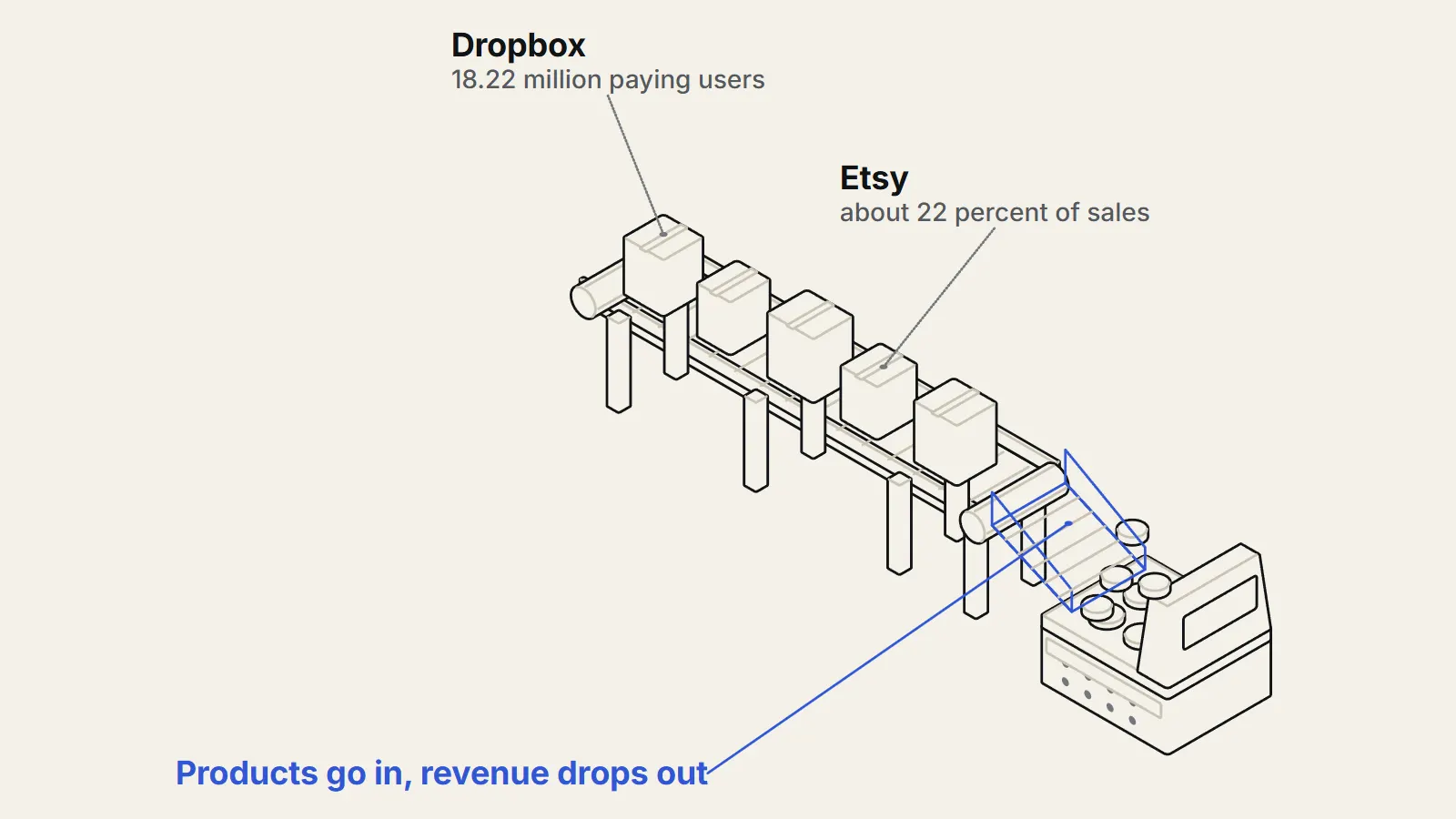
Startups make money in a small number of ways: they charge customers a recurring subscription, take a cut of trades between buyers and sellers (a marketplace), sell attention to advertisers, or sell their own time as a service. Each model has a different shape. Subscriptions turn one sale into a stream of payments, marketplaces earn a slice of someone else's sales, advertising needs huge audiences, and services scale only as fast as people can be hired. The clearest way to see the difference is to look at what large public companies disclose in their annual filings, because they must report revenue and costs in a standard way.
How do subscription startups make money?
A subscription business charges a customer a repeating fee for ongoing access. Dropbox, the file-storage company, is a clean example. Its annual report for 2024 (https://www.sec.gov/Archives/edgar/data/1467623/000146762325000011/dbx-20241231.htm) says anyone can sign up free and then upgrade to a paid plan, and that over 90 percent of its revenue comes from self-serve channels, meaning people buy through the website or app without a salesperson.1
The numbers show how the model works. Dropbox reported 18.22 million paying users1 at the end of 2024 and revenue of $2,548.2 million for the year. It reports a measure called average revenue per paying user, or ARPU: revenue divided by the average number of paying users. For 2024 that was $140.231.1 In other words, the typical paying customer was worth about $140 over the year.
Two features make subscriptions attractive. First, the cost of serving one more customer is low relative to the price. Dropbox's cost of revenue was $445.1 million, which left a gross margin of 83 percent.1 Gross margin is the share of revenue left after the direct costs of delivering the product. Second, payments recur, so a customer won't need to be won again every month. The catch is conversion. The filing warns that a majority of its registered users may never become paying subscribers, and it counts over 700 million registered users against 18.22 million payers, a ratio under 3 percent. The filing itself notes that registered numbers overstate unique people, so that ratio is a rough guide, not a precise conversion rate.1
How do marketplaces make money?
A marketplace connects buyers and sellers and takes a fee. The startup does not own the goods, so it avoids inventory, but it only earns when trades happen. Etsy, the online market for handmade and vintage goods, shows the mechanics. According to its 2024 annual report (https://www.sec.gov/Archives/edgar/data/1370637/000137063725000017/etsy-20241231.htm), required fees on sellers include transaction fees, payment-processing fees and listing fees, while optional services include on-site advertising and shipping labels.2
Etsy reported gross merchandise sales (GMS), the total value of goods sold on its platforms, of $12,586,952 thousand, or about $12.6 billion, in 2024. Its revenue was $2,808,332 thousand2, of which $2,020,744 thousand was marketplace revenue and $787,588 thousand was services revenue.2 Dividing revenue by GMS gives a take rate: by our calculation, about 22 percent for total revenue and about 16 percent for marketplace fees alone. Net income was $303.3 million, about 11 percent of revenue.2
Marketplaces face a "chicken and egg" problem: sellers come only if there are buyers, and buyers come only if there are sellers. Costs can also rise to attract either side. Etsy's filing notes that revenue from its Offsite Ads fee offset about 31 percent of its marketplace performance-marketing spend in 2024, a reminder that finding buyers is itself a large cost.2
How does advertising make money, and what are its limits?
An advertising business offers users a free product and charges companies to reach them. It works only with very large audiences, because each user is worth a modest amount per year to an advertiser. Meta Platforms, which owns Facebook and Instagram, is the extreme case. Its results for 2024 (https://investor.atmeta.com/investor-news/press-release-details/2025/Meta-Reports-Fourth-Quarter-and-Full-Year-2024-Results/) show total revenue of $164,501 million, of which advertising revenue was $160,633 million.3 By our calculation, that is about 98 percent of the total.
Advertising rewards scale and attention, which is why few startups can build a stand-alone advertising model. A young company with 100,000 users has a small audience to sell. Many startups therefore begin with subscriptions or fees and add advertising only later, as Etsy has with its optional advertising services.
What about services?
A service business, such as a software consultancy or design studio, sells hours of skilled work. It can earn money from the first client with no product to build, which is its main strength. Its weakness is that revenue rises roughly in line with headcount, so profit does not multiply the way it can for a subscription product with an 83 percent gross margin. The largest example is Accenture, a consulting and technology services firm, whose fiscal 2024 results (https://www.sec.gov/Archives/edgar/data/1467373/000146737324000266/fy24q4plc8-kexhibit.htm) show revenues of $64.9 billion4 and a GAAP operating margin of 14.8 percent.4 Operating margin counts all operating costs, not just direct ones, so it is not the same measure as Dropbox's gross margin, and the two should not be compared directly.
What is disputed or hard to compare?
The strongest argument against reading too much into these three examples is survivorship: Dropbox, Etsy and Meta are large winners, and most startups never reach their scale. Their margins and take rates are not typical of an early-stage firm. A second problem is that definitions differ. The filings define ARPU, GMS and take rate in their own ways, so a "22 percent take rate" at one company may not be like-for-like with another. Third, a model that works for one company may not travel: Dropbox's total revenue grew only 1.9 percent in 2024, which suggests that even a profitable subscription business can saturate.1
What is not known?
This piece uses public companies because they publish audited numbers. It cannot say what typical private startups earn, since they rarely disclose revenue. It also cannot say which model is best. Models are often combined, and the right mix depends on the customer, the cost of reaching them, and how long they stay. Whether a business is worth building is a question about unit economics (https://therealigned.com/story/unit-economics-in-plain-english), which is the topic of a companion piece on revenue and cost per customer.
Key takeaways
- Most startups earn money through subscriptions, marketplace fees, advertising or services.
- Dropbox shows the subscription model: 18.22 million paying users, $140.23 revenue per paying user and an 83 percent gross margin in 2024.
- Etsy shows a marketplace: about $12.6 billion of sales produced $2.8 billion of revenue, a take rate of roughly 22 percent by a calculation from its filing.
- Meta shows the extreme of advertising, where about 98 percent of revenue came from ads, but that needs a vast audience.
- Large public companies are survivors, so their numbers are a guide to how each model works, not a forecast for a new venture.
Sources
- 1Dropbox, Inc. Form 10-K for fiscal year 2024 (opens the source in a new tab) · U.S. Securities and Exchange Commission (Dropbox, Inc.), 2025 · Primary source · https://www.sec.gov/Archives/edgar/data/1467623/000146762325000011/dbx-20241231.htm
- 2Etsy, Inc. Form 10-K for fiscal year 2024 (opens the source in a new tab) · U.S. Securities and Exchange Commission (Etsy, Inc.), 2025 · Primary source · https://www.sec.gov/Archives/edgar/data/1370637/000137063725000017/etsy-20241231.htm
- 3Meta Reports Fourth Quarter and Full Year 2024 Results (opens the source in a new tab) · Meta Platforms, Inc. investor relations, 2025 · Primary source · https://investor.atmeta.com/investor-news/press-release-details/2025/Meta-Reports-Fourth-Quarter-and-Full-Year-2024-Results/
- 4Accenture plc Form 8-K exhibit: fourth-quarter and full-year fiscal 2024 results (opens the source in a new tab) · U.S. Securities and Exchange Commission (Accenture plc), 2024 · Primary source · https://www.sec.gov/Archives/edgar/data/1467373/000146737324000266/fy24q4plc8-kexhibit.htm