On 16 October 2026 Canada's immigration department announced the Express Entry changes that start on 3 November 20261: extra points in the ranking score for people with Canadian work experience, or a qualifying job offer, in a high-wage occupation.1 This piece answers that news item, which we saw trending on 15 and 16 October, and explains the points system. Everything here is as of 17 October 2026, comes from the official news release (https://www.canada.ca/en/immigration-refugees-citizenship/news/2026/10/canada-refocusing-express-entry-on-top-talent-that-drives-economic-growth.html) and other pages of Immigration, Refugees and Citizenship Canada (IRCC), and is explanation, not immigration advice.
How does Express Entry work?
Express Entry is the online system IRCC uses to manage applications for three programs: the Canadian Experience Class, the Federal Skilled Worker Program and the Federal Skilled Trades Program.2 Candidates who qualify go into a pool and are given a CRS score under the Comprehensive Ranking System (CRS), the points system at the heart of the process.1 IRCC then holds rounds of invitations, each with its own requirements and cut-off score, and a higher score does not guarantee an invitation.3
| Date (2026) | Round | Invitations | Lowest score |
|---|---|---|---|
| 28 September | Provincial Nominee Program | 733 | 725 |
| 29 September | Canadian Experience Class | 2,000 | 518 |
| 1 October | Trades occupations | 3,500 | 476 |
| 13 October | Provincial Nominee Program | 752 | 772 |
| 15 October | Canadian Experience Class | 2,500 | 519 |
| 16 October | French-language proficiency | 5,000 | 435 |
The table shows why no single cut-off describes the system. The lowest score invited ranges from 435 to 772 because each round selects a different group. The nominee rounds sit highest, which fits the grid, where a provincial nomination alone is worth 600 points.5
What is a CRS score and what counts towards it?
The CRS score adds up points in groups. Core factors are worth up to 500 points5 for a candidate without a spouse or partner (460 with one): age up to 110, education 150, first official language 136, second official language 24 and Canadian work experience 80.5 Skills transferability, which pairs education, language and work experience, is worth up to 100. Additional points include 600 for a provincial or territorial nomination, up to 50 for French, 15 or 30 for Canadian study and 15 for a sibling in Canada.5
At present the grid has no line for job offers. IRCC stopped awarding points for them on 25 March 2025: 200 points for senior management offers (Major Group 00) and 50 for other high-skilled jobs, according to the law firm Fragomen's report of that change.6 From 3 November 2026 the grid will again have points tied to a qualifying job offer, but set by wage level rather than by occupation group.53
What are the Express Entry changes from 3 November 2026?
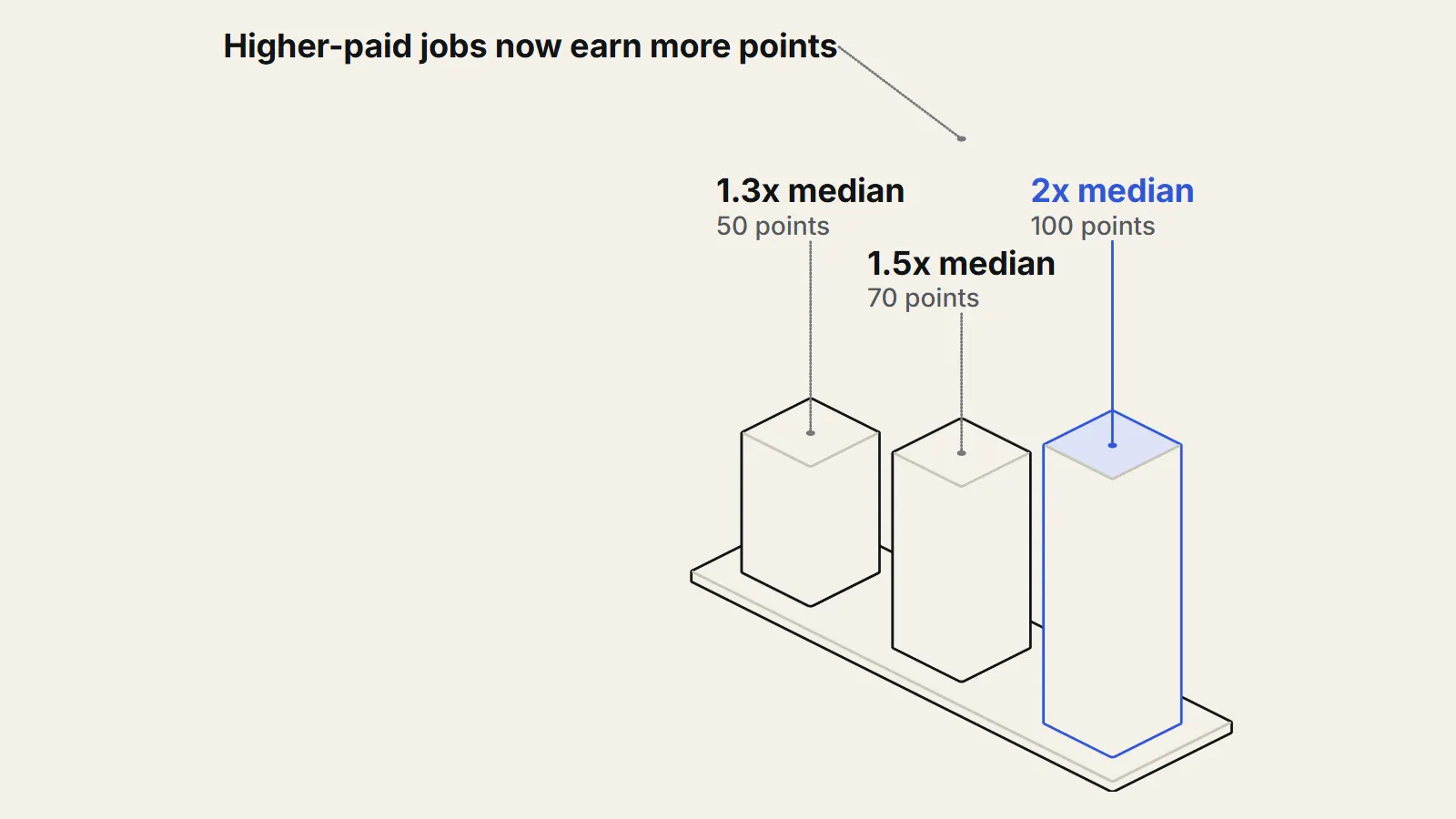
There are two new sources of points, and a candidate receives whichever is higher, not both added together3.3 The first is at least 12 months of eligible Canadian work experience in a high-wage occupation, added on top of the existing Canadian work experience points, which reach 80 for five years. The second is a qualifying job offer in a high-wage occupation. How many points depends on how far the occupation's median wage sits above the workforce median, as the table shows.3
| Occupation median wage | Canadian work experience points | Job offer points |
|---|---|---|
| At least 2 times the median | 70 | 100 |
| 1.5 to under 2 times | 40 | 70 |
| 1.3 to under 1.5 times | 20 | 50 |
A qualifying offer must generally be full-time, continuous work in Canada for at least one year after the candidate becomes a permanent resident.3 From 3 November a labour market impact assessment (LMIA) is no longer required for such an offer to earn the points, or to meet the job-offer requirement in the Federal Skilled Worker and Federal Skilled Trades programs. IRCC says it will still check that offers are genuine and that anti-fraud measures are in place.1 IRCC puts the maximum for this labour-market factor at 150 points, or 140 with a spouse or partner; for work experience, the 80 points for duration plus up to 70 high-wage points add up to 150.3
IRCC will recalculate the scores of candidates already in the pool automatically. Candidates who want job offer points must update their profile with the required details before 3 November. The recalculation may take up to two weeks, and invitation rounds will be paused1 during that time.1
What counts as a high-wage occupation?
IRCC calls an occupation a high-wage occupation if the median wage of everyone in Canada doing that job is at least 1.3 times the median wage of the overall Canadian workforce.1 The test applies to the job code (the National Occupational Classification, NOC), not to the candidate's own pay. There are three levels: level 1 at twice the median or more, level 2 from 1.5 to under 2 times, and level 3 from 1.3 to under 1.5 times. IRCC gives each code the highest level it reached in the last three years of Job Bank, Labour Force Survey and Census wage data, and the current list, which takes effect on 3 November, uses 2023 to 2025 data.7
Examples on IRCC's high-wage page (https://www.canada.ca/en/immigration-refugees-citizenship/services/immigrate-canada/express-entry/check-score/high-wage.html) include petroleum engineers, specialists in surgery and judges at level 1; software engineers and designers, registered nurses and librarians at level 2; and chemists, architects and social workers at level 3. If a code's level changes after someone is invited, the level in effect on the invitation date still applies.7
How does a points system change who gets selected?
This section is our own reading of the mechanism, not IRCC's. A ranked pool with a cut-off works like a queue: a round invites the highest scores until its set number of invitations is used, so extra points for one group move that group up and push everyone else back, without adding places.3 Against that, the 20 to 100 new points are a large shift. The Canadian Experience Class cut-off moved by one point between the 29 September and 15 October rounds, from 518 to 519.4 Two candidates with the same score today could land on opposite sides of the line after 3 November, depending on their job code.
Using a wage band as the test is a choice of signal. In our explainer on why wages rise (https://therealigned.com/story/why-wages-rise) we describe pay as the outcome of productivity, bargaining power and competition for workers, so a high median wage can reflect any of the three. Scarcity can lift pay too: our piece on the Black Death and wages (https://therealigned.com/story/black-death-and-wages) notes that from 1348 labour became scarce and surviving workers could ask for more. A wage threshold therefore captures jobs that are well paid, which overlaps with, but is not the same as, jobs that are short of workers. Who bears the cost of a rule is also not always the party it names, a point we make in who really pays taxes (https://therealigned.com/story/who-really-pays-taxes).
What does the evidence say, and what is the case against?
IRCC's September 2026 summary of four studies on outcomes five to six years after admission finds that Express Entry immigrants generally earn more than other economic immigrants, that job offers are linked to modestly higher earnings (most for senior management), and that more Canadian work experience is linked to higher earnings.8 Express Entry has only run since 2015, so longer-term effects are not assessed, and the summary we opened does not report a test of the new wage-level rule.8 The consultation found broad support for simplifying the system and for focusing on the best predictors of economic success.9
What is still only proposed?
Separate from the 3 November rules, IRCC has been consulting on larger reforms: merging the three programs into one with a minimum language level of CLB 6 and a high school requirement, reforming age points, changing the points for Canadian study, limiting certificate of qualification points to Red Seal trades, and removing the spousal and sibling points.9 The consultation report (https://www.canada.ca/en/immigration-refugees-citizenship/corporate/transparency/consultations/2026-consultations-express-entry-reforms-report.html), dated 15 October 2026, says no final policy has been set, that changes need amendments to the regulations, and that effective dates and effects on profiles already in the pool have not been announced. The survey drew about 17,500 responses.9
What is not known?
We do not know how the cut-off will move after the recalculation, how many candidates in the pool hold high-wage experience, when rounds will resume, or which of the proposals will go ahead. IRCC's release says rounds will be paused during the recalculation but gives no date for the next one.1 The 150-point figure that appears in some headlines is a maximum, not 150 new points: it is the 80 duration points plus up to 70 high-wage points.3 Because this follows a news item from 16 October, details may have changed since; check IRCC's pages.
Key takeaways
- From 3 November 2026 Express Entry adds points for Canadian work experience or a job offer in an occupation whose median wage is at least 1.3 times the workforce median.
- The new points are 20, 40 or 70 for experience and 50, 70 or 100 for a job offer, whichever is higher, not both.
- A labour market impact assessment is no longer required for a qualifying offer to earn these points.
- Points move candidates within a set number of invitations; they do not add places and do not guarantee an invitation.
- Wider reforms, such as merging the three programs, are proposals and were not decided as of 17 October 2026.
Sources
- 1Canada refocusing Express Entry on top talent that drives economic growth (opens the source in a new tab) · Immigration, Refugees and Citizenship Canada, 2026 · Primary source · https://www.canada.ca/en/immigration-refugees-citizenship/news/2026/10/canada-refocusing-express-entry-on-top-talent-that-drives-economic-growth.html
- 2Express Entry: how it works (opens the source in a new tab) · Immigration, Refugees and Citizenship Canada, 2026 · Primary source · https://www.canada.ca/en/immigration-refugees-citizenship/services/immigrate-canada/express-entry/works.html
- 3Changes to Express Entry for high-wage occupations (opens the source in a new tab) · Immigration, Refugees and Citizenship Canada, 2026 · Primary source · https://www.canada.ca/en/immigration-refugees-citizenship/news/2026/10/changes-to-express-entry-for-high-wage-occupations.html
- 4Express Entry rounds of invitations (opens the source in a new tab) · Immigration, Refugees and Citizenship Canada, 2026 · Primary source · https://www.canada.ca/en/immigration-refugees-citizenship/services/immigrate-canada/express-entry/submit-profile/rounds-invitations.html
- 5Express Entry: Comprehensive Ranking System criteria (grid) (opens the source in a new tab) · Immigration, Refugees and Citizenship Canada, 2026 · Primary source · https://www.canada.ca/en/immigration-refugees-citizenship/services/immigrate-canada/express-entry/eligibility/criteria-comprehensive-ranking-system/grid.html
- 6Canada: removal of job offer points from the Express Entry system (opens the source in a new tab) · Fragomen, 2025 · Reporting · https://www.fragomen.com/insights/canada-removal-of-lmia-based-job-offer-points-from-express-entry-system-forthcoming.html
- 7High-wage occupations and how we assess them (opens the source in a new tab) · Immigration, Refugees and Citizenship Canada, 2026 · Primary source · https://www.canada.ca/en/immigration-refugees-citizenship/services/immigrate-canada/express-entry/check-score/high-wage.html
- 8Express Entry and labour market outcomes of economic immigrants (opens the source in a new tab) · Immigration, Refugees and Citizenship Canada, 2026 · Report · https://www.canada.ca/en/immigration-refugees-citizenship/corporate/reports-statistics/research/express-entry-labour-market-outcomes-economic-immigrants.html
- 92026 consultations on Express Entry reforms: report (opens the source in a new tab) · Immigration, Refugees and Citizenship Canada, 2026 · Primary source · https://www.canada.ca/en/immigration-refugees-citizenship/corporate/transparency/consultations/2026-consultations-express-entry-reforms-report.html