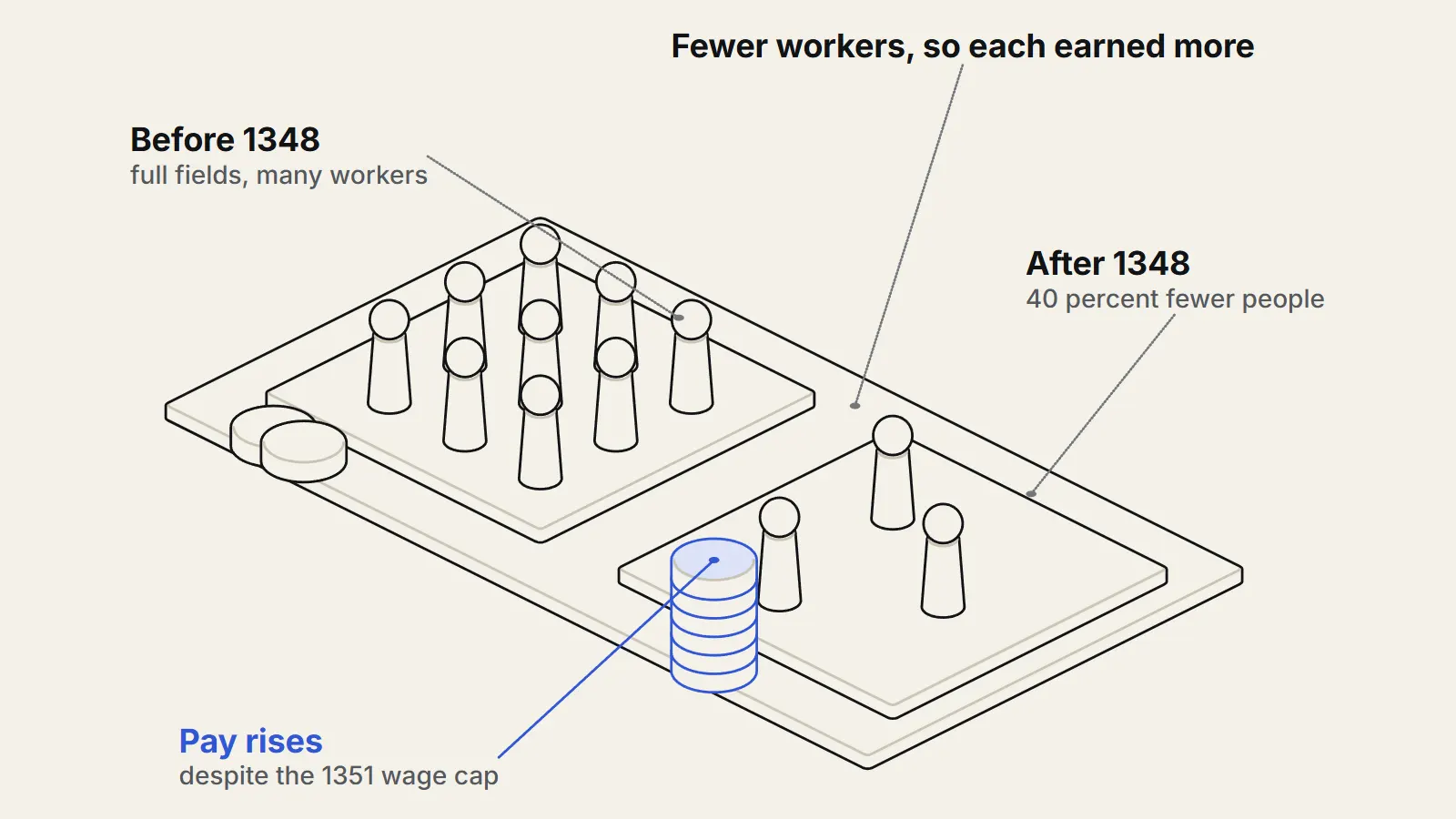
The Black Death changed wages because it removed a large share of the workforce while the land, tools and buildings stayed where they were. Employers who needed harvests brought in suddenly had fewer people to hire, and the people left could ask for more. Over the following century, English workers did end up with real wages (pay adjusted for prices) well above the pre-plague level. The crown tried to stop this with wage-cap laws, the 1349 Ordinance of Labourers and the 1351 Statute of Labourers. The laws slowed the rise for a while, but they did not reverse it. This piece explains the mechanism, what the laws said, and where historians still disagree.
How did the Black Death change the supply of labour?
The plague reached England in 1348. Economists who have reviewed the evidence describe a population collapse of about 40 percent1 across Europe, and call it the largest demographic shock in European history.1 Because so many workers died at once, labour became scarce relative to land. That is the basic logic of supply and demand applied to people: when something becomes rarer, its price tends to rise, and the price of labour is the wage.
The first effect, though, ran the other way. In a 2020 review by Remi Jedwab, Noel Johnson and Mark Koyama (https://www2.gwu.edu/~iiep/assets/docs/papers/2020WP/JedwabIIEP2020-14.pdf), the immediate impact in England was a breakdown of normal economic life: crops went unharvested and building projects stopped. Real wages for unskilled and skilled workers fell by about 20 percent over the next two years1, partly because prices jumped. The authors cite an English consumer price index that rose 27 percent between 1348 and 1350.1 So the story is not that workers gained overnight. They gained after a period of disruption and inflation.
What did the Ordinance and Statute of Labourers say?
The royal government saw the shortage as a problem for employers and for public order. The 1349 Ordinance, dated 18 June at Westminster, opens by noting that a great part of the people, especially workmen and servants, had died, and that surviving workers were refusing to work unless paid excessive wages. The text of the Ordinance (https://sourcebooks.web.fordham.edu/seth/ordinance-labourers.asp) (reprinted in a 1915 collection of English historical sources) ordered that workers take only the wages that were customary in the twentieth year of the king's reign or in the five or six ordinary years before it.2
The Ordinance went further than a pay freeze. It applied to every able-bodied man and woman under sixty who had no trade and no land of their own, whether free or bond. Workers who left service without reasonable cause could be imprisoned. Anyone who paid or accepted more than the customary wage owed double the excess. Craftsmen and sellers of food were told to keep to customary or reasonable prices, and giving alms to able-bodied beggars was forbidden.2
Parliament returned to the subject in 1351. The Statute of Labourers (https://sourcebooks.fordham.edu/seth/statute-labourers.asp) blamed the "malice of servants" and fixed pay at the level of the twentieth year of the reign or four years earlier. It also listed specific rates: for example, 1 penny a day for hoeing and haymaking, 3 pence a day for a master carpenter and 4 pence for a master freestone mason. Offenders could be put in the stocks, and county justices were given the job of hearing cases.3
Did the wage laws work?
Partly, and only for a time. Jedwab and his co-authors report that the English limits on nominal (money) wages were highly effective in holding down wage growth in the 1350s, with declining effectiveness afterwards.1 The same review notes a wider pattern: many regulations meant to stop wages rising proved impossible to enforce, because workers could move and find better work. The authors point to the large number of fines for breaking contracts and moving as evidence of how hard the rules were to apply. In their reading, some workers judged it more profitable to risk a small fine for a much better contract.1
How high did wages go afterwards?
Gregory Clark, an economic historian at the University of California, Davis, built a long series of English farm labourers' wages. In his working paper on farm wages from 1208 to 1850 (https://faculty.econ.ucdavis.edu/faculty/gclark/papers/long_march_of_history.pdf), real farm wages in the years just before the plague averaged only 63 percent of their level in the 1770s. After the plague, wages in the years 1350 to 1549 averaged 35 percent above the level of the 1770s4.4 Put differently, by this measure the average farm worker of the late Middle Ages was better off than the average farm worker of the 1770s, a period when the economy was already approaching industrialisation.
The Jedwab review adds that English real wages kept increasing until the middle of the fifteenth century and then fell as population recovered.1 Clark also describes an older and widely quoted series for building craftsmen, compiled by Henry Phelps-Brown and Sheila Hopkins, which implies that real wages after the onset of the plague in 1349 were not equalled again until the 1880s.4 Clark presents his farm series as a different story from that older one, so the craftsmen figure should be read as one estimate, not as settled fact.
Why did workers keep gaining?
Once the population was low, a worker who disliked an employer could often find another, and the evidence on fines suggests many did. The review also notes that serfdom, a system that tied peasants to a lord's land, was widespread in Western Europe in 1300 and in sharp decline by 1500. Many scholars link that decline to the Black Death, though the review says it is unclear through what mechanism.1
What is disputed?
The main dispute is about how far the plague, rather than other forces, explains the rise in living standards. Wages and total income per person are different things. The Jedwab review shows that in England real wages rose strongly while estimated GDP per person rose more modestly, and it describes the effect on living standards as still debated.1 Another dispute is about what wage figures mean. The review notes that the historian John Hatcher argues medieval labour markets could not guarantee continuous or regular employment, so a high daily wage does not translate neatly into high yearly earnings.1 Some economists have suggested workers may have taken part of their gains as more leisure, a reading Hatcher strongly disputes.
What is not known?
Nobody can say exactly how much any single law held wages down, because we cannot observe a version of 1350s England without it. Clark notes that the wage records for the centuries before 1670 draw heavily on the high-wage south of England, so national trends before then hold only if northern wages kept the same relation to southern ones, which Clark's sources suggest was true as far back as 1580.4 Records of fines show who was caught, not how many got away with paying more. And the quality of the wage series themselves is open to revision, as the gap between the craftsmen and farm series shows.
Key takeaways
- The Black Death cut Europe's population by about 40 percent, which made labour scarce relative to land.
- England responded with the 1349 Ordinance and 1351 Statute of Labourers, which tried to freeze pay at pre-plague levels.
- The laws held down money wages for a time, but evidence of fines suggests they were hard to enforce, and real wages ended up well above their pre-plague level.
- Historians still debate how much of the change came from the plague itself, and what daily wage data say about actual yearly earnings.
Sources
- 1The Economic Impact of the Black Death (opens the source in a new tab) · IIEP Working Paper 2020-14, George Washington University, 2020 · Paper · https://www2.gwu.edu/~iiep/assets/docs/papers/2020WP/JedwabIIEP2020-14.pdf
- 2Ordinance of Laborers, 1349 (opens the source in a new tab) · Internet History Sourcebooks Project, Fordham University (from Source Problems in English History), 1915 · Primary source · https://sourcebooks.web.fordham.edu/seth/ordinance-labourers.asp
- 3Statute of Laborers, 1351 (opens the source in a new tab) · Internet History Sourcebooks Project, Fordham University, 1351 · Primary source · https://sourcebooks.fordham.edu/seth/statute-labourers.asp
- 4The Long March of History: Farm Laborers' Wages in England 1208-1850 (opens the source in a new tab) · University of California, Davis (working paper), 2001 · Paper · https://faculty.econ.ucdavis.edu/faculty/gclark/papers/long_march_of_history.pdf