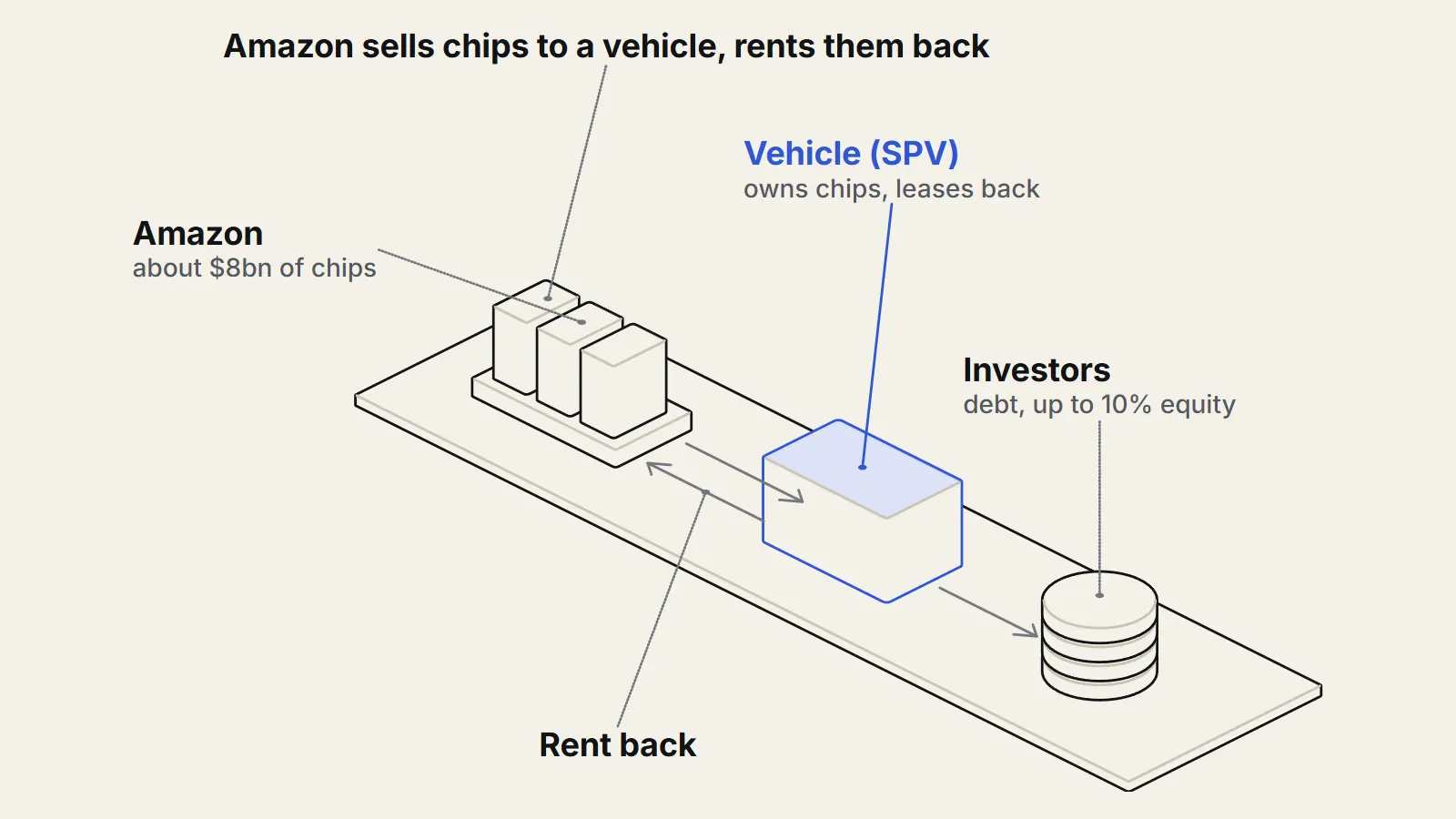
This piece answers a news item we saw on 15 and 16 October 2026. The Financial Times reported on 1 October that Amazon is trying to move about $8 billion of Nvidia chips1 to investors, and Reuters carried the report on 2 October.1 In plain terms, the Amazon Nvidia chips would be placed in a special purpose vehicle, a separate company set up for one job, and Amazon would then lease them back. The original article is behind a paywall that we could not open, so we rely on the Reuters and European Business Magazine accounts of it. Neither Amazon nor Nvidia had replied to Reuters when it published, and the reports do not say the deal is done. This is an explanation, not investment advice.
What did the report say about the Amazon Nvidia chips deal?
According to Reuters, the chips are thousands of Nvidia Grace Blackwell units that Amazon is installing in more than a dozen US data centres across five states, including Nevada and Virginia. Amazon either bought or leased them. The vehicle would raise money by issuing debt, and Amazon plans to offer investors an equity stake of up to 10 percent1 in it.1 The Financial Times, as relayed by Reuters, said Amazon had held talks in recent weeks to gauge investor interest.1
European Business Magazine adds that the investors would receive lease payments backed by Amazon, and that Amazon expects capital spending above $200 billion this year, mostly on chips and data centres for its cloud business.2 Neither account gives a lease term, a price or a credit rating, so we do not guess them. For scale, Amazon's annual report for 2025 shows purchases of property and equipment of $131.8 billion that year, up from $83.0 billion in 2024.3 An $8 billion package is therefore a slice of a very large spending programme, not the whole of it.
What is a special purpose vehicle, and how does a sale and leaseback work?
A special purpose vehicle (SPV) is a legal entity created to hold particular assets and raise money against them. In a sale and leaseback, the owner sells an asset to such an entity and rents it straight back, so it keeps using the asset but receives cash today and pays rent over time. The vehicle funds the purchase with borrowed money and with equity from investors, and the rent is what services the debt. Airlines and property companies have long done this with aircraft and buildings, as European Business Magazine notes.2 Lenders in such a structure look mostly at the tenant's ability to pay, much as when banks lend against a borrower's promise (https://therealigned.com/story/how-banks-create-money) instead of the cash they hold.
Equity works differently from debt: it is a share of ownership that is paid only after lenders, and so it takes the first losses. It is the same basic bargain that startup investors accept (https://therealigned.com/story/how-startups-actually-make-money), though here the cash flows are lease payments rather than a hoped-for sale.
There is a recent precedent. In October 2025 Meta announced a joint venture with funds managed by Blue Owl Capital for its Hyperion data centre campus in Richland Parish, Louisiana. Blue Owl's funds would own 80 percent of the joint venture4 and Meta the rest, with roughly $27 billion of total development costs to be funded.4 That deal covered buildings and long-lived power and cooling systems. Chips are a different kind of asset, which is the next question.
Why do GPUs lose value so fast, and why does that matter for financing?
Accounting spreads the cost of equipment over its expected useful life, and that estimate is a judgement. Amazon's annual report says that from 1 January 2025 it shortened the useful life of a subset of its servers and networking equipment from six years to five. In 2025 that change raised depreciation and amortisation expense by $1.4 billion and cut net income by $1.0 billion3, mostly in its cloud segment. The report also says the life had been lengthened from five to six years from 1 January 2024.3 Even the owner, in other words, has moved its own estimate in both directions.
European Business Magazine points to the risk this creates for lenders: Nvidia releases a more powerful generation roughly every year, so older chips can lose value quickly, which makes them weak collateral for long-term debt.2 Debt that runs for many years also piles up interest, a point we cover in our guide to compound interest over time (https://therealigned.com/story/compound-interest-time-vs-amount). A building can still be sold at a sensible price after thirty years; a chip generation may be superseded in one. One reading is that investors in a chip vehicle would be relying on the lessee's promise to pay rent, which the magazine describes as backed by Amazon, more than on what the chips could fetch if sold. We stress that this is our reading of the structure, not something the reports state.
Is the Amazon Nvidia chips deal off balance sheet?
The reports describe the aim as improving Amazon's balance sheet and taking a more asset-light approach, by moving costly chips to investors.1 Whether that makes the chips and the debt disappear from Amazon's own accounts depends on accounting rules about control and on the exact lease terms. A leaseback also creates a promise to pay rent for years, which accounting rules generally require a tenant to recognise in some form. The reports we opened do not describe the accounting, and we have not seen Amazon's own filing on this plan, so we cannot say how it would be treated. Amazon's annual report does show that it already uses finance leases: equipment acquired under them was $2.9 billion in 2025, up from $0.9 billion in 2024.3
What is the strongest counterargument, and what is not known?
The strongest counterargument is that this is ordinary financing and not a sign of strain. Selling and leasing back assets is an old technique, and a company with heavy spending plans can reasonably prefer to share the cost with investors who want steady rental income. Amazon would keep using the chips throughout. European Business Magazine itself sets the plan beside other heavy AI-related borrowing, and notes that pension funds holding large technology companies through index funds may be offered pieces of similar deals.2 Whether that is prudent or risky depends on terms nobody has published.
Several things are not known as of 17 October 2026: whether the deal will go ahead, the lease length, who bears the loss if chips are worth less than expected when the lease ends, and how Amazon would account for it. Readers can check the Reuters report (https://www.investing.com/news/stock-market-news/amazon-seeks-to-offload-8-billion-of-nvidia-chips-to-investors-ft-reports-4928877) and Amazon's annual report (https://www.sec.gov/Archives/edgar/data/1018724/000101872426000004/amzn-20251231.htm) themselves; the Meta press release (https://investor.atmeta.com/investor-news/press-release-details/2025/Meta-Announces-Joint-Venture-with-Funds-Managed-by-Blue-Owl-Capital-to-Develop-Hyperion-Data-Center/default.aspx) gives the earlier precedent. If the deal is announced formally, those numbers will replace our caveats.
Key takeaways
- As reported on 1 and 2 October 2026, Amazon wants to move about $8 billion of Nvidia chips into a vehicle and lease them back.
- A special purpose vehicle borrows and raises equity to buy the assets; the lease payments service that debt.
- Chips age faster than buildings, and Amazon itself changed its server life estimate in 2024 and again in 2025.
- Whether the deal is off balance sheet depends on accounting terms that have not been published.
- This is an explanation of a reported plan, not advice on any investment.
Sources
- 1Amazon seeks to offload $8 billion of Nvidia chips to investors, FT reports (opens the source in a new tab) · Reuters, 2026 · Reporting · https://www.investing.com/news/stock-market-news/amazon-seeks-to-offload-8-billion-of-nvidia-chips-to-investors-ft-reports-4928877
- 2Amazon Seeks to Offload $8bn of Nvidia Chips to Investors (opens the source in a new tab) · European Business Magazine, 2026 · Reporting · https://europeanbusinessmagazine.com/amazon-8bn-nvidia-chips-investors/
- 3Amazon.com, Inc. Annual Report on Form 10-K for 2025 (opens the source in a new tab) · U.S. Securities and Exchange Commission, 2026 · Primary source · https://www.sec.gov/Archives/edgar/data/1018724/000101872426000004/amzn-20251231.htm
- 4Meta Announces Joint Venture with Funds Managed by Blue Owl Capital to Develop Hyperion Data Center (opens the source in a new tab) · Meta Platforms, 2025 · Primary source · https://investor.atmeta.com/investor-news/press-release-details/2025/Meta-Announces-Joint-Venture-with-Funds-Managed-by-Blue-Owl-Capital-to-Develop-Hyperion-Data-Center/default.aspx