Jio Platforms' share sale closed on Friday 23 October 2026, and its IPO allotment is due on Monday 26 October. Bidding ran from 21 to 23 October, the basis of allotment is scheduled for 26 October, refunds and share credits for 27 October and listing for 28 October, which is tentative1. Allotment is the step that decides who gets shares and how many. This piece explains how it works, using Jio's issue as the example. It does not say whether anyone should apply or sell, and it leaves out unofficial price chatter.
What Jio is selling
The issue is a fresh issue of 27 crore shares, with no offer for sale, in a price band of Rs 1,065 to Rs 1,119 a share1. A fresh issue means the company creates new shares and keeps the money. In an offer for sale, existing shareholders sell and the company receives nothing. Hyundai Motor India's 2024 issue was entirely an offer for sale2. At up to Rs 30,213 crore, Jio's issue tops a ranking of Indian IPOs that includes Hyundai at Rs 27,870 crore, LIC at Rs 21,000 crore in 2022 and Paytm at Rs 18,300 crore in 20212. That ranking assumes the issue is completed at the proposed size. SEBI lists the red herring prospectus (https://www.sebi.gov.in/filings/public-issues/oct-2026/jio-platforms-limited-rhp_105274.html) on its public-issues page, dated 15 October 20263. The figures in this piece come from a data aggregator and the SEBI listing, not from the prospectus itself, so check them against the prospectus.
How Jio IPO allotment is split by investor type
An IPO does not sell to one pool of buyers. The price band is fixed first, and SEBI's FAQ (https://www.sebi.gov.in/sebi_data/faqfiles/may-2025/1747290561386.pdf) says in a book-built IPO the band is disclosed at least two working days before the issue opens, with bidders then quoting a price and quantity4. Shares are then divided by investor type. In the net offer to the public, qualified institutional buyers are allocated 50%, non-institutional investors 15% and retail investors 35%1, with smaller preferential portions for employees and existing shareholders. A retail bid is one to 14 lots of 12 shares, or Rs 13,428 to Rs 1,87,992 at the top of the band1. Before the issue opened, anchor investors bid on 19 October and were offered shares worth Rs 8,109.85 crore1, a separate block outside the table below.
| Category | Share of net offer | Subscription at 7:28 pm on day 3 (provisional) |
|---|---|---|
| Qualified institutional buyers (ex-anchor) | 50.00% | 67.15x |
| Non-institutional investors | 15.00% | 13.99x |
| Retail individual investors | 35.00% | 2.76x |
| Whole issue | 21.36x |
What oversubscribed means for allotment
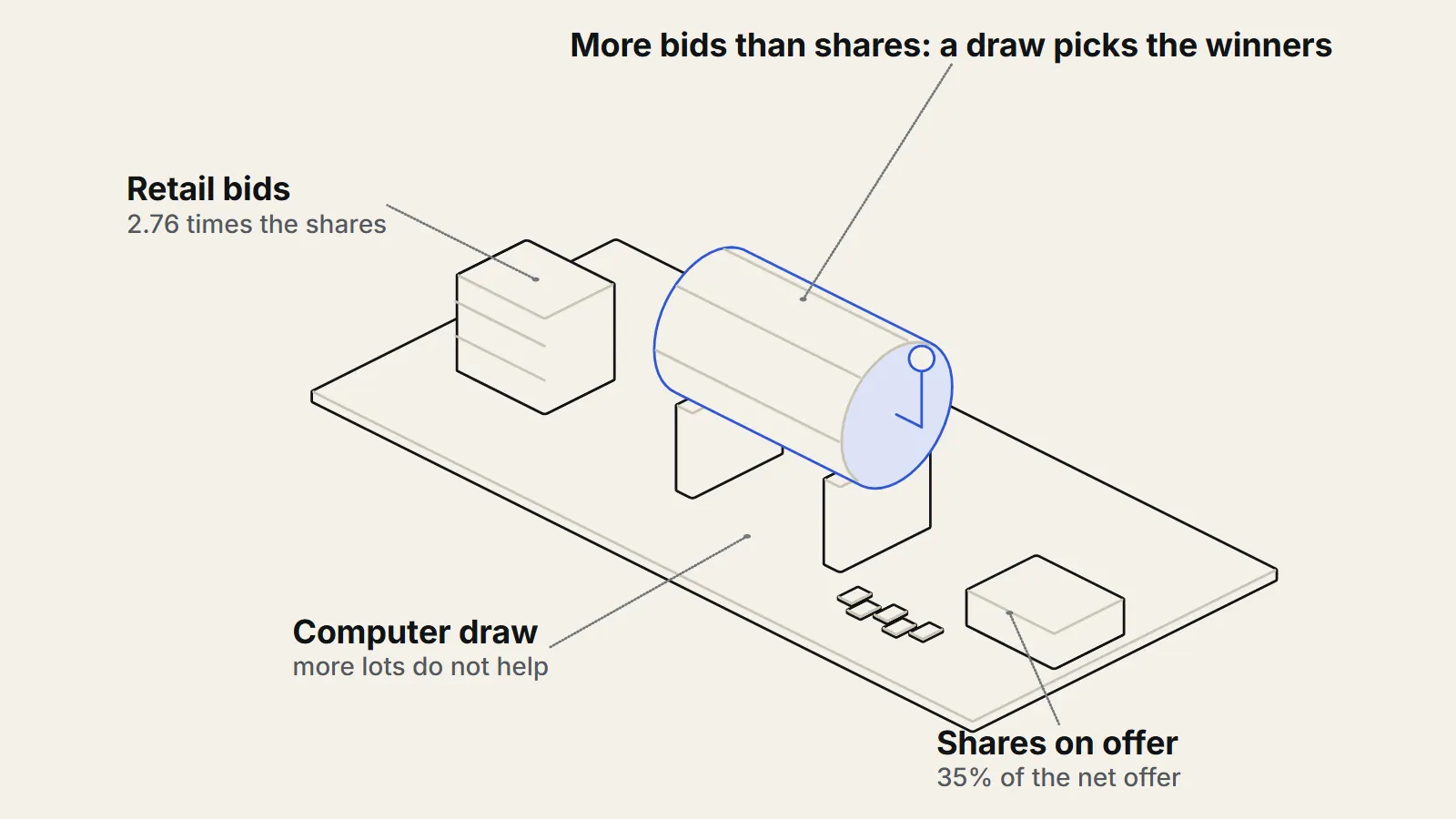
Subscription is demand divided by supply. A category subscribed 2.76 times has roughly 2.76 shares applied for each share on offer, so it cannot fill everyone. SEBI's rules shape what happens next. According to its FAQ, allotment to QIBs is proportionate, while each retail and non-institutional allottee gets at least the minimum bid lot, subject to availability, with any remainder allotted proportionately4. The same FAQ says there is no discretion in allotment among categories. When even a minimum lot for every applicant is impossible, a broker explainer says the registrar runs a computer draw, and bidding for more lots does not improve the odds of getting the base lot5. Which applicants receive shares in the retail category will therefore depend on how many distinct applicants there are compared with the lots available, a number the registrar knows and this piece does not.
The timeline from close to listing
SEBI cut the gap between closing and listing from six working days to three. Its board memo sets out listing within T+3 days of issue closure, T being the closing day, with bids closing at 4 pm for QIB and non-institutional categories and 5 pm for retail, and unblocking of non-allottees' money set for T+26. Jio's dates fit that pattern. T is Friday 23 October, the basis of allotment is Monday 26 October, refunds and share credits are Tuesday 27 October and listing is Wednesday 28 October. Weekends are not working days, which is why a Friday close leads to a Monday allotment. The registrar for the issue is Kfin Technologies1, where applicants can check their status once allotment is final.
What this piece leaves out
It does not value Jio, forecast a listing price or compare it with other shares. Grey-market premiums are an unofficial figure traded outside the exchanges. They are not part of the allotment process and are not used here. Subscription figures above are provisional and will be replaced by final exchange data, and the listing date was marked tentative when this was written.
Key takeaways
- Jio's issue is fresh shares only, so the proceeds go to the company, not to selling shareholders.
- Shares are split by investor type, and each category is allotted by its own rules.
- A category that is oversubscribed cannot fill every bid; retail allottees get at least one lot where shares allow.
- From close to listing takes three working days, so Jio's Friday close leads to a Wednesday listing.
Sources
- 1Jio Platforms IPO: date, price, subscription and allotment details (opens the source in a new tab) · Chittorgarh.com, 2026 · Reporting · https://www.chittorgarh.com/ipo/jio-platforms-ipo/3152/
- 2India's biggest IPOs ranked by issue size (opens the source in a new tab) · Kotak Neo, 2026 · Reporting · https://www.kotakneo.com/news/ipos/jio-platforms-ipo-vs-indias-biggest-ipos-by-issue-size/
- 3Jio Platforms Limited - Red Herring Prospectus (public issues filing) (opens the source in a new tab) · Securities and Exchange Board of India, 2026 · Primary source · https://www.sebi.gov.in/filings/public-issues/oct-2026/jio-platforms-limited-rhp_105274.html
- 4Frequently Asked Questions on the Issue of Capital and Disclosure Requirements Regulations, 2018 (opens the source in a new tab) · Securities and Exchange Board of India, 2025 · Primary source · https://www.sebi.gov.in/sebi_data/faqfiles/may-2025/1747290561386.pdf
- 5IPO Allotment Status: T+3 Timeline and How to Check (opens the source in a new tab) · Sahi, 2026 · Reporting · https://www.sahi.com/blogs/ipo-allotment-status-how-allotment-works-and-how-to-check-it
- 6Reduction of timeline for listing of shares in Public Issue from existing T+6 days to T+3 days (SEBI board memorandum) (opens the source in a new tab) · Securities and Exchange Board of India, 2023 · Primary source · https://www.sebi.gov.in/sebi_data/meetingfiles/jul-2023/1688530983272_1.pdf