- Place
- Santa Clara, California, United States
- Years
- 2019–2026
- Policy
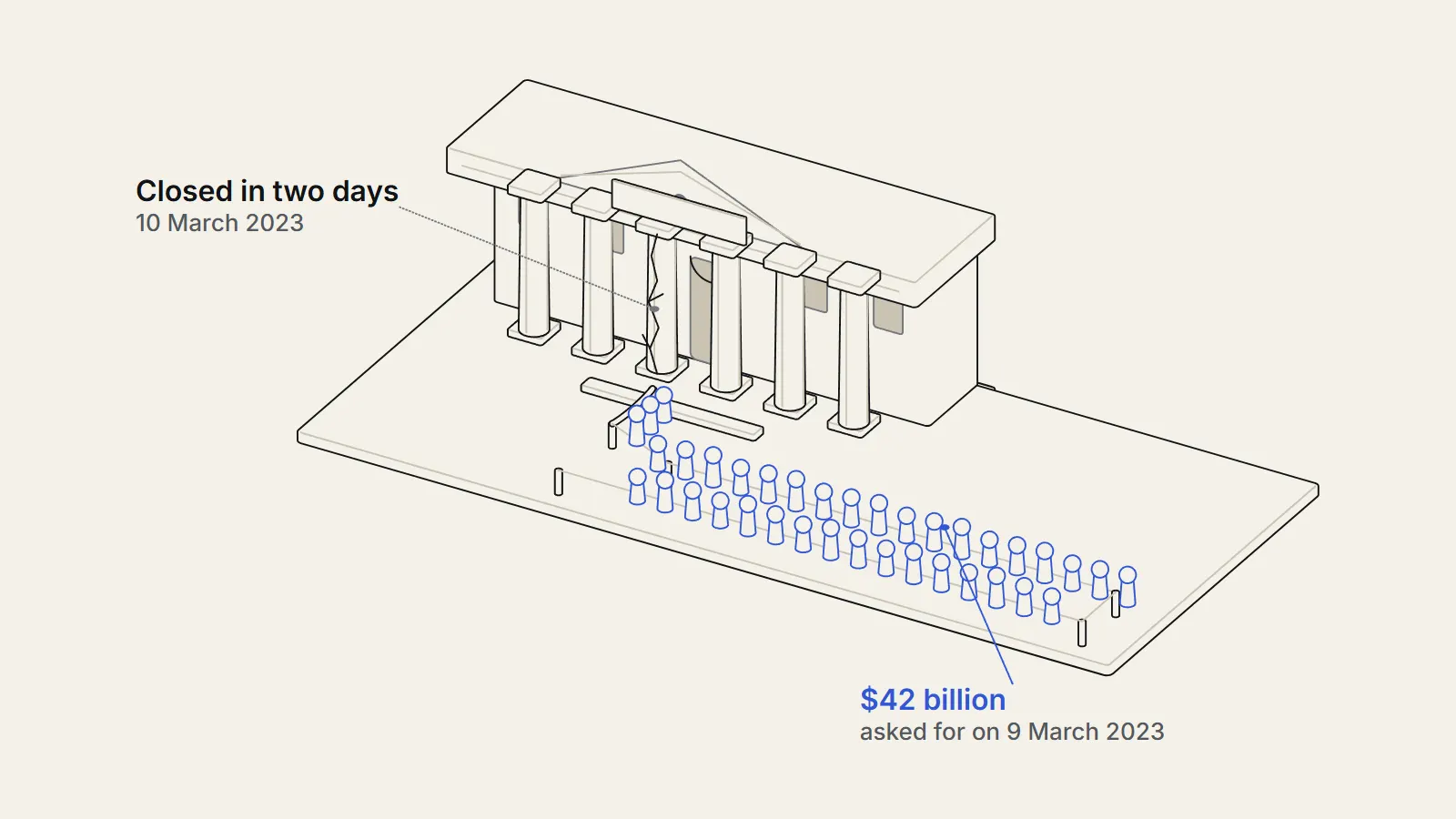
- Regulators closed Silicon Valley Bank on March 10, 2023, then guaranteed insured and uninsured deposits on March 12 and opened a Fed loan facility valuing bank collateral at par.
- Outcome
- Customers sought about $42 billion in one day; the FDIC fund loss was estimated at $16.1 billion, and about $16.7 billion for SVB and Signature is being recovered from large banks.
The Silicon Valley Bank collapse took two days. On March 8, 2023 the Santa Clara lender told investors it had sold securities at a loss and needed more capital; on March 9 its customers asked to withdraw about $42 billion, and on March 10 regulators closed it.2 Two days later the authorities guaranteed every depositor, insured or not, and the cost of that decision is being recovered from large banks, with payments dated through March 2026.3
Before
A small bank that grew very fast
Silicon Valley Bank, or SVB, served technology companies and the start-ups that venture capital firms backed. In 2017 it held about $45 billion of deposits and about $50 billion of assets.2 By March 31, 2022 its deposits exceeded $200 billion and its assets stood at $217 billion.2
The money arrived because its customers were raising money. SVB Financial Group told investors that its clients were getting cash from public offerings, SPAC fundraising and venture capital rounds, which were at notably high levels in 2021 and early 2022.1 Deposits rose from $103.2 billion in 2020 to $191.4 billion in 2021.2
The Federal Reserve's own review (https://www.federalreserve.gov/publications/files/svb-review-20230428.pdf) counted a 271 percent rise in assets from the end of 2018 to the end of 20211, against 29 percent for the banking industry as a whole.1 The Government Accountability Office (https://www.gao.gov/products/gao-23-106736) (GAO) measured a shorter window, 2019 to 2021, and found 198 percent for SVB, 134 percent for Signature Bank and a median of 33 percent for 19 peer banks.4 The two figures differ because they start in different years, not because the sources disagree.
Where the money went
A bank has to put deposits somewhere. SVB made fewer loans than the average large bank, 35 percent of assets against 58 percent, and bought securities instead. Its securities holdings rose from $23 billion in 2018 to $125 billion in 2021, an increase of 443 percent, and its held-to-maturity (HTM) holdings grew from $15 billion to $98 billion.2 Most of the HTM portfolio was agency mortgage-backed securities with maturities of 10 years or more, and the portfolio had a weighted-average duration of 6.2 years at the end of 2022.1
Two accounting terms matter here. A security classed as held to maturity is carried at its purchase cost, not at today's market price, on the basis that the bank means to keep it until it is repaid. The Fed review adds that selling a portion of an HTM portfolio would generally force the whole portfolio to be reclassified and marked to market.1 That made it costly for SVB to sell some of these bonds to raise cash.
The price of a long, fixed-rate bond falls when interest rates rise, because new bonds pay more. As interest rates rose from 0.25 percent in March 2022 to 4.5 percent in December 2022, SVB's unrealized losses on HTM securities grew from about $1.3 billion at the end of 2021 to about $15.2 billion a year later, and losses on securities held for sale grew from $313 million to $2.5 billion.2 The word unrealized means the bank had not sold the bonds, so the loss was on paper. Our comparison: $15.2 billion is close to the $15.5 billion of equity capital SVB reported in its 2022 year-end filing.2
Deposits that could leave in a day
The other half of the problem was who held the deposits. FDIC insurance covers deposits up to $250,000 per depositor, per bank, per ownership category, and the part above the cap is uninsured.2 At the end of 2022 about 94 percent of SVB's total deposits were uninsured1, against 41 percent at the average large bank, and venture-backed companies held more than half of the deposits.1
The bank also looked weak on the inside. The Fed review says SVB failed its own internal liquidity stress tests and removed interest-rate hedges rather than managing the risk of rising rates.1 The Fed's inspector general (https://oig.federalreserve.gov/reports/board-material-loss-review-silicon-valley-bank-sep2023.pdf) called the complete removal of the hedges a significant error by management.2 A director told supervisors in 2022 that controls always lag growth.1
Supervisors were slow too. The San Francisco Fed downgraded SVB in June 2022 and began an enforcement action in August 2022, but did not finish it before the bank failed.4 SVB had crossed $100 billion of average assets in June 2021 and become what the Fed calls a Category IV firm, but some of that category's requirements, including stress testing, had not yet started because of transition periods; its first stress test would have come in 2024.1
The decision
Three days that changed the rules
On March 8, 2023 the bank announced a restructuring. By the Fed's account it had sold $21 billion of securities held for sale, booked a $1.8 billion after-tax loss, planned to raise $2.25 billion of capital and to increase its term borrowing by $15 billion to $30 billion.1 The inspector general's report gives the planned capital raise as $2 billion, so we show the Fed's figure and note the difference.2 Silvergate Capital said the same day that it would wind down its bank, which, the Fed review says, further affected depositor sentiment.1
Depositors read the announcement as a sign of distress. On March 9 customers asked to withdraw about $42 billion, nearly 25 percent of the bank's $166 billion of deposits2 and almost 300 percent of its capital.2 Management expected more than $100 billion of further outflows on March 10, and the bank did not have enough cash or collateral to pay.1
The California regulator closed the bank on the morning of March 10 and named the FDIC receiver.1 The FDIC moved insured deposits to a newly created institution, the Deposit Insurance National Bank of Santa Clara, and told customers that insured deposits would be available by Monday, March 13.5 At the end of 2022 the bank had about $209.0 billion of assets and $175.4 billion of deposits.5
Then, on Sunday March 12, the authorities went further. According to the Fed's announcement (https://www.federalreserve.gov/newsevents/pressreleases/monetary20230312a.htm), after consulting the President and acting on recommendations from the FDIC and Fed boards, the Treasury Secretary approved actions that, in the Fed's words, fully protect all depositors, both insured and uninsured.6 GAO describes this as the systemic risk exception, and reports that the FDIC and the Fed judged that not guaranteeing uninsured deposits would likely have caused more bank runs (https://therealigned.com/story/bank-runs-explained) and harmed the wider economy.4
The Fed also opened the Bank Term Funding Program (BTFP). It offered loans of up to one year to banks and other eligible institutions, took Treasuries, agency debt and mortgage-backed securities as collateral, and valued that collateral at par, meaning face value.6 The Treasury made up to $25 billion available from its Exchange Stabilization Fund as a backstop.6 In plain terms, a bank sitting on bonds that had lost market value could borrow against them at face value without selling.
- June 2021SVB crosses $100 billion of average assets and becomes a Category IV firmSource 1 (opens the source in a new tab)
- Mar to Dec 2022Interest rates rise from 0.25 percent to 4.5 percentSource 2 (opens the source in a new tab)
- June 2022San Francisco Fed downgrades SVB; an enforcement action begins in AugustSource 4 (opens the source in a new tab)
- Mar 8, 2023SVB announces the securities sale and capital raise; Silvergate announces its wind-downSource 1 (opens the source in a new tab)
- Mar 9, 2023About $42 billion of withdrawals requestedSource 2 (opens the source in a new tab)
- Mar 10, 2023California regulator closes SVB; FDIC appointed receiverSource 5 (opens the source in a new tab)
- Mar 12, 2023All depositors protected; Bank Term Funding Program announcedSource 6 (opens the source in a new tab)
- Mar 13, 2023Insured depositors have access to fundsSource 5 (opens the source in a new tab)
- Sep 25, 2023Fed inspector general publishes its material loss reviewSource 2 (opens the source in a new tab)
- Mar 11, 2024BTFP stops making new loansSource 7 (opens the source in a new tab)
- Mar 30, 2026Final scheduled payment date of the FDIC special assessmentSource 3 (opens the source in a new tab)
The strongest case against the rescue
Moral hazard is the incentive to take on greater risk as a result of being protected from the consequences of risk-taking.
— FDIC, Options for Deposit Insurance Reform, May 2023
The same FDIC report is careful to say that deposit insurance also has benefits, because it protects small savers and reduces run risk, and it sets out three options: a finite limit (kept or raised), unlimited coverage, or higher coverage targeted at business payment accounts.9 It did not conclude that the 2023 guarantee was wrong.
The Bank Policy Institute authors made a narrower criticism of the loan programme. They estimate that because loans were made against collateral at par, the aggregate shortfall between what was lent and what the collateral was worth reached more than $20 billion8, and they point out that the loans cost one-year OIS plus 10 basis points, a low rate that could be repaid without penalty.8 They also note that borrowing surged again in late November 2023 when the loan rate fell below the rate the Fed pays on bank reserves, creating a profit from borrowing, until the Fed changed the rate in January 2024.8
appears to have operated largely as intended, but at considerable risk and cost
— Bank Policy Institute authors on the Bank Term Funding Program, April 2025
There is a distributional point as well. Accounts above $250,000 made up less than 1 percent of deposit accounts by number at the end of 2022, and the top 1 percent of banks by assets held about 77 percent of uninsured deposits.9 The uninsured balances that the guarantee covered therefore sat in a small share of accounts and were concentrated in the largest banks. Those facts do not settle whether the guarantee was right. They describe who held the money it protected.
What happened
What the Silicon Valley Bank collapse cost
Within weeks the FDIC estimated that the failure would cost its Deposit Insurance Fund about $20 billion; in May 2023 it lowered the estimate to about $16.1 billion.2 To recover the loss from protecting uninsured depositors, the FDIC set up a special assessment on large banks.3
| Feature | What the FDIC says |
|---|---|
| Amount to be recovered | About $16.7 billion for the two failures combined |
| Who pays | 141 insured institutions belonging to 110 banking organizations |
| Excluded | Organizations with under $5 billion of estimated uninsured deposits |
| Base | Estimated uninsured deposits at December 31, 2022, minus the first $5 billion |
| Rate | 3.36 basis points per quarter for seven quarters, then 2.97 |
| Collection | First quarter of 2024 to fourth quarter of 2025; final payment dated March 30, 2026 |
The Fed's loan facility had a different cost profile. The BPI authors count nearly 9,000 loans to about 1,327 borrowers at a peak above $165 billion.8 The Fed stopped making new loans on March 11, 2024. Its report of November 12, 2024 shows $57.56 billion outstanding on October 31, 2024, with collateral of $71.94 billion pledged and $8.86 billion of interest and fees received.7 The BPI authors date the last repayment to March 11, 2025.8 We could not confirm that the Fed and BPI value the collateral on the same basis or on the same dates, so we do not net their figures against each other.
What changed in the rules and the numbers
The Fed's own review, released on April 28, 2023, listed four findings: the board and management failed to manage risks, supervisors did not fully appreciate the vulnerabilities, supervisors did not make the bank fix problems quickly enough, and the Fed's tailoring of rules after a 2018 law, together with a shift in supervisory stance, reduced standards and promoted a less assertive approach.1 Michael Barr, who oversaw the review, described the review as a first step and a self-assessment that takes an unflinching look at the conditions that led to the failure.10
The review also tested one counterfactual. SVB had opted out of counting unrealized gains and losses on securities held for sale in its regulatory capital. Had it counted them, the review calculates, capital would have been $1.9 billion lower and its common equity ratio 10.4 percent instead of 12.1 percent.1 The review adds that the lower capital may have led the bank to raise more capital or make different business decisions.1
The FDIC's May 2023 report set the failure in a wider trend. The uninsured share of all deposits peaked in 2021 at its highest level since 1949, and the 2022 total value of uninsured deposits was more than five times its real value in 1990.9 About 28 percent of FDIC-insured institutions had more than a third of their domestic deposits uninsured at the end of 2022.9
What economists still disagree on
Was the Silicon Valley Bank collapse about rates or about oversight?
The official reviews put the main weight on the bank and its supervisors. The Fed review says the failure can be tied directly to the board and senior management, and adds that Fed supervisors did not take forceful enough action.1 The inspector general's report, which the law requires after a failure with a material loss to the insurance fund and which says it does not serve any investigatory purposes, points to a concentrated customer base, weak governance and risk management, unhedged long-dated securities and poorly handled communication of the capital plan.2
Academic work puts more weight on the rate shock and on how depositors behave. Jiang, Matvos, Piskorski and Seru mark US bank assets to market for the rate rises from Q1 2022 to Q1 2023 and find an average fall of 10 percent, about $2 trillion. Their model shows that such declines can set off self-fulfilling runs, and that banks with large losses, thin capital and high uninsured leverage are most exposed.11 On that reading, SVB was extreme, not unique. The Fed review reads it differently: it says the banking system is sound and resilient, with strong capital and liquidity, and that in some respects SVB was an outlier because of its concentrated business model, interest rate risk and reliance on uninsured deposits.1 The two claims are not strictly opposed, because the papers measure paper losses and run risk while the Fed describes capital and liquidity, but they point readers in different directions about how far the Silicon Valley Bank collapse generalises.
A third strand looks at speed. Cookson and co-authors, using Twitter data, find that banks with high prior exposure to Twitter lost 4.3 percentage points more stock market value during the run, and that attention, not negative sentiment, is the factor linked to run risk.12 The Fed review likewise says the run was fuelled by social media and a tightly connected network of venture investors and technology firms.1
- Agreed in the sources: SVB held a large, long-dated bond portfolio, 94 percent of its deposits were uninsured, and the run took about one day.
- Disputed: how much weight to give the rate rise, management, supervision and the 2018 and 2019 changes to rules.
- Disputed: whether a guarantee of all deposits was needed, and whether the Fed loan programme was priced and secured adequately.
- Not known: how many other banks would have failed without the guarantee.
The data have limits. The Fed review is, in Barr's words, a self-assessment, and the Fed was also SVB's supervisor.10 The inspector general's review is independent but was produced under a statutory mandate.2 The effect of the rule changes is a counterfactual that no one can observe: the Fed itself says only that the bank may have raised more capital or made different decisions.1
If uninsured depositors at SVB had been left to take losses, would the run have spread to other banks, and how could anyone know what would have happened?
Lessons
Key takeaways
- The failure came from a mismatch: long-dated bonds funded by deposits that could leave at once. Rising rates exposed it.
- Concentration made it fast. A bank whose customers share a network and are mostly above the insurance cap can lose a quarter of its deposits in a day.
- The response protected uninsured depositors, and the cost was passed to large banks through a special assessment of about $16.7 billion for two failures.
- The main open question is not the cause but the counterfactual: whether leaving uninsured deposits unprotected would have spread the run.
The Silicon Valley Bank collapse is easy to retell as one badly run bank, and the official reviews do put heavy weight on management. What carries over is the mechanism: deposits that can be withdrawn at once, assets that cannot be sold without a loss, and a public that can see and share news within hours. What does not necessarily carry over is the United States' $250,000 cap, its supervisory categories and its assessment tool. We did not review other countries' deposit rules for this piece, so we cannot say how far the details travel.
Sources
- 1Review of the Federal Reserve's Supervision and Regulation of Silicon Valley Bank (opens the source in a new tab) · Board of Governors of the Federal Reserve System, 2023 · Report · https://www.federalreserve.gov/publications/files/svb-review-20230428.pdf
- 2Material Loss Review of Silicon Valley Bank (2023-SR-B-013) (opens the source in a new tab) · Federal Reserve OIG, 2023 · Primary source · https://oig.federalreserve.gov/reports/board-material-loss-review-silicon-valley-bank-sep2023.pdf
- 3Special Assessment Pursuant to Systemic Risk Determination (opens the source in a new tab) · FDIC, 2026 · Primary source · https://www.fdic.gov/deposit-insurance-assessments/special-assessment-pursuant-systemic-risk-determination
- 4Bank Regulation: Preliminary Review of Agency Actions Related to March 2023 Bank Failures (GAO-23-106736) (opens the source in a new tab) · GAO, 2023 · Report · https://www.gao.gov/products/gao-23-106736
- 5Silicon Valley Bank, Santa Clara, California, Closed (press release 23016) (opens the source in a new tab) · FDIC, 2023 · Primary source · https://www.fdic.gov/news/press-releases/2023/pr23016.html
- 6Federal Reserve Board announces it will make available additional funding to eligible depository institutions (March 12, 2023) (opens the source in a new tab) · Federal Reserve, 2023 · Primary source · https://www.federalreserve.gov/newsevents/pressreleases/monetary20230312a.htm
- 7Periodic Report: Update on Bank Term Funding Program (November 12, 2024) (opens the source in a new tab) · Federal Reserve, 2024 · Primary source · https://www.federalreserve.gov/publications/files/13-3-report-btfp-20241113.pdf
- 8Bank Term Funding Program: Experience and Lessons Learned (opens the source in a new tab) · Bank Policy Institute, 2025 · Report · https://bpi.com/bank-term-funding-program-experience-and-lessons-learned/
- 9Options for Deposit Insurance Reform (opens the source in a new tab) · FDIC, 2023 · Report · https://www.fdic.gov/analysis/options-deposit-insurance-reforms/report/options-deposit-insurance-reform-full.pdf
- 10Federal Reserve Board announces the release of the report reviewing the supervision and regulation of Silicon Valley Bank (April 28, 2023) (opens the source in a new tab) · Federal Reserve, 2023 · Primary source · https://www.federalreserve.gov/newsevents/pressreleases/bcreg20230428a.htm
- 11Monetary Tightening and U.S. Bank Fragility in 2023: Mark-to-Market Losses and Uninsured Depositor Runs? (opens the source in a new tab) · NBER Working Paper 31048; Journal of Financial Economics vol. 159, 2024 · Paper · https://www.nber.org/papers/w31048
- 12Social media as a bank run catalyst (opens the source in a new tab) · Journal of Financial Economics vol. 176, 2026 · Paper · https://ideas.repec.org/a/eee/jfinec/v176y2026ics0304405x25002260.html