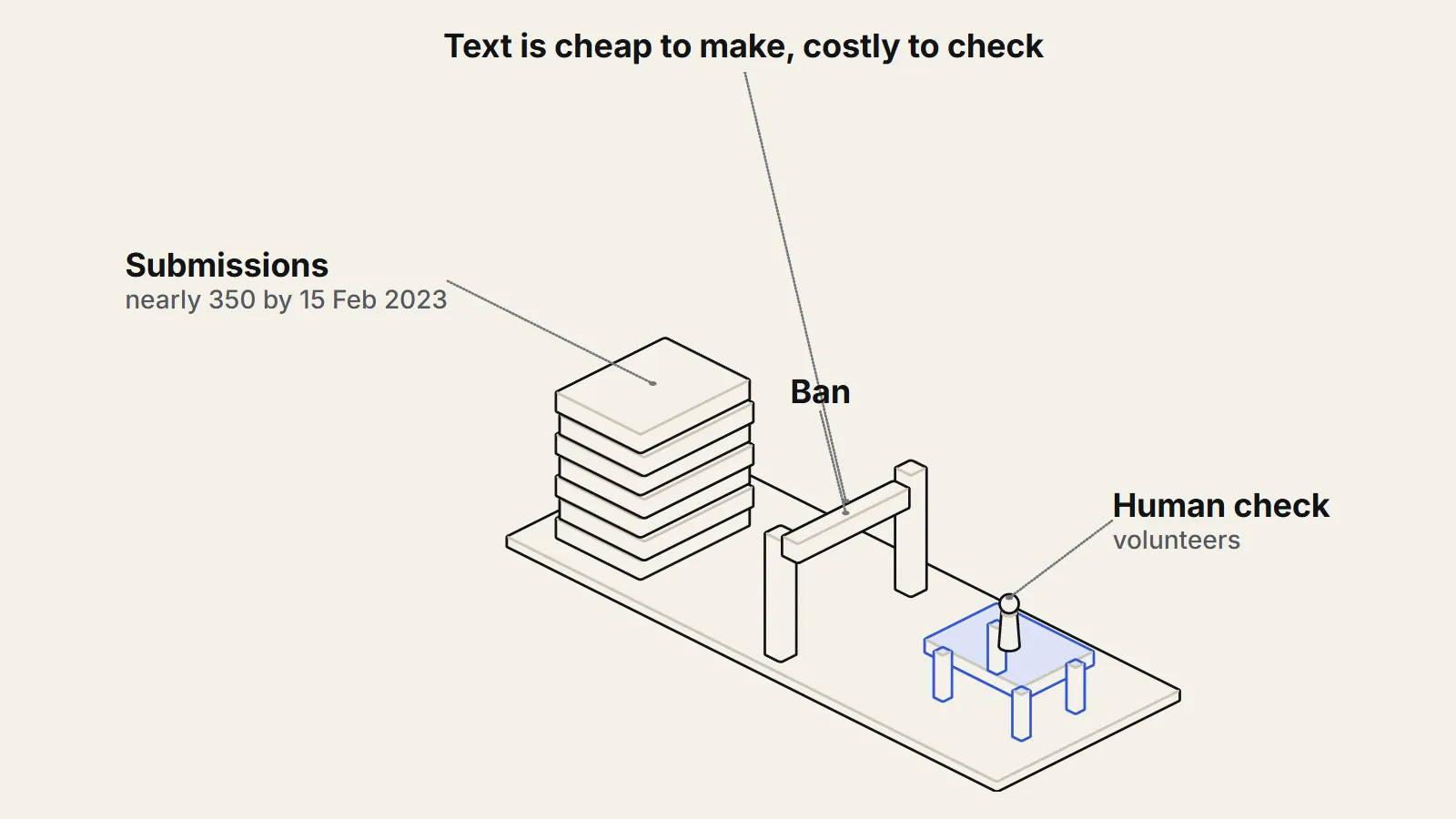
As of 16 October 2026, a United States magazine is in the news for an AI content ban: Current Affairs says (https://www.currentaffairs.org/news/why-were-banning-ai) it will publish no AI-generated content, meaning no text and no illustrations made by generative AI. The item drew a long argument on Hacker News, where we saw it on 15 and 16 October. This piece answers that news item; it does not break it. Why would a publisher ban AI writing, and can a ban work? Our reading is that bans respond to a cost gap: generating text is almost free, while checking it is not. A ban is a blunt but cheap way to protect the checking.
What does the Current Affairs AI content ban say?
Current Affairs is a unionised nonprofit magazine. In an editor's note filed on 15 October 2026, Nathan J. Robinson wrote that its new union contract includes an AI policy. Text generated by AI may not be published in the magazine, and AI-generated art may not be used as illustration1.1 The rule is narrower than the headline suggests. Writers may still use new tools for research, and artists may use tools for smaller jobs such as adding texture or changing a colour. The stated test is whether a tool helps workers or replaces them.1
The note gives several reasons. For-profit newsrooms have a cost incentive to replace writers; art models were trained on artists' work without permission; and readers should be getting human thought. The magazine also admits that AI text may occasionally slip through, especially in freelance submissions.1 One illustration in the note is a hypothetical, not data: 100 AI posts produced in four minutes at almost no cost, set against 20 posts by writers costing $5,000.1 We treat that as the author's argument about incentives, not as a measured finding.
Why do publishers ban AI writing? The cost gap
The economics are simple to state. A passable paragraph now costs almost nothing to produce, but deciding whether it is true, original and worth printing still takes a person's time. When one side of an exchange gets cheap and the other does not, the people on the costly side are swamped. Two earlier bans on AI-generated content show the pattern.
Stack Overflow, the programming question site, banned ChatGPT-generated answers on 5 December 2022. It said the answers typically look as if they might be good and are very easy to produce, yet the average rate of correct answers was too low. The volume, in the thousands, had swamped its volunteer-based quality-curation system2.2 The ban was announced as temporary, with a permanent decision left to a wider staff discussion.2
Clarkesworld, a science fiction magazine, met the same problem in short-story submissions. Its editor, Neil Clarke, published a chart of spam submissions (https://neil-clarke.com/a-concerning-trend/): roughly 25 in November 2022, about 50 in December and over 100 in January 2023, then nearly 350 by 15 February 20233.3 By his account 38 percent of that month's spam submissions had led to bans, and on 20 February 2023, after more than 50 arrived before noon, the magazine temporarily closed submissions.3
There is a labour side to this too. Our explainer on why wages rise (https://therealigned.com/story/why-wages-rise) shows that pay depends on productivity, bargaining power and competition for workers. A tool that lets an employer swap cheap output for a worker's changes the third of those. Whether that is happening in publishing is not something the sources we opened measure. History also shows how hard it is to hold a rule against a strong market pull: see our piece on the Black Death and wages (https://therealigned.com/story/black-death-and-wages) for how wage-cap laws fared in England after 1348. And AI vendors, like other young technology firms, need paying customers; our explainer on how startups actually make money (https://therealigned.com/story/how-startups-actually-make-money) covers that side of the market.
Can anyone enforce an AI content ban on AI-generated text?
Enforcement is where the argument gets hard. Current Affairs concedes that some AI text may pass. On Hacker News, one commenter said there is no auditing body for a human-made label of the kind that exists for food, and another argued that language models already write articles that go undetected.4 AI detection tools do not close the gap. Clarke wrote that tools for spotting machine-written text are unreliable, with false negatives and false positives, and he declines to describe how he spots spam so that spammers cannot adapt.3
A 2023 study of AI detectors (https://arxiv.org/abs/2304.02819) by Weixin Liang and colleagues tested seven widely used detectors. They misclassified over half of 91 essays by non-native English speakers as AI-generated, an average false positive rate of 61.22 percent5, while doing near-perfectly on 88 essays by US eighth-graders.5 The lesson is limited: it is one 2023 study with a small sample, and detectors have changed since. But it shows that a policy leaning on detectors can wrongly accuse the writers least likely to be believed, so human editorial judgement stays the real enforcement tool.
What is the strongest case against an AI content ban?
Supporters have a reply, and we state it fairly too. Current Affairs says its test already allows research help and small tool uses, so the line is replacement, not use. Some commenters compared the ban to a grass-fed label: a promise that readers can choose to reward.4 Whether readers value that promise enough to pay for it is a market question, and the answer is not in our sources.
What do we not know?
We do not know how much AI text Current Affairs will receive or catch, whether readers will pay more for a human-only promise, or whether other publishers will copy it. Stack Overflow's ban was described as temporary when announced, and we have not tracked how its policy has changed since. We read the Hacker News thread when it showed about 254 points and 200 comments; it reflects one online community, not public opinion. This article explains a debate and is not advice on business, legal or employment decisions.4
To read the originals, see the Current Affairs note (https://www.currentaffairs.org/news/why-were-banning-ai) and the Hacker News thread (https://news.ycombinator.com/item?id=50108131).
Key takeaways
- Current Affairs, a US nonprofit magazine, banned AI-generated text and art in a union contract, with research use allowed.
- Earlier bans at Stack Overflow and Clarkesworld followed floods of AI output that swamped human checking.
- AI detection tools are weak, and a 2023 study found they flagged over half of non-native English essays as AI.
- The strongest case against an AI content ban is that it is blunt and hard to enforce; supporters see a promise to readers.
- Much remains unknown, including how readers will value human-only work.
Sources
- 1Why We're Banning AI (opens the source in a new tab) · Current Affairs, 2026 · Essay · https://www.currentaffairs.org/news/why-were-banning-ai
- 2Stack Overflow bans ChatGPT (opens the source in a new tab) · The Register, 2022 · Reporting · https://www.theregister.com/2022/12/05/stack_overflow_bans_chatgpt/
- 3A Concerning Trend (opens the source in a new tab) · Clarkesworld Magazine, 2023 · Primary source · https://neil-clarke.com/a-concerning-trend/
- 4Why We're Banning AI (Hacker News discussion) (opens the source in a new tab) · Hacker News, 2026 · Reporting · https://news.ycombinator.com/item?id=50108131
- 5GPT detectors are biased against non-native English writers (opens the source in a new tab) · arXiv, 2023 · Paper · https://arxiv.org/abs/2304.02819