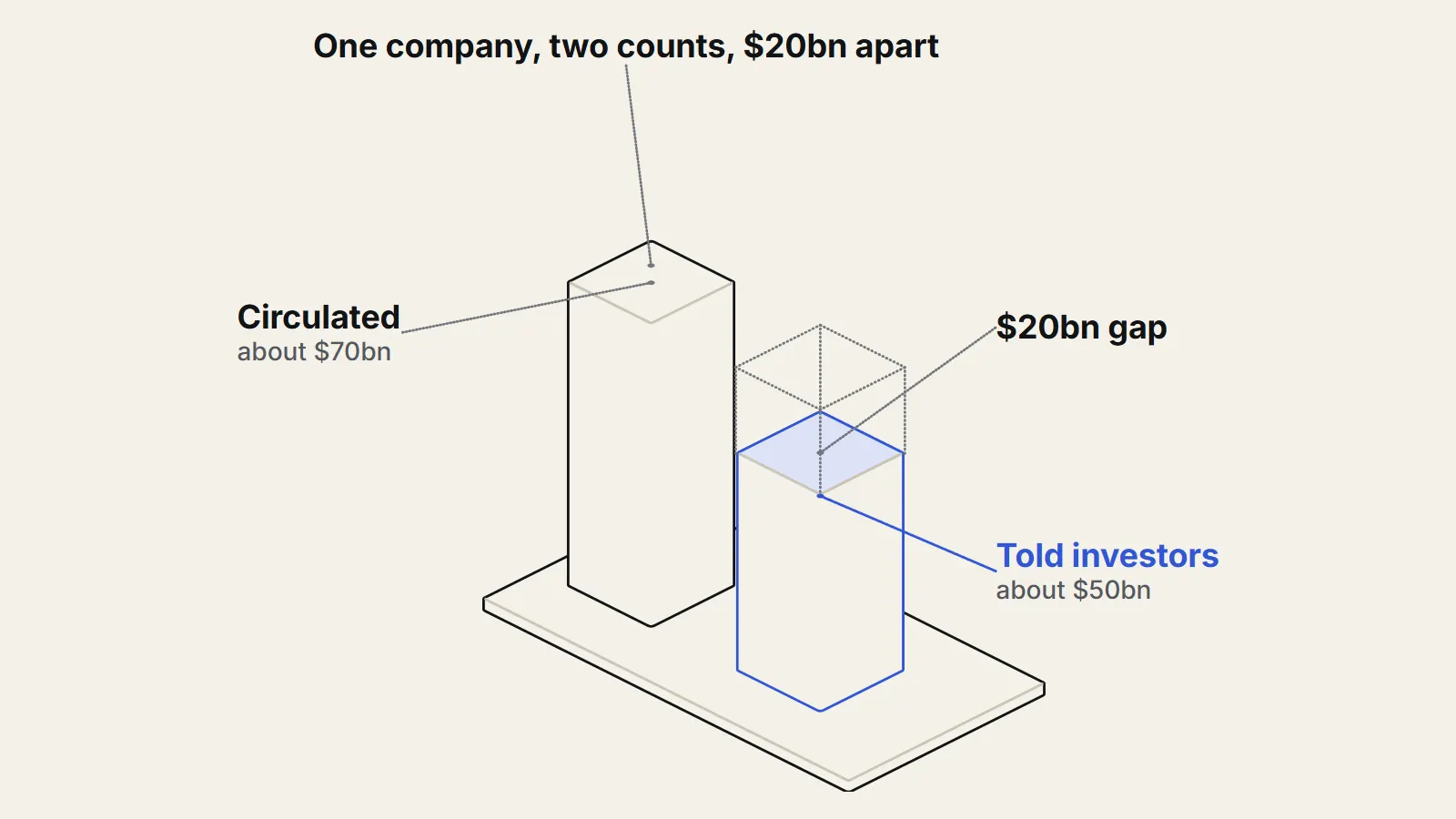
Annualized revenue is a recent period's sales scaled up to a full year, and on 8 October 2026 the Financial Times reported that OpenAI told investors its figure was approaching $50 billion at the end of September1, roughly $20 billion below the $70 billion that had circulated since late that month.1 The gap seems to come mostly from how the number was built, not from sales that disappeared. This piece answers that news item, which we saw on 15 and 16 October 2026 and describe as of 17 October. It explains a measure; it is not investment advice.
What is annualized revenue?
Take one month's sales and multiply by twelve, or one quarter's and multiply by four. The result is annualized revenue, also called a revenue run rate. By our arithmetic, $50 billion a year is about $4.2 billion a month. It is a projection of the current pace, and it assumes nothing slows or speeds up. That is the same shortcut as in our guide to compound interest (https://therealigned.com/story/compound-interest-time-vs-amount), and it has the same weakness: the further you extend a short stretch, the more a single good or bad period matters.
It is also not an accounting result. We did not find an official definition of annualized revenue in the pages we opened; companies choose their own. In a 2019 reply to US Securities and Exchange Commission staff (https://www.sec.gov/Archives/edgar/data/1361113/000117184319004567/filename1.htm), the software firm Varonis described its own annual recurring revenue figure as an operating metric and not a non-GAAP financial measure2, meaning it is not built by adjusting a reported accounting number.2 Two firms can therefore both say "annualized revenue" and mean different things.
Why did OpenAI's annualized revenue come in $20 billion lower?
On 29 September, Axios reported, as TechCrunch summarised (https://techcrunch.com/2026/10/08/openais-revenue-is-reportedly-20-billion-less-than-previously-projected/), that OpenAI revenue was nearing $70 billion on an annualized basis; some later pieces give $68 billion.13 On 8 October the Financial Times, citing financial documents it had reviewed, put the figure at about $50 billion (https://www.investing.com/news/stock-market-news/openai-annualized-revenue-at-50bn-far-below-reports-ft-4939530) as of September.4 It said the higher number came from "attempts by OpenAI's own investors to produce a direct comparison" with Anthropic's annualized revenue.1 Another report describes the route: investors began with an estimate of $40 billion in August, then added the 70 percent growth OpenAI had cited.5 Our arithmetic: $40 billion times 1.7 is $68 billion, which matches the lower of the circulating numbers. The figures were mixed from different dates and different bases.
What is the difference between gross and net revenue?
The reports point to a counting difference. Anthropic counts sales made through cloud partners such as AWS and Google Cloud in its annualized revenue; OpenAI does not.41 Accounting separates a principal, which controls the service before the customer gets it and records the full amount (gross), from an agent, which only arranges the sale and records its fee (net).6 Net income is generally unaffected, but the top line and margins can change a lot.6
A made-up example shows the effect. A customer pays a cloud partner $100 for an AI service, and the partner passes $80 to the model developer. A gross count books $100 and a net count books $80, for the same sale. The numbers are our illustration, not either company's. We have not seen the contracts of either firm, so we cannot say which treatment fits each case.
How does this change the comparison with Anthropic?
Reuters, as relayed by TheNextWeb, reported that Anthropic's annualized revenue passed $65 billion at the end of July.7 Set beside a $50 billion figure for OpenAI, that looks like a clear lead for Anthropic, but the two numbers are on different bases and two months apart, which is the comparison problem the FT described. The same report says Anthropic's second-quarter revenue was $11.5 billion against $6.7 billion for OpenAI.7 We do not know whether those quarterly figures share one basis either. As with any headline number, how it is built matters, as we found when looking at what inflation measures and what it misses (https://therealigned.com/story/what-inflation-measures-and-what-it-misses).
OpenAI's investor materials, as reported by CNBC, showed total run-rate growth of 77 percent in the third quarter and 107 percent for enterprise7.73 On 9 October, Bloomberg reported that OpenAI expects at least $70 billion by the end of the year, and that the company declined to comment.7 From $50 billion, that would be growth of 40 percent in one quarter, by our calculation. So the $70 billion number may return, this time on OpenAI's own basis. Until then, the figure is a forecast, and a run rate can change quickly. Companies that sell subscriptions face the same issue, as we describe in how startups actually make money (https://therealigned.com/story/how-startups-actually-make-money).
Is the gap in OpenAI's revenue really only accounting?
Shares did move that day: reports have Oracle down about 5 percent and Nvidia down about 3 percent.3 Those reports do not agree on the cause of every move, and a one-day fall is not evidence of either view.
What is not known about OpenAI's annualized revenue?
- Whether OpenAI has explained the figure publicly: TechCrunch reported no response from the company, and we found no statement in the pages we opened.
- What the FT's documents show in full. The article is behind a paywall, so we read reports of it, and OpenAI's investor presentation is not public.
- Whether the $70 billion year-end target will use the same net basis as the $50 billion figure.
- How either company's partner contracts would be classed under the principal-and-agent test.
Key takeaways
- Annualized revenue scales a short period up to a year; it is a projection, not reported revenue.
- The roughly $20bn gap fell between a figure built by investors and the one OpenAI reportedly gave them.
- Anthropic is reported to count cloud-partner sales and OpenAI is not, so the two numbers are not like for like.
- Gross and net counting change the top line but generally not profit.
- Key facts here rest on press reports of an FT article we could not open, so treat the details as reported, not audited.
Sources
- 1OpenAI's revenue is reportedly $20 billion less than previously projected (opens the source in a new tab) · TechCrunch, 2026 · Reporting · https://techcrunch.com/2026/10/08/openais-revenue-is-reportedly-20-billion-less-than-previously-projected/
- 2Varonis Systems response to SEC staff comment letter on ARR (opens the source in a new tab) · US Securities and Exchange Commission (EDGAR), 2019 · Primary source · https://www.sec.gov/Archives/edgar/data/1361113/000117184319004567/filename1.htm
- 3OpenAI's Revenue Appears $20 Billion Lighter Than Reported (opens the source in a new tab) · Yahoo Finance, 2026 · Reporting · https://finance.yahoo.com/technology/ai/articles/openai-revenue-appears-20-billion-100435362.html
- 4OpenAI annualized revenue at $50bn, far below reports - FT (opens the source in a new tab) · Investing.com, 2026 · Reporting · https://www.investing.com/news/stock-market-news/openai-annualized-revenue-at-50bn-far-below-reports-ft-4939530
- 5OpenAI's annualized revenue is $20 billion lower than prior investor estimates (opens the source in a new tab) · Yahoo Finance, 2026 · Reporting · https://finance.yahoo.com/technology/article/openais-annualized-revenue-20-billion-lower-than-prior-investor-estimates-174058048.html
- 6Principal/Agent Considerations (Gross vs Net) in ASC 606 (opens the source in a new tab) · RevenueHub, 2025 · Reporting · https://www.revenuehub.org/article/principalagent-considerations-gross-vs-net
- 7OpenAI expects a $70bn revenue run rate by year-end, Bloomberg reports (opens the source in a new tab) · The Next Web, 2026 · Reporting · https://thenextweb.com/news/openai-revenue-70bn-year-end-50bn-september