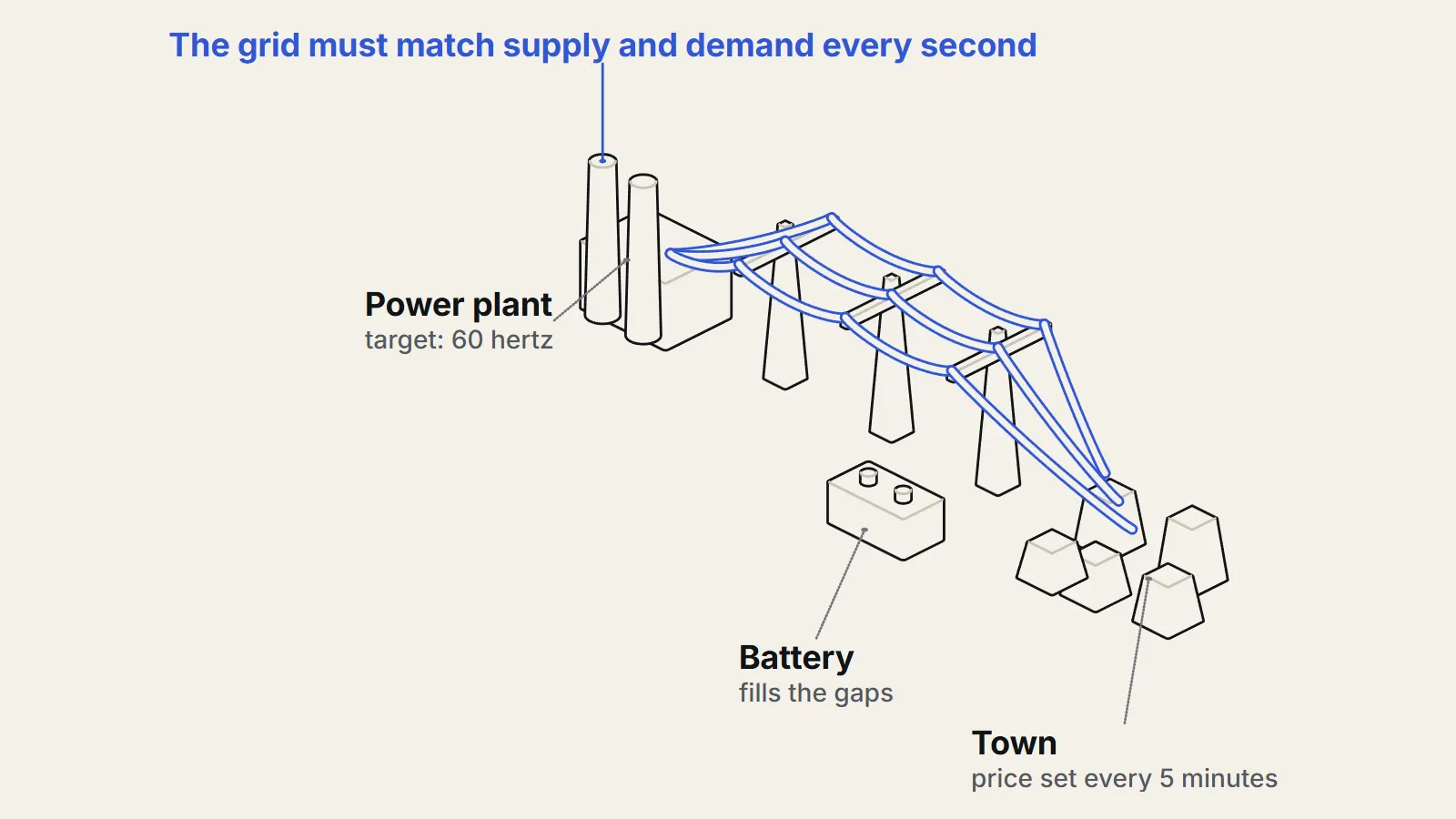
The electricity grid works by matching what power plants put in with what customers take out at every moment. Grid operators called balancing authorities are responsible for keeping supply and demand matched. If they fall out of balance, the result can be local or even widespread blackouts. Markets set the price of that balancing, and batteries are now being added to make it easier. This explainer covers how the balance is kept, how wholesale markets work, and why storage matters.
How does the grid keep supply and demand balanced?
The US Energy Information Administration (EIA), the federal statistics agency for energy, says a balancing authority ensures that demand and supply are precisely balanced to keep the grid safe and reliable. Most are electric utilities, and every regional transmission organization acts as one.1 The Lower 48 states are split into three largely independent systems: the Eastern Interconnection, the Western Interconnection and ERCOT, which covers most of Texas. They rarely transfer power among themselves, and ERCOT is unusual because its balancing authority, interconnection and regional transmission organization are the same body.1 The source is the EIA explainer on delivery to consumers (https://www.eia.gov/energyexplained/electricity/delivery-to-consumers.php).
The signal that tells operators whether the system is in balance is frequency. A reference document from the North American Electric Reliability Corporation (NERC) describes each interconnection as one large machine in which all generators rotate in step. When supply exceeds demand, frequency rises above its scheduled value, which is typically 60 hertz2, and when supply falls short, it declines.2 The reference document is NERC's Balancing and Frequency Control (https://www.nerc.com/globalassets/who-we-are/standing-committees/rstc/rs/reference_document_nerc_balancing_and_frequency_control.pdf).
Small mismatches are normal, so frequency drifts above and below nominal all the time. Two layers of response restore balance. First, most generators have governors that inject more energy when frequency is below nominal and a little less when it is above, and some devices such as motors use less power at a lower frequency. Second, within minutes, operators use reserves and automatic generation control to hold balance over the day and bring frequency back to its scheduled value.2
There is also a built-in cushion. NERC explains that the spinning mass in a typical generator stores a large amount of energy. When a large generator trips offline or a big load switches on, energy flows from those rotating masses into the system, an effect that spreads across an interconnection within a handful of seconds.2 NERC compares it to a spinning bicycle wheel under a brake. This effect buys time for the governors and reserves to act, and the document notes that for some resources it is emulated rather than a pure physical effect.
How do wholesale electricity markets work?
In regions with organized markets, generators sell power through auctions run by a grid operator. EIA describes two linked markets in its New York example. In the day-ahead market, participants bid to provide electricity for each hour of the next delivery day, and prices reflect expected conditions including transmission limits. The real-time market handles the small remaining share needed to meet actual demand, with prices based on 5-minute intervals, and it responds to events such as weather or generator outages.3 The EIA article (https://www.eia.gov/todayinenergy/detail.php?id=3230) on the New York system explains the example.
Prices are specific to a place, because transmission lines have limits. In New York, a persistent constraint between upstate and downstate limited power flowing south, so on a day in September 2011 downstate prices rose above upstate prices at the afternoon peak.3 EIA also notes that real-time price spikes rarely raise retail rates much, because real-time sales are a small share of supply, though sustained high real-time prices can influence the day-ahead market.
More generally, EIA says the wholesale price of electricity reflects the real-time cost of supplying it. Demand is usually highest in the afternoon and early evening, so costs are usually higher then. Summer prices are usually highest because more expensive generation sources are added to meet higher demand, and fuel prices, especially for natural gas and petroleum, also feed through.4
Why does storage matter?
Storage lets operators move energy from when it is cheap to when it is scarce. EIA reports that utility-scale battery storage in the US grew at an average of 70 percent a year5 over three years and stood at 43.6 gigawatts of operating capacity at the end of 2025, rising to nearly 52 gigawatts by mid-2026.5 The agency says batteries paired with solar plants can store electricity when wholesale prices are low and release it when prices are high. About 54 gigawatts more is planned over the next two and a half years.5 The EIA battery storage article (https://www.eia.gov/todayinenergy/detail.php?id=67925) has the figures.
What is disputed or uncertain?
What is not known?
Several things are open. The mix of storage, new generation and transmission that gives the lowest cost at a given reliability is argued over by planners and depends on local conditions. How much of the planned battery capacity will be built on time is uncertain. And the examples above come from particular places and years, so prices in other regions or at other times can behave differently. This piece does not cover retail rates, which also include the cost of wires and other services.
Key takeaways
- Balancing authorities must keep supply and demand matched continuously, and imbalances can cause blackouts.
- Frequency, scheduled at 60 hertz in North America, is the signal: it rises when supply exceeds demand and falls when it is short.
- Wholesale markets set prices by hour in the day-ahead market and by 5-minute intervals in real time, and prices differ by place when transmission is constrained.
- Wholesale prices reflect the real-time cost of supplying power and are usually highest at afternoon and early evening peaks.
- US utility-scale battery capacity reached 43.6 gigawatts by the end of 2025 and nearly 52 by mid-2026, which lets operators shift energy from cheap hours to scarce ones.
Sources
- 1Electricity explained: How electricity is delivered to consumers (opens the source in a new tab) · US Energy Information Administration, 2026 · Primary source · https://www.eia.gov/energyexplained/electricity/delivery-to-consumers.php
- 2Balancing and Frequency Control: Reference Document (opens the source in a new tab) · NERC Resources Subcommittee, 2021 · Report · https://www.nerc.com/globalassets/who-we-are/standing-committees/rstc/rs/reference_document_nerc_balancing_and_frequency_control.pdf
- 3Transmission congestion drives power price division between upstate and downstate New York (opens the source in a new tab) · US Energy Information Administration, Today in Energy, 2011 · Primary source · https://www.eia.gov/todayinenergy/detail.php?id=3230
- 4Electricity explained: Factors affecting electricity prices (opens the source in a new tab) · US Energy Information Administration, 2026 · Primary source · https://www.eia.gov/energyexplained/electricity/prices-and-factors-affecting-prices.php
- 5Battery storage capacity averaged 70% growth over the last three years (opens the source in a new tab) · US Energy Information Administration, Today in Energy, 2026 · Primary source · https://www.eia.gov/todayinenergy/detail.php?id=67925
- 6NERC Warns Long-Term Grid Reliability Risks Mounting from Surging Demand, Lagging Resources (opens the source in a new tab) · POWER Magazine, 2026 · Reporting · https://www.powermag.com/nerc-warns-long-term-grid-reliability-risks-mounting-from-surging-demand-lagging-resources/