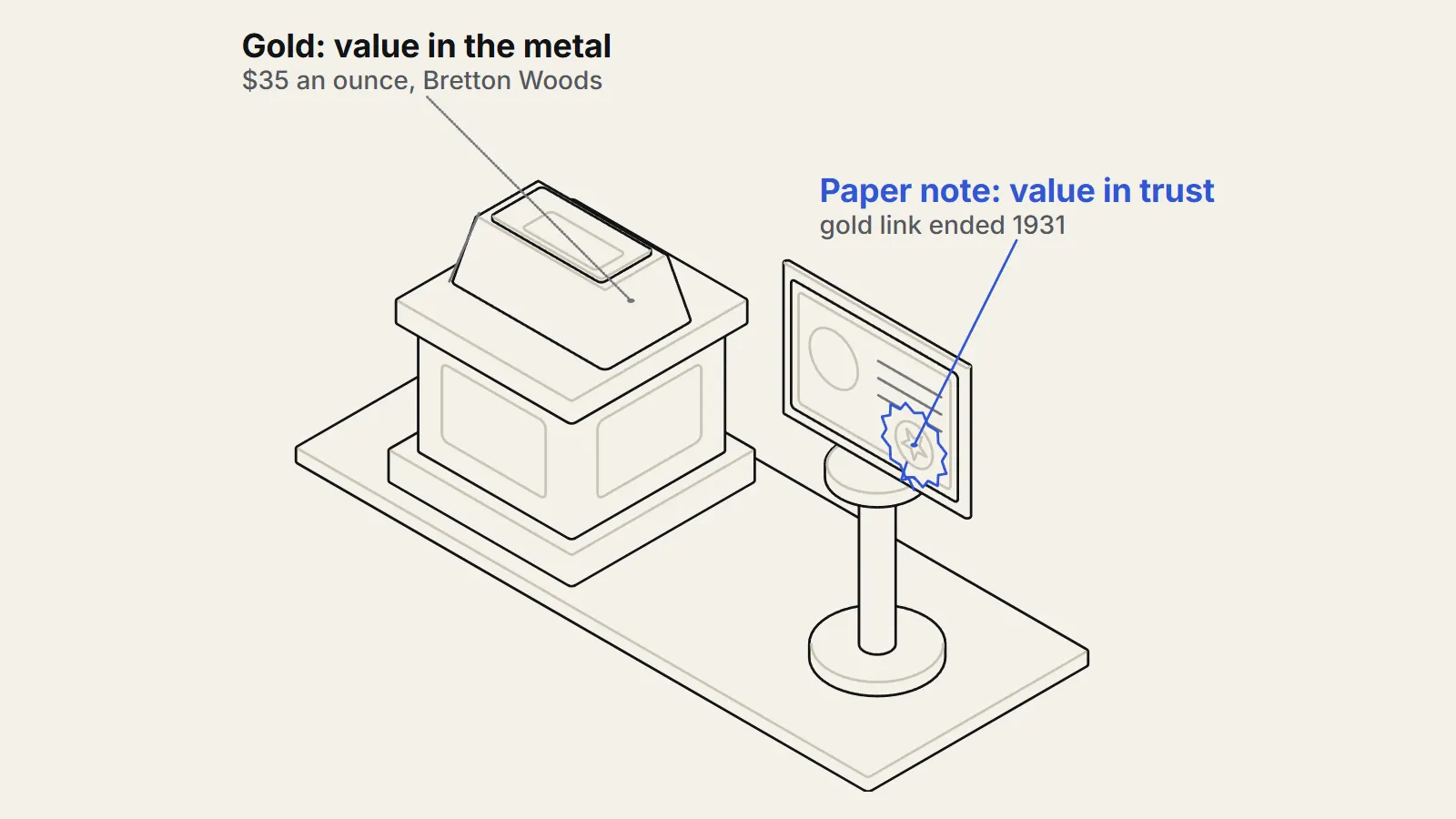
Fiat money is money with no backing except trust: a government declares it legal tender and manages its supply, and people accept it because others will. Commodity money is the opposite, with value that comes from the material it is made of, such as gold or silver. Today almost every currency is fiat. Each type solves one problem and creates another, which is why the choice between them has been argued about for centuries. This piece explains how each works and what each costs.
What is the difference between fiat and commodity money?
The Bank of England (https://www.bankofengland.co.uk/explainers/what-is-money) says money does three jobs: it works as a medium of exchange, it holds value over time, and it gives prices a common yardstick.1 Both types do these jobs. They differ in why people accept them. In the Bank's description, commodity money gets its value from the material it is made of, while fiat money is not convertible to gold or any other asset1 and works because the public trusts the government and how it manages the economy.1
Between the two sit gold-linked systems. Under these, paper notes were not valuable themselves but could be swapped for a fixed amount of gold. The Bank of England notes that it has issued banknotes for more than 300 years, and for most of that time they could be exchanged for gold, until the Gold Standard (https://therealigned.com/story/the-gold-standard-and-why-it-ended) ended in 1931.1 In the United States, the pre-1933 price was $20.67 an ounce2, and under the later Bretton Woods system the dollar was fixed to gold at $35 an ounce3.23
Fiat money covers more than banknotes. In the Bank of England's account, banknotes, coins, bank deposits and electronic payments are all fiat money today, and a government sets its value and regulates how much is in circulation.1 That is why trust in how the government manages the economy matters so much to this kind of money, and why the quantity and quality of policy decisions, not a physical stock of metal, sets how much a unit is worth over time.1
Why did the world move away from gold?
Two events matter most. In the Depression of the 1930s, countries on the gold standard could not easily expand their money supplies. The Federal Reserve's history essay says that economic historians generally conclude Roosevelt's reflation sped recovery, and that Barry Eichengreen and Jeffrey Sachs found in 1985 that recovery in the US and most leading industrial countries began when they left gold and reflated.2 The US banned gold exports and conversion on April 20, 1933, and later restored a gold link in January 1934.2
The second event was August 15, 1971. President Nixon closed the gold window (https://www.federalreservehistory.org/essays/gold-convertibility-ends), so foreign governments could no longer exchange dollars for gold, and the Federal Reserve's history says the system in effect turned into a fiat one.3 The same announcement included a 90-day freeze on wages and prices and a 10 percent import surcharge, and the same essay describes the United States as vulnerable to a run on its gold and keen to stave off inflation.3 The essay on the Great Inflation notes that with the gold link gone, most major currencies including the dollar were unanchored, an arrangement it calls an irredeemable paper money standard.4 The Bank of England adds the main benefit: fiat money lets the supply respond to economic conditions, while under a gold standard the supply was limited by how much gold could be mined.1
What are the trade-offs of each?
| Commodity or gold-linked money | Fiat money | |
|---|---|---|
| What backs it | A material, or a promise to swap for one | Trust in the government and its management of the economy |
| Supply | Limited by gold available and by the fixed price | Set by policy, so it can flex |
| Main strength | Restrains how much money can be created | Can respond to a downturn or a shortage of money |
| Main risk | Can transmit or deepen downturns, as in the 1930s | Can be over-issued, as in the 1970s inflation |
The gold-linked case rests on restraint. If a government must be ready to swap notes for gold, it cannot print without limit. The record after 1971 shows the other side of that argument. Across the years around the end of the gold link, inflation in the United States was about 1 percent in 1964, above 12 percent by 1974 and more than 14 percent in 19804.4 That does not prove fiat money caused it, since the essay describes several causes, but it shows that a currency without a gold link can lose value quickly when policy goes wrong.
What is disputed or unknown?
Economists differ on how much weight to give each risk. Defenders of gold-linked money point to the discipline it imposes. Critics point to the 1930s, when the link to gold limited what governments could do about falling money supplies and prices. The Federal Reserve's history says the evidence on recovery favours leaving gold, but that is a statement about one period, not a verdict on all periods. We also do not know how well today's arrangements would hold up under a long run of poor policy; the 1970s are one example of what that can look like, and many countries have kept inflation lower since. This piece does not cover newer forms of money, such as digital currencies, and does not recommend any system.
Key takeaways
- Commodity money draws value from a material such as gold; fiat money rests on trust in the government and its policy.
- Gold-linked money tied the supply to gold. The US price was $20.67 an ounce before 1933 and $35 under Bretton Woods.
- The US ended gold convertibility for foreign governments on August 15, 1971, and most major currencies became fiat.
- Fiat money gives flexibility but depends on policy; gold-linked money gives restraint but can deepen downturns.
- Each system gives up something to get something else, and the evidence depends on the period.
Sources
- 1What is money? (opens the source in a new tab) · Bank of England, 2025 · Primary source · https://www.bankofengland.co.uk/explainers/what-is-money
- 2Roosevelt's Gold Program (opens the source in a new tab) · Federal Reserve History, Federal Reserve Board, 2013 · Reporting · https://www.federalreservehistory.org/essays/roosevelts-gold-program
- 3Nixon Ends Convertibility of U.S. Dollars to Gold and Announces Wage/Price Controls (opens the source in a new tab) · Federal Reserve History, Federal Reserve Board, 2013 · Reporting · https://www.federalreservehistory.org/essays/gold-convertibility-ends
- 4The Great Inflation (opens the source in a new tab) · Federal Reserve History (Federal Reserve Board), 2013 · Primary source · https://www.federalreservehistory.org/essays/great-inflation